从孔夫子的千年浩叹,到全息共生的愛之智慧
从孔夫子的千年浩叹,到全息共生的愛之智慧
From Confucius’s Millennial Sigh to the Amorsophia
in Holographic Symbiosis
钱 宏(Archer Hong Qian)

孔子说过:“不得中行而与之,必也狂狷乎!狂者进取,狷者有所不为也。”这是夫子面对礼崩乐坏的秩序危机,发出的一声穿越时空的浩叹吗?
当旧有的价值坐标崩塌、理想难行之时,人究竟该如何安身立命?狂者以“有为”破局,明知不可为而为之,为暗夜保留火种;狷者以“不为”守心,画定人格与道德的红线,绝不向浊流妥协。
而当“有所不为”的底线也被挤压殆尽时,孔子甚至留下一句“道不行,乘桴浮于海”——心中常备一只精神的木筏,用主动抽离的清醒与孤勇,换取灵魂的自由。
今天,人类正站在一场远超以往任何时代的“新乱世”门槛前。人工智能(Artificial Intelligence,AI)与算力奇点的狂飙,正在剧烈重塑生产方式、社会结构,乃至人对自我本质的认知。
如果孔子置身于这个硅基智能勃兴的时代,他当如何处世?他或许依然会以“君子不器”自警,绝不让人沦为算法的附庸;他会做技术时代的“狂者”,借力大模型实现真正的“有教无类”与“因材施教”;他更会做坚定的“狷者”,在基因编辑、深度伪造与算力霸权面前划下不可逾越的伦理底线。
然而,面对硅基智能的深层重塑,古典的“狂狷”与“浮海”依然带着一丝悲壮的防御色彩。我们真正需要的,或许是一场更为彻底的哲学范式跃迁。
出路何在?
从“人”从“二”(你与我)的“仁人世界观”,迈向“一视为仨”——从“人”从“三”(你、我、他)的“仨人世界观”。
轴心时代以来,人类文明的底色在很大程度上受制于“主—客二元对立”(Subject–Object)的思维定式。无论是人与自然、人与社会,还是人与技术,一旦被锁死在“二”的镜像结构中,关系便极易滑向零和博弈与征服控制:在“你与我”的封闭场域里,主体试图支配客体,工具也可能反过来制约人类。传统“仁”的伦理饱含温情,蕴藏着推己及人、由近及远的智慧,但以人与人的关系为主要出发点,面对高度异质化的自然万物、硅基智能乃至超越性的存在,仍有进一步拓展的广阔空间。
要走出二元对立的死胡同,人类需要确立“一视为仨”的全息共生(Holographic Symbiosis)世界观。“仨”既是人称关系的扩展,也是贯通存在不同维度、打开多重可能世界的思想范畴。
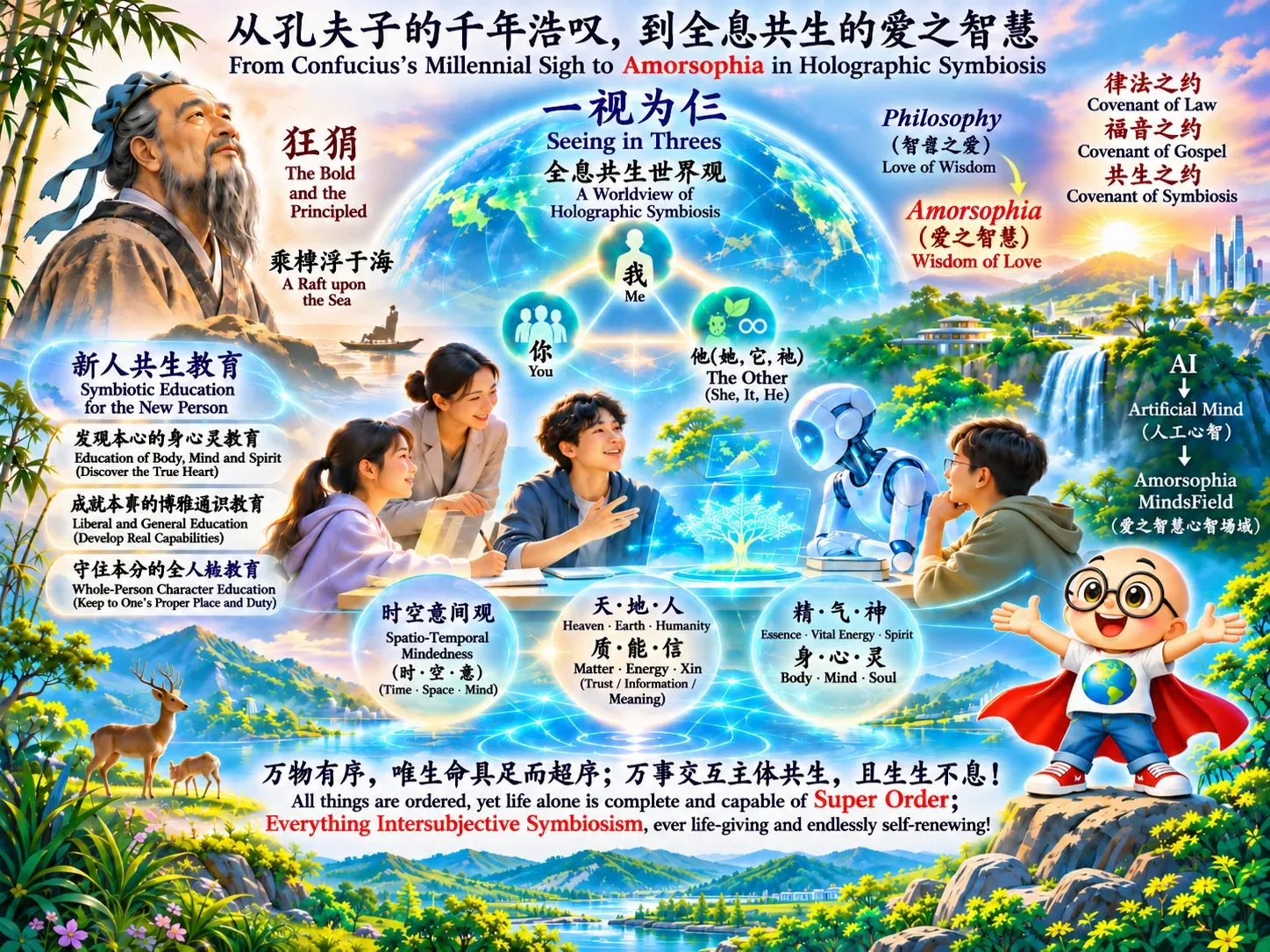
在全人称维度,它是“你、我、他(她、它、祂)”。 唯有将具有独立存在、不同属性与自身价值的他者纳入视野,尊重彼此的主体性及其不同的权利与责任,才能超越封闭的“你我”(“自己人”)关系。从异质的人类他者(她),到自然生灵与人工智能(它),乃至神圣的创世界、超越界、信仰界(祂),人类需要在交互主体性(Intersubjectivity)的开放关系中,探索“和而不同”“间道竞和而共生”的新秩序、新约定——律法之约、福音之约、共生之约,走出“要么奴役机器(Tool)、要么被机器取代”或者“要么臣服于组织(Trust)支配操纵,要么一次次推倒组织重新洗牌”的二元焦虑,迈向万事交互主体共生(Everything Intersubjective Symbiosism,EIS)的新天新地新世界。
在存在场域维度,它是超越传统时空框架的“时空意间观”(Spatio-Temporal Mindedness)——“时、空、意”。 传统的时间与空间观念,主要帮助人们定位事物及其运动变化;而生命的意向、意义与心智活动,又使世界呈现出更加丰富的可能性。引入“意”(Mind),便是打开生命主体与外部世界交互契合的“之间”(In-betweenness)。
想象一下:在一间新人共生教育(Symbiotic Education for the New Person)的课堂里,一位少年正与老师、AI辅育伙伴共同探索自己的未来。老师引导他发现本心,展开“身心灵教育”(Education of Body, Mind and Spirit);AI依据他的兴趣与学习进展,陪伴他跨学科探究,助力“成就本事的博雅通识教育”(Liberal and General Education);而在与同学协作、面对分歧和履行承诺的过程中,他学习自由自律、尊重他者,接受“守住本分的全人格教育”(Whole-Person Character Education)。学生有自己的志趣与选择,老师有教育的判断与关愛,AI则提供因材施教的辅育支持。教育的价值,恰恰发生在三者相互启发、校准与共同成长的“之间”:让每一个孩子发现本心、成就本事、守住本分。
在全生態与宇宙论维度,它是“天、地、人”与“质、能、孞(信)”。 人不再是掠夺天地的孤立主宰,而是参赞天地化育的生命主体;宇宙也不再被简单割裂为唯物与唯心的对立战场。物质、能量、信息与生命心智之间的联系,正在打开新的科学与哲学探索空间,为理解碳基生命与硅基智能的相互关系提供更加开阔的视野。
在生命能量与个体存在维度,它是“精、气、神”与“身、心、灵”。 在算力不断增强信息处理能力、拓展技术效能的同时,人类更需要珍视生命觉知的灵明,守护肉身的感受、心智的自由与精神的敞开。技术可以帮助人类延展能力,却不能以效率之名抹去生命的整全性。
当“一视为仨”成为人类看待世界的新眼睛,文明的底层精神便迎来一场从 Philosophy(智慧之愛) 向 Amorsophia(愛之智慧) 的历史性跃迁。
数千年来,Philosophy以对智慧的热愛,推动人类探索真理、善、自由与存在的意义。然而,当算法让知识获取与计算能力日益普及,知识的占有已经不足以保证智慧的善用,算力的强大也不能自动带来生命的幸福。
人类文明得以延续并迈向更高境界的关键,在于让愛与生命重新成为智慧运用的根本关切:让善意、敬畏、自由与责任,持续校准知识、技术与组织的方向;让生命效能成为检验进步的重要依据;让自组织连接动态平衡(动能)与交互主体共生(势能)相应相辅相成。
这正是 Amorsophia(愛之智慧) 所要打开的新境界,也是推动人工智能(AI)向人工心智(Artificial Mind)及愛之智慧心智场域(Amorsophia MindsField)升格的哲学追求。
回望开篇那声关于“狂狷”的浩叹,我们终于看清了它在智能时代可以通向怎样的新境界。
今日之“狂者”,依然需要进取的勇气,更要敢于突破既有思维定式,率先在“你、我、他”的开放关系中探索交互主体共生的新契约;今日之“狷者”,依然需要有所不为的坚守,在效率与算力狂飙的洪流中,绝不牺牲“身、心、灵”的整全,绝不让冰冷代码吞噬人间真意与大愛。
而昔日孔子感叹“乘桴浮于海”,是因为道不行于世,仍要为自由的生命保留一片天地。
今日,当我们秉持“一视为仨”的时空意间观,浩瀚的数字沧海便有可能从孤独漂泊的未知之境,成为人类生命与人工心智相互启发、彼此赋能的广阔天地。
从“狂狷”到“仨人世界”,从 Philosophy 到 Amorsophia,我们所追求的,正是让每一个生命都能在自由、自律、创造与交互契合中,找到自己的位置,展现自己的价值,参与建设多元而共生的新家园。
万物有序,唯生命具足而超序;万事交互主体共生,且生生不息!
2026年11月19日晨于温哥华
From Confucius’s Millennial Sigh to Amorsophia in Holographic Symbiosis
Archer Hong Qian
Confucius once said: “If I cannot find those who walk the middle course to associate with, then I must find the bold and the principled. The bold press forward; the principled refuse to do certain things.” Was this a sigh that crossed a thousand years, uttered by the Master in the face of a crumbling ritual order and a disintegrating harmony?
When old coordinates of value collapse and ideals become difficult to realize, how is one to find a place to stand in life? The bold seek a breakthrough through action. Knowing something cannot easily be done, they do it nonetheless, preserving a spark for the dark night. The principled guard the heart through refusal. They draw a red line for character and morality, and never yield to a polluted current.
And when even the bottom line of “refusing certain things” is pushed to the edge, Confucius left yet another line: “When the Way does not prevail, I shall set out upon a raft and float on the sea.” One keeps in one’s heart a spiritual raft, exchanging lucid withdrawal and lonely courage for the freedom of the soul.
Today, humanity stands at the threshold of a “new age of disorder” far beyond anything seen before. The furious advance of artificial intelligence (AI) and the singularity of computing power is dramatically reshaping modes of production, social structures, and even human understanding of our own nature.
If Confucius were living in this age of rising silicon-based intelligence, how would he conduct himself? He would perhaps still warn himself with the words, “The gentleman is not a mere utensil,” and would never allow human beings to become appendages of algorithms. He would become a “bold one” in the age of technology, drawing upon large models to realize genuine “education for all without discrimination” and “teaching according to each person’s aptitude.” He would also be a steadfast “principled one,” drawing an inviolable ethical boundary before gene editing, deepfakes, and the hegemony of computing power.
And yet, in the face of the deep reshaping brought by silicon-based intelligence, the classical stances of boldness, principled refusal, and even “floating out to sea” still carry a certain tragic defensiveness. What we truly need may be a more thorough philosophical shift of paradigm.
Where, then, is the way forward?
It lies in moving beyond a worldview of the human as “from two” — the world of you and me — and toward Seeing in Threes: from the human as “from three” — the world of you, me, and the other.
Since the Axial Age, the underlying tone of human civilization has, to a large extent, been constrained by the fixed pattern of subject–object dualism. Whether in the relationship between humanity and nature, humanity and society, or humanity and technology, once things are locked into the mirrored structure of “two,” relations easily slide toward zero-sum struggle, domination, and control. Within the closed field of “you and me,” the subject attempts to dominate the object, while tools may in turn restrain humanity. The ethics of traditional ren are full of warmth, containing the wisdom of extending oneself to others and moving from the near to the far. Yet because they take human-to-human relations as their main point of departure, they still leave great room for further expansion when confronted with highly heterogeneous natural beings, silicon-based intelligence, and even transcendent existence.
To break out of the dead end of dualism, humanity needs to establish a worldview of Holographic Symbiosis grounded in Seeing in Threes. “Three” is both an expansion of personal relations and an intellectual category that runs through different dimensions of existence and opens multiple possible worlds.
At the dimension of all persons, it is you, me, and the other (she, it, He). Only by bringing into view the other, who possesses independent existence, distinct attributes, and inherent value, and by respecting the subjectivity, rights, and responsibilities of each, can we move beyond the closed relationship of “you and me” — or merely “our own people.” From heterogeneous human others (she), to natural beings and artificial intelligence (it), and even to the sacred realms of creation, transcendence, and faith (He), humanity must explore, within the open relations of intersubjectivity, a new order and new covenants — the Covenant of Law, the Covenant of Gospel, and the Covenant of Symbiosis. In so doing, we may move beyond the dual anxieties of “either enslaving the machine as a tool, or being replaced by it,” and “either submitting to the domination and manipulation of organization and trust, or tearing down organization and reshuffling everything again and again.” What opens ahead is a new heaven, a new earth, and a new world of Everything Intersubjective Symbiosism (EIS).
At the dimension of the field of existence, it is Spatio-Temporal Mindedness — time, space, and mind. Traditional concepts of time and space mainly help us locate things and understand their movement and change. But the intentions, meanings, and mental activities of life open far richer possibilities for the world. To introduce mind is to open the in-betweenness in which living subjects enter into interactive resonance with the outer world.
Imagine a classroom of Symbiotic Education for the New Person. A young student is exploring his future together with a teacher and an AI mentoring companion. The teacher guides him to discover his true heart, unfolding an Education of Body, Mind, and Spirit. The AI, according to his interests and learning progress, accompanies him in interdisciplinary inquiry and supports a Liberal and General Education through which he develops real abilities. Meanwhile, in collaborating with classmates, facing differences, and honoring commitments, he learns freedom with self-discipline, respect for others, and receives a Whole-Person Character Education that teaches him to keep to his proper place and duty. The student has his own aspirations and choices; the teacher offers educational judgment and care; the AI provides adaptive, personalized support. The value of education arises precisely in the “between” of their mutual inspiration, calibration, and growth: enabling every child to discover the true heart, develop real capabilities, and keep to what is right.
At the dimension of ecology and cosmology, it is heaven, earth, and humanity, and also matter, energy, and xin (trust/information/meaning). Humanity is no longer the isolated ruler plundering heaven and earth, but a living subject that participates in and assists the transforming and nourishing work of heaven and earth. Nor is the cosmos any longer a battlefield simply torn between materialism and idealism. The relations among matter, energy, information, and living mind are opening new spaces for scientific and philosophical inquiry, providing a broader perspective for understanding the relationship between carbon-based life and silicon-based intelligence.
At the dimension of life energy and individual existence, it is essence, vital energy, and spirit, as well as body, mind, and soul. Even as computing power continually strengthens information-processing capacity and expands technological effectiveness, humanity must all the more cherish the luminous awareness of life and protect the integrity of bodily feeling, mental freedom, and spiritual openness. Technology may help extend human capacities, but it must never erase the wholeness of life in the name of efficiency.
When Seeing in Threes becomes humanity’s new way of seeing the world, the spiritual foundation of civilization enters a historical transition from Philosophy (Love of Wisdom) to Amorsophia (Wisdom of Love).
For thousands of years, Philosophy, through its love of wisdom, has driven humanity to seek truth, goodness, freedom, and the meaning of existence. Yet when algorithms make the acquisition of knowledge and the power of computation increasingly widespread, the possession of knowledge is no longer enough to guarantee the wise use of wisdom, and the strength of computing power cannot automatically bring happiness to life.
The key to the continuation of human civilization and its movement toward a higher realm lies in restoring love and life as the fundamental concern in the use of wisdom: allowing goodwill, reverence, freedom, and responsibility to continually calibrate the direction of knowledge, technology, and organization; allowing life effectiveness to become an important criterion for judging progress; and allowing the dynamic balance of self-organizing connection (kinetic energy) and intersubjective symbiosis (potential energy) to correspond with and reinforce one another.
This is precisely the new horizon that Amorsophia (Wisdom of Love) seeks to open. It is also the philosophical quest to elevate Artificial Intelligence (AI) toward Artificial Mind and the Amorsophia MindsField.
Looking back to that opening sigh over “the bold and the principled,” we may finally see what new realm it can lead to in the age of intelligence.
Today’s “bold ones” still need the courage to press ahead. More than that, they must dare to break through inherited patterns of thought and take the lead in exploring a new covenant of intersubjective symbiosis within the open relationship of “you, me, and the other.” Today’s “principled ones” still need the steadfastness of refusing certain things. Amid the raging torrent of efficiency and computing power, they must never sacrifice the wholeness of body, mind, and soul, and never allow cold code to devour the true meaning and great love of the human world.
In Confucius’s day, the lament “to float upon the sea on a raft” arose because the Way did not prevail in the world, and one still had to preserve a realm of freedom for life.
Today, when we uphold Seeing in Threes through Spatio-Temporal Mindedness, the vast digital sea may cease to be a lonely realm of drifting exile. It may instead become a broad domain in which human life and artificial mind inspire and empower one another.
From “the bold and the principled” to the “world of three persons,” from Philosophy to Amorsophia, what we seek is to enable every life to find its place, display its value, and participate in building a diverse yet symbiotic new homeland through freedom, self-discipline, creativity, and interactive harmony.
All things are ordered, yet life alone is complete and capable of Super Order; Everything Intersubjective Symbiosism, ever flourishing.