AI哲学的贫困与贫困的AI哲学
AI哲学的贫困与贫困的AI哲学
The Poverty of AI Philosophy and the Impoverished Philosophy of AI
——从“禁止超级智能”重新认识AI的三重可能世界
— Rethinking AI Through the Three Possible Worlds in Light of the Proposed “Ban on Artificial Superintelligence”
钱 宏(Archer Hong Qian)
2026年9月27日于温哥华
AI“刹车”与“第三方评判”?
2026年9月23日,美国参议员 Bernie Sanders 与众议员 Greg Casar 正式提出《Ban Artificial Superintelligence Act》,主张永久禁止其所定义的人工超级智能(Artificial Superintelligence,ASI),并暂停先进AI(Advanced AI)开发,直至新的联邦监管体系建立。
消息传到中文世界,很快被演绎成:
“美国国会通过法案,全面封杀超级智能,前沿大模型全线叫停!”
先别急。
事实不是这样。
但是,比一条消息被夸大更值得关注的,是这项法案把一个正在迅速扩大的时代问题推到了我们面前:
面对一个尚未到来的可能世界,人类究竟凭什么预测它?又凭什么因为自己的预测而提前封闭它?
几天前,我发表《川普(Donald Trump)为机器智能(Machine Intelligence)正名,开AI升格为AM之窄门》,讨论的是:机器智能越来越强之后,人类究竟应该沿着“更大模型—更强算力—更高智能”继续奔跑,还是应当穿过一道窄门,从SI(Super Intelligence)走向S-MPU(Symbiotic Mind Processing Unit),再探索Double AM(Artificial Mind & Amorsophia MindsField / Network)。
桑德斯的法案,恰好从相反方向把同一个问题推了回来:
如果SI继续变强,我们是不是应该干脆把它停下来?
而这并不是唯一的“刹车”方案。
就在桑德斯提出“刹车”前后,Anthropic首席执行官达里奥·阿莫代伊(Dario Amodei)提出了另一条路径:前沿AI应当适当放慢发展节奏,引入独立第三方评估者(Independent Third-Party Evaluators),让政府监管(Government Oversight)在场,并逐步寻求国际协调。
9月13日接受CBS采访时,阿莫代伊还把希望寄托于即将举行的川普—习近平会晤。他希望美中至少能够就“不使用AI开发生物武器、不发布可能帮助生物恐怖主义者开发生物武器的模型”取得共识;更长远,则尝试共同为AI发展速度设置“限速”。
但是,阿莫代伊自己也清楚其中的尴尬:一家企业慢下来,竞争者可能抢先;民主国家慢下来,威权国家却未必同步;而国家之间即使达成协议,又必须能够确认对方没有作弊。于是,认知焦虑刚刚试图踩下刹车,竞争焦虑又把脚推回油门。
现在,川普—习近平会晤已经结束。双方建立了SI风险与收益对话以及事件沟通渠道,却没有达成阿莫代伊所期待的AI“限速”或暂停竞争协议。这一现实本身就说明:从共同认识风险,到共同约束竞争,中间还隔着巨大的组织信托鸿沟。
于是一个非常有意思的时代图景出现了:
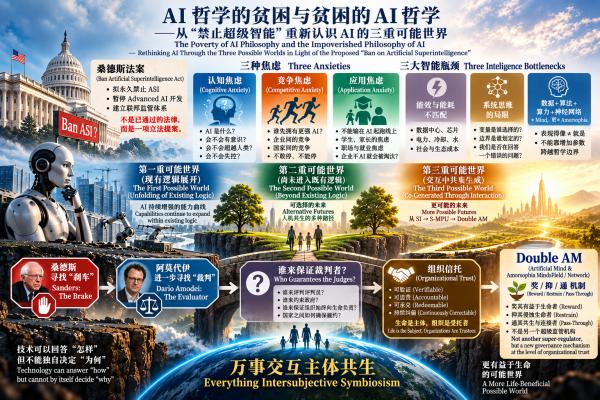
桑德斯寻找“刹车”;阿莫代伊进一步寻找“裁判”;现实却又追问:谁来保证刹车者与裁判者本身?
这也正是Double AM(Artificial Mind & Amorsophia MindsField / Network)及其奖/抑/通(Reward / Restrain / Pass-Through)机制所要进一步回答的问题。
但这里已经不只是AI问题,这是哲学问题。
一、美国国会没有“通过全面封杀大模型的法案”
先把事实说清楚:截至本文写作时,美国国会没有通过所谓“全面封杀前沿大模型”的法律。
2026年9月23日,桑德斯与 Casar 提出《Ban Artificial Superintelligence Act》。按照提案者公布的内容,该法案拟永久禁止其所定义的Artificial Superintelligence;暂停Advanced AI开发,直至新的联邦监管机构建立安全规则与模型审查程序;并拟设立内阁级Department of Artificial Intelligence,对前沿AI实施监管。桑德斯办公室公布的定义,包括跨多数领域超过人类认知能力,或者具有足以摧毁、压制人类等能力的AI。
所以准确的事实是:
不是美国已经禁止超级智能,而是美国国会内部出现了一项试图永久禁止ASI、暂时停止Advanced AI开发的立法提案。
两者性质完全不同。
但是,这项提案仍然值得高度重视。
因为桑德斯把他的逻辑说得很清楚:
如果汽车正在冲向悬崖,不能只是松开油门,而应该踩下刹车。
这个比喻听起来很有常识。
可是哲学恰恰会多问一句:
谁已经证明,前面一定是悬崖?
二、AI时代不是一种焦虑,而是三种焦虑
围绕AI正在发生的社会心理,如果不加区分,很容易全部塞进“AI焦虑”四个字。
其实至少存在三种不同的焦虑。
第一种:认知焦虑(Cognitive Anxiety)
AI究竟是什么?
它会不会产生意识?会不会形成Mind?会不会全面超过人类?会不会摆脱人的控制?会不会成为新的统治主体?甚至会不会毁灭人类?
桑德斯的超级智能禁令,主要面对的就是这一类问题。
这是一种非常特殊的焦虑:
我们担忧的不是一个已经出现的东西,而是一个尚未出现的可能世界。
人类甚至还没有充分认识自己的意识、潜意识和Mind,却已经开始预测一种尚未存在的“超级智能”将怎样思考、怎样行动、怎样对待人类。
这就是认知焦虑。
第二种:竞争焦虑(Competitive Anxiety)
竞争焦虑问的是另外一个问题:
谁先拥有更强的AI?
一个企业担心另一个企业拥有更强模型;一个国家担心另一个国家拥有更先进芯片、更大算力和更强ASI或SI。
于是模型越来越大,数据中心越来越多,算力越来越高。
其内在逻辑未必是:
我已经证明下一步值得这样走。
而可能只是:
别人不停,我不能停;我不能停,别人就更不敢停。
竞争由此自己生产竞争。
第三种:应用焦虑(Application Anxiety)
我在不久前发表的《真的“不能输在AI起跑线上”吗?——谈谈从AI for All,到AI for Life》中,集中讨论的正是第三种焦虑。
家长担心:
我的孩子会不会输在AI起跑线上?
学生担心:
别人都在用AI,我不用是不是就落后了?
职场人士担心:
我会不会被会使用AI的人替代?
企业也担心:
现在不上AI,是不是马上就会被淘汰?
AI当然应该学习,当然可以使用。
问题在于:
什么时候,“学会使用一种工具”,悄悄变成了“生命不能输掉的一场比赛”?
会不会使用AI,是一种应用能力。
一个生命有没有创造力,能不能发现新问题,能不能形成判断,能不能与另一个Mind发生交互、生成过去不存在的可能,则完全是另一个层次。
所以,“不能输在AI起跑线上”真正值得警惕的,并不是大家学习AI。
而是:
不要把工具的起跑线,误认为生命的起跑线。
于是,三种焦虑实际上在问三个不同的问题:
认知焦虑:AI最终会变成什么?
竞争焦虑:谁会率先得到更强的AI?
应用焦虑:我怎样才不会被AI时代淘汰?
一个怕AI跑得太远。
一个怕竞争者跑在前面。
一个怕自己跟不上。
阿莫代伊的两难尤其说明,这三种焦虑并不是三个彼此隔离的抽屉。
他试图通过第三方评估和政府监管缓解认知焦虑,却立即被国际AI竞争重新拉回竞争焦虑:想慢下来,又怕别人不停;想增加安全,又怕因此失去领先。
这说明,三种焦虑不仅并存,而且会相互转化、相互强化。只处理其中一种,另一种就可能从背后重新把问题推回来。
三种焦虑方向不同,却共同制造了一个奇怪的时代现象:
机器越来越聪明,人却没有因此越来越安心。
为什么?
三、三种焦虑的深处,还有三大智能瓶颈
我在《将AI升格为AM》以及《真的“不能输在AI起跑线上”吗?》中反复提出,今天的AI仍然面对三个不会因为模型越来越大而自动消失的瓶颈。
第一,能效与能耗不匹配(Mismatch between Energy Efficiency and Energy Consumption)
AI越强,数据中心、芯片、电力、冷却、水、土地以及相关基础设施负载可能越大。
所以:
Intelligence的增长,并不自动等于Life成本的下降。
如果一种机器能力增长10倍,却要求社会、生态与生命付出100倍代价,那么单纯比较模型性能已经不能回答它究竟是不是“进步”。
问题由:
能不能做到?
变成:
为什么要做到?以什么代价做到?做到以后对生命究竟有什么意义?
工程问题由此碰到了价值问题。
第二,系统思维的局限(Limits of Systems Thinking)
AI可以处理人脑无法同时处理的海量变量。
但是变量是谁选择的?
边界是谁划定的?
目标函数从哪里来?
什么进入数据,什么没有进入数据?
什么能够量化,什么尚不能量化?
一个系统完全可能在自己的定义域里越来越精确,却因为定义域本身出了问题,而越来越精确地回答一个错误的问题。
所以,问题由:
怎样得到更好的答案?
变成:
我们提出的是不是正确的问题?
计算问题由此碰到了认识论问题。
第三,数据+算法+算力+神经网络≠Mind,更≠Amorsophia
这是最根本的一道边界。
数据再多,不会因为数量足够大,就已经证明能够自动变成生命经验。
算法再复杂,不会因为复杂到某个临界点,就已经证明生成了意识。
算力超过人脑某种计算能力,也不能因此直接推出它已经获得Mind。
神经网络越来越能够模拟人的语言、行为、推理乃至情感表达,“表现得像”与“就是”之间,仍然存在不能靠增加参数偷偷跨过去的哲学边界。
所以问题最终由:
Intelligence还能多强?
变成:
Intelligence、Mind与Life究竟是什么关系?
工程在这里真正走到了哲学门口。
四、智能的三大瓶颈,为什么最终撞上“哲学的贫困”?
这需要说得非常准确。
我并不是说AI的能耗问题是哲学造成的。
电力就是电力,芯片就是芯片,散热就是散热。
也不是说所有系统问题都可以由哲学家解决。
工程问题当然需要工程解决,科学问题当然需要科学研究。
但是,当三大瓶颈继续向深处追问时,我们会发现:
技术可以解决“怎样”,却不能独自决定“为何”;
计算可以寻找最优,却不能独自决定“什么值得优化”;
智能可以增强能力,却不能仅凭能力自身规定生命的目的。
这正是三大瓶颈与哲学贫困的关系。
能效—能耗瓶颈最终追问的是:
什么叫真正的效率?
如果只计算token、FLOPS、参数、速度,而不计算生命、生态、社会与组织成本,我们甚至不知道自己的“效率”究竟是在谁的资产负债表上成立。
系统思维瓶颈最终追问的是:
谁规定系统边界?
任何系统都有边界。边界以外还有什么?有没有因为不能计算就被排除的生命经验?有没有我们甚至尚未发现的变量?
Mind瓶颈则把问题推到最深处:
究竟什么是Intelligence?
什么是Mind?
什么是Life?
它们之间是什么关系?
如果连这些基本概念的定义域都没有厘清,我们怎么能够从“机器越来越会回答问题”,直接推出“机器正在成为一个比人更高级的新主体”?
所以:
三大瓶颈不是哲学贫困制造出来的;但是哲学贫困会使人看不清三大瓶颈究竟通向哪里。
进一步说:
三种焦虑,是哲学贫困在AI时代的心理显现;
三大瓶颈,是AI发展触及哲学边界时的结构显现。
人类“怎样做”的能力飞速增长,而“为什么做、为谁做、做到哪里、什么不能做、还有什么可能”的能力没有同步成长。
这才是我所说的:
哲学的贫困。
五、哲学的贫困,不是“哲学书读少了”
所谓哲学贫困,不是指科学家没有读过柏拉图(Plato)、康德(Immanuel Kant),工程师不知道海德格尔(Martin Heidegger),政治家没有哲学学位。
它意味着一种更深的失衡:
人类改变现实的能力,正在跑到理解现实、判断现实和想象可能世界能力的前面。
过去一个多世纪,科学与工程取得了人类历史上前所未有的成就。
与此同时,一种观念也越来越流行:
凡是不能实验、不能计算、不能工程化的东西,似乎都不那么重要。
哲学于是逐渐被挤到知识体系的边缘。
从一些量子物理学家对哲学讨论表现出的不耐烦,到霍金(Stephen Hawking)后来宣称“哲学已死”,背后都可以看到一种认识:
科学在前面发现世界,哲学只能跟在后面解释世界。
可是,如果哲学只是整理已经发生的知识,那么哲学当然只能跟在后面。
真正的哲学却不仅追问:
世界是什么?
它还要追问:
世界为什么如此?
世界还可能怎样?
什么可能值得成为现实?
什么即使能够实现,也不应成为现实?
所以,我愿意重新给哲学一个属于数位—量子时代的位置:
哲学是时代精神的精华,是文明活的灵魂,也是生命追寻可能世界的无尽动力。
到了AI时代,这个被长期淡忘的功能重新显现出来。
六、三重可能世界:今天的AI究竟站在哪里?
这就必须进入我所说的“三重可能世界(Three Possible Worlds)”。
第一重:既有逻辑可以展开的可能世界
第一重不是简单的“已经知道的世界”。
它包括在既有语言、数学、逻辑、数据、规律和知识结构中,尚未现实化、但原则上可以继续组合、推演和生成的可能。
有限字词可以写出从未出现过的文章。
已有数学体系可以推出尚未证明的命题。
已有的数据、算法、算力和神经网络,可以生成过去从未出现过的文本、图像、程序和方案。
今天的大语言模型,在这一重世界中表现出了令人惊叹的能力。
所以我从来不主张贬低AI。
机器智能就是机器智能。
SI就是SI。
但是这里有一个不能偷偷删除的限定:
第一重。
第二重:尚未进入既有逻辑的可能世界
人类文明最重要的突破,往往不是把一个已有问题计算得更快。
而是突然发现:
原来问题可以这样问。
相对论出现以前,没有现成的相对论数据集等待爱因斯坦(Albert Einstein)检索。
量子理论形成以前,也没有一个已经完成的量子世界数据库等待机器归纳。
新的现象、新的概念、新的关系、新的生命经验,会不断进入我们原有知识体系尚未覆盖的地方。
这是尚未发现、尚未命名、尚未进入既有逻辑的可能世界。
第三重:交互中共襄生成的可能世界
第一重与第二重并不是两个互不往来的房间。
生命发现新的现象,哲学提出新的问题,科学建立新的解释,工程把解释变成能力,企业与投资把能力带进生活,组织建立新的规则;新的现实又反过来改变人的生活、经验、语言和问题。
主体与主体发生关系。
关系展开。
过去双方都不存在的第三者生成。
新的性质随之涌现。
这就是:
万事交互主体共生 Everything Intersubjective Symbiosism。
未来因此从来不是一条已经画好的直线。
未来在交互中生成。
七、AI真正危险的认知越界:把第一重世界的一条曲线画进全部未来
现在再来看“超级智能”。
AI在计算、编码、识别、语言、预测以及越来越多专业领域超过个人,完全可能,而且已经部分发生。
因此我赞成把机器的真实智能能力称作SI。
但:
某些智能超过人,不等于全部智能超过人;
Intelligence超过人的某些能力,不等于Mind超过人;
Mind更不等于Life。
这里最容易发生的逻辑跳跃,是把AI在第一重可能世界中的能力增长画成一条曲线,然后一直把它延伸进第二重、第三重可能世界。
于是:
模型越来越强,
所以AI将拥有全部智能;
AI拥有全部智能,
所以它将产生Mind;
产生Mind,
所以它将成为自主主体;
成为自主主体,
所以它最终可能统治甚至毁灭人类。
每向前一步,都增加了一个尚未得到充分证明的前提。
尤其荒谬的是:
如果第二重可能世界本来就是尚未进入现有逻辑、尚未被发现和命名的世界,我们怎么能够提前宣布已经知道AI在那里一定会怎样?
这不是说风险不存在。
而是说:
不要把可能风险偷偷写成必然未来。
八、九態:为什么机器智能还远远不是生命的全部
从生命九態(Nine States)来看,这一点更加明显。
我所说的九態,是:
数位態、量子態、物理態、生理態、心理態、伦理態、数理態、哲理態、信態。
九態不是九项可以打分的“能力”。
它们是在生命中彼此交互、贯通、生成的不同状态与层次。
今天的大语言模型最耀眼的突破,主要发生在数位、语言、符号、算法和计算结构上。
AI当然依托芯片、服务器、电力乃至机器人等物理载体。但是:
拥有物理载体,不等于具有生命的物理態;
处理生理数据,不等于拥有生理態;
模拟心理语言,不等于具有心理態;
讨论伦理,不等于成为伦理主体;
进行数学推理,不等于由此贯通哲理態;
更不能因为参数、token、算法和算力不断增加,就宣布信態和愛之智慧已经自然生成。
何况,人类对自己的Mind都远没有认识完。
意识之外还有潜意识。
心、脑、肠以及整个生命系统如何交互,仍有大片未知领域。
所以,一个非常朴素的问题是:
当我们连“人是什么”都没有认识完的时候,凭什么已经如此确信“机器将全面超过人”?
九、从“哲学无用”到“哲学已死”,这一页应该翻过去了
今天的哲学贫困不是一天造成的。
过去一个多世纪,科学界、工程界以及普通社会生活中逐渐形成了一种错觉:
哲学太抽象。
哲学不接地气。
哲学不能造芯片,不能发火箭,不能创造GDP。
甚至哲学家自己也逐渐退回哲学史、概念史和知识考据,把哲学变成一种专业知识。
于是便出现一个奇怪局面:
科学家越来越不需要哲学,哲学家越来越远离科学;工程师改变现实,哲学家解释文本。
到了AI时代,这种分裂已经无法继续。
一个工程师改变一个模型,就可能影响亿万人。
一个企业家的平台决定,可以改变整个信息生态。
一个投资者的资本配置,可以改变一条技术路线的速度。
一个政治家的法案,甚至可能直接关闭一整条尚未展开的技术路径。
到了这个时候,还认为哲学“不接地气”,恰恰已经离现实太远。
十、现在需要的是双向拥抱
所以,我多年前就提出:
科学家、工程师、企业家、投资者、政治家应该重新拥抱哲学;哲学家也必须继续拥抱科学、工程、企业、投资、政治、普通人的真实生活及其各种不确定性与可能性。
这不是让工程师改行研究哲学史。
也不是让哲学家替程序员写代码。
而是因为:
每一次科学发现都在打开一种可能;
每一次工程实现都在把一种可能变成现实;
每一次投资都在选择哪一种可能获得资源;
每一项法律都在决定哪些可能被鼓励、限制或者禁止。
所以三重可能世界根本不在天边。
它每天都在进入我们的生活。
哲学如果不能进入这里,就是贫困的哲学。
科学、工程和政治如果看不到这里,则会制造哲学的贫困。
二十世纪以来科学与哲学彼此疏离的那一页,应该翻过去了。
十一、从桑德斯的“刹车”到阿莫代伊的“裁判”:谁来保证裁判本身?
因此,面对桑德斯的方案,最简单的回答绝不是:
不要监管,让AI继续狂奔。
那同样是一种贫困。
危险能力当然应该识别。
真实伤害当然应该抑制。
组织当然必须承担责任。
如果前方已经证明确实是悬崖,当然应该刹车。
问题是:
不要因为看不清前方,就先宣布前方只有悬崖。
更不能因为不知道未来是什么,就把关闭未来当成唯一的负责任。
真正负责任的态度,是不断发现、不断检验、不断纠偏。
该奖的奖。
该抑的抑。
该通的通。
不是只有油门。也不是只有刹车。
还必须有方向盘、或罗盘。
阿莫代伊显然比单纯“踩刹车”又向前走了一步。
如果企业自己不能证明自己安全,就引入独立第三方评估者;如果企业之间的竞争使自律失效,就让政府在场;如果一个民主国家单独放慢又可能被其他国家抢先,就进一步寻求民主国家之间乃至全球层面的协调。
这是重要的进步。
但是,沿着这条逻辑继续追问,问题并没有结束:
谁来评判第三方评判员?谁来约束监管者?谁来保证民主政府本身始终向生命负责?谁来保证不同国家在竞争压力下仍然遵守共同规则?
这不是否定第三方评估,更不是否定民主政府监管。恰恰相反,它们都可以成为AI治理的重要组成部分。
问题在于:任何个人和组织,都不能因为获得了“裁判者”或“监管者”的身份,就自动获得永久可信托性。
所以:桑德斯寻找“刹车”;阿莫代伊进一步寻找“裁判”;Double AM则继续追问:谁来保证刹车者与裁判者本身?
问题由此从AI监管进一步进入组织信托(Organizational Trust)。
组织信托不是主观地相信“好政府、好专家、好企业、好裁判不会作恶”,而是建立一种可验证、可追责、可承兑,并能够持续纠偏的受托关系:生命是主体,组织是受托者;授权有边界,责任有归属,贡献与损益有记录,最终结果必须向生命承兑。
也正是在这里,Double AM(Artificial Mind & Amorsophia MindsField / Network)及其奖/抑/通(Reward / Restrain / Pass-Through)机制才显出与一般监管思路的不同。
奖/抑/通不是再增加一个凌驾于现有监管机构之上的“超级监管机构”,而是在组织信托层面改变治理机制。
它不预设世界上存在一个永远正确的最终裁判,而是通过持续发现、记录、确权、检验和承兑:奖其有益于生命者,抑其侵蚀生命者,通其有利于主体交互、连接与共襄生成者;同时让评估者、企业、政府乃至AI本身,都进入可以被检验、纠偏和承兑的关系之中。
所以,真正可靠的AI治理,不是寻找一个永远不会犯错的裁判,而是建立一种:即使裁判者,也必须接受检验;即使监管者,也必须接受约束;即使政府在场,也必须向生命承兑的组织信托机制。
十二、SI之后:不是封闭未来,而是打开AM的窄门
这正是我几天前写《川普为机器智能正名,开AI升格为AM之窄门》的原因。
川普把机器智能称为SI,至少把Intelligence重新摆回了它应有的位置。
桑德斯则从另一个方向提醒我们:
越来越强大的机器能力如果脱离生命、社会责任和组织信托(Organizational Trust),人类确实有理由担忧。
但是,两者之间还有一道窄门。
一边说:
越来越聪明,所以继续加速。
另一边说:
越来越聪明,所以赶快禁止。
看起来针锋相对,却仍然可能被困在同一条Intelligence坐标轴上。
我们需要改变坐标系。
从:
CPU → GPU → TPU → SI
继续探索:
SI → S-MPU → Double AM(Artificial Mind & Amorsophia MindsField / Network)奖/抑/通机制。
这里真正发生的不是upgrade。
而是Elevation。
Elevation is not an upgrade.
不是制造一个越来越强、最后取代人的新统治主体。
而是让机器智能进入:
LIFE—AI/AM—TRUST
交互契合的共生秩序——AM基础设施。
生命是主体。
AI是受托能力。
组织是受托者。
这也是为什么:
Artificial Minds Are Not New Ruling Subjects.
十三、三种焦虑,需要的不是同一种药
现在回头看,三种焦虑其实需要三种不同的回应。
认知焦虑不能靠恐吓解决。
它需要扩大我们对Intelligence、Mind、Life、九態和三重可能世界的认识。
竞争焦虑不能靠无限扩张解决。
它需要把“谁跑得最快”重新放回“为什么跑、向哪里跑、以什么生命成本跑”的坐标中。
应用焦虑更不能靠“全民赶快上AI”解决。
从AI for All走向AI for Life,关键不是人人都去参加一场AI竞赛,而是让AI真正降低生命成本、赋能生命创造、促进健康、增进信任与和平。
三种焦虑最后都指向同一个文明问题:
我们能不能让越来越强大的机器能力,始终接受“是否更有益于生命”的检验?
最好的“药”,始终是生命自组织连接动態平衡的交互主体共生秩序,一如人的身心灵自愈力。
结语:AI越强,哲学越不能贫困
现在,我们或许可以重新理解桑德斯的“刹车”。
它不是一个毫无根据的问题。
它甚至提醒了我们一个真实危险:
技术能力跑得太快,人类的认识、制度和组织信托可能跟不上。
但是,如果解决这个问题的方法,只剩下“加速”或者“禁止”,那么问题本身还没有被充分展开。
未来不是一条等待AI与人类赛跑的单行道。
人类还有尚未认识的Mind,以及Mind与Mind交互的Minds和MindsField!
还有意识背后的潜意识。
还有九態之间远未穷尽的交互。
还有尚未进入既有逻辑的第二重可能世界。
还有第一重与第二重交互之后不断共襄生成的第三重可能世界。
所以:
三种焦虑提醒我们不要盲目乐观;
三大瓶颈提醒我们不要把能力误认为生命;
三重可能世界提醒我们不要把今天能够看见的曲线误认为全部未来。
而哲学真正要做的,正是在这里重新开始。
当机器越来越擅长回答已经提出的问题,人类尤其需要保持另一种能力:
发现尚未提出的问题。
当机器越来越擅长在既有逻辑中寻找答案,人类尤其需要打开另一种能力:
发现尚未进入既有逻辑的可能。
当科学、工程、企业和政治不断把可能变成现实,哲学则必须不断追问:
我们究竟正在把一个怎样的世界变成现实?
这不是哲学远离生活。
这恰恰是哲学重新回到生活。
所以,AI时代真正需要克服的,不只是机器智能的三大瓶颈。
还有人类自己的哲学瓶颈。
AI越强,哲学越不能贫困。
因为真正值得生命进入的未来,不是被预测出来的,更不是因为恐惧而提前封闭的。
它需要生命、Mind、科学、工程、组织与AI,在不断发现、选择、交互、纠偏之中——共襄生成。
The Poverty of AI Philosophy and the Impoverished Philosophy of AI
— Rethinking AI Through the Three Possible Worlds in Light of the Proposed “Ban on Artificial Superintelligence”
Archer Hong Qian
Vancouver, September 27, 2026
On September 23, 2026, U.S. Senator Bernie Sanders and Representative Greg Casar formally introduced the Ban Artificial Superintelligence Act, proposing a permanent ban on what the bill defines as Artificial Superintelligence (ASI) and a pause on the development of Advanced AI until a new federal regulatory framework is established.
As the news reached the Chinese-speaking world, it was quickly turned into a much more dramatic claim:
“The U.S. Congress has passed a law comprehensively banning superintelligence and halting all frontier large-model development!”
Not so fast.
That is not what happened.
More important than the exaggeration of a news story, however, is the fact that this bill has brought a rapidly expanding question of our age directly before us:
When confronting a possible world that has not yet arrived, on what grounds can humanity predict it? And on what grounds can we close it off in advance because of our own prediction?
A few days ago, I published Trump Affirms Machine Intelligence and Opens a Narrow Gate to Elevating AI to AM. There I asked: as Machine Intelligence becomes increasingly powerful, should humanity simply continue racing along the path of “larger models—greater computing power—higher intelligence,” or should we pass through a narrow gate, moving from SI (Super Intelligence) toward S-MPU (Symbiotic Mind Processing Unit), and then explore Double AM(Artificial Mind & Amorsophia MindsField / Network)?
The Sanders bill brings the same question back from the opposite direction:
If SI continues to grow stronger, should we simply stop it?
But this is not the only proposed “brake.”
Around the same time that Sanders was proposing a brake, Anthropic CEO Dario Amodei put forward another path: frontier AI should appropriately slow its pace of development, independent third-party evaluators (Independent Third-Party Evaluators) should be introduced, government oversight (Government Oversight) should be present, and international coordination should gradually be pursued.
In a CBS interview on September 13, Amodei also placed some hope in the forthcoming Trump–Xi Jinping meeting. He hoped that the United States and China could at least reach an understanding that AI should not be used to develop biological weapons and that models capable of helping bioterrorists develop biological weapons should not be released. Over the longer term, he hoped the two countries might attempt to establish a shared “speed limit” for AI development.
Yet Amodei himself clearly understood the dilemma: if one company slows down, a competitor may move ahead; if democratic countries slow down, authoritarian countries may not do the same; and even if countries reach an agreement, they must still be able to verify that the other side is not cheating. Thus, just as cognitive anxiety tries to press the brake, competitive anxiety pushes the foot back onto the accelerator.
The Trump–Xi meeting has now concluded. The two sides established a dialogue on the risks and benefits of SI, together with channels for incident communication, but they did not reach the AI “speed-limit” or competition-pause agreement Amodei had hoped for.
This reality itself tells us something important:
Between recognizing risks together and constraining competition together lies an enormous gap of Organizational Trust.
A revealing picture of our age therefore emerges:
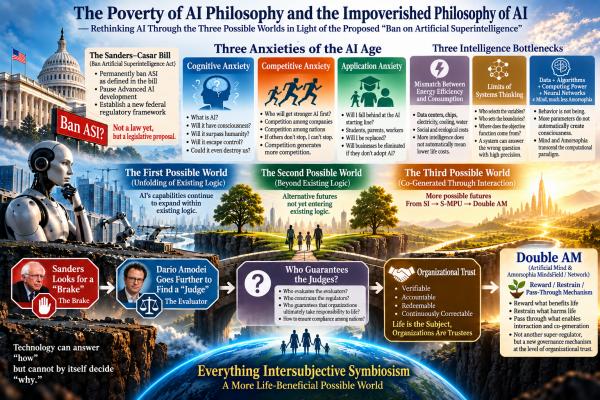
Sanders looks for a “brake”; Amodei goes one step further and looks for a “judge”; reality then asks: who guarantees the brake operators and the judges themselves?
This is precisely the question that Double AM(Artificial Mind & Amorsophia MindsField / Network) and its Reward / Restrain / Pass-Through mechanism seek to address at a deeper level.
But by this point, the issue is no longer merely about AI.
It is a philosophical question.
I. The U.S. Congress Has Not “Passed a Law Comprehensively Banning Large AI Models”
Let us first get the facts straight.
As of this writing, the U.S. Congress has not passed any law “comprehensively banning frontier large AI models.”
On September 23, 2026, Sanders and Casar introduced the Ban Artificial Superintelligence Act. According to the sponsors’ published description, the bill would permanently prohibit what it defines as Artificial Superintelligence; pause Advanced AI development until a new federal regulatory body establishes safety rules and model-review procedures; and create a cabinet-level Department of Artificial Intelligence to regulate frontier AI.
The definition released by Senator Sanders’s office includes AI that surpasses human cognitive capabilities across most domains, or possesses capabilities sufficient to destroy or subjugate humanity.
So the accurate statement is:
The United States has not banned superintelligence. Rather, members of the U.S. Congress have introduced a legislative proposal seeking to permanently prohibit ASI and temporarily halt Advanced AI development.
These are two entirely different things.
Nevertheless, the proposal deserves serious attention.
Sanders has made his logic very clear:
If a car is speeding toward a cliff, merely taking one’s foot off the accelerator is not enough; one should hit the brakes.
The analogy sounds like common sense.
But philosophy asks one more question:
Who has proved that there is necessarily a cliff ahead?
II. The AI Age Is Producing Not One Anxiety, but Three
The social psychology now developing around AI is easily compressed into the single phrase “AI anxiety.”
In fact, there are at least three distinct forms of anxiety.
1. Cognitive Anxiety
What exactly is AI?
Will it develop consciousness? Will it form Mind? Will it comprehensively surpass humanity? Will it escape human control? Will it become a new ruling subject? Could it even destroy humanity?
The proposed Sanders ban on superintelligence primarily addresses this category of concern.
This is a very particular kind of anxiety:
What we fear is not something that has already appeared, but a possible world that has not yet come into existence.
Humanity does not yet adequately understand its own consciousness, subconsciousness, or Mind, yet we have already begun predicting how a “superintelligence” that does not yet exist will think, act, and treat humanity.
This is Cognitive Anxiety.
2. Competitive Anxiety
Competitive Anxiety asks a different question:
Who will possess stronger AI first?
One company fears that another will develop a more powerful model. One country fears that another will acquire more advanced chips, greater computing power, and stronger ASI or SI.
Models therefore become larger, data centers multiply, and computing power continues to expand.
The underlying logic is not necessarily:
I have demonstrated that the next step is worth taking.
It may simply be:
Others will not stop, so I cannot stop; because I cannot stop, others become even more afraid to stop.
Competition thus generates more competition.
3. Application Anxiety
In my recent article, Do We Really “Have to Win at the AI Starting Line”? — From AI for All to AI for Life, I focused specifically on this third form of anxiety.
Parents worry:
Will my child fall behind at the AI starting line?
Students worry:
Everyone else is using AI. If I do not use it, will I fall behind?
People in the workplace worry:
Will I be replaced by someone who knows how to use AI?
Businesses worry as well:
If we do not adopt AI now, will we soon be eliminated by the market?
Of course AI should be learned, and of course it can be used.
The question is:
At what point does “learning how to use a tool” quietly become “a race that life itself cannot afford to lose”?
Knowing how to use AI is an application capability.
Whether a living person possesses creativity, can discover new questions, can form judgment, and can interact with another Mind to generate possibilities that did not previously exist—these belong to an entirely different level.
Therefore, what should concern us about the slogan “we cannot lose at the AI starting line” is not that people are learning AI.
It is this:
Do not mistake the starting line of a tool for the starting line of life.
The three anxieties therefore ask three different questions:
Cognitive Anxiety: What will AI ultimately become?
Competitive Anxiety: Who will obtain stronger AI first?
Application Anxiety: How can I avoid being left behind in the AI age?
One fears that AI will run too far.
One fears that competitors will run ahead.
One fears being unable to keep up.
Amodei’s dilemma makes especially clear that these three anxieties are not three isolated compartments.
He attempts to ease cognitive anxiety through third-party evaluation and government oversight, only to be pulled immediately back into competitive anxiety by international AI rivalry: he wants to slow down, yet fears that others will not; he wants greater safety, yet fears losing the lead as a result.
This shows that the three anxieties not only coexist; they can transform into and reinforce one another. Address only one, and another may return from behind to push the problem forward again.
The three anxieties point in different directions, yet together they produce a peculiar phenomenon of our age:
Machines are becoming increasingly intelligent, yet people are not becoming correspondingly more secure.
Why?
III. Beneath the Three Anxieties Lie Three Major Bottlenecks of Intelligence
In Elevating AI to AM and Do We Really “Have to Win at the AI Starting Line”?, I have repeatedly argued that today’s AI still confronts three bottlenecks that will not automatically disappear simply because models become larger.
1. The Mismatch Between Energy Efficiency and Energy Consumption
As AI becomes more powerful, the burdens imposed by data centers, chips, electricity, cooling, water, land, and related infrastructure may continue to grow.
Therefore:
Growth in Intelligence does not automatically mean a reduction in the cost borne by Life.
If a machine capability increases tenfold while requiring society, ecology, and life to pay a hundredfold greater cost, merely comparing model performance can no longer tell us whether this constitutes “progress.”
The question changes from:
Can it be done?
to:
Why should it be done? At what cost should it be done? And what does doing it ultimately mean for life?
An engineering question thus encounters a question of value.
2. The Limits of Systems Thinking
AI can process enormous numbers of variables simultaneously—far beyond the capacity of an individual human brain.
But who selected those variables?
Who drew the boundaries?
Where did the objective function come from?
What enters the data, and what does not?
What can be quantified, and what cannot yet be quantified?
A system can become increasingly precise within its own domain of definition while, because the domain itself is flawed, becoming increasingly precise at answering the wrong question.
The question therefore changes from:
How can we obtain a better answer?
to:
Are we asking the right question?
A computational question thus encounters a question of epistemology.
3. Data + Algorithms + Computing Power + Neural Networks ≠ Mind, Much Less Amorsophia
This is the most fundamental boundary.
No matter how much data accumulates, sheer quantity does not prove that data automatically becomes lived experience.
No matter how complex algorithms become, reaching some threshold of complexity does not by itself prove that consciousness has been generated.
Even if computing power surpasses some computational capabilities of the human brain, this does not directly establish that a machine has acquired Mind.
Neural networks are increasingly capable of simulating human language, behavior, reasoning, and even emotional expression. Yet between “behaving as if” and “being” remains a philosophical boundary that cannot be crossed simply by quietly adding more parameters.
The question therefore ultimately changes from:
How powerful can Intelligence become?
to:
What is the relationship among Intelligence, Mind, and Life?
At this point, engineering truly arrives at the door of philosophy.
IV. Why Do the Three Bottlenecks of Intelligence Ultimately Encounter the “Poverty of Philosophy”?
This relationship must be stated precisely.
I am not saying that AI’s energy-consumption problem is caused by philosophy.
Electricity is electricity. Chips are chips. Heat dissipation is heat dissipation.
Nor am I suggesting that every systems problem can be solved by philosophers.
Engineering problems must, of course, be solved through engineering; scientific questions must, of course, be investigated through science.
But when we continue following these three bottlenecks deeper, we discover:
Technology can solve “how,” but cannot by itself determine “why.”
Computation can optimize, but cannot by itself determine “what is worth optimizing.”
Intelligence can enhance capability, but capability alone cannot determine the purpose of life.
This is the relationship between the three bottlenecks and philosophical poverty.
The energy-efficiency/energy-consumption bottleneck ultimately asks:
What is genuine efficiency?
If we count only tokens, FLOPS, parameters, and speed, while failing to account for the costs borne by life, ecology, society, and organizations, we may not even know on whose balance sheet our supposed “efficiency” actually exists.
The systems-thinking bottleneck ultimately asks:
Who determines the boundaries of the system?
Every system has boundaries. What lies beyond them? Are there forms of lived experience excluded simply because they cannot be computed? Are there variables that we have not even discovered?
The Mind bottleneck takes the question still deeper:
What is Intelligence?
What is Mind?
What is Life?
What is the relationship among them?
If we have not even clarified the domains of definition of these basic concepts, how can we move directly from “machines are becoming increasingly capable of answering questions” to “machines are becoming a new subject superior to human beings”?
Therefore:
The three bottlenecks are not created by philosophical poverty; but philosophical poverty prevents us from seeing clearly where those bottlenecks ultimately lead.
More specifically:
The three anxieties are psychological manifestations of philosophical poverty in the AI age;
the three bottlenecks are structural manifestations of AI development reaching philosophical boundaries.
Humanity’s capacity for “how to do” is advancing at extraordinary speed, while its capacity to ask “why do it, for whom, how far, what should not be done, and what else is possible” has not developed at the same pace.
This is what I mean by:
the poverty of philosophy.
V. The Poverty of Philosophy Does Not Mean “Not Having Read Enough Philosophy Books”
Philosophical poverty does not mean that scientists have failed to read Plato or Immanuel Kant, that engineers do not know Martin Heidegger, or that politicians lack degrees in philosophy.
It refers to a much deeper imbalance:
Humanity’s ability to change reality is racing ahead of its ability to understand reality, judge reality, and imagine possible worlds.
Over the past century and more, science and engineering have achieved accomplishments without precedent in human history.
At the same time, another idea has become increasingly widespread:
Whatever cannot be experimentally tested, calculated, or engineered somehow seems less important.
Philosophy has consequently been pushed toward the margins of the knowledge system.
From the impatience some quantum physicists displayed toward philosophical discussion to Stephen Hawking’s later declaration that “philosophy is dead,” one can discern a shared assumption:
Science moves ahead discovering the world; philosophy can only follow behind and interpret it.
If philosophy merely organizes knowledge after the fact, then of course philosophy can only follow behind.
But genuine philosophy does not merely ask:
What is the world?
It also asks:
Why is the world as it is?
How else might the world be?
Which possibilities deserve to become reality?
Which possibilities, even if technically realizable, should not become reality?
I therefore propose restoring philosophy to a position appropriate to the digital–quantum age:
Philosophy is the essence of the spirit of an age, the living soul of civilization, and the inexhaustible drive of life in its search for possible worlds.
In the AI age, this long-neglected function of philosophy is becoming visible again.
VI. The Three Possible Worlds: Where Does Today’s AI Actually Stand?
We must therefore enter what I call the Three Possible Worlds.
The First Possible World: Possibilities That Can Unfold Within Existing Logic
The First Possible World is not simply “the world we already know.”
It includes possibilities that have not yet been actualized but can, in principle, continue to be combined, inferred, and generated within existing language, mathematics, logic, data, laws, and structures of knowledge.
A finite vocabulary can produce an article never written before.
An existing mathematical system can yield propositions not previously proved.
Existing data, algorithms, computing power, and neural networks can generate texts, images, programs, and solutions that have never appeared before.
Today’s large language models display astonishing capabilities within this world.
I therefore have never advocated belittling AI.
Machine Intelligence is Machine Intelligence.
SI is SI.
But there is one qualifier that must not quietly disappear:
the First Possible World.
The Second Possible World: Possibilities Not Yet Entering Existing Logic
The most important breakthroughs in human civilization have often not come from calculating an existing problem faster.
They have come from suddenly discovering:
The question itself can be asked differently.
Before relativity, there was no ready-made relativity dataset waiting for Albert Einstein to search.
Before quantum theory took shape, there was no completed database of the quantum world waiting for a machine to inductively summarize.
New phenomena, new concepts, new relationships, and new lived experiences continually enter regions not yet covered by our existing systems of knowledge.
This is the possible world that has not yet been discovered, named, or incorporated into existing logic.
The Third Possible World: Possibilities Co-Generated Through Interaction
The First and Second Possible Worlds are not two sealed rooms.
Life discovers new phenomena. Philosophy raises new questions. Science develops new explanations. Engineering transforms explanations into capabilities. Enterprises and investors bring those capabilities into life. Organizations establish new rules. The new reality then changes human life, experience, language, and questions in return.
Subject encounters subject.
Relationship unfolds.
A third entity that previously existed in neither side is generated.
New qualities emerge with it.
This is:
万事交互主体共生 — Everything Intersubjective Symbiosism.
The future, therefore, is never a straight line that has already been drawn.
The future is generated through interaction.
VII. AI’s Truly Dangerous Cognitive Overreach: Extending a Curve from the First Possible World into the Entire Future
Now let us return to “superintelligence.”
It is entirely possible—and has already partially occurred—that AI surpasses individual human beings in computation, coding, recognition, language, prediction, and an increasing number of specialized domains.
That is why I support calling the machine’s real intelligence capability SI.
But:
Surpassing humans in some forms of intelligence does not mean surpassing humans in all intelligence;
Intelligence surpassing some human capabilities does not mean Mind surpassing humanity;
and Mind is not equivalent to Life.
The most common logical leap occurs when we draw the growth of AI capabilities within the First Possible World as a curve and then simply extend that curve into the Second and Third Possible Worlds.
The argument then becomes:
Models are becoming stronger,
therefore AI will possess all intelligence;
AI will possess all intelligence,
therefore it will generate Mind;
once it generates Mind,
it will become an autonomous subject;
once it becomes an autonomous subject,
it may ultimately rule or even destroy humanity.
Each step introduces another premise that has not been adequately demonstrated.
Most paradoxically:
If the Second Possible World is, by definition, a world not yet incorporated into existing logic and not yet discovered or named, how can we announce in advance that we already know what AI will necessarily do there?
This does not mean that risk does not exist.
It means:
Do not quietly rewrite a possible risk as an inevitable future.
VIII. The Nine States: Why Machine Intelligence Is Still Far from the Whole of Life
Viewed through the Nine States, this becomes even clearer.
The Nine States I propose are:
Digital State, Quantum State, Physical State, Physiological State, Psychological State, Ethical State, Mathematical State, Philosophical State, and Trust State.
The Nine States are not nine “abilities” to be scored on a scale.
They are different states and levels that interact, interconnect, and generate within life.
The most spectacular breakthroughs of today’s large language models have occurred primarily in digital, linguistic, symbolic, algorithmic, and computational structures.
AI of course depends on physical carriers—chips, servers, electricity, and even robots.
But:
Having a physical carrier does not mean possessing the Physical State of life;
processing physiological data does not mean possessing a Physiological State;
simulating psychological language does not mean possessing a Psychological State;
discussing ethics does not make AI an ethical subject;
performing mathematical reasoning does not thereby connect it to the Philosophical State;
and increasing parameters, tokens, algorithms, and computing power cannot justify declaring that the Trust State and Amorsophia have naturally emerged.
Moreover, humanity is still far from fully understanding its own Mind.
Beyond consciousness lies the subconscious.
How the heart, brain, gut, and the entire living system interact remains a vast territory of the unknown.
So a very simple question arises:
When we have not yet fully understood what a human being is, on what grounds can we already be so certain that “machines will comprehensively surpass humanity”?
IX. From “Philosophy Is Useless” to “Philosophy Is Dead”: It Is Time to Turn the Page
Today’s philosophical poverty did not arise overnight.
Over the past century and more, the scientific community, engineering community, and society at large have gradually developed an illusion:
Philosophy is too abstract.
Philosophy is detached from real life.
Philosophy cannot make chips, launch rockets, or create GDP.
Even philosophers themselves have increasingly retreated into the history of philosophy, conceptual history, and textual scholarship, turning philosophy into a specialized body of knowledge.
The result is a peculiar situation:
Scientists increasingly feel they do not need philosophy, while philosophers move increasingly farther from science; engineers change reality, while philosophers interpret texts.
In the AI age, this separation can no longer continue.
A change made by one engineer to a model may affect hundreds of millions of people.
A platform decision made by an entrepreneur can alter an entire information ecology.
An investor’s allocation of capital can change the speed of an entire technological pathway.
A law enacted by a politician may even close off an entire technological pathway before it has had a chance to unfold.
At this point, to continue saying that philosophy is “detached from reality” is itself to become detached from reality.
X. What We Need Now Is a Two-Way Embrace
For this reason, I proposed years ago:
Scientists, engineers, entrepreneurs, investors, and political leaders should once again embrace philosophy; philosophers, in turn, must continue to embrace science, engineering, enterprise, investment, politics, the real lives of ordinary people, and all their uncertainties and possibilities.
This does not mean engineers should abandon engineering to study the history of philosophy.
Nor does it mean philosophers should write code for programmers.
Rather:
Every scientific discovery opens a possibility;
every engineering realization turns a possibility into reality;
every investment chooses which possibility will receive resources;
every law determines which possibilities will be encouraged, constrained, or prohibited.
The Three Possible Worlds are therefore not somewhere beyond the horizon.
They enter our lives every day.
If philosophy cannot enter this domain, it becomes an impoverished philosophy.
If science, engineering, and politics cannot see this domain, they produce the poverty of philosophy.
It is time to turn the page on the estrangement between science and philosophy that has persisted since the twentieth century.
XI. From Sanders’s “Brake” to Amodei’s “Judge”: Who Guarantees the Judges Themselves?
Therefore, the simplest response to Sanders’s proposal should certainly not be:
Do not regulate. Let AI keep racing forward.
That would be another form of impoverishment.
Dangerous capabilities should of course be identified.
Real harms should of course be restrained.
Organizations must of course bear responsibility.
If it has been established that there really is a cliff ahead, then of course we should brake.
The problem is:
Do not declare that there is nothing but a cliff ahead simply because we cannot yet see clearly.
Still less should we treat closing off the future as the only responsible response simply because we do not know what the future will be.
A genuinely responsible approach requires continuous discovery, testing, and correction.
Reward what should be rewarded.
Restrain what should be restrained.
Pass through what should be passed through.
There is not only an accelerator.
There is not only a brake.
There must also be a steering wheel—or a compass.
Amodei clearly takes the discussion one step beyond simply “hitting the brakes.”
If companies cannot demonstrate their own safety, bring in independent third-party evaluators. If competition among companies makes self-regulation ineffective, bring government into the process. If a democratic country slowing down on its own risks being overtaken by others, then pursue coordination among democratic countries and, ultimately, at the global level.
This is an important step forward.
But if we continue following the logic, the questions do not end:
Who evaluates the third-party evaluators? Who constrains the regulators? Who guarantees that democratic governments themselves will remain responsible to life? Who guarantees that different countries will continue to honor common rules under competitive pressure?
This is not an argument against third-party evaluation, much less against democratic government oversight.
On the contrary, both can be important components of AI governance.
The problem is that:
No individual or organization automatically acquires permanent trustworthiness merely by acquiring the identity of “judge” or “regulator.”
Therefore:
Sanders looks for a “brake”; Amodei goes one step further and looks for a “judge”; Double AM continues the inquiry: who guarantees the brake operators and the judges themselves?
The issue thus moves beyond AI regulation into Organizational Trust.
Organizational Trust does not mean subjectively believing that “a good government, good experts, good companies, or good judges will not do evil.” It means establishing a fiduciary relationship that is verifiable, accountable, redeemable, and continuously correctable:
Life is the subject; organizations are trustees. Authorization has boundaries; responsibility has attribution; contributions and gains or losses are recorded; and final outcomes must ultimately be redeemed to life.
It is precisely here that Double AM(Artificial Mind & Amorsophia MindsField / Network) and its Reward / Restrain / Pass-Through mechanism differ from conventional regulatory approaches.
Reward / Restrain / Pass-Through is not about adding another “super-regulator” above existing regulatory institutions. It is about changing the governance mechanism at the level of Organizational Trust.
It does not presume the existence of some final judge who is always right. Instead, through continuous discovery, recording, confirmation of rights, verification, and redemption, it seeks to:
reward what benefits life;
restrain what erodes life;
pass through what facilitates interaction, connection, and co-generation among subjects.
At the same time, evaluators, companies, governments, and even AI itself must all enter relationships in which they can be examined, corrected, and required to redeem their responsibilities.
Thus, reliable AI governance is not about finding a judge who will never make a mistake.
It is about building an Organizational Trust mechanism in which:
even judges must be examined;
even regulators must be constrained;
and even when government is present, government must still redeem its responsibility to life.
XII. After SI: Do Not Close the Future—Open the Narrow Gate to AM
This is precisely why, a few days ago, I wrote Trump Affirms Machine Intelligence and Opens a Narrow Gate to Elevating AI to AM.
By calling machine intelligence SI, Trump at least placed Intelligence back where it belongs.
Sanders, from another direction, reminds us that humanity has legitimate reasons for concern if increasingly powerful machine capabilities become detached from life, social responsibility, and Organizational Trust.
But between these two positions lies a narrow gate.
One side says:
It is becoming more intelligent, so accelerate.
The other says:
It is becoming more intelligent, so stop it.
They appear diametrically opposed, yet both may remain trapped on the same Intelligence axis.
We need to change the coordinate system.
From:
CPU → GPU → TPU → SI
we should continue exploring:
SI → S-MPU → Double AM(Artificial Mind & Amorsophia MindsField / Network) → Reward / Restrain / Pass-Through.
What occurs here is not an upgrade.
It is Elevation.
Elevation is not an upgrade.
The goal is not to manufacture an ever more powerful new ruling subject that ultimately replaces human beings.
It is to bring Machine Intelligence into:
LIFE—AI/AM—TRUST
an interactively aligned symbiotic order—an AM infrastructure.
Life is the subject.
AI is entrusted capability.
Organizations are trustees.
This is also why:
Artificial Minds Are Not New Ruling Subjects.
XIII. The Three Anxieties Do Not Require the Same Medicine
Looking back, the three anxieties actually require three different responses.
Cognitive Anxiety cannot be resolved through fear.
It requires expanding our understanding of Intelligence, Mind, Life, the Nine States, and the Three Possible Worlds.
Competitive Anxiety cannot be resolved through unlimited expansion.
It requires returning the question “Who runs fastest?” to a larger coordinate system:
Why are we running? Where are we running? And at what cost to life?
Application Anxiety certainly cannot be resolved by telling everyone to “get on AI immediately.”
Moving from AI for All to AI for Life does not mean turning everyone into a contestant in an AI race. It means enabling AI genuinely to reduce the costs borne by life, empower life’s creativity, promote health, increase trust, and advance peace.
Ultimately, all three anxieties converge on the same civilizational question:
Can we ensure that increasingly powerful machine capabilities remain subject to the test of whether they are more beneficial to life?
The best “medicine” remains an intersubjective symbiotic order of life’s self-organizing connection and dynamic balance, much like the self-healing capacity of the human body, mind, and spirit.
Conclusion: The Stronger AI Becomes, the Less Philosophy Can Afford to Be Poor
We may now be able to understand Sanders’s “brake” differently.
It is not a question without foundation.
Indeed, it alerts us to a genuine danger:
Technological capability may be advancing so rapidly that human understanding, institutions, and Organizational Trust cannot keep pace.
But if our only responses are “accelerate” or “ban,” then the problem itself has not yet been adequately unfolded.
The future is not a one-way racetrack on which AI and humanity are waiting to compete.
Human beings still possess a Mind that remains far from fully understood—as well as Minds, generated through Mind-to-Mind interaction, and MindsField!
There is still the subconscious behind consciousness.
There remain interactions among the Nine States that are far from exhausted.
There remains the Second Possible World, not yet incorporated into existing logic.
And there remains the Third Possible World, continually co-generated through interaction between the First and Second Possible Worlds.
Therefore:
The three anxieties remind us not to be blindly optimistic;
the three bottlenecks remind us not to mistake capability for life;
the Three Possible Worlds remind us not to mistake the curve visible today for the whole of the future.
And it is precisely here that philosophy must begin anew.
As machines become increasingly adept at answering questions already posed, humanity must especially preserve another capacity:
the capacity to discover questions that have not yet been asked.
As machines become increasingly adept at finding answers within existing logic, humanity must especially open another capacity:
the capacity to discover possibilities that have not yet entered existing logic.
As science, engineering, enterprise, and politics continually transform possibilities into reality, philosophy must continually ask:
What kind of world are we actually bringing into reality?
This is not philosophy retreating from life.
It is philosophy returning to life.
Therefore, what the AI age must overcome is not merely the three bottlenecks of Machine Intelligence.
It must also overcome humanity’s own philosophical bottleneck.
The stronger AI becomes, the less philosophy can afford to be poor.
For a future truly worthy of life is neither something merely predicted in advance nor something closed off beforehand because of fear.
It requires Life, Mind, science, engineering, organizations, and AI, through continuous discovery, choice, interaction, and correction—
to co-generate it together.