共生经济学的第一性原理
共生经济学的第一性原理
The First Principle of Symbionomics
——从 K-Economy 的确诊到共生经济学 Q-Economy 的组织信托重建
— From the Diagnosis of K-Economy to the Rebuilding of Organizational Trust in Q-Economy
钱 宏(Archer Hong Qian)
面对 K-Economy(K型经济),怎么办?
这个问题并非来自抽象的理论游戏,而来自一个越来越具体的现实困境:一边是经济基础承受着税费、债务、行政、合规、住房、教育、医疗以及各种制度性成本的叠加压力;另一边,人们仍在不断寻找新的融资方式、新的货币传导方式和所谓“底层生态的制度创新”。这些探索并非没有意义。
问题在于,如果庞大的上层组织负载本身没有进入诊断,那么底层越精巧的创新,越可能只是在旧结构里重新布管。
有人主张直接融资与间接融资中心化协同发展,有人设想以数字人民币直达劳动者,形成去中心化的精准货币机制和经济微循环。这些办法可以改善“钱怎么走”,却绕不开一个更前置的问题:钱为什么在这里被截留、耗散和重新分配?谁决定资源流向?谁承担组织成本?谁创造价值?谁获得承兑?
技术可以改变资金抵达经济基础的路径,却不能自动改变上层建筑及其组织自我繁殖机制(Reproductive Officialdom殖官)汲取经济基础的方式。
由此,问题第一次从“资金流”推到了“组织流”。
这也正是共生经济学(Symbionomics)重新确诊 K-Economy、进而提出 Q-Economy(Q型经济)的现实入口。
一、先把 K 确诊:它不是贫富两条线,而是生命转动力的结构性断裂
K-Economy 最容易被直观地理解为收入和财富分化:一部分人向上,一部分人向下。但如果诊断停在这里,治疗自然也只能停在收入再分配、刺激消费或者重新配置金融资源。
共生经济学(Symbionomics)所看到的 K 更深一层:庞大的政治—行政—财政上层建筑,与已经超负荷承载的经济基础之间,可能逐步逼近一种 K 型矛盾阈值(K-shaped Contradiction Threshold)。一端不断增加组织成本、汲取资源、制造制度负载;另一端则是企业、家庭和个体生命的创造力、收入预期与价值承兑能力不断被削弱。
这里的 K,不只是财富分布的两条线,而是生命转动力的结构性断裂。
所以,诊 K 不能只问“谁富了、谁穷了”,还必须问:一个社会的生命创造为什么越来越难以转化为可持续的生活改善?为什么经济增长可以发生,而生命的获得感、自由度、健康度与信任度却未必同步提高?问题的中间,隔着一个组织。
二、底层创新为什么替代不了上层结构逻辑纠偏?
融资结构改革、数字货币、精准投放、经济微循环,都可能是有用的工具。但工具只有放进正确的组织关系里才会产生预期效果。
如果殖官主义(Colonial Bureaucratism)所形成的刑徒经济(Convict Economy)+货殖经济(Mercantile Economy)的组织机制基本不变,那么融资制度怎么改、货币传导怎么改,仍主要是在原有结构里面优化“钱怎么流”。真正决定 K 是否继续生成的,却是“组织怎样取得资源、怎样使用权力、怎样形成成本、怎样向生命承兑”。
于是便出现一个近乎荒诞的悖论:上面继续超载,下面努力微循环;一边继续抽血,一边研究怎样精准输血。
融资可以重新布管,货币可以精准滴灌;但若组织汲取机制依旧,水流得再精准,也改变不了水源不断被上游截取。
因此,“底层生态的制度创新”真正要成立,不能只在底层做文章。它必须与上层建筑的组织信托重建相连接。组织信托(Organizational Trust)也不是一句漂亮的伦理口号,而是权力、责任、成本、贡献与价值承兑之间可以被发现、记录、检验和追责的组织关系。
三、从“资金流”追溯到“组织流”:诊 K → Q 疗
只有从“资金流”追溯到“组织流”,从货币传导追溯到权力、责任、成本与价值承兑,K-Economy 的诊断才真正抵达病灶,共生经济学的 Q-Economy 治疗才真正开始。
诊 K(Diagnosing K),不能只诊收入分配,而要诊“组织负载—生命创造—价值承兑”之间的结构性断裂;Q 疗(Q-Therapy),也不能止于给底层增加流动性,而必须降低组织成本、恢复生命转动力、重建组织信托。
但是,这又带出一个更大的历史问题:在人类找到 Q-Economy 这种诊疗方法以前,面对一次次类似的结构性断裂,究竟采取过什么办法?
为什么几千年来不断改革、开放、革命、斗争、征税、刺激、放松管制,K 仍然能够以新的形式重新生成?
四、Q-Economy不是把K拉平,更不是绕成一个O
既然 K-Economy 的病理,不只是贫富分化,而是“组织负载—生命创造—价值承兑”之间发生了结构性断裂,那么,所谓 Q 疗究竟要治疗什么?Q-Economy 又究竟是什么?
首先必须说清楚:
Q,不是把 K 的两端强行拉平。
如果把 K 仅仅理解为一条向上、一条向下的财富曲线,那么最直观的办法当然是把上面的一部分搬到下面,使两端在统计上重新靠近。这种再分配在特定条件下当然可能必要,也能够解决现实生活中的某些问题;但它并没有自动回答:下端的生命为什么失去了继续创造和发展的转动力?上端的积累中,哪些来自真实创造,哪些来自组织优势、制度租值和成本外部化?一次拉平以后,新的 K 为什么不会再次形成?
所以,Q不是平均主义意义上的“拉平K”。
Q也不是把K的两条线掰过来,首尾相接圈圈绕,最后绕成一个止下循环取代的 O。
O可以表示循环,而且是一个封闭圈子内的循环。生命却不是为了完成一次循环以后“一夜回到解放前”。生命的本质在于创造,在于连接,在于生成,在于不断打开下一种可能。
这就是为什么叫 Q-Economy,而不是 O-Economy。
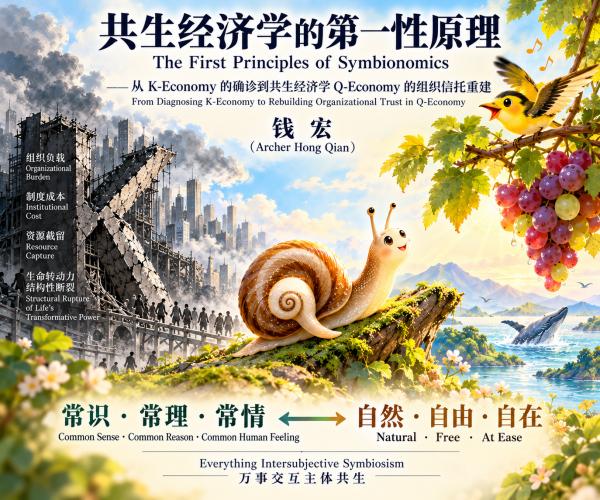
仔细看 Q:一个圆环之外,底部还伸出去一笔。通常,人们把它称作 Q 的“尾巴”。但是,如果从生命的视角重新看它,那一笔不是尾巴,更象征着蜗牛伸向前方的头。
台湾有首充满生活情趣的儿歌《蜗牛与黄鹂鸟》,恰好可以帮助我们理解这个 Q。
黄鹂鸟会飞,站得高,也走得快;蜗牛看似弱小,行动缓慢。当黄鹂鸟觉得葡萄还没有成熟、现在就开始往上爬未免太早时,蜗牛有自己的生命时间:
正因为我走得慢,所以我现在就要出发。
它不是为了战胜黄鹂鸟,也不是要求把黄鹂鸟拉下来和自己一样慢;它更没有必要把自己改造成黄鹂鸟。
它只是为了生活,按照自己的生命禀赋和生命节律,一步一步坚定地向前。
蜗牛不是黄鹂鸟,更不是鲸鱼。它不需要变成黄鹂鸟才具有价值,也不需要拥有鲸鱼的体量才具有尊严。
万事各从其类,各展其能,各得其所得。生命有差异,禀赋有不同,节律有快慢,需要也各有其度,而生命尊严第一。蜗牛何必成为黄鹂鸟?黄鹂鸟又何必成为鲸鱼?生命之所以丰富,正在于各自成为自己,又能与他者相遇。
这份自然、自由、自在,正是共生经济学背后的哲学原点:
Everything Intersubjective Symbiosism(EIS,万事交互主体共生)。所谓“万事”,不是把世界还原成同一种存在;所谓 Intersubjective(交互主体),也不是取消主体差异以后再谈共生。恰恰因为各自存在、彼此有别,主体之间才真正有“间”,才可能连接、交互、契合,并生成原来任何一方都没有的第三者、新价值与新可能。
所以,万事交互主体共生,不是消灭差异以后共生,而是让不同主体保持自身生命尊严,在“间”中自然连接、自由交互、自在生成。
蜗牛仍然是蜗牛,黄鹂鸟仍然是黄鹂鸟。
不是蜗牛必须变成黄鹂鸟,也不是为了照顾蜗牛,就把黄鹂鸟的翅膀剪掉;不是让强者支配弱者,也不是以帮助弱者为名消灭生命之间真实存在的差异。
平等首先是生命尊严的平等,而不是生命结果的强制相同。
人的真实生活需要,总体也是有限的。生命依其本性而生活,本可自然、自由、自在;真正容易失去边界的,往往不是生命需要本身,而是脱离生命以后,被占有、攀比、权力和组织不断放大的欲求。
因此,Q-Economy所追求的,从来不是“大家一样多”“大家一样快”“大家站在同一个位置”。
人为拉平与强求同一,看似一个以平等为名,一个以统一为名,一旦越过生命主体自身的边界,都可能走向支配、操纵与欺诈。
这种奴役甚至可能从两个相反的方向发生。
一种是以“为了你好”“替你作主”“帮助弱者”乃至实现某种绝对平等为理由,剥夺他者作为主体选择自己生活的权利——这是以爱他者之名走向的奴役。
另一种则是为了无限财富、无限权力、无限增长,把自己也变成欲望、竞争和组织机器的囚徒——这是自我奴役。
两条道路方向看似相反,最后却可能殊途同归:
生命不再是目的,而成为某种主义、权力、财富或者组织目标的工具。
无论以爱他者之名支配他者,还是被无限欲望驱使而自我奴役,结果都一样:生命失去自然,失去自由,也失去自在。这才是真正需要警惕的“通往奴役之路”。
由此,Q与K、O的区别就清楚了。
K呈现的是生命转动力的结构性断裂;
强行拉平K,只是人为重新安排两端的位置;
O形成了循环,却仍封闭;
Q则在循环中伸出了生命的头,向他者、向生活、向未来、向新的生成继续前行。
所以,Q-Economy不是要求所有生命得到同样的结果,而是要使不同生命在尊严平等的前提下:
各从其类,各展其能,各得其所得。
让生命的创造能够被发现,让真实贡献能够被记录和确权,让价值能够得到承兑,让承兑重新赋能生命,使那些已经失去转动力的生命重新获得继续创造、继续生活、继续向前的可能。
这也正是“生命本自具足,又非独存”在经济生活中的展开。
“本自具足”,所以蜗牛不必成为黄鹂鸟;生命无需成为别人,才能证明自己的价值。
“又非独存”,所以蜗牛也不是孤立存在的。葡萄藤、黄鹂鸟、阳光雨露、时间季节以及其他生命共同构成它生活于其中的关系世界。生命需要在与他者的交互中连接、创造、交换、承兑并继续生成。
因此,Q-Economy可以得到一个更完整的定义:
Q-Economy,是共生经济学(Symbionomics)以“生命本自具足,又非独存”为第一性原理,以 Everything Intersubjective Symbiosism(万事交互主体共生)为哲学参照,在尊重生命差异与尊严平等的前提下,通过价值发现、记录确权、组织信托、价值承兑与再赋能,修复 K-Economy 中断裂的生命转动力,使不同生命各展其能、各得其所得,并在交互主体关系中不断生成新的价值与可能的一种动态经济形态。
因此:
Q不是K的反面,Q是对K断裂的治疗;
Q不是平均,Q是转动力;
Q不是O,Q不是封闭循环。
O是闭合的循环;Q是交互中的生成。
Q下面多出来的那一笔,是生命伸向生活、伸向他者、伸向未来的头。
五、千百年来,我们为什么总在 K 的两端来回摆动?
回看历史,人类并非没有寻找出路。相反,几乎每一次严重的经济社会失衡,都会催生改革、革命、再分配或者新的政府—市场组合。问题是,这些办法往往改变了 K 的形态,却未必改变 K 的再生机制。
在中国历史中,第一反应通常是在既有组织结构内部变法、维新、改革。从商鞅变法、王莽改制、王安石变法、张居正改革,到晚清改革以及现代中国的改革开放,各自时代、目标、方法和历史结果当然不同,不能简单等同;但从组织行为角度,可以提出同一个问题:改革究竟改变了组织的受托逻辑,还是主要提高了既有组织的资源动员与治理能力?
开放又增加了一个变量:从外部引入资本、技术、市场、知识乃至正制度外部性(Positive Institutional Externalities),扩大经济基础和税基。开放当然能够释放巨大的生命创造力;然而,如果经济基础扩大,而上层组织的成本—权力—责任—承兑关系没有同步重构,那么经济基础越大,上层组织能够调动、汲取和配置的资源也可能越多。
改革可以救活旧结构,开放可以做大经济基础;但如果组织信托没有重建,改革和开放取得的成功,也可能反过来强化原有组织结构。
而有限改革一旦高度依附具体改革者,又容易出现“人亡政息”、反复无常乃至倒退。
于是,第二种反应便出现:既然改不动,就推倒重来。
从传统王朝更替到近现代革命,具体性质并不相同。这里要追问的不是谁更正义,而是一个组织机制问题:换了统治者,是否就改变了统治组织的生成逻辑?旧官僚被打破,新官僚又会形成;旧财政体系瓦解,新财政体系又会扩张;旧权力网络被清除,新权力网络又可能重新生成(参看吉拉斯《新阶级》,1957)。
于是,“谁坐江山”改变了,“组织为什么存在、为谁存在、成本由谁承担、价值向谁承兑”却未必发生根本变化。殖官主义因而不能只被理解为某一群“坏官”的道德问题,它首先是一种能够再生产自身的组织机制。
西方现代政治经济思想走出了另一组道路。马克思从资本—劳动关系切入,对资本积累与阶级关系进行系统批判;阶级冲突在不同国家又表现为革命、工会运动、议会竞争和社会民主改革等不同形式。一个多世纪以后,皮凯蒂重新以长期财富与收入数据讨论不平等,并把累进税、财富税和资本税等再分配工具带回公共讨论。
这些路径都碰到了真实问题,但共生经济学还要继续追问:即使通过阶级斗争、征税或者再分配,把 K 的两端重新拉近,造成 K 不断生成的组织机制是否已经改变?如果“生命创造—组织成本—价值承兑”的关系没有改变,一轮再分配以后,新的 K 会不会再次形成?
还有一条影响二十世纪至今的轴线:政府还是市场?面对危机、失业与需求不足,凯恩斯主义强调宏观需求管理;面对政府膨胀、计划失灵和知识高度分散的问题,哈耶克等自由主义思想强调市场价格、竞争与对政府权力的限制。两边都看到了真实的一面,也都留下了重要工具。
于是,一个世纪的政策实践形成了熟悉的钟摆:市场失灵,向政府摆;政府失灵,又向市场摆;需求不足,向需求侧摆;成本过高、活力不足,又向供给侧摆。
人类不断调整钟摆,却很少追问:钟摆的支点究竟是什么?
六、当诊断坐标错了,左右东西之争便失去了第一性意义
追到这里,问题已经不再只是比较哪一种改革、革命、税制或者宏观政策更有效,而是必须检查我们提出问题时使用的坐标本身。
几个世纪以来,人们习惯把政治经济问题放进一系列二分叙事:资本主义还是社会主义,民族国家主义还是多元文化主义,左还是右,公还是私,东方还是西方,政府还是市场,精英还是草根,所谓“民粹”还是“建制”。
这些概念当然没有从历史中消失,它们仍然可以描述制度差异、政治联盟和社会冲突。但是,一旦面对 K-Economy 所揭示的“组织负载—生命创造—价值承兑”的结构性断裂,它们就失去了作为第一性诊断坐标的资格。
资本主义社会可以形成沉重的组织负载,社会主义社会也可以;东方可以出现,西方也可以;公有组织可能脱离委托者,私有组织同样可能借垄断、寻租和权力结合脱离利益相关者;精英可以创造知识和制度,也可能形成封闭利益集团;草根能够释放生命创造力,也可能被情绪、口号和短期利益裹挟。
靶心错了,射得再准也没有意义。
真正的第一问不再是“你站哪一边”,而是:这种组织安排究竟降低了还是增加了组织成本?释放了还是抑制了生命创造?发现、记录并承兑了价值,还是截留、转移和耗散了价值?组织究竟接受生命的委托,还是反过来支配生命?
由此,资本主义与社会主义不再是第一问;左与右不再是第一问;东方与西方不再是第一问;公与私不再是第一问;民族国家主义与多元文化主义不再是第一问;精英与草根也不再是第一问。
第一问,是生命与组织。
如果这个靶心没有瞄准,却继续把大量时间耗费在标签战争里,那么争论越激烈,距离病灶可能越远。
左边发现右边的问题,右边发现左边的问题;政府发现市场的问题,市场发现政府的问题;草根发现精英的问题,精英发现所谓民粹的问题;东方批评西方,西方批评东方——彼此都可能看见了对方的一部分病,却都没有把“组织本身”放上诊疗台。
于是,人类不断换方向,却没有换参照系;不断寻找新的答案,却仍在回答旧的问题。K-Economy 于是一次又一次“原事在”。
七、Q-Economy:不是再选择钟摆的一端,而是改变钟摆的支点
当旧的二分坐标退回第二层变量,Q-Economy 才真正显现出自己的理论位置。它不是再发明一个新的“主义”去替换旧主义,不是用 Q 消灭 K,也不是把左右、公私、东西方重新排列组合一次。
它改变的是问题的定义域:从“谁战胜谁”转向生命如何创造、组织如何受托、价值如何承兑;从二元对立的选边,转向差异主体之间的连接、交互、契合与生成。
这正是“一视为仨”与间性思维(Intersubjective Thinking)进入经济学的地方。二分可以帮助我们识别差异,却不能把差异预设成“东风压倒西风”或“西风压倒东风”的压倒逻辑。两个差异主体发生关系,并不只有一方消灭另一方这一种结果;它们还可能在“间”中生成第三种新价值、新组织和新可能。
过去的问题是:钟摆应该摆向左还是右、政府还是市场、公还是私、精英还是草根。Q-Economy 追问的则是:为什么钟摆不断摆回来?支撑整个钟摆运行的组织关系究竟是什么?
这个支点,就是组织信托(Organizational Trust)。
政府不是天然的善,也不是天然的恶;市场亦然。公有不是天然有效,私有也不是天然有效;精英不是天然可信,草根也不是天然正确。真正需要检验的是:能不能降低组织成本?能不能释放生命创造?能不能发现、记录、确权并承兑真实贡献?能不能使权力与责任匹配?能不能让组织重新成为生命的受托者,而不是生命的支配者?
这就是 Q-Economy 与过去各种“选边方案”的根本区别:它不是寻找下一次钟摆应该摆向哪里,而是第一次把钟摆的支点本身放到诊疗台上。
八、为什么 Q-Economy 只能在共生经济学的语境中提出?
Q-Economy 并不是脱离共生经济学而凭空出现的一套政策方案。它只能在共生经济学的理论范畴和生命原点中被提出。因为只有参照系退回生命,K 才能够被重新确诊,Q 才能够从“拉平两端”转向“恢复生命转动力”。
传统经济学通常从资本、劳动、土地、市场、政府、供给、需求、货币、分配等变量开始讨论经济。共生经济学则先问一个更原初的问题:Economy 从哪里发生?
Economy,从生命发生。
没有生命,就没有需要;没有需要,就没有生产;没有生命之间的连接,就没有交换;没有交互,就没有组织;没有生命创造,也就没有真正需要讨论的经济价值。
因此,共生经济学不是简单在既有经济学里增加几个变量,而是把经济重新放回“生命—生活—生态”的发生关系中:
生产回归生活,生活呈现生态,生态激励生命。
也正是在这一理论语境下,K-Economy 才不再只是一个分配形状,Q-Economy 也不再只是另一种再分配方案。K 是生命转动力的断裂;Q 是生命转动力的恢复。
由此,组织信托也不再是后来附加的一项伦理要求,而是从共生经济学的生命原点自然生长出来的制度要求:生命需要组织,但组织不能反客为主;生命委托组织,组织必须向生命承兑。
九、共生经济学第一性原理:回归生命,就是回归常识、常情、常理
如果继续追问:共生经济学凭什么把生命放在经济学的原点?答案并不玄奥。它可以归结为一句最朴素的第一性原理(First Principle):
生命本自具足,又非独存。
“本自具足”,意味着生命具有自组织、自创造、自发展的内在能力;“又非独存”,意味着生命必须进入关系、连接与组织,在主体与主体的交互中生成新的价值与可能。
于是,经济学的第一性问题也随之改变。它不再首先是公还是私、政府还是市场、资本还是劳动,而是:一种经济组织究竟是在释放生命的创造力,还是在耗散生命的创造力?
第一性原理走到底,恰恰不是复杂化,而是回到生命最朴素的常识、常情、常理。常识,是不违背生命与生活的基本事实;常情,是不违背生命真实的感受与需要;常理,是不违背关系、责任与承兑的基本逻辑。说到底,常识、常情、常理所守护的,正是生命的自然、自由、自在。
一个家庭不能永远入不敷出,这是常识;一个政府不能让自己的组织成本无限膨胀,而让承载它的经济基础长期超负荷运行,这是常识;劳动者创造价值,却越来越无法从自己的劳动中获得足以维持和发展生命的承兑,不合常情;受托者取得权力,却不承担与权力相称的责任,不合常理;一个组织长期消耗的资源超过它为生命创造的价值,就必须纠偏,也是常识。
所以,共生经济学所说的“回归常识”,不是再发明一种意识形态,而恰恰是剥落意识形态以后,重新看见生命:让生命顺其自然,而不被人为扭曲;让主体保有自由,而不被组织支配;让人在关系与责任之中各安其位、各得其所,活得自在。自然、自由、自在,不是脱离制度的浪漫想象,而是制度是否合乎常识、常情、常理的生命尺度。
也正是在这个意义上,米莱“电锯改革”以及川普“常识新政”的一系列现实政策,值得放在“常识”尺度下逐项观察,而不是先把它们塞进左、右、资本主义、社会主义的标签盒子。阿根廷当前改革公开把提高经济自由、减少公共支出和提高国家效率列为目标;美国 2026 年《总统经济报告》则把监管改革、税制、贸易、能源、劳动等列为重要政策领域。对这些政策的评价仍应落到具体后果,而不是人物或党派标签。
我把川普新政概括为“常识新政”(Common-Sense Agenda),也是在这个定义域里:不是因为某个意识形态标签天然正确,而是因为其许多实际政策可以被放回成本、赋能、健康、信任与和平这些生活尺度中检验。选举政治中的党派站边和意识形态语言有其现实语境,但不应遮蔽政策本身的组织效果。
十、第一性原理的价值参量:GDE 测量
如果“生命本自具足,又非独存”是共生经济学的第一性原理,那么接下来的问题就是:怎样把这一原理从哲学判断转化为可以进入经济活动的价值参量和测量尺度?
传统 GDP(Gross Domestic Product,国内生产总值)告诉我们一个经济体生产了多少,却不能进一步回答:这些生产究竟降低了还是增加了生命成本?赋能了还是抑制了生命创造?改善了还是损害了健康?增加了还是破坏了信任?促进了和平还是制造了冲突?
因此,共生经济学提出:
GDE(Gross Domestic Effectiveness,国内总效能)。
GDE 不是简单否定 GDP,而是以生命效能对 GDP 进行价值校准。GDP 回答“生产了多少”,GDE 进一步回答:
这些生产,对于生命、生活与生态究竟产生了多少真实效能?
其基本公式是:
GDE=Σ(GDP? × η?)
其中,GDP? 是第 i 项经济活动所形成的 GDP;η?=GDE?/GDP? 是该项经济活动的生命效能系数。
η? 的意义,就是不再默认“一元 GDP 必然等于一元真实价值”,而是进一步检验这一元 GDP 究竟有多少转化成了生命、生活与生态的有效增益。
那么,η? 依据什么进行价值校准?
这就进入 GDE 的五个基本参量:
C——降本(Cost Reduction):是否降低资源、生产、交易与组织成本;
E——赋能(Empowerment):是否增强生命主体的发展能力与创造能力;
H——健康(Health):是否增进人的生命健康以及生命所依存的生态健康;
T——信任(Trust):是否降低欺诈、猜疑和制度摩擦,增进人与人、人与组织之间的信任;
P——和平(Peace):是否减少对抗、暴力、战争及其造成的生命与财富耗损。
这样,共生经济学就不再只问“GDP 增长了多少”,而开始追问:
增长究竟给生命留下了什么?
由此还可以进一步得到:
R=GDE/GDP
R 表示 GDE 与 GDP 的总体比率。GDP 显示经济活动的产出规模,R 则进一步显示这些产出经过生命效能校准以后,有多大程度转化为真实效能。
再向生命的实际感受推进一步,共生经济学提出幸福函数:
H=G/T
这里的 H 是 Happiness(幸福),不同于前述五因中的 H=Health(健康);G 表示生命获得的有效增益,T 表示获得这些增益所付出的管理与交易成本。其基本含义很朴素:
生命获得的真实增益越大,为此付出的管理与交易成本越低,幸福效能越高。
至此,共生经济学第一性原理才从“生命本自具足,又非独存”,进入可以观察经济活动的价值参量:
GDP → η? → GDE → R → H=G/T
GDP 看产出,η? 校准每一项产出的生命效能,GDE 测量经过生命效能校准后的国内总效能,R 检验 GDP 向 GDE 的总体转化程度,H=G/T 最后回到生命本身:经济增长究竟有没有以合理的成本,转化为生命真实可感的幸福?
但是,测量还不是治疗。GDE把价值照亮,Q-Economy还要让价值重新流回生命。
GDE 可以帮助我们发现什么是具有生命效能的价值;接下来还要回答:价值如何被记录、确权、承兑,并重新赋能创造它的生命?
这正是 GDE 测量通向 Q-Economy 的门。
十一、从 GDE 测量到 Q-Economy:价值承兑如何恢复生命转动力
GDE 解决“价值怎么看”,Q-Economy 进一步解决“价值怎么转”——怎样让被发现的真实价值,经由记录、确权与承兑,重新成为生命继续创造的转动力。
GDE 解决“价值怎么看”,Q-Economy 进一步解决“价值怎么转”。
这里的“转”,不是简单的转移支付,也不是把已经形成的财富从一部分人手中拿出来,再分给另一部分人。
它首先是生命转动力(Life Transformative Power)的恢复。
为什么 K-Economy 会形成?
并不只是因为财富最终分成了向上的一条线和向下的一条线,而是因为从生命创造到价值承兑的过程中,某些关键环节发生了断裂。
生命创造了价值,却未必被发现;
价值被发现了,却未必被记录;
贡献被记录了,却未必得到确权;
权利得到确认了,却未必能够承兑;
即使发生了承兑,也未必重新赋能生命,使其获得进入下一轮创造的能力。
与此同时,庞大的组织成本、制度负载、交易摩擦以及各种汲取机制,又可能在这一过程中不断截留和耗散生命创造的成果。
所以,K 的真正病理并不是一幅静态的收入分布图,而是:
生命创造出来的价值,在转化为生命自身继续创造的能力之前,发生了结构性断裂。
这也解释了为什么仅仅依靠再分配不能完成 Q 疗。
再分配当然可以在特定条件下缓解生活困难、缩小收入差距,也可能具有必要的社会保障功能。但是,如果生命创造—价值发现—记录确权—组织承兑之间的机制没有建立起来,那么再分配主要改变的仍然是价值存量在不同主体之间的位置,而没有必然恢复价值创造与生命赋能之间的转动力。
Q-Economy 要做的恰恰是后者。
因此,从 GDE 测量进入 Q-Economy,必须形成一条完整的价值运动链:
生命创造 → GDE 校准 → 价值发现 → 记录 → 确权 → 组织信托 → 价值承兑 → 再赋能生命 → 新的生命创造。
这条链中,每一步都不可缺少。
发现,解决的是价值不能继续被 GDP 的总量数字所遮蔽;
记录,解决的是生命贡献不能发生以后便无影无踪;
确权,解决的是“谁创造、谁贡献、谁应当获得承兑”;
组织信托,解决的是由谁接受委托,把权力、资源、责任与价值承兑连接起来;
承兑,则使已经创造并得到确认的价值真正返回生命;
而再赋能,使承兑不是一次性的消费终点,而成为下一轮生命创造的起点。
于是,一个完全不同于传统“生产—分配—再分配”的动态结构出现了:
创造不是终点,分配也不是终点,承兑以后重新赋能生命,才使经济重新形成循环。
这就是 Q。
Q 不是一个静态指标,也不是 K 的反向图形。Q 是生命创造力经过价值发现、确权、承兑和再赋能以后,不断重新获得转动力的动态结构。
因此,Q 也不是要消灭 K 的某一端。第四节已经说明,Q不是拉平K,更不是把K弯成一个封闭的O;到了这里,我们可以进一步看清:Q真正要恢复的是生命从创造到承兑、再从承兑进入新创造的转动力。
让越来越多失去转动力的生命重新进入创造,让创造被发现,让贡献被确权,让价值被承兑,让承兑重新赋能生命。
因此,从 K 到 Q,不是:
K → 拉平 → Q
而是:
K → 确诊断裂 → GDE 校准生命效能 → 发现并确权真实贡献 → 组织信托 → 价值承兑 → 生命再赋能 → Q。
这也使 GDE 与 Q-Economy 的理论关系清楚起来。
没有 GDE,Q 缺少判断“什么是真正具有生命效能的价值”的尺度;
没有价值发现与确权,GDE 仍可能只是宏观统计;
没有组织信托,已经发现和确权的价值无法形成稳定的承兑机制;
没有价值承兑,生命创造与生命所得仍然可能彼此断裂;
没有再赋能生命,承兑就可能停留于一次性分配,不能形成 Q 的持续运动。
所以:
GDE 是价值校准,组织信托是承兑支点,Q 是生命转动力。
或者把整个过程再压缩成一条线:
GDP → η? → GDE → 价值发现与确权 → 组织信托 → 价值承兑 → 生命再赋能 → Q
而从生命本身看,它不是一条走到 Q 就结束的直线,而是一个不断生成的循环:
生命 → 创造 → GDE 校准 → 发现确权 → 信托承兑 → 再赋能 → 生命……
Q,就发生在这个循环之中。
于是,价值的“转”最终必然进入组织问题。
谁来发现?谁来记录?谁来确权?谁来承兑?谁又保证承兑者不能反过来成为价值的截留者和生命的支配者?
这就把 Q-Economy 推到了下一道真正的制度门槛:
组织信托。
十二、重建组织信托:让组织从价值截留者回归生命受托者
如果说第十节的 GDE 回答了“什么是真正具有生命效能的价值”,第十一节的 Q-Economy 回答了“价值怎样重新转化为生命创造力”,那么接下来的问题便无法回避:
谁来完成这一转化?
答案只能是组织。
因为“生命本自具足”,却“又非独存”。
一个生命可以创造,却不可能独自完成现代社会所有的信息发现、交换、协作、基础设施建设、公共服务、规则维护和跨时空价值承兑。因此,人类必然形成政府、企业、市场、平台、社区、金融机构以及今天越来越深度参与经济社会运行的 AI 等各种组织。
问题从来不是“要不要组织”。
真正的问题是:
组织究竟是谁的组织?
组织为什么存在?因为生命需要连接。
组织为什么获得权力?因为生命有所委托。
组织为什么能够占用资源?因为完成受托事项需要成本。
那么,组织凭什么证明自己的正当性?不是因为它叫政府、国企、私企、市场、平台,也不是因为它自称代表人民、股东、消费者或者某一种主义。
它只能通过一个最朴素的关系证明自己:
接受生命委托,以合理成本完成受托事项,并将共同创造的价值向生命作出可以检验的承兑。
这就是组织信托(Organizational Trust)。
因此,组织信托不是“大家彼此相信一点”意义上的一般社会信任,也不是要求生命无条件信任组织。
恰恰相反,它首先要求组织成为值得被信托的受托者。这意味着:
权力必须对应责任;
资源必须对应效能;
成本必须接受检验;
贡献必须能够发现;
价值必须能够确权;
承诺必须能够承兑。
到了这里,我们才能真正理解为什么前面那些融资创新、数字货币创新乃至底层生态创新都不能替代组织信托。
因为技术可以提高记录效率,却不能自行决定谁有权确权;
数字货币可以提高支付效率,却不能自行决定谁应当获得承兑;
算法可以提高资源配置效率,却不能自行回答组织为什么拥有配置资源的权力;
融资可以重新布管,却不能自动阻止上游继续截流。
技术解决“怎样做得更快”,组织信托解决“凭什么这样做、为谁这样做、做完以后向谁负责”。
这也正是殖官主义组织机制与 Q-Economy 的根本分野。
在殖官主义结构中,组织容易从生命的受托者异化为生命的支配者:权力不断扩大,责任可以转移;组织成本不断增长,却由经济基础承担;生命创造的价值不断进入组织体系,却未必能够按照贡献重新承兑给生命。
于是,组织本身成为 K 的生成器。
Q-Economy 所要求的,则恰恰相反:
让组织重新成为生命的受托者,让组织成本重新接受生命效能检验,让权力重新与责任连接,让价值承兑重新与生命创造连接。
这时候,政府还是市场、公有还是私有、中央还是地方、大组织还是小组织,都退回到第二层问题。
第一层问题始终只有一个:
这个组织是否值得生命信托?
如果答案要从经济学上而不是从口号上给出,就必须重新回到前面的尺度:
它有没有降本(C)?有没有赋能(E)?有没有促进健康(H)?有没有增加信任(T)?
有没有减少冲突、增进和平(P)?
它创造出来的 GDP,有多少真正转化成了 GDE?
R=GDE/GDP 是提高了,还是降低了?生命为获得这些增益付出的管理与交易成本,是降低了,还是越来越高?
最终,H=G/T 所表达的生命幸福效能,是改善了,还是恶化了?
于是,组织信托第一次不再只是政治学、伦理学中的漂亮词,而进入了共生经济学可以观察、记录、测量、比较和承兑的制度结构。
这也使全文开头那个问题得到了回答。
面对 K-Economy,我们当然可以改革融资结构,可以发展数字货币,可以创新经济微循环,可以进行底层生态创新。
但所有这些创新,都必须接受同一个第一性检验:它究竟是在降低组织负载、恢复生命转动力,还是只让原有组织结构运行得更加精巧?
如果是后者,那么技术越先进,甚至可能只是让旧的汲取机制更加高效。
如果是前者,它才真正进入 Q-Economy。
所以,从 K-Economy 到 Q-Economy,真正发生的并不是又一次左右摆动,也不是公私转换、东西互换,更不是再发明一种新的意识形态。
它发生的是一个更基础的转变:
从组织支配生命,回到组织受托于生命;
从 GDP 记录产出,走向 GDE 校准生命效能;
从价值创造与价值所得的断裂,走向发现—记录—确权—承兑;
从一次性的分配与再分配,走向承兑以后重新赋能生命。
至此,全文一路追问的“钟摆支点”,也可以说完整了:
组织信托,是支点;
生命,是尺度;
GDE,是价值校准;
常识、常情、常理,是生命的自然、自由、自在;
Q,是生命转动力的恢复与持续生成。
从 K-Economy 的确诊到 Q-Economy 的组织信托重建,共生经济学所做的,不是再给生命增加一套外在安排,而是让经济与组织重新回到生命本身:尊重自然,保障自由,成全自在。
重建组织信托,势在必行。
资料核验说明
本文中的 K-Economy、Q-Economy、殖官主义、刑徒经济、货殖经济、“诊 K—Q 疗”以及相关理论判断,属于作者在共生经济学语境中的概念与分析框架。文中历史人物和不同思想传统用于比较制度与组织机制,不作功过排名。
关于当代政策事实:阿根廷放松管制与国家转型部公开将“提高经济自由、减少公共支出、提高国家效率”列为工作目标;美国白宫经济顾问委员会发布的《2026 年总统经济报告》设置监管改革、国际贸易、能源、劳动等专章。本文据此讨论其政策方向,但对具体政策效果仍应分别依据数据持续检验。
The First Principle of Symbionomics
— From the Diagnosis of K-Economy to the Rebuilding of Organizational Trust in Q-Economy
Archer Hong Qian

Facing K-Economy: What Is to Be Done?
This question does not arise from an abstract theoretical exercise, but from an increasingly concrete real-world predicament. On one side, the economic base is bearing the cumulative pressures of taxes and fees, debt, administration, compliance, housing, education, healthcare, and various institutional costs. On the other, people continue to search for new forms of financing, new mechanisms of monetary transmission, and what has been called “institutional innovation in the grassroots ecosystem.” These explorations are not without value.
The problem is that if the enormous organizational burden of the upper structure itself is excluded from the diagnosis, then the more sophisticated grassroots innovation becomes, the more likely it is merely to reroute pipelines within the old structure.
Some advocate coordinated development of centralized direct and indirect financing; others envision a digital renminbi reaching workers directly, thereby creating a decentralized mechanism of precise monetary delivery and an economic microcirculation. Such approaches may improve “how money flows,” but they cannot bypass a more prior question: Why is money intercepted, dissipated, and redistributed here in the first place? Who decides where resources flow? Who bears organizational costs? Who creates value? Who receives redemption for that value?
Technology can change the route by which funds reach the economic base, but it cannot automatically change the way the superstructure—and its mechanism of organizational self-reproduction (Reproductive Officialdom, 殖官)—extracts from that base.
Thus, for the first time, the question moves from the “flow of funds” to the “flow of organization.”
This is precisely the real-world point of entry from which Symbionomics re-diagnoses K-Economy and advances Q-Economy.
I. Diagnose K First: It Is Not Two Lines of Rich and Poor, but a Structural Rupture in Life’s Transformative Power
K-Economy is most readily understood in visual terms as a divergence of income and wealth: one group moves upward while another moves downward. But if the diagnosis stops there, the treatment can only stop at income redistribution, consumption stimulus, or the reallocation of financial resources.
Symbionomics sees a deeper K: the massive political-administrative-fiscal superstructure and an already overloaded economic base may be moving toward a K-shaped Contradiction Threshold. One side continuously raises organizational costs, extracts resources, and creates institutional burdens; the other sees the creativity, income expectations, and capacity for value redemption of enterprises, families, and individual lives continually weakened.
Here, K is not merely two lines in the distribution of wealth. It is a structural rupture in life’s transformative power.
Diagnosing K, therefore, cannot ask only “who became richer and who became poorer?” It must also ask: Why does the creative activity of life in a society become increasingly difficult to transform into sustainable improvements in living? Why can economic growth occur while people’s sense of gain, freedom, health, and trust do not necessarily improve in step? Between them stands an organization.
II. Why Can Grassroots Innovation Not Substitute for Correcting the Logic of the Upper Structure?
Reform of financing structures, digital currency, targeted delivery, and economic microcirculation may all be useful tools. But tools produce their intended effects only when placed within the right organizational relationships.
If the organizational mechanism formed by Colonial Bureaucratism—its Convict Economy plus Mercantile Economy—remains basically unchanged, then however financing institutions or monetary transmission are reformed, the main optimization still concerns “how money flows” within the existing structure. What truly determines whether K continues to regenerate is how organizations obtain resources, exercise power, generate costs, and redeem value to life.
A nearly absurd paradox then appears: the top continues to overload while the bottom works on microcirculation; one side keeps drawing blood while the other studies how to perform precise transfusions.
Financing can be replumbed and money can be delivered by precision drip; but if the organizational extraction mechanism remains intact, no matter how precisely the water flows, it cannot change the fact that the source is continually intercepted upstream.
For “institutional innovation in the grassroots ecosystem” to become real, therefore, it cannot work only at the grassroots. It must be connected to the rebuilding of Organizational Trust in the superstructure. Organizational Trust is not a beautiful ethical slogan. It is an organizational relationship in which power, responsibility, cost, contribution, and value redemption can be discovered, recorded, examined, and held accountable.
III. From the “Flow of Funds” Back to the “Flow of Organization”: Diagnose K, Treat with Q
Only by tracing the “flow of funds” back to the “flow of organization,” and monetary transmission back to power, responsibility, cost, and value redemption, can the diagnosis of K-Economy truly reach the lesion and the Q-Economy treatment of Symbionomics truly begin.
Diagnosing K cannot be limited to diagnosing income distribution. It must diagnose the structural rupture among “organizational burden - life creation - value redemption.” Q-Therapy, likewise, cannot stop at adding liquidity to the grassroots. It must reduce organizational costs, restore life’s transformative power, and rebuild Organizational Trust.
But this raises a larger historical question: before humanity found a diagnostic and therapeutic approach such as Q-Economy, what methods had it used in the face of repeated structural ruptures of this kind?
Why, after millennia of reform, opening, revolution, struggle, taxation, stimulus, and deregulation, can K still regenerate in new forms?
IV. Q-Economy Does Not Flatten K, Nor Does It Bend It into an O
If the pathology of K-Economy is not merely inequality but a structural rupture among “organizational burden - life creation - value redemption,” then what exactly is Q-Therapy meant to treat? What, exactly, is Q-Economy?
The first point must be made clear:
Q does not forcibly flatten the two ends of K.
If K is understood only as one wealth curve rising while another falls, the most intuitive response is of course to move some of what is above to what is below, bringing the two ends statistically closer together. Such redistribution may certainly be necessary under particular conditions and may solve some real problems of daily life. But it does not automatically answer why lives at the lower end have lost the transformative power to continue creating and developing; which portions of accumulation at the upper end arise from genuine creation and which from organizational advantage, institutional rents, and externalized costs; or why a new K would not form again after one round of flattening.
Q, therefore, is not “flattening K” in an egalitarian sense.
Nor is Q a matter of bending the two lines of K around, joining head to tail, circling and circling until they become an O that merely replaces one closed cycle with another.
O can represent a cycle, but it is a cycle within a closed circle. Life does not exist merely to complete one cycle and then “return overnight to the starting point.” The essence of life lies in creation, connection, generation, and the continual opening of the next possibility.
That is why it is called Q-Economy, not O-Economy.
Look carefully at Q: outside the circular loop, one stroke extends from the bottom. It is usually called the “tail” of Q. But if we look again from the perspective of life, that stroke is not a tail; it more closely symbolizes the head of a snail reaching forward.
A Taiwanese children’s song, “The Snail and the Oriole,” full of the delight of everyday life, happens to help us understand this Q.
The oriole can fly, stand high, and move fast. The snail looks small and moves slowly. When the oriole thinks the grapes are not yet ripe and that it is far too early to start climbing, the snail has its own life-time:
Precisely because I move slowly, I must set out now.
It is not trying to defeat the oriole, nor does it demand that the oriole be pulled down and made equally slow. Still less does it need to remake itself into an oriole.
It simply lives according to its own endowment and rhythm of life, moving forward one firm step at a time.
A snail is not an oriole, still less a whale. It does not have to become an oriole in order to possess value, nor does it need the scale of a whale in order to possess dignity.
All things follow their own kind, unfold their own capacities, and receive what is theirs to receive. Lives differ; endowments differ; rhythms are fast or slow; needs have their own measure—and the dignity of life comes first. Why must a snail become an oriole? Why must an oriole become a whale? The richness of life lies precisely in each becoming itself while also encountering others.
This naturalness, freedom, and ease are the philosophical point of origin behind Symbionomics:
Everything Intersubjective Symbiosism (EIS, 万事交互主体共生).
“Everything” does not reduce the world to one uniform mode of existence; nor does “Intersubjective” abolish differences among subjects before speaking of symbiosis. On the contrary, precisely because each exists in its own right and differs from the others, there can truly be a “between” among subjects—a relational space in which they connect, interact, fit together, and generate a third party, new value, and new possibilities that none possessed alone.
Everything Intersubjective Symbiosism, therefore, does not mean symbiosis after differences have been eliminated. It means enabling different subjects to preserve their own dignity of life and, in the “between,” to connect naturally, interact freely, and generate with ease.
The snail remains a snail; the oriole remains an oriole.
The snail need not become an oriole, and neither should the oriole’s wings be clipped in the name of caring for the snail. It is neither the domination of the weak by the strong nor the elimination of real differences among lives in the name of helping the weak.
Equality begins with equality in the dignity of life, not the compulsory sameness of life outcomes.
Human beings’ real needs in life are, in the aggregate, limited. Life, when allowed to live according to its nature, can be natural, free, and at ease. What most readily loses all limits is often not life’s needs themselves, but desires magnified by possession, comparison, power, and organization after they have become detached from life.
Q-Economy therefore never seeks “the same amount for everyone,” “the same speed for everyone,” or “everyone standing in the same position.”
Artificial leveling and enforced sameness may appear respectively in the name of equality or unity, but once they cross the boundary of the living subject, both can move toward domination, manipulation, and deception.
Such enslavement can even arise from two opposite directions.
One is to deprive others, in the name of “doing it for your own good,” “deciding for you,” “helping the weak,” or even achieving absolute equality, of their right as subjects to choose their own lives. This is enslavement carried out in the name of loving others.
The other is to pursue unlimited wealth, unlimited power, and unlimited growth until one becomes a prisoner of desire, competition, and the organizational machine. This is self-enslavement.
The two paths appear to move in opposite directions, yet they may ultimately arrive at the same place:
Life ceases to be the end and becomes an instrument of an ideology, a power, wealth, or an organizational objective.
Whether one dominates others in the name of loving them or enslaves oneself under the drive of limitless desire, the result is the same: life loses its naturalness, its freedom, and its ease. This is the real “road to serfdom” that deserves vigilance.
The distinction among Q, K, and O is now clear.
K presents a structural rupture in life’s transformative power;
forcibly flattening K merely rearranges the positions of its two ends;
O creates a cycle, but remains closed;
Q extends the head of life out of the cycle and continues forward—toward others, toward living, toward the future, and toward new generation.
Q-Economy therefore does not require all lives to obtain identical outcomes. Rather, under the premise of equal dignity, it enables different lives to:
follow their own kind, unfold their own capacities, and receive what is theirs to receive.
It allows life’s creation to be discovered, real contributions to be recorded and entitled, value to be redeemed, and redemption to empower life again, so that lives that have lost transformative power can once more gain the possibility of continuing to create, continuing to live, and continuing to move forward.
This is also the unfolding in economic life of the proposition: “Life is inherently self-sufficient, yet never exists alone.”
“Inherently self-sufficient” means that the snail need not become the oriole; life need not become someone else in order to prove its value.
“Yet never exists alone” means that the snail does not exist in isolation. The grapevine, the oriole, sunlight and rain, time and seasons, and other lives together constitute the relational world in which it lives. Life must connect, create, exchange, redeem value, and continue to generate through interaction with others.
Q-Economy can therefore be given a fuller definition:
Q-Economy is a dynamic economic form within Symbionomics that takes “Life is inherently self-sufficient, yet never exists alone” as its First Principle and Everything Intersubjective Symbiosism as its philosophical frame of reference. On the premise of respecting differences among lives and equality in dignity, it repairs the ruptured transformative power of life in K-Economy through value discovery, recording and entitlement confirmation, Organizational Trust, value redemption, and re-empowerment, enabling different lives to unfold their capacities, receive what is theirs to receive, and continually generate new value and possibilities through intersubjective relationships.
Therefore:
Q is not the opposite of K; Q is the treatment of K’s rupture.
Q is not equality of outcomes; Q is transformative power.
Q is not O; Q is not a closed cycle.
O is a closed cycle; Q is generation through interaction.
The extra stroke beneath Q is the head of life reaching toward living, toward others, and toward the future.
V. Why Have We Spent Millennia Swinging Back and Forth Between the Two Ends of K?
Looking back through history, humanity has not failed to search for ways out. On the contrary, almost every severe economic and social imbalance has given rise to reform, revolution, redistribution, or a new combination of government and market. The problem is that these approaches often changed the form of K without necessarily changing the mechanism by which K regenerates.
In Chinese history, the first response has usually been reform, institutional change, or renewal within the existing organizational structure. From Shang Yang’s reforms, Wang Mang’s restructuring, Wang Anshi’s reforms, and Zhang Juzheng’s reforms to the late-Qing reforms and modern China’s reform and opening, their eras, aims, methods, and historical outcomes were of course different and cannot simply be equated. Yet from the standpoint of organizational behavior, the same question can be asked: Did reform change the fiduciary logic of the organization, or did it mainly improve the existing organization’s capacity for resource mobilization and governance?
Opening added another variable: importing capital, technology, markets, knowledge, and even Positive Institutional Externalities from outside, thereby expanding the economic base and the tax base. Opening can certainly unleash enormous creative power in life. Yet if the economic base expands while the cost-power-responsibility-redemption relationship of the upper organization is not reconstructed in step, then the larger the economic base becomes, the more resources the upper organization may be able to mobilize, extract, and allocate.
Reform can revive an old structure, and opening can enlarge the economic base; but if Organizational Trust is not rebuilt, the very success of reform and opening may in turn strengthen the original organizational structure.
Moreover, when limited reform depends heavily on a particular reformer, it is prone to the old pattern in which “the policy dies with the person,” followed by reversals and even regression.
A second response then appears: if it cannot be reformed, tear it down and start again.
Traditional dynastic replacement and modern revolution are not the same in nature. The question here is not who was more just, but one of organizational mechanism: does replacing the ruler necessarily change the generative logic of the ruling organization? Old bureaucracies are broken and new bureaucracies form; old fiscal systems collapse and new fiscal systems expand; old networks of power are cleared away and new ones may regenerate (see Milovan Djilas, The New Class, 1957).
Thus, “who rules” may change while “why the organization exists, for whom it exists, who bears its costs, and to whom value is redeemed” may remain fundamentally unchanged. Colonial Bureaucratism therefore cannot be understood merely as a moral problem of a group of “bad officials.” It is first of all an organizational mechanism capable of reproducing itself.
Modern Western political-economic thought developed another set of paths. Marx approached the problem through the capital-labor relationship and systematically criticized capital accumulation and class relations; class conflict then took different forms in different countries, including revolution, trade-union movements, parliamentary competition, and social-democratic reform. More than a century later, Piketty returned inequality to public debate through long-run data on wealth and income and through redistributive instruments such as progressive taxation, wealth taxes, and capital taxes.
All these paths encountered real problems. Symbionomics, however, must continue to ask: even if class struggle, taxation, or redistribution brings the two ends of K closer together, has the organizational mechanism that continually generates K actually changed? If the relationship among “life creation - organizational cost - value redemption” remains unchanged, will a new K form after another round of redistribution?
Another axis has shaped policy from the twentieth century to the present: government or market? Faced with crisis, unemployment, and insufficient demand, Keynesianism emphasizes macroeconomic demand management. Faced with expanding government, planning failures, and highly dispersed knowledge, Hayek and other liberal thinkers emphasize market prices, competition, and limits on government power. Both sides saw something real and both left important tools.
A familiar policy pendulum thus formed over a century of practice: when markets fail, swing toward government; when government fails, swing back toward markets; when demand is insufficient, swing toward the demand side; when costs are too high and vitality too weak, swing toward the supply side.
Humanity keeps adjusting the pendulum, yet seldom asks: what is the fulcrum on which the pendulum turns?
VI. When the Diagnostic Coordinates Are Wrong, Left-versus-Right and East-versus-West Lose Their First-Order Significance
At this point, the question is no longer merely which reform, revolution, tax system, or macroeconomic policy is more effective. We must examine the coordinates with which we formulate the question itself.
For centuries, people have habitually placed political-economic questions within a series of binary narratives: capitalism or socialism, nation-state nationalism or multiculturalism, Left or Right, public or private, East or West, government or market, elite or grassroots, so-called “populism” or “the establishment.”
These concepts have certainly not disappeared from history. They can still describe institutional differences, political coalitions, and social conflicts. But once we confront the structural rupture of “organizational burden - life creation - value redemption” revealed by K-Economy, they lose their qualification as first-order diagnostic coordinates.
Capitalist societies can develop heavy organizational burdens, and so can socialist societies. The problem can arise in the East and in the West. Public organizations can become detached from those who entrusted them, while private organizations can likewise become detached from stakeholders through monopoly, rent-seeking, and combinations with power. Elites can create knowledge and institutions, but can also form closed interest groups. Grassroots actors can release the creative power of life, but can also be swept along by emotion, slogans, and short-term interests.
If the bull’s-eye is wrong, shooting accurately is meaningless.
The real first question is no longer “Which side are you on?” but: Does this organizational arrangement reduce or increase organizational costs? Does it release or suppress life’s creativity? Does it discover, record, and redeem value, or intercept, transfer, and dissipate it? Does the organization accept a mandate from life, or does it turn around and dominate life?
Capitalism versus socialism is therefore no longer the first question; Left versus Right is no longer the first question; East versus West is no longer the first question; public versus private is no longer the first question; nation-state nationalism versus multiculturalism is no longer the first question; nor is elite versus grassroots.
The first question is life and organization.
If we fail to aim at this bull’s-eye and continue spending enormous amounts of time on wars of labels, then the more intense the argument becomes, the farther it may move from the lesion.
The Left identifies problems on the Right; the Right identifies problems on the Left. Government identifies problems in markets; markets identify problems in government. Grassroots actors identify problems among elites; elites identify problems in so-called populism. East criticizes West, and West criticizes East. Each may see part of the other’s illness, yet neither places “organization itself” on the diagnostic table.
Humanity therefore keeps changing direction without changing its frame of reference; keeps seeking new answers while still answering old questions.
K-Economy thus remains, again and again, “the same old problem.”
VII. Q-Economy: Not Choosing Another End of the Pendulum, but Changing Its Fulcrum
When the old binary coordinates retreat to the level of secondary variables, Q-Economy can finally reveal its theoretical position. It does not invent a new “ism” to replace the old ones; it does not use Q to eliminate K; nor does it merely rearrange Left and Right, public and private, East and West.
It changes the domain in which the problem is defined: from “who defeats whom” to how life creates, how organizations are entrusted, and how value is redeemed; from choosing sides in binary opposition to connection, interaction, fitting, and generation among differentiated subjects.
This is where the Paradigm of “Seeing One as Three” and Intersubjective Thinking enter economics. Binary division can help us identify differences, but it cannot pre-program those differences into a logic in which “the East wind prevails over the West wind” or “the West wind prevails over the East wind.” When two differentiated subjects enter into relationship, the only possible outcome is not that one eliminates the other. In the “between,” they may generate a third new value, a new organization, and a new possibility.
The old question was whether the pendulum should swing Left or Right, toward government or market, public or private, elite or grassroots. Q-Economy asks instead: Why does the pendulum keep swinging back? What organizational relationship supports the operation of the entire pendulum?
That fulcrum is Organizational Trust.
Government is not inherently good or evil; neither is the market. Public ownership is not inherently efficient, nor is private ownership. Elites are not inherently trustworthy, nor are grassroots actors inherently correct. What truly requires examination is whether an arrangement can reduce organizational costs, release life’s creativity, discover, record, confirm entitlement to, and redeem real contributions, align power with responsibility, and restore the organization to its role as trustee of life rather than ruler over life.
This is the fundamental difference between Q-Economy and earlier “choose-a-side” solutions: rather than searching for where the pendulum should swing next, it places the fulcrum itself on the diagnostic table.
VIII. Why Can Q-Economy Arise Only Within the Context of Symbionomics?
Q-Economy is not a policy program that appeared out of nowhere, detached from Symbionomics. It can be proposed only within the theoretical domain and life-origin of Symbionomics. Only when the frame of reference returns to life can K be re-diagnosed and Q move from “flattening the two ends” to “restoring life’s transformative power.”
Traditional economics usually begins with variables such as capital, labor, land, markets, government, supply, demand, money, and distribution. Symbionomics first asks a more primordial question: Where does Economy arise?
Economy arises from life.
Without life, there is no need; without need, there is no production; without connections among lives, there is no exchange; without interaction, there is no organization; without life’s creation, there is no economic value truly worth discussing.
Symbionomics therefore does not merely add a few variables to existing economics. It returns the economy to the generative relationship of “life - living - ecology”:
Production returns to living; living manifests ecology; ecology inspires life.
Only within this theoretical context does K-Economy cease to be merely a distributive shape, and Q-Economy cease to be merely another redistribution scheme. K is the rupture of life’s transformative power; Q is its restoration.
Organizational Trust likewise ceases to be an ethical requirement added later. It becomes an institutional requirement that grows naturally from the life-origin of Symbionomics: life needs organization, but organization must not reverse the relationship and become master; life entrusts organization, and organization must redeem value to life.
IX. The First Principle of Symbionomics: Returning to Life Means Returning to Common Sense, Common Human Feeling, and Common Reason
If we continue to ask why Symbionomics places life at the origin of economics, the answer is not mysterious. It can be condensed into the simplest First Principle:
Life is inherently self-sufficient, yet never exists alone.
“Inherently self-sufficient” means that life possesses intrinsic capacities for self-organization, self-creation, and self-development. “Yet never exists alone” means that life must enter relationships, connections, and organizations, generating new value and possibilities through interaction among subjects.
The first-order question of economics therefore changes as well. It is no longer first of all public or private, government or market, capital or labor. It becomes: Does an economic organization release life’s creativity, or dissipate it?
Follow the First Principle to its end and it does not become more complicated. It returns to life’s simplest common sense, common human feeling, and common reason. Common sense means not violating the basic facts of life and living. Common human feeling means not violating life’s real feelings and needs. Common reason means not violating the basic logic of relationship, responsibility, and redemption. Ultimately, what common sense, common human feeling, and common reason protect is life’s naturalness, freedom, and ease.
A household cannot permanently spend beyond its means: that is common sense. A government cannot allow its organizational costs to expand without limit while forcing the economic base that supports it to operate under chronic overload: that is common sense. When workers create value yet become increasingly unable to receive from their labor enough redemption to sustain and develop life, that violates common human feeling. When a trustee obtains power but does not bear responsibility commensurate with that power, that violates common reason. When an organization chronically consumes more resources than the value it creates for life, correction is required: that too is common sense.
Symbionomics’ “return to common sense” is therefore not the invention of another ideology. It is precisely the rediscovery of life after ideological layers are stripped away: allowing life to follow its nature rather than be artificially distorted; allowing subjects to retain freedom rather than be dominated by organizations; allowing people, within relationships and responsibility, to find their place, receive what is theirs, and live at ease. Naturalness, freedom, and ease are not romantic fantasies detached from institutions; they are life-based measures of whether institutions accord with common sense, common human feeling, and common reason.
It is in this sense that Milei’s “chainsaw reform” and the series of real-world policies in Trump’s “Common-Sense Agenda” can be examined item by item against the measure of common sense, rather than first being forced into boxes labeled Left, Right, capitalism, or socialism. Argentina’s current reform publicly lists increasing economic freedom, reducing public expenditure, and improving state efficiency among its goals; the United States’ 2026 Economic Report of the President treats regulatory reform, taxation, trade, energy, and labor as major policy areas. Evaluation of these policies should still rest on their concrete consequences rather than on labels attached to individuals or parties.
I describe Trump’s agenda as a “Common-Sense Agenda” within this same domain of definition: not because any ideological label is inherently correct, but because many of its practical policies can be examined through the life-based measures of cost reduction, empowerment, health, trust, and peace. Partisan positioning and ideological language in electoral politics have their real contexts, but they should not obscure the organizational effects of policy itself.
X. Value Parameters of the First Principle: GDE Measurement
If “Life is inherently self-sufficient, yet never exists alone” is the First Principle of Symbionomics, the next question is: How can this principle be transformed from a philosophical judgment into value parameters and measures that can enter economic activity?
Traditional GDP (Gross Domestic Product) tells us how much an economy produces, but it cannot further answer whether that production reduces or increases the costs borne by life; empowers or suppresses life’s creativity; improves or damages health; builds or destroys trust; promotes peace or creates conflict.
Symbionomics therefore proposes:
GDE (Gross Domestic Effectiveness).
GDE does not simply reject GDP. It calibrates GDP by life effectiveness. GDP answers “How much was produced?” GDE goes further:
How much real effectiveness did this production generate for life, living, and ecology?
Its basic formula is:
GDE = Σ (GDP? × η?)
where GDP? is the GDP generated by the i-th economic activity, and η? = GDE? / GDP? is the life-effectiveness coefficient of that activity.
The meaning of η? is that we no longer assume “one unit of GDP necessarily equals one unit of real value.” Instead, we further examine how much of that unit of GDP is actually transformed into effective gains for life, living, and ecology.
By what criteria, then, is η? calibrated?
This leads to GDE’s five basic parameters:
C — Cost Reduction: Does it reduce resource, production, transaction, and organizational costs?
E — Empowerment: Does it strengthen the developmental and creative capacities of living subjects?
H — Health: Does it improve human health and the ecological health on which life depends?
T — Trust: Does it reduce fraud, suspicion, and institutional friction, while increasing trust among people and between people and organizations?
P — Peace: Does it reduce confrontation, violence, war, and the resulting loss of life and wealth?
Symbionomics thus no longer asks only “How much did GDP grow?” It begins to ask:
What did growth actually leave for life?
From this we can further derive:
R = GDE / GDP
R is the overall ratio of GDE to GDP. GDP shows the scale of output generated by economic activity; R shows how much of that output, after calibration by life effectiveness, has been transformed into real effectiveness.
Moving one step further toward life’s actual experience, Symbionomics proposes the happiness function:
H = G / T
Here H means Happiness, and is distinct from H = Health among the five GDE parameters. G represents the effective gains obtained by life; T represents the management and transaction costs paid to obtain those gains. Its basic meaning is simple:
The greater the real gains obtained by life, and the lower the management and transaction costs required to obtain them, the higher the effectiveness of happiness.
At this point, the First Principle of Symbionomics moves from “Life is inherently self-sufficient, yet never exists alone” into value parameters through which economic activity can be observed:
GDP → η? → GDE → R → H = G / T
GDP measures output; η? calibrates the life effectiveness of each unit of output; GDE measures Gross Domestic Effectiveness after life-effectiveness calibration; R tests the overall degree to which GDP is transformed into GDE; and H = G / T ultimately returns to life itself: Has economic growth, at a reasonable cost, actually been transformed into happiness that life can genuinely experience?
But measurement is not treatment. GDE illuminates value; Q-Economy must enable value to flow back to life.
GDE can help us discover what constitutes value with genuine life effectiveness. The next question is how that value can be recorded, entitled, redeemed, and used to empower again the life that created it.
This is the doorway from GDE measurement to Q-Economy.
XI. From GDE Measurement to Q-Economy: How Value Redemption Restores Life’s Transformative Power
GDE answers “How should value be seen?” Q-Economy goes further to answer “How should value be transformed?”—how real value, once discovered, can pass through recording, entitlement confirmation, and redemption, and once again become the transformative power by which life continues to create.
The “transformation” here is not simply a transfer payment, nor is it merely taking already-created wealth from one group and distributing it to another.
It is first and foremost the restoration of Life Transformative Power.
Why does K-Economy form?
Not merely because wealth eventually divides into an upward line and a downward line, but because critical links between life creation and value redemption have broken.
Life creates value, but that value may not be discovered.
Value is discovered, but may not be recorded.
Contribution is recorded, but entitlement may not be confirmed.
Entitlement is confirmed, but value may still not be redeemed.
Even when redemption occurs, it may not re-empower life and enable it to enter the next round of creation.
Meanwhile, enormous organizational costs, institutional burdens, transaction frictions, and various extraction mechanisms may continually intercept and dissipate the fruits of life’s creation along the way.
The true pathology of K is therefore not a static chart of income distribution. It is this:
The value created by life suffers a structural rupture before it can be transformed into life’s own capacity to continue creating.
This also explains why redistribution alone cannot complete Q-Therapy.
Redistribution can certainly alleviate hardship, narrow income gaps, and serve necessary social-security functions under particular conditions. But if the mechanisms linking life creation, value discovery, recording and entitlement confirmation, and organizational redemption are not established, redistribution mainly changes the location of existing value among different subjects. It does not necessarily restore the transformative power connecting value creation with life empowerment.
Q-Economy seeks precisely the latter.
The transition from GDE measurement to Q-Economy therefore requires a complete chain of value movement:
Life Creation → GDE Calibration → Value Discovery → Recording → Entitlement Confirmation → Organizational Trust → Value Redemption → Re-empowerment of Life → New Life Creation.
Every link in this chain is indispensable.
Discovery prevents value from continuing to be obscured by aggregate GDP figures.
Recording prevents life’s contribution from disappearing without trace once it occurs.
Entitlement confirmation answers “Who created, who contributed, and who should receive redemption?”
Organizational Trust determines who accepts the mandate and connects power, resources, responsibility, and value redemption.
Redemption allows value that has been created and confirmed to truly return to life.
Re-empowerment ensures that redemption is not a one-time endpoint of consumption, but the starting point of the next round of life creation.
A dynamic structure fundamentally different from the traditional sequence of “production - distribution - redistribution” now appears:
Creation is not the endpoint, and distribution is not the endpoint. Only when redemption re-empowers life does the economy form a renewed cycle.
This is Q.
Q is not a static indicator, nor is it the reverse image of K. Q is the dynamic structure through which life’s creativity, after value discovery, entitlement confirmation, redemption, and re-empowerment, continually regains transformative power.
Q therefore does not seek to eliminate one end of K. As Section IV explained, Q does not flatten K, nor bend K into a closed O. Here we can see more clearly that what Q truly restores is the transformative power that carries life from creation to redemption and from redemption into new creation.
Let more and more lives that have lost transformative power re-enter creation; let creation be discovered; let contribution be entitled; let value be redeemed; let redemption re-empower life.
Thus, the movement from K to Q is not:
K → Flattening → Q
but:
K → Diagnosis of Rupture → GDE Calibration of Life Effectiveness → Discovery and Entitlement Confirmation of Real Contribution → Organizational Trust → Value Redemption → Re-empowerment of Life → Q.
The theoretical relationship between GDE and Q-Economy now becomes clear.
Without GDE, Q lacks a scale for judging “what value truly possesses life effectiveness.”
Without value discovery and entitlement confirmation, GDE may remain merely a macro statistic.
Without Organizational Trust, value already discovered and entitled cannot form a stable mechanism of redemption.
Without value redemption, life creation and what life receives may remain disconnected.
Without re-empowering life, redemption may stop at one-time distribution and fail to form Q’s continuous movement.
Therefore:
GDE is value calibration; Organizational Trust is the fulcrum of redemption; Q is life’s transformative power.
Or, the entire process can be compressed into a single line:
GDP → η? → GDE → Value Discovery and Entitlement Confirmation → Organizational Trust → Value Redemption → Re-empowerment of Life → Q
Viewed from life itself, however, this is not a straight line ending at Q, but a continuously generative cycle:
Life → Creation → GDE Calibration → Discovery and Entitlement Confirmation → Trust and Redemption → Re-empowerment → Life …
Q occurs within this cycle.
The “transformation” of value therefore ultimately enters the organizational question.
Who discovers? Who records? Who confirms entitlement? Who redeems? And who ensures that the redeemer does not in turn become an interceptor of value and a ruler over life?
This brings Q-Economy to its next real institutional threshold:
Organizational Trust.
XII. Rebuilding Organizational Trust: Returning Organization from Interceptor of Value to Trustee of Life
If Section X’s GDE answers “What is value with genuine life effectiveness?” and Section XI’s Q-Economy answers “How is value transformed back into life’s creative power?” then the next question cannot be avoided:
Who completes this transformation?
The answer can only be organization.
For “Life is inherently self-sufficient,” yet “never exists alone.”
A life can create, but it cannot by itself complete all the information discovery, exchange, cooperation, infrastructure construction, public services, rule maintenance, and cross-temporal and cross-spatial value redemption required by modern society. Human beings therefore inevitably form governments, enterprises, markets, platforms, communities, financial institutions, and, today, various AI systems that participate ever more deeply in economic and social operations.
The question has never been “Do we need organizations?”
The real question is:
Whose organization is it?
Why does an organization exist? Because life needs connection.
Why does an organization receive power? Because life has entrusted it.
Why may an organization occupy resources? Because carrying out entrusted tasks entails costs.
Then how does an organization prove its legitimacy? Not because it is called a government, a state-owned enterprise, a private enterprise, a market, or a platform; nor because it claims to represent the people, shareholders, consumers, or some ideology.
It can prove itself only through the simplest relationship:
Accept the mandate of life, carry out the entrusted task at reasonable cost, and make verifiable redemption to life of the value created together.
This is Organizational Trust.
Organizational Trust, therefore, is not ordinary social trust in the sense that “everyone should trust one another a little more,” nor does it require life to trust organizations unconditionally.
On the contrary, it first requires organizations to become trustees worthy of trust. This means:
Power must correspond to responsibility.
Resources must correspond to effectiveness.
Costs must be subject to examination.
Contributions must be discoverable.
Value must be capable of entitlement confirmation.
Promises must be redeemable.
Only here can we truly understand why the earlier innovations in financing, digital currency, and even grassroots ecosystems cannot substitute for Organizational Trust.
Technology can improve the efficiency of recording, but cannot by itself decide who has the right to confirm entitlement.
Digital currency can improve payment efficiency, but cannot by itself decide who ought to receive redemption.
Algorithms can improve the efficiency of resource allocation, but cannot by themselves answer why an organization possesses the power to allocate resources.
Financing can replumb the system, but cannot automatically prevent continued interception upstream.
Technology answers “How can this be done faster?” Organizational Trust answers “By what right is this done, for whom is it done, and to whom is responsibility owed afterward?”
This is also the fundamental dividing line between the organizational mechanism of Colonial Bureaucratism and Q-Economy.
Within a Colonial Bureaucratist structure, an organization can easily become alienated from trustee of life into ruler over life: power continually expands while responsibility can be shifted; organizational costs continually grow while the economic base bears them; value created by life continually enters the organizational system but may not be redeemed back to life according to contribution.
The organization itself then becomes a generator of K.
Q-Economy requires precisely the opposite:
Return organization to its role as trustee of life; subject organizational costs again to the test of life effectiveness; reconnect power with responsibility; reconnect value redemption with life creation.
At this point, government or market, public or private, central or local, large organization or small organization all retreat to second-order questions.
The first-order question remains only one:
Is this organization worthy of life’s trust?
If the answer is to be given economically rather than rhetorically, we must return to the measures introduced earlier:
Has it reduced costs (C)? Has it empowered (E)? Has it promoted health (H)? Has it increased trust (T)? Has it reduced conflict and advanced peace (P)?
How much of the GDP it created was actually transformed into GDE?
Did R = GDE / GDP rise or fall? Did the management and transaction costs life paid to obtain those gains fall, or did they become ever higher?
Ultimately, did the life-happiness effectiveness expressed by H = G / T improve or deteriorate?
Organizational Trust thus ceases to be merely a beautiful phrase in political science or ethics. It enters an institutional structure that Symbionomics can observe, record, measure, compare, and redeem.
This also answers the question posed at the beginning of the essay.
Facing K-Economy, we can of course reform financing structures, develop digital currency, innovate economic microcirculation, and pursue grassroots ecosystem innovation.
But all these innovations must pass the same first-principle test: Are they reducing organizational burden and restoring life’s transformative power, or merely making the old organizational structure operate more ingeniously?
If the latter, then the more advanced the technology becomes, the more efficiently it may merely operate the old extraction mechanism.
If the former, then it has truly entered Q-Economy.
The real transition from K-Economy to Q-Economy, therefore, is not another swing between Left and Right, nor a conversion between public and private, nor an exchange of East and West, still less the invention of another ideology.
It is a more fundamental transformation:
from organization dominating life, back to organization entrusted by life;
from GDP recording output, toward GDE calibrating life effectiveness;
from the rupture between value creation and what life receives, toward discovery - recording - entitlement confirmation - redemption;
from one-time distribution and redistribution, toward re-empowering life after redemption.
At this point, the “fulcrum of the pendulum” pursued throughout this essay can be stated in full:
Organizational Trust is the fulcrum.
Life is the measure.
GDE is value calibration.
Common sense, common human feeling, and common reason are life’s naturalness, freedom, and ease.
Q is the restoration and continuous generation of life’s transformative power.
From the diagnosis of K-Economy to the rebuilding of Organizational Trust in Q-Economy, what Symbionomics does is not impose yet another external arrangement upon life. It returns economy and organization to life itself: respect naturalness, safeguard freedom, and fulfill ease.
Rebuilding Organizational Trust is imperative.
Note on Source Verification
The concepts and theoretical judgments in this essay—including K-Economy, Q-Economy, Colonial Bureaucratism, Convict Economy, Mercantile Economy, “Diagnose K - Treat with Q,” and related analytical frameworks—belong to the author’s conceptual system within Symbionomics. Historical figures and different traditions of thought are used to compare institutional and organizational mechanisms, not to rank their merits or faults.
Regarding contemporary policy facts: Argentina’s Ministry of Deregulation and State Transformation publicly lists “increasing economic freedom, reducing public expenditure, and improving state efficiency” among its objectives; the U.S. Council of Economic Advisers’ 2026 Economic Report of the President includes dedicated chapters on regulatory reform, international trade, energy, labor, and related policy areas. The essay uses these materials to discuss policy direction, while the effects of specific policies should continue to be evaluated separately on the basis of data.