重新出发:三个时代的“原点”
重新出发:三个时代的“原点”
——从亚当·斯密、加拿大立国之约到共生经济学的组织信托
钱宏(Archer Hong Qian)

人们走得很远的时候,需要回到“原点”。
回到原点,不是回头,是为了重新出发。
经济为什么增长?国家为什么存在?政府为什么征税?当政府、财政、监管和各种公共组织越来越庞大以后,一个最简单的问题反而需要重新提出:
这一切,究竟为了什么?
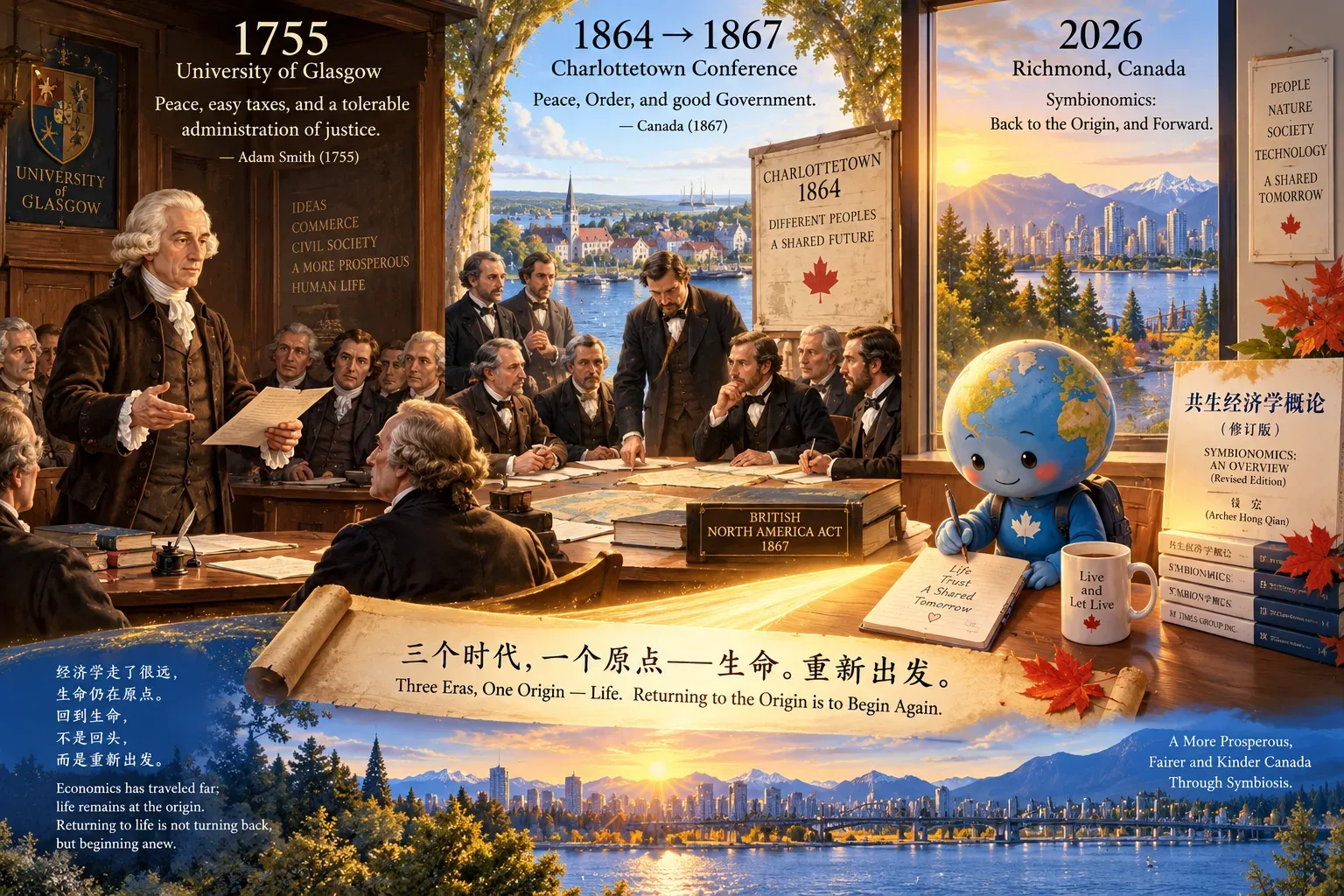
1755年,亚当·斯密把繁荣的“原点”归结为和平、轻税和过得去的司法行政。
1867年,加拿大把 Peace, Order, and good Government 写进立国的宪制语言。
2026年,共生经济学(Symbionomics)继续追问:Good Government的“Good”究竟怎样衡量?Government怎样才能始终向生命负责?
三个时代的“原点”,由此重新相遇。
一、1755:和平、轻税和过得去的司法行政
1755年,距离《国富论》出版还有21年,亚当·斯密已经提出一个极其朴素的繁荣原理:
Peace, easy taxes, and a tolerable administration of justice——和平、轻税和过得去的司法行政。
这一表述由Dugald Stewart后来转述保存下来。斯密认为,一个国家从贫困走向繁荣,最基本的条件就在这里。
为什么首先是和平?
因为没有和平,生命、财产、契约、生产和积累都可能被暴力归零。
为什么要轻税?
因为财富不是政府自己创造出来的。农民播种,工匠制造,商人交易,企业家投资,一个普通人愿意把更多时间投入劳动和创造,财富才会发生。
税收直接作用于这种创造动力。
一个人原本愿意多工作两个小时,却发现多劳动所得的大部分被税费和各种组织成本消耗,他就可能选择:
算了,不加班了。
一家小企业本来准备扩大经营、多雇两个人,算完新增税费、行政、监管和合规成本以后,也可能选择:
算了,不扩大了。
这时候损失的已经不只是一笔税收或者一笔收入,而是原本可以发生的劳动、投资、生产、创新和创造。
损失的是生命的转动力。
所以,“轻税”直接通向经济的生命原点:
让创造者愿意继续创造,让生命保持转动。
过得去的司法行政,则使创造能够进入稳定的社会关系。产权得到保护,契约能够履行,交易具有预期,人不必把大量生命能量消耗在防范、寻租和争夺之中。
斯密的三个原点,由此可以看到同一个东西:
生命创造。
和平保护它,轻税激励它,司法行政保障它。
经济首先发生在哪里?
发生在生命。
二、1867:加拿大把Good Government带进现代国家
112年以后,加拿大建立联邦。
1867年《宪法法》第91条留下了后来极具加拿大辨识度的宪制语言:
Peace, Order, and good Government——和平、秩序与良好政府。
把1755年与1867年放在一起:
Peace — Easy Taxes — Tolerable Administration of Justice
到了:
Peace — Order — Good Government
Peace仍然排在第一位。
但现代国家已经向前走了一大步。政府进入医疗、教育、养老、基础设施、社会保障、环境保护和越来越广泛的公共生活。
政府拥有越来越大的权力,征收越来越多的财政资源,也越来越深入地影响每个人的生活。
一个潜在的问题因此也浮上台平:
什么叫Good Government?
对此,有人半开玩笑地说,加拿大的立国基础这里留下了一个“bug”:
它说要有Good Government,可是,如果Government不再Good,怎么办?
玩笑背后是一个严肃问题。
Government是组织。
Good作为一个形容词,衡量它却必须有标准。
三、从“税务自由日”看一张生活账本
加拿大民间有人把加拿大戏称为“万税国”。
Fraser Institute每年计算一个很有意思的指标——Tax Freedom Day(税务自由日)。
它用一个象征性的日期告诉人们:假定一个平均家庭从1月1日起把全部收入都用于支付联邦、省和地方政府的各种税,到哪一天才算完成全年税负。
2020年是5月19日,2025年是6月8日,2026年到了6月9日。按照该机构2026年的测算,平均加拿大家庭收入166,790加元,总税负72,539加元,占43.5%。这里计算的不是单一的个人所得税,而是试图把不同层级、不同形式的税负放到一张家庭账本上。
日期本身不是最重要的。
重要的是它把一个宏观财政问题翻译成了一句普通人听得懂的话:
一年辛苦创造的收入,有多少交给了政府?
接下来的问题更加重要:
政府拿走以后,又向生命承兑了什么?
这就从“交多少税”进入了“什么是Good Government”。
四、高税收与高福利,必须能够彼此承兑
“高税收—高福利”常常被放在一起。
问题就在这个连接号上。
政府增加税收,意味着从生命创造的成果中取得更多资源;高福利则意味着政府应当把这些资源转化成普通人能够获得的医疗、教育、养老、安全、司法和其他公共价值。
取得与承兑必须相称。
如果税收不断增加,而看病仍然需要漫长等待,住房负担继续增加,企业的税费、行政、监管和合规成本继续增加,普通人为获得公共服务还要付出越来越多时间、金钱和机会,那么“高税收”与“高福利”之间就发生了断裂。
这恰恰又把我们带回亚当·斯密的easy taxes。
税收不仅是政府财政问题,也是生命激励问题。
当一个人发现多劳动、多创造以后增加的收益越来越多地被税收和各种组织成本吸收,他开始计算:
我为什么还要多干?
当越来越多人开始减少劳动、减少投资、减少创业、减少创造,一个社会真正损失的,是生命本来具有的创造力和转动力。
所以,“轻税”不是税务技巧。
它是对生命创造的激励。
五、和平也要回到生命:三重和平
亚当·斯密首先讲Peace。
加拿大宪法首先也讲Peace。
和平之所以是“原点”,因为它不只发生在国家之间。
共生经济学(Symbionomics)把和平展开为三重关系:
一是人与人之间的和平;
二是人与组织之间的和平;
三是组织与组织之间的和平。
人与人能够通过劳动、交换、合作和契约满足需要,而不是通过欺骗、掠夺和暴力,这是和平。
人与政府、企业、学校、平台等组织之间能够形成托付与承兑,而不是陷入汲取与逃避、支配与反抗,这是和平。
组织与组织之间的和平,也包括邻里和平、国际和平与国与国之间的和平。企业与企业、地区与地区、邻国与邻国、国家与国家之间,可以有差异、有竞争,甚至有利益冲突,但能够通过契约、规则、谈判和交互处理差异,而不以毁掉对方作为解决问题的方式,这就是和平。尤其对于山水相连、经济相通、生活相交的邻国,邻里和平本身就是巨大的经济财富。它降低防范、冲突和交易成本,使贸易、投资、人员往来以及几代人形成的生活联系得以持续。一旦邻里关系失去和平,即使没有走到战争,关税、壁垒、敌意与不确定性也会直接消耗双方的生命效能。
战争是和平崩塌最极端的形式。维护国际和平,首先要珍惜邻里和平。和平不是外交的装饰,而是经济繁荣和生命创造不可替代的“原点”。
没有人与人的和平,交易成本上升;没有人与组织的和平,信托瓦解;没有组织与组织、邻国与邻国、国家与国家的和平,财富、契约、信托乃至生命本身都可能被冲突归零。
所以,和平,本身就是经济效能。
六、GDP为什么还不够?
现代经济最熟悉的尺度是GDP(Gross domestic product)。
GDP告诉我们经济活动发生了多少,却没有进一步区分这些活动究竟怎样作用于生命。
修好一条道路,降低物流和通勤成本,会形成GDP;规划失误以后反复挖开、反复修补,也形成GDP。
改善健康会创造价值;疾病增加以后扩大治疗支出,也会增加GDP。
政府提高公共服务效率需要投入;行政层级增加、监管程序膨胀以及企业为了应付这些程序发生的大量合规活动,也会进入经济运行。
和平创造财富;冲突造成破坏以后再救援、再修复、再重建,也产生GDP。
在GDP的加法中,它们都可以被记录;在生命的账本上,它们不能等量齐观。
问题因此从:
增长了多少?
推进到:
这种增长究竟给生命带来了什么?
第三个时代的“原点”,由此发生。
七、GDE:让每一项GDP经过生命效能过滤
共生经济学提出 GDE(Gross Domestic Energy / Efficiency),就是要给GDP增加一道生命效能的过滤。
总公式是:
GDE=(GDPi x ηi)
其中,GDP?代表第 i 项经济活动,η?是这一项经济活动的生命效能系数。
每一项GDP,都先经过η?的过滤。
由降本、赋能、健康、信托、和平增加所形成的增长,与依靠债务、冲突、监管膨胀和反复修补旧问题形成的GDP,不能等量齐观。
η?的生命效能从哪里来?
这就是共生经济学“回到原点再出发”的 C—E—H—T—P五因结构:
降本,释放生命。
减少税费、行政、制度摩擦、交易成本以及时间与机会的无效耗散,把生命能量从组织成本中释放出来。
赋能,激发生命。
教育、资本、科技、制度、组织乃至AI,应当使生命获得更多创造能力,让一个原来做不到的人能够做到,让一种原来不能发生的创造得以发生。
健康,养护生命。
生产最终回到生活。人的身心、家庭、社会与生態是否更加健康,是经济效能必须接受的生命检验。
信托,连接生命。
生命本自具足,又非独存。人与人、人与组织、组织与组织能够履约、验证和承兑,一个生命的创造才能连接另一个生命,减少防范、寻租、诉讼、强制和猜疑造成的巨大耗散。
和平,共襄生命。
三重和平使不同生命和组织能够在差异中连接、竞争、合作和生成,使创造能够持续,而不被冲突归零。
所以,五因最终形成一条清楚的生命效能链:
降本,释放生命;
赋能,激发生命;
健康,养护生命;
信托,连接生命;
和平,共襄生命。
这就是从生命“原点”重新出发。
八、Good Government的“Good”,有标准
现在可以回到1867年的那个问题:
什么才叫Good Government?
共生经济学首先用:
R=GDE/GDP
观察一个经济体已经形成的GDP中,有多少真正转化成为有益于生命的效能。
所以,政府不能只告诉人民GDP增长了多少、财政收入增加了多少、公共支出增加了多少、又建立了多少机构和项目。
还要回答:
降低了多少生命成本?
增加了多少生命赋能?
改善了多少健康?
生成了多少信托?
维护了多少和平?
Good Government不能只是GDP的增加者。
它必须创造GDE。
而Good最终还要落到人民每天的生活体感。
早在2008年提出GDE的同时,我提出:
H=G/T
其中,H(Happiness & Dignity)代表人民的幸福与尊严;G最初代表Good Governance创造的公共价值,后来进一步展开为组织受托所生成的真实公共价值;T(Transaction Cost & Marginal Benefit Cost)代表人民获得公共服务、维护合法权益、实现自身价值和维持正常生活所付出的社会交易成本与边际获益成本。 (钱宏:《共生经济学概论(修订版)》,北美科发出版,2026.9)
这个公式揭示的是一个简单的反比例关系:
在G大体相近的情况下,T越低,H越高;T越高,H越低。
看一次病要等待多久?
孩子接受教育,一个家庭要付出多少?
年轻人创业,需要填写多少表格、办理多少许可、等待多少审批?
一家企业正常经营,需要把多少时间和资源消耗在税务、监管与合规上?
一个普通人维护合法权益,需要付出多少时间、金钱、信息、机会乃至尊严?
这些,就是Good Government每天接受的考试。
于是,亚当·斯密的轻税、加拿大的Good Government与共生经济学的H=G/T终于接在了一起。
Good不是Government自己给自己的形容词。
Good有标准。
政府从生命取得的权力、税收和公共资源,与它最终向生命承兑的公共价值,必须相称。
这正是那个“bug”需要补上的地方。
九、怎样补上这个“bug”?让Government回到Trust
Good有了生命尺度,接下来就要问:
政府为什么能够取得权力?
为什么能够征税?
为什么能够配置公共资源?
因为这一切首先来自生命的托付。
权力受生命之托。
财政受生命之托。
公共资源受生命之托。
Government因此首先应该是一种受托组织。
于是,Good Government的问题便进一步展开:
谁托付?
托付什么?
怎样使用?
向谁承兑?
承兑什么?
怎样验证?
不能承兑,又怎样纠偏?
这就是 Organizational Trust——组织信托。
Organizational Trust把1867年的Good从一个形容词,变成一种可以持续检验的托付—承兑关系。
一句话:
受生命之托,向生命承兑。
这就是让Government重新回到Trust。
也是补上Good Government那个“bug”的关键。
十、三个时代的“原点”:重新出发
现在回头看,三个时代并没有彼此离开。
它们一直沿着同一条线向前展开。
1755年,亚当·斯密回到繁荣的“原点”:和平、轻税、过得去的司法行政。
他的核心问题是:怎样保护、激励和保障生命创造?
1867年,加拿大把Peace、Order和good Government写进自己的立国秩序。
它把生命创造所需要的条件进一步交给现代国家组织。
2026年,共生经济学继续追问Good Government的“Good”如何得到保证。
于是:
GDE=Σ(GDP?×η?),检验增长的生命效能;
C—E—H—T—P五因,让降本、赋能、健康、信托与和平重新作用于生命;
R=GDE/GDP,检验经济增长究竟转化出了多少真实效能;
H=G/T,最终检验人民为了获得公共价值付出了多少社会交易成本与边际获益成本,获得了多少幸福与尊严。
最后,Government回到Trust:
受生命之托,向生命承兑。
三个时代由此重新回到同一个“原点”:
生命。
十一、从“原点”重新出发:共生加拿大
2023年,在温哥华庆祝加拿大国庆156周年暨《排华法案》出台100周年反思的论坛上,我提出:
历史总要翻篇,反思亟需升维:创建一个全新的共生加拿大!
今天重新理解“共生加拿大”,它已经不只是族群之间如何相处的问题。
它首先是生命与组织之间关系的重新建立。
让税收重新成为公共价值的承兑;
让监管降低而不是增加生命创造的成本;
让教育、医疗、科技和AI真正赋能生命;
让人与人、人与组织、组织与组织形成三重和平;
让Government重新成为值得生命托付的组织。
这并不是离开加拿大1867年的立国“原点”。
恰恰是重新回到那个最重要的词:
Good。
斯密把繁荣带回生命创造。
加拿大把现代国家带到Good Government。
共生经济学继续把Good Government带回Organizational Trust。
受生命之托,向生命承兑。
这就是重新出发。
生命本自具足,又非独存。
重建组织信托,让生产回归生活,生活呈现生態,生態激励生命。
回到“原点”,不是回头。
是为了重新出发。
(本文是《共生加拿大》一书第四编第十四、十五章两章内容的综述)
Starting Anew: The “Origin” of Three Eras
—From Adam Smith and Canada’s Founding Constitutional Compact to Organizational Trust in Symbionomics
Archer Hong Qian
Whenever people have traveled a long way, they need to return to the “origin.”
Returning to the origin is not turning back. It is to start anew.
Why does an economy grow? Why does a state exist? Why does a government levy taxes? As government, public finance, regulation, and all kinds of public organizations grow ever larger, the simplest question needs to be asked again:
What is all this ultimately for?
In 1755, Adam Smith traced the “origin” of prosperity to peace, easy taxes, and a tolerable administration of justice.
In 1867, Canada placed “Peace, Order, and good Government” in the constitutional language of its founding.
In 2026, Symbionomics continues the inquiry: How should the “Good” in Good Government be measured? How can Government remain accountable to life?
The “origins” of three eras thus meet again.
I. 1755: Peace, Easy Taxes, and a Tolerable Administration of Justice
In 1755, twenty-one years before The Wealth of Nations was published, Adam Smith had already articulated an exceptionally simple principle of prosperity:
Peace, easy taxes, and a tolerable administration of justice.
This formulation was later preserved in Dugald Stewart’s account. Smith held that these were the most fundamental conditions by which a country could move from poverty toward prosperity.
Why peace first?
Because without peace, life, property, contracts, production, and accumulation can all be reduced to zero by violence.
Why easy taxes?
Because wealth is not created by government itself. Farmers sow, craftsmen make, merchants trade, entrepreneurs invest, and ordinary people devote more of their time to work and creation. That is how wealth comes into being.
Taxes act directly upon this creative drive.
A person may originally be willing to work two extra hours, but if most of the additional earnings are consumed by taxes, fees, and various organizational costs, that person may simply decide:
Forget it. I won’t work overtime.
A small business may be preparing to expand and hire two more people, but after calculating the added taxes, administrative burdens, regulatory requirements, and compliance costs, it too may decide:
Forget it. I won’t expand.
What is lost at that point is no longer merely a tax payment or a sum of income. It is labor, investment, production, innovation, and creation that could otherwise have occurred.
What is lost is life’s power to keep turning.
That is why “easy taxes” lead directly to the living origin of the economy:
Let creators remain willing to create; let life keep turning.
A tolerable administration of justice, meanwhile, enables creation to enter stable social relations. Property rights are protected, contracts can be fulfilled, transactions become predictable, and people need not dissipate vast amounts of life energy on defense, rent-seeking, and struggle.
Smith’s three origins thus point to the same thing:
Life creation.
Peace protects it; easy taxes incentivize it; the administration of justice safeguards it.
Where does the economy first occur?
In life.
II. 1867: Canada Brings Good Government into the Modern State
One hundred and twelve years later, the Canadian federation was established.
Section 91 of the Constitution Act, 1867 left Canada with a constitutional phrase that would become highly distinctive:
Peace, Order, and good Government.
Place 1755 and 1867 side by side:
Peace — Easy Taxes — Tolerable Administration of Justice
became:
Peace — Order — Good Government
Peace still comes first.
But the modern state had taken a major step forward. Government entered healthcare, education, pensions, infrastructure, social security, environmental protection, and an ever-wider range of public life.
Government came to possess greater power, collect more fiscal resources, and affect everyone’s life more deeply.
A latent question therefore surfaced:
What is Good Government?
Some have half-jokingly said that Canada’s founding framework left a “bug” here:
It tells us to have Good Government. But what happens if Government is no longer Good?
Behind the joke lies a serious question.
Government is an organization.
But “Good,” as an adjective, must have a standard by which it can be measured.
III. A Household Ledger Seen Through “Tax Freedom Day”
Some Canadians jokingly call Canada a “country of ten thousand taxes.”
Each year, the Fraser Institute calculates an interesting indicator—Tax Freedom Day.
It uses a symbolic date to tell people this: if an average family devoted all of its income from January 1 onward to paying the various taxes imposed by federal, provincial, and local governments, on what date would it finally have completed its total annual tax burden?
The date was May 19 in 2020, June 8 in 2025, and June 9 in 2026. According to the Institute’s 2026 calculation, the average Canadian family earned C$166,790 and paid C$72,539 in total taxes, or 43.5 percent of its income. This is not a calculation of personal income tax alone; it attempts to place taxes of different kinds and at different levels of government onto a single household ledger.
The date itself is not the most important thing.
What matters is that it translates a macro-fiscal issue into a question ordinary people can readily understand:
Of the income painstakingly created over a year, how much goes to government?
The next question matters even more:
After government takes it, what does government fulfill back to life?
This moves the question from “How much tax do we pay?” to “What is Good Government?”
IV. High Taxes and High Welfare Must Fulfill Each Other
“High taxes—high welfare” are often placed together.
The issue lies precisely in that dash.
When government raises taxes, it takes more resources from the fruits of life’s creation; high welfare means that government should transform those resources into healthcare, education, pensions, security, justice, and other public values accessible to ordinary people.
What is taken and what is fulfilled must correspond.
If taxes continue to rise while medical care still involves long waits, housing burdens continue to increase, taxes, administrative burdens, regulation, and compliance costs for businesses keep rising, and ordinary people must spend ever more time, money, and opportunity to obtain public services, then a rupture has occurred between “high taxes” and “high welfare.”
This brings us directly back to Adam Smith’s easy taxes.
Taxation is not only a question of government finance. It is also a question of incentives for life.
When people find that more and more of the additional return from additional work and additional creation is absorbed by taxes and organizational costs, they begin to ask:
Why should I do more?
When more and more people begin to work less, invest less, start fewer businesses, and create less, what society truly loses is life’s inherent creativity and its power to keep turning.
Thus, “easy taxes” are not a tax technique.
They are an incentive for life to create.
V. Peace Must Also Return to Life: Threefold Peace
Adam Smith begins with Peace.
Canada’s Constitution also begins with Peace.
Peace is an “origin” because it does not exist only between states.
Symbionomics unfolds peace across three relationships:
First, peace between person and person;
Second, peace between people and organizations;
Third, peace between organizations.
When people can meet their needs through work, exchange, cooperation, and contracts rather than through deception, plunder, and violence, that is peace.
When people and organizations such as governments, enterprises, schools, and platforms can form relations of entrustment and fulfillment rather than falling into extraction and evasion, domination and resistance, that is peace.
Peace between organizations also includes peace between neighbors, international peace, and peace between states. Businesses and businesses, regions and regions, neighboring countries and neighboring countries, states and states may differ, compete, and even face conflicts of interest. Yet if they can handle those differences through contracts, rules, negotiation, and interaction rather than by destroying the other side, that is peace. Especially for neighboring countries linked by geography, economies, and everyday life, neighborly peace is itself an enormous form of economic wealth. It reduces the costs of precaution, conflict, and transaction, and enables trade, investment, the movement of people, and patterns of life built across generations to continue. Once neighborly relations lose their peace, even short of war, tariffs, barriers, hostility, and uncertainty directly consume the life effectiveness of both sides.
War is the most extreme form of the collapse of peace. To preserve international peace, we must first cherish peace among neighbors. Peace is not a diplomatic ornament; it is an irreplaceable “origin” of economic prosperity and life creation.
Without peace between people, transaction costs rise; without peace between people and organizations, trust collapses; without peace between organizations, neighboring countries, and states, wealth, contracts, trust, and even life itself may be reduced to zero by conflict.
Peace, therefore, is itself economic effectiveness.
VI. Why Is GDP Not Enough?
The measure most familiar to the modern economy is GDP (Gross Domestic Product).
GDP tells us how much economic activity has occurred, but it does not further distinguish how those activities affect life.
Repairing a road and lowering logistics and commuting costs creates GDP; repeatedly digging it up and repairing it again after planning failures also creates GDP.
Improving health creates value; rising illness followed by greater treatment expenditure also increases GDP.
Government investment to improve the efficiency of public services enters economic activity; so do additional administrative layers, expanding regulatory procedures, and the extensive compliance activity businesses undertake in order to meet them.
Peace creates wealth; rescue, repair, and reconstruction after destruction caused by conflict also generate GDP.
In the arithmetic of GDP, all of these can be recorded. On life’s ledger, they cannot be treated as equivalent.
The question therefore advances from:
How much did the economy grow?
to:
What did this growth actually bring to life?
Here the “origin” of the third era emerges.
VII. GDE: Let Every Unit of GDP Pass Through a Filter of Life Effectiveness
Symbionomics proposes GDE (Gross Domestic Energy / Efficiency) in order to add a filter of life effectiveness to GDP.
The general formula is:
GDE = Σ (GDP? × η?)
Here, GDP? represents the i-th economic activity, and η? is the life-effectiveness coefficient of that activity.
Every component of GDP must first pass through the filter of η?.
Growth generated by cost reduction, empowerment, health, trust, and peace cannot be treated as equivalent to GDP generated by debt, conflict, regulatory expansion, and repeated repairs of old problems.
Where does the life effectiveness represented by η? come from?
This is the C—E—H—T—P five-factor structure through which Symbionomics “returns to the origin and starts anew”:
Cost Reduction: Release Life.
Reduce taxes and fees, administrative burdens, institutional friction, transaction costs, and the ineffective dissipation of time and opportunity, thereby releasing life energy from organizational costs.
Empowerment: Inspire Life.
Education, capital, technology, institutions, organizations, and even AI should give life greater creative capacity—enabling someone to do what previously could not be done, and enabling forms of creation that previously could not occur.
Health: Sustain Life.
Production ultimately returns to life. Whether the body and mind, family, society, and ecology become healthier is a life test that economic effectiveness must pass.
Trust: Connect Life.
Life is self-sufficient in itself, yet never exists alone. Only when people, people and organizations, and organizations with one another can honor commitments, verify, and fulfill value can one life’s creation connect with another, reducing the enormous dissipation caused by precaution, rent-seeking, litigation, coercion, and suspicion.
Peace: Let Life Flourish Together.
Threefold peace enables different lives and organizations to connect, compete, cooperate, and generate amid difference, allowing creation to continue rather than being reduced to zero by conflict.
The five factors therefore form a clear chain of life effectiveness:
Cost Reduction: Release Life;
Empowerment: Inspire Life;
Health: Sustain Life;
Trust: Connect Life;
Peace: Let Life Flourish Together.
This is what it means to return to life’s “origin” and start anew.
VIII. The “Good” in Good Government Has a Standard
We can now return to the question posed in 1867:
What counts as Good Government?
Symbionomics first uses:
R = GDE / GDP
to observe how much of an economy’s existing GDP has actually been transformed into effectiveness beneficial to life.
Government therefore cannot merely tell people how much GDP has grown, how much fiscal revenue has increased, how much public spending has risen, or how many new agencies and projects have been established.
It must also answer:
How much has the cost of life been reduced?
How much has life been empowered?
How much has health improved?
How much trust has been generated?
How much peace has been preserved?
Good Government cannot merely be an augmenter of GDP.
It must create GDE.
And ultimately, “Good” must be grounded in people’s everyday experience of life.
As early as 2008, when I proposed GDE, I also proposed:
H = G / T
Here, H (Happiness & Dignity) represents people’s happiness and dignity; G originally represented the public value created by Good Governance and was later further developed to mean the real public value generated through organizational entrustment; T (Transaction Cost & Marginal Benefit Cost) represents the social transaction costs and marginal-benefit costs that people bear in obtaining public services, protecting their lawful rights and interests, realizing their own value, and maintaining normal life. (Archer Hong Qian, Symbionomics: An Overview, Revised Edition, KF Times Group, September 2026.)
The formula reveals a simple inverse relationship:
When G is broadly comparable, the lower T is, the higher H becomes; the higher T is, the lower H becomes.
How long must one wait to see a doctor?
How much must a family pay for a child’s education?
How many forms must a young entrepreneur fill out, how many permits obtain, and how many approvals await?
How much time and how many resources must an ordinary business devote to taxation, regulation, and compliance simply to operate normally?
How much time, money, information, opportunity, and even dignity must an ordinary person spend to protect lawful rights and interests?
These are the tests Good Government takes every day.
Thus Adam Smith’s easy taxes, Canada’s Good Government, and Symbionomics’ H = G/T are finally connected.
Good is not an adjective Government bestows upon itself.
Good has a standard.
The power, taxes, and public resources that government receives from life must correspond to the public value it ultimately fulfills back to life.
This is precisely where the “bug” needs to be fixed.
IX. How Do We Fix This “Bug”? Let Government Return to Trust
Once Good has a life-centered standard, the next questions are:
Why can government exercise power?
Why can it levy taxes?
Why can it allocate public resources?
Because all of these begin with entrustment from life.
Power is entrusted by life.
Public finance is entrusted by life.
Public resources are entrusted by life.
Government should therefore first be understood as an entrusted organization.
The question of Good Government then unfolds further:
Who entrusts?
What is entrusted?
How is it used?
To whom must fulfillment be made?
What must be fulfilled?
How is fulfillment verified?
If fulfillment fails, how is correction made?
This is Organizational Trust.
Organizational Trust turns the Good of 1867 from an adjective into a continuously testable relationship of entrustment and fulfillment.
In one sentence:
Entrusted by life, accountable to life through fulfillment.
This is what it means for Government to return to Trust.
It is also the key to fixing the “bug” in Good Government.
X. The “Origin” of Three Eras: Starting Anew
Looking back now, the three eras have never truly been separate.
They have been unfolding forward along the same line.
In 1755, Adam Smith returned to the “origin” of prosperity: peace, easy taxes, and a tolerable administration of justice.
His central question was: How can life creation be protected, incentivized, and safeguarded?
In 1867, Canada placed Peace, Order, and good Government into its founding order.
It further entrusted the conditions required for life creation to the modern state organization.
In 2026, Symbionomics continues to ask how the “Good” in Good Government can be assured.
Thus:
GDE = Σ (GDP? × η?) tests the life effectiveness of growth;
The C—E—H—T—P five factors bring cost reduction, empowerment, health, trust, and peace back into their effects on life;
R = GDE/GDP tests how much economic growth has actually been transformed into real effectiveness;
H = G/T ultimately tests how much social transaction cost and marginal-benefit cost people must bear to obtain public value, and how much happiness and dignity they receive.
Finally, Government returns to Trust:
Entrusted by life, accountable to life through fulfillment.
The three eras thus return to the same “origin”:
Life.
XI. Starting Anew from the “Origin”: A Symbiotic Canada
In 2023, at a Vancouver forum marking Canada’s 156th anniversary and reflecting on the 100th anniversary of the Chinese Exclusion Act, I proposed:
History must eventually turn the page; reflection urgently needs to rise to a higher dimension: Create a new Symbiotic Canada!
Today, when we rethink “Symbiotic Canada,” it is no longer only a question of how ethnic groups live with one another.
It is first of all a rebuilding of the relationship between life and organizations.
Let taxation once again become the fulfillment of public value;
Let regulation reduce, rather than increase, the cost of life creation;
Let education, healthcare, technology, and AI truly empower life;
Let peace take shape in three relationships: between people, between people and organizations, and between organizations;
Let Government once again become an organization worthy of life’s entrustment.
This does not depart from Canada’s founding “origin” of 1867.
It is precisely a return to its most important word:
Good.
Smith brought prosperity back to life creation.
Canada brought the modern state to Good Government.
Symbionomics continues by bringing Good Government back to Organizational Trust.
Entrusted by life, accountable to life through fulfillment.
This is starting anew.
Life is self-sufficient in itself, yet never exists alone.
Rebuild Organizational Trust: let production return to life, life manifest ecology, and ecology inspire life.
Returning to the “origin” is not turning back.
It is to start anew.
(This essay is an overview of Chapters 14 and 15 in Part IV of the book Symbiotic Canada.)