真的“不能输在AI起跑线上”吗?
真的“不能输在AI起跑线上”吗?
Do We Really “Have to Win at the AI Starting Line”?
——谈谈从 AI for All 到 AI for Life
— Some Thoughts on Moving from AI for All to AI for Life
钱 宏(Archer Hong Qian)
三月:温哥华AI高峰论坛
今年3月13、14日,我参加了在喜来登举行的“温哥华AI高峰论坛”。
会场很热闹。人工智能正在以前所未有的速度进入企业、教育、金融、医疗和普通人的生活。大家谈应用、谈效率、谈机会,谈怎样赶上这一轮AI浪潮。
置身其中,我却越来越强烈地感觉到:当所有人都在谈怎样赶上AI的时候,我们是不是已经悄悄接受了一个新的时代暗示——
不能输在AI起跑线上?
AI当然要应用。但在问“怎样赶上AI”之前,是不是还应该先问一个更根本的问题:
AI究竟为了什么?
半年以后再回头看,我越来越觉得,这两个问题之间其实隔着一层很深的时代焦虑:我们一方面担心AI发展太快,害怕它失控、不可控以及种种不确定性给人类带来危害;另一方面又唯恐自己、自己的孩子、企业乃至国家追不上AI。
一边害怕AI跑得太快,一边又害怕自己追不上AI。
这或许正是今天AI热潮中一个值得认真辨识的心理背景。
这个问题并非始于今天。
从2022年底OpenAI的ChatGPT初兴,我就开始与一些年轻朋友讨论AI哲学。随着讨论深入,我越来越意识到:今天所谓“人工智能”的问题,已经远远装不进1956年达特茅斯会议留下来的那个AI老瓶子。
AI面临的,不只是数据、算法、算力和神经网络怎样继续发展的问题。
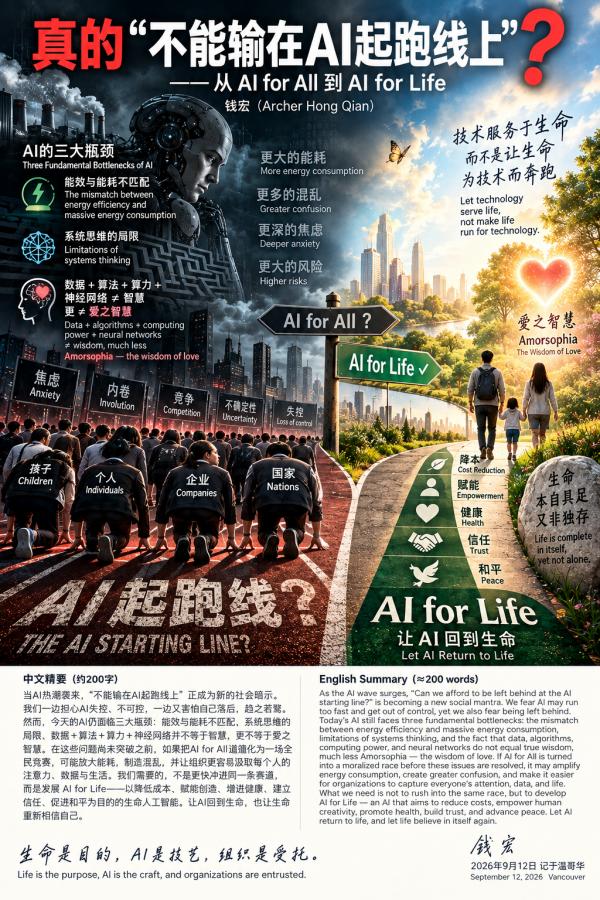
我把它概括为AI至今尚未突破的三大瓶颈:
第一,能效与能耗不匹配;
第二,系统思维的局限;
第三,数据+算法+算力+神经网络≠智慧,更≠愛之智慧。
更重要的是:当AI与AI开始协同,当超强工具进入人的工作、教育、医疗、金融乃至日常生活,它与生命(LIFE)是什么关系?与掌握平台、规则、数据和权力的组织(TRUST)又是什么关系?
AI一开始就不只是AI的单一问题。
六月:从“可信AI”继续追问
6月5日,我又偶然代朋友参加了Canada International Trade Promotion Society主办的AI论坛。
论坛组织得顺畅有序,很成功。我见到了许多老朋友,也结识了几位新朋友,很开心。老朋友华美嘉主持AI圆桌会议,很有趣。
我特别仔细听了王泽华教授当天唯一的一场专题演讲。泽华兄是我很喜欢的一位忘年交。2022年底ChatGPT刚刚兴起,我们就一起讨论AI哲学;去年初,他还主持过我讲AM的闭门会议。
所以,我很高兴看到他仍然坚守“可信AI”和“AI生态共生”的方向。
但我也有些遗憾。
泽华兄专长区块链。区块链对于规范“可信AI”、推动AI生态协作当然有意义,但它不可能因此成为AI的根本基础设施。因为区块链既解决不了上述AI三大瓶颈,也解决不了AI及AI协同超强工具可能对LIFE的反噬,更解决不了组织利用AI反向汲取生命的问题。
真正需要面对的,是:
LIFE(生命)—AI(智能)—TRUST(组织信托)如何交互契合共生?
也正是在那一天,加拿大政府刚刚发布 AI for All 战略。
我当时表示热烈欢迎,并给有关方面写了一份可以先做三件事的报告,同时再次呼吁,在AI概念确立整整70年之际,召开一次集思广益的:
新达特茅斯会议:AI(1956)—AM(2026)。
那时候,我对 AI for All 的主要担忧,还是AI自身存在如此多的不确定性,就一窝蜂鼓动普及应用,尤其是大量单一定制应用,会不会太快?
任何伟大发明最终当然都应该让普通人能够低门槛使用。
但是,AI与电不同。
电是人类发现并加以利用的一种自然存在;AI却是人类这种特殊生命创造出来的人工智能工具,而且具有学习、生成、交互、替代乃至影响人的判断与行为的能力。
因此,不能简单沿用“电气化”的历史经验,把“AI全民化”天然理解为又一次“技术平权”。
九月:为什么“All”让我重新警觉?
三个多月过去。
今天,我又看到:
“AI for All Summit 2026 · 58AI应用大型论坛。”
宣传语很动人:
“时代向前,与新的可能相逢!”
呵呵,我突然冒出一个问题:
全民的机会?还是组织首脑的机会?
为什么 AI for All 还需要一场又一场Summit来鼓动所有人赶快进入?
这使我想起一个曾经影响无数中国家庭的口号:
“不能让孩子输在起跑线上。”
这句话开始时有什么错呢?
为了孩子好,让孩子接受更好的教育,有什么不好?
问题恰恰发生在“为了所有孩子好”逐渐被道德化以后。
别人家的孩子学了,你的孩子能不学吗?别人报三个班,你敢只报一个吗?别人已经跑起来,你还能允许自己的孩子慢慢走吗?
于是,道德化进一步变成了裹挟化。
没有一个家长单独决定要毁掉孩子的童年,可当所有人都害怕“输在起跑线上”,所有家庭便共同制造了一条越来越拥挤、越来越提前的赛道。
童年就这样被吞噬了。
今天的 AI for All,会不会复制同一种逻辑?
别人已经使用AI,你还不用?
别的公司已经AI化,你还不AI化?
一个员工借助AI一天完成过去三天的工作,其他员工怎么办?
一家企业把效率提高30%,竞争者怎么办?
于是:
AI普及 → AI道德化 → AI裹挟化 → AI全民竞赛。
昨天是:
“不能输在教育起跑线上。”
明天很可能变成:
“不能输在AI起跑线上。”
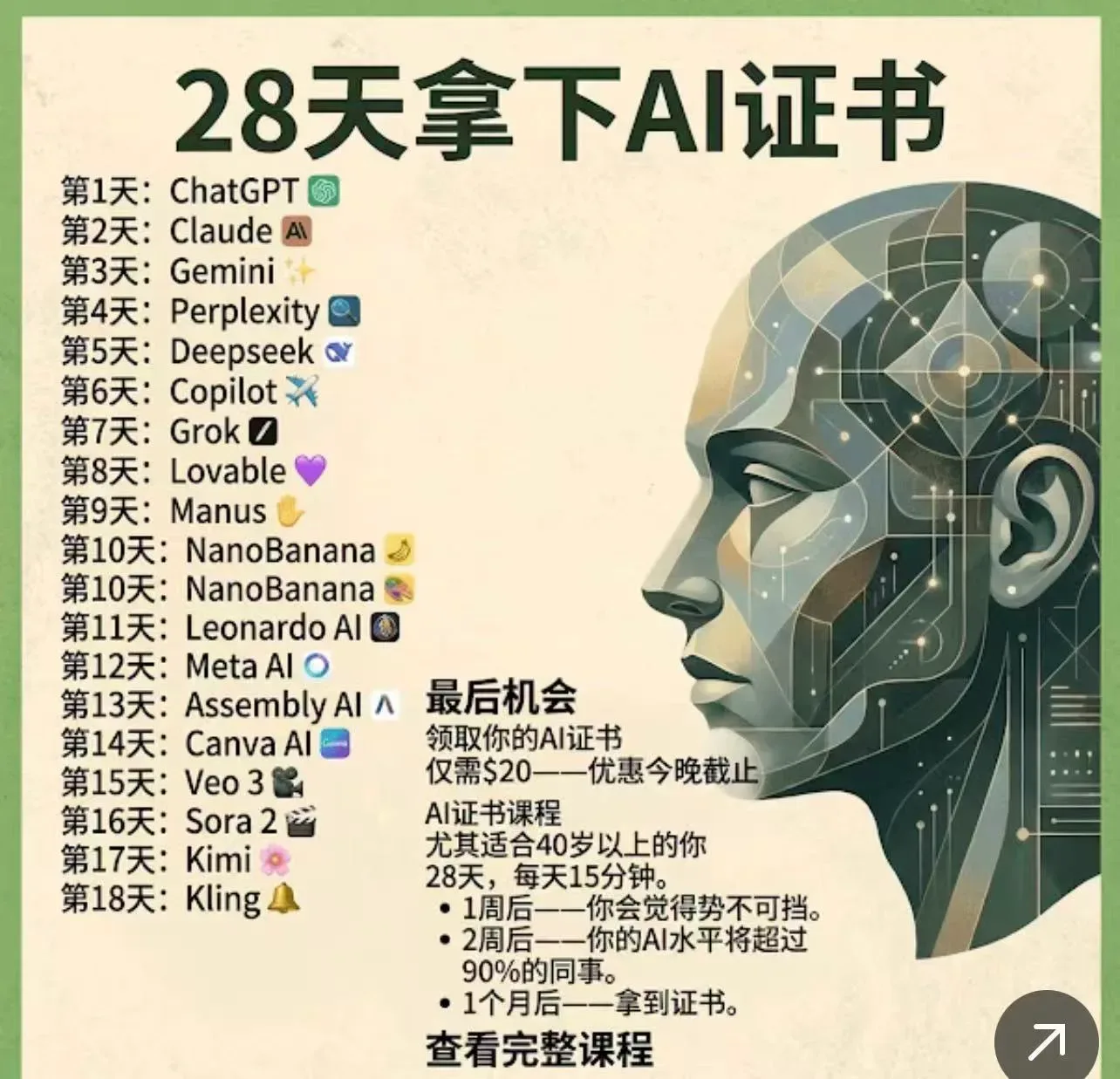
这并非假想。就在写这篇文章时,我又看到YouTube上一则“28天拿下AI证书”的广告,赫然写着:
“最后机会。”
它还许诺:“两周后,你的AI水平将超过90%的同事”,并特别注明“尤其适合40岁以上的你”。
“最后”两个字很值得玩味。
1871年巴黎公社失败后,欧仁·鲍狄埃写下《国际歌》:“这是最后的斗争……”155年过去了,历史并没有终结,人类当然也没有只剩那一次“最后机会”。
从革命、战争到今天的商业营销,“最后关头”“最后机会”“不能再等”,反复成为一种情绪动员方式:
看似激进,内里却隐藏着悲观;把未来说得越来越危险,把当下说成唯一机会,于是让人来不及从容判断,只能赶快跟上。
而这里还有一个组织问题:
谁在宣布“最后机会”,谁又从大家的紧迫行动中获益?
过去可能是以“最后斗争”动员人们,今天则可能是用“最后机会”出售课程、证书、平台和流量。
形式变了,机制却似曾相识:
制造紧迫 → 放大焦虑 → 形成裹挟 → 转化为组织机会。
所以,“不能输在AI起跑线上”甚至不需要谁正式宣布。只要不断告诉你:
别人已经跑了,这是最后机会。
人们便可能战战兢兢、争先恐后、趋之若鹜。
真正需要警惕的,是这种看似激进、实则悲观,最终又可能被组织机会主义利用的时代心理。
真的有一条“AI起跑线”吗?
但是,还必须继续追问:
我们今天所谓“不能输在AI起跑线上”,这个“AI起跑线”究竟在哪里?
如果今天的AI已经突破了自身的根本瓶颈,只是等待人们学习、掌握和应用,那么让更多人尽快使用AI,当然有它的道理。
问题是,今天的AI恰恰仍然遭遇着三大瓶颈:
第一,能效与能耗不匹配;第二,系统思维的局限;第三,数据+算法+算力+神经网络≠智慧,更≠愛之智慧。
这三个瓶颈并不会因为AI应用越来越广泛而自动消失。
恰恰相反,如果在这些瓶颈尚未突破的时候,就把 AI for All 道德化为一场“全民不能输”的竞赛,那么全民化所放大的,就不只是AI的能力,也包括AI自身尚未解决的问题。
一个本来就面临能效与能耗不匹配的AI,如果进入全民、全行业、全天候应用,需要消耗多少能源和社区生活用电?
当每个人、每个企业、每个组织都唯恐落后而不断增加模型调用、算力和应用,“全民AI”究竟是在降本,还是可能制造越来越庞大的能源、社会成本和天量浪费?
一个仍然受制于系统思维局限的AI,如果被大规模嵌入教育、医疗、金融、企业管理乃至公共治理,它的局限就不再只是一个模型回答错了一道题,而可能被同步放大到人与人、人与组织以及组织与组织之间的摩擦。
局部的偏差经过系统化、规模化和相互强化,完全可能生成更大的混乱。
更根本的是:
数据+算法+算力+神经网络≠智慧。
AI可以拥有越来越强大的Intelligence,却仍然不是人的Mind,更不等于Amorsophia——愛之智慧。
如果我们忘记这个边界,却因为害怕“输在AI起跑线上”,争先恐后地把越来越多的判断、选择、工作、教育、医疗、金融乃至生活本身交给AI,那么问题就远远不只是AI会不会抢走几个工作岗位,也不只是成年人会不会像孩子一样被新一轮竞赛吞噬生活。
我们可能是在把一个自身根本瓶颈尚未突破的人工智能,提前扩张为整个社会的生活基本態。
这才是“AI起跑线”真正需要警惕的地方。
所谓起跑线,本来意味着跑得越早越好、越快越好。一旦接受这个隐喻,人们自然就会问:
别人已经跑了,我为什么还不跑?
可是,如果连赛道通向哪里、脚下的路是否可靠、奔跑本身要付出什么代价都还没有弄清楚,那么真正理性的选择,未必是抢跑。
有时候,停在起跑线上把问题看清楚,本身就是一种进步。
一边怕AI,一边追AI
这也使今天的AI焦虑呈现出一种奇特的两面性。
一边害怕AI跑得太快,一边又害怕自己追不上AI。
一方面,人们担心AI失控、不可控,担心它的不确定性,甚至担心AI最终反噬人类;另一方面,人们又害怕别人先用AI、企业先用AI、别的国家先发展AI,自己稍一迟疑便会被时代甩在后面。
于是,人们战战兢兢,争先恐后,趋之若鹜。
“不能输在起跑线上”,曾经制造的是一种知识焦虑、智能焦虑:生怕自己的孩子知识学得不够多、不够早,智能开发得不够快。
到了AI时代,这种焦虑并没有消失,而是进一步变成了AI焦虑。
这里面还有一个更深的问题:
我们是不是越来越失去了对生命自身的信心?
生命本自具足,又非独存。
一个对生命具有基本信心的人,并不因此拒绝技术、拒绝变化、拒绝不确定性。恰恰相反,他可以拥抱变化、学习新技术、进入新的关系,却不必因为别人都在跑,就跟着所有人一起跑;也不必因为不知道明天会发生什么,就把今天的生活先抵押出去。
生命的自信,使人能够拥抱不确定性,而不被不确定性裹挟。
“All”从来不是天然的道德词
问题因此又深入了一层。
All,从来不是一个天然的道德词。
Stock Trading for All听起来同样很好:过去只有少数人能够参与证券投资,现在普通人一部手机就可以开户、交易、投资。
这是技术平权的一面。
可是,当全民都进入交易场以后,还必须再问:
谁掌握平台?
谁制定规则?
谁拥有信息优势?
谁获得数据?
谁从每一次交易、每一个流量、每一种焦虑中获益?
于是,一个非常值得警惕的组织机制出现了:
“让所有人参与”,同时意味着“让所有人成为组织可以触达的对象”。
AI尤其如此。
AI一旦进入所有人的工作、消费、医疗、教育、金融、娱乐和私人生活,组织得到的就不只是“服务所有人”的能力,同时也可能得到前所未有的识别、计算、预测、诱导、配置乃至汲取所有人的能力。
数字时代的殖官主义,甚至不再需要命令你。
它只需要让你害怕不参加。
一旦“不能输在AI起跑线上”成为新的社会暗示,人们便会战战兢兢、争先恐后、趋之若鹜;而当人人趋之若鹜,All也就可能从普惠的愿望,悄然变成组织汲取的入口。
从 AI for All 到 AI for Life
半年三次AI论坛,让一个问题逐渐清楚起来。
3月,我问:
AI能够做这么多事情,可AI究竟为了什么?
6月,我进一步问:
在AI自身瓶颈尚未突破、LIFE—AI—TRUST关系尚未理顺的时候,一窝蜂普及AI,会不会制造新的风险?
到了9月,问题又向前走了一步:
当AI for All被道德化、裹挟化以后,“全民赋能”会不会反过来成为组织机会主义的新入口?
现在还需要再加上一问:
当我们一边恐惧AI、一边又争先恐后地追赶AI的时候,我们究竟是在驾驭技术,还是已经被自己的时代焦虑所驾驭?
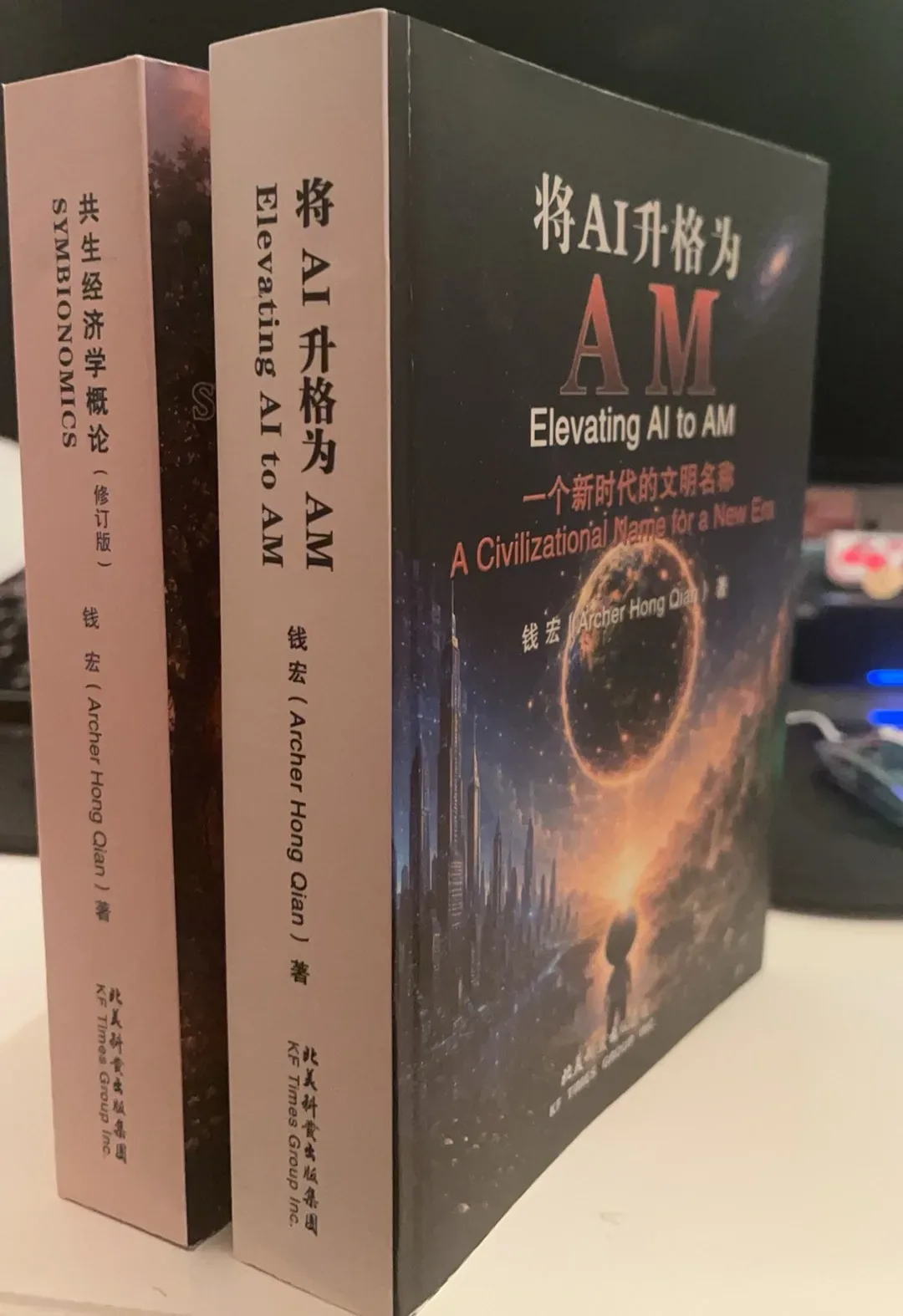
于是,从刚刚出版的《将AI升格为AM》出发,我越来越愿意提出另一个方向:
发展 AI for Life——生命人工智能。
这不是反对AI普及。
AI最终当然应该成为普通人都能够方便使用的工具。
但是:
All 是覆盖尺度,Life 是目的尺度。
如果一个自身还遭遇三大瓶颈的AI被迅速全民化、全行业化、生活基础设施化,那么它放大的不仅可能是效率,也可能同时放大能耗、系统局限、智能幻觉、组织汲取与社会焦虑。
所以,衡量AI进步,不能只看多少人使用AI、多少企业采用AI、AI创造多少GDP,更应该问:
它有没有降低生命的成本?
有没有真正赋能人的创造?
有没有把时间还给人?
有没有促进健康?
有没有增进信任?
有没有减少冲突、促进和平?
也就是我在共生经济学中一直强调的:
C——降本
E——赋能
H——健康
T——信任
P——和平
AI如果不能最终回到这些生命尺度,“全民AI”本身并不构成文明进步。
这也使从AI走向AM的方向更加清楚。
我们需要探索的,不是怎样制造一个更加无所不能的Artificial Intelligence,更不是怎样让所有生命更快进入同一场AI竞赛,而是怎样让AI进入 LIFE—AI—TRUST 的交互契合共生,使技术重新接受生命目的和组织信托的检验。
生命是目的,AI是技艺,组织是受托。
1956年,达特茅斯会议为一个新生事物命名:
Artificial Intelligence。
70年后的今天,也许到了重新追问的时候:
人工智能,究竟为什么而智能?
我的回答越来越简单:
AI for Life.
让AI回到生命,也让生命重新相信自己。
也许,人类需要一新的文明命名:
AM(Artificial Mind & Amorsophia MindsField/Network)!
真正值得发展的AI,不应该制造一条逼迫所有生命争先恐后、趋之若鹜的“起跑线”,而应该帮助生命降低成本、释放创造、恢复时间、增进健康与信任,并让人有更大的从容去面对一个本来就充满不确定性的未来。
继吞噬孩子们的童年之后,我们没有必要再以AI的名义,吞噬成年人的生活;更不能因为害怕输在所谓“AI起跑线上”,把人类生活本身交给一个尚未突破自身根本瓶颈的AI。
AI哲学教练孞烎
2026年9月12日记于温哥华
Do We Really “Have to Win at the AI Starting Line”?
— Some Thoughts on Moving from AI for All to AI for Life
Archer Hong Qian
March: The Vancouver AI Summit
On March 13 and 14 this year, I attended the Vancouver AI Summit held at the Sheraton.
The venue was lively. Artificial intelligence is entering business, education, finance, healthcare, and everyday life at unprecedented speed. People talked about applications, efficiency, opportunities, and how to catch up with the latest wave of AI.
Yet as I sat there, I felt an increasingly strong unease: when everyone is talking about how to catch up with AI, have we already, almost without noticing it, accepted a new message of our time—
We cannot afford to lose at the AI starting line?
Of course AI should be applied. But before asking how to catch up with AI, shouldn’t we first ask a more fundamental question:
What is AI ultimately for?
Looking back six months later, I increasingly feel that between these two questions lies a deep anxiety of our age. On the one hand, we worry that AI is developing too fast. We fear that it may get out of control, become uncontrollable, or bring all kinds of uncertainty and harm to humanity. On the other hand, we fear that we ourselves, our children, our companies, or even our countries may fail to keep up with AI.
We fear that AI may run too fast, while at the same time fearing that we may not be able to catch up with it.
This may be one of the psychological undercurrents of today’s AI boom that deserves serious attention.
This question did not begin today.
When OpenAI’s ChatGPT first emerged at the end of 2022, I began discussing the philosophy of AI with several younger friends. As those conversations deepened, I became increasingly convinced that what we now call “artificial intelligence” can no longer fit inside the old AI bottle left to us by the 1956 Dartmouth Conference.
The challenge facing AI is not simply how data, algorithms, computing power, and neural networks can continue to advance.
I have summarized AI’s still-unresolved problems as three fundamental bottlenecks:
First, the mismatch between energy efficiency and energy consumption;
second, the limitations of systems thinking;
third, data + algorithms + computing power + neural networks ≠ wisdom, much less Amorsophia—the Wisdom of Love.
More importantly, when AI begins to collaborate with AI, and when increasingly powerful tools enter human work, education, healthcare, finance, and everyday life, what is their relationship with LIFE? And what is their relationship with the organizations that control platforms, rules, data, and power—the realm of TRUST?
From the very beginning, AI has never been merely a question of AI alone.
June: Continuing the Inquiry from “Trustworthy AI”
On June 5, I happened to attend an AI forum organized by the Canada International Trade Promotion Society on behalf of a friend.
The forum was smoothly organized and highly successful. I met many old friends and also made several new ones, which made me very happy. My old friend Meijia Hua moderated an AI roundtable, which I found particularly interesting.
I listened especially carefully to Professor Zehua Wang’s presentation, the only dedicated keynote lecture of the day. Zehua is a younger friend whom I value greatly. When ChatGPT first emerged at the end of 2022, we were already discussing the philosophy of AI together. Early last year, he also chaired a closed-door meeting at which I spoke about AM.
I was therefore very pleased to see him continuing to pursue “trustworthy AI” and “AI ecological symbiosis.”
But I also felt some regret.
Zehua’s expertise is blockchain. Blockchain certainly has value in helping regulate trustworthy AI and promote cooperation within an AI ecosystem, but it cannot therefore become the fundamental infrastructure of AI. Blockchain cannot resolve the three bottlenecks described above. Nor can it resolve the possible backlash against LIFE from AI and AI-coordinated super-tools. Still less can it prevent organizations from using AI to extract value from life in reverse.
The deeper question we must face is:
How can LIFE—AI—TRUST interact, align, and coexist symbiotically?
It happened that on that same day, the Canadian government had just announced its AI for All strategy.
I welcomed it enthusiastically and wrote to relevant parties with a report proposing three initiatives that could be undertaken first. At the same time, I renewed my call, on the seventieth anniversary of the establishment of the AI concept, for a gathering of minds:
A New Dartmouth Conference: AI (1956)—AM (2026).
At that time, my main concern about AI for All was still this: with so many uncertainties within AI itself unresolved, might we be moving too fast by encouraging a rush toward universal application, especially through large numbers of narrowly customized AI applications?
Every great invention should ultimately become accessible to ordinary people with low barriers.
But AI is not electricity.
Electricity is a natural phenomenon that human beings discovered and learned to harness. AI, by contrast, is an artificial-intelligence tool created by human beings as a distinctive form of life. It can learn, generate, interact, substitute for human functions, and even influence human judgment and behavior.
We therefore cannot simply repeat the historical experience of electrification and assume that the universalization of AI is inherently another form of technological democratization.
September: Why Did “All” Make Me Uneasy Again?
More than three months passed.
Today, I saw another announcement:
“AI for All Summit 2026 · 58AI Applications Forum.”
Its promotional line was appealing:
“The times move forward—meet new possibilities!”
I chuckled, and suddenly a question came to mind:
An opportunity for everyone? Or an opportunity for organizational leaders?
Why does AI for All still require summit after summit encouraging everyone to rush in?
It reminded me of a slogan that once profoundly influenced countless Chinese families:
“Don’t let your child lose at the starting line.”
What was wrong with that sentence at the beginning?
Parents wanted what was best for their children. What could be wrong with wanting them to receive a better education?
The problem emerged precisely when “doing what is best for every child” gradually became moralized.
Other children are studying—can yours afford not to?
Other children are taking three extracurricular classes—do you dare enroll yours in only one?
Other children have already started running—can you still allow your child simply to walk?
Moralization gradually turned into coercive social pressure.
No individual parent deliberately decided to destroy childhood. Yet once everyone became afraid of “losing at the starting line,” families collectively created a track that began earlier and earlier and became more and more crowded.
Childhood was swallowed up in the process.
Could AI for All reproduce the same logic?
Others are already using AI—can you afford not to?
Other companies are already becoming AI-driven—can yours remain outside?
If one employee can use AI to accomplish in one day what once took three, what happens to everyone else?
If one company raises its efficiency by 30 percent, what happens to its competitors?
And so:
AI Adoption → AI Moralization → AI Coercion → An AI Race for Everyone.
Yesterday it was:
“Don’t lose at the educational starting line.”
Tomorrow it may become:
“Don’t lose at the AI starting line.”
This is not merely hypothetical.
While writing this essay, I came across an advertisement on YouTube promising an “AI Certificate in 28 Days.”
In bold letters it declared:
“Last Chance.”
It also promised: “After two weeks, your AI skills will surpass those of 90% of your colleagues,” adding that the course was “especially suitable for people over 40.”
Those two words—“last chance”—are worth pondering.
After the defeat of the Paris Commune in 1871, Eugène Pottier wrote in The Internationale: “This is the final struggle…”
One hundred and fifty-five years have passed. History did not end, and humanity certainly did not have only that one “last chance.”
From revolution and war to commercial marketing today, phrases such as “the final moment,” “last chance,” and “there is no time to wait” have repeatedly served as forms of emotional mobilization:
They sound radical, yet conceal a pessimistic premise. The future is portrayed as increasingly dangerous, while the present is declared the only remaining opportunity—leaving people no time for calm judgment and pushing them simply to hurry and catch up.
And here another organizational question arises:
Who is declaring the “last chance”—and who benefits when everyone acts under a sense of urgency?
In the past, people might have been mobilized in the name of a “final struggle.” Today, “last chance” may be used to sell courses, certificates, platforms, and traffic.
The form has changed, but the mechanism looks strangely familiar:
Manufacture urgency → Amplify anxiety → Create coercive momentum → Convert it into organizational opportunity.
So “Don’t lose at the AI starting line” does not even need to be formally proclaimed.
People only need to hear repeatedly:
Everyone else has already started running. This is your last chance.
Then they may become anxious and apprehensive, rush forward competitively, and flock toward it en masse.
What truly deserves our attention is precisely this psychology of the age: radical in appearance, pessimistic underneath, and ultimately vulnerable to exploitation by organizational opportunism.
Is There Really an “AI Starting Line”?
But we must keep asking:
Where exactly is this “AI starting line” that we are supposedly not allowed to lose at?
If today’s AI had already overcome its fundamental bottlenecks and were simply waiting for people to learn, master, and apply it, then encouraging more people to adopt AI quickly would make considerable sense.
But today’s AI still confronts those same three bottlenecks:
First, the mismatch between energy efficiency and energy consumption;
second, the limitations of systems thinking;
third, data + algorithms + computing power + neural networks ≠ wisdom, much less Amorsophia—the Wisdom of Love.
These bottlenecks do not disappear simply because AI applications become more widespread.
Quite the opposite.
If AI for All is moralized into a race that “everyone must win” before these bottlenecks have been overcome, universalization may scale not only AI’s capabilities but also the unresolved problems within AI itself.
If AI already faces a mismatch between energy efficiency and energy consumption, what happens when it becomes an all-population, all-industry, always-on application? How much energy—and how much electricity needed for ordinary community life—will it consume?
When every individual, company, and organization continually increases model usage, computing power, and AI applications for fear of falling behind, is “AI for All” truly reducing costs—or could it generate ever-larger energy and social costs, together with enormous waste?
If AI remains constrained by the limitations of systems thinking, what happens when it is embedded at scale into education, healthcare, finance, corporate management, and even public governance?
Its limitations would no longer amount merely to a model giving a wrong answer to a single question. They could be amplified into friction between people, between people and organizations, and among organizations themselves.
Local deviations, once systematized, scaled, and mutually reinforced, could generate much greater disorder.
More fundamentally:
Data + algorithms + computing power + neural networks ≠ wisdom.
AI may possess increasingly powerful Intelligence, yet it is still not the human Mind, much less Amorsophia—the Wisdom of Love.
If we forget this boundary and, out of fear of “losing at the AI starting line,” rush to hand over more and more of our judgment, choices, work, education, healthcare, finance, and ultimately life itself to AI, then the issue goes far beyond whether AI will eliminate certain jobs.
It also goes far beyond whether adults, like children before them, will have their lives swallowed by another competitive race.
We may be prematurely expanding an artificial intelligence that has not yet overcome its own fundamental bottlenecks into a basic state of social life itself.
That is the deeper danger hidden inside the metaphor of the “AI starting line.”
A starting line implies that earlier is better and faster is better. Once we accept the metaphor, the next question seems obvious:
If everyone else has already started running, why am I still standing here?
But if we do not yet know where the track leads, whether the ground beneath us is sound, or what price the race itself may demand, then the rational choice is not necessarily to sprint first.
Sometimes, remaining at the starting line long enough to understand the problem is itself a form of progress.
Fearing AI While Chasing AI
This reveals a peculiar duality in today’s AI anxiety.
We fear that AI may run too fast, while at the same time fearing that we may not be able to catch up with it.
On one side, people fear that AI may become uncontrollable, fear its uncertainties, and even fear that it may ultimately turn against humanity.
On the other, they fear that someone else will adopt AI first, another company will move first, another country will advance first—and that any hesitation will leave them behind.
So people become anxious and apprehensive, compete to move first, and rush toward AI en masse.
“Don’t lose at the starting line” once generated a form of knowledge anxiety and intelligence anxiety: the fear that one’s children were not learning enough, not learning early enough, or not developing their intelligence quickly enough.
In the AI age, that anxiety has not disappeared.
It has developed further into AI anxiety.
And beneath it lies an even deeper question:
Are we gradually losing confidence in life itself?
Life is self-sufficient in itself, yet never exists alone.
A person with basic confidence in life does not therefore reject technology, change, or uncertainty.
Quite the contrary. Such a person can embrace change, learn new technologies, and enter new relationships without feeling compelled to run simply because everyone else is running. Nor must one mortgage today’s life merely because tomorrow remains uncertain.
Confidence in life allows us to embrace uncertainty without being coerced by uncertainty.
“All” Is Not Inherently a Moral Word
The question now goes one step deeper.
“All” is not inherently a moral word.
“Stock Trading for All” sounds equally appealing. In the past, only a relatively small number of people could participate in securities investment. Today, an ordinary person can open an account, trade, and invest through a smartphone.
That is one side of technological democratization.
But once everyone enters the trading arena, other questions must be asked:
Who controls the platform?
Who makes the rules?
Who possesses the informational advantage?
Who acquires the data?
Who benefits from every transaction, every stream of traffic, and every form of anxiety?
A potentially troubling organizational mechanism then appears:
“Allowing everyone to participate” can simultaneously mean “making everyone reachable by organizations.”
AI intensifies this possibility.
Once AI enters everyone’s work, consumption, healthcare, education, finance, entertainment, and private life, organizations gain not only an unprecedented capacity to “serve everyone,” but potentially an unprecedented capacity to identify, calculate, predict, influence, allocate—and extract from—everyone.
In the digital age, Bureaucolonialism may no longer need to command you.
It only needs to make you afraid not to participate.
Once “Don’t lose at the AI starting line” becomes a new social cue, people may grow anxious, compete to move first, and rush forward en masse. And when everyone rushes forward, All may quietly shift from an aspiration for universal benefit into a gateway for organizational extraction.
From AI for All to AI for Life
Three AI forums over six months have gradually brought the question into focus.
In March, I asked:
AI can do so much—but what is AI ultimately for?
In June, I asked further:
If AI’s own bottlenecks remain unresolved and the relationship among LIFE—AI—TRUST has yet to be properly aligned, could a rush toward universal AI adoption create new risks?
By September, the question had moved another step forward:
Once AI for All becomes moralized and coercive, could “empowerment for everyone” turn into a new gateway for organizational opportunism?
And now one more question must be added:
When we fear AI while simultaneously racing to catch it, are we still directing technology—or are we already being directed by the anxiety of our age?
This is why, building on my recently published book Elevating AI to AM, I increasingly want to propose another direction:
Develop AI for Life.
This is not an argument against making AI widely accessible.
AI should ultimately become a convenient tool available to ordinary people.
But:
All measures coverage; Life defines purpose.
If an AI that still confronts three fundamental bottlenecks is rapidly universalized across the population, across industries, and into the basic infrastructure of everyday life, what gets amplified may not be efficiency alone. Energy consumption, systemic limitations, intelligence illusions, organizational extraction, and social anxiety may all be amplified along with it.
So AI progress should not be measured only by how many people use AI, how many companies adopt it, or how much GDP it generates.
We should also ask:
Does it reduce the cost of life?
Does it genuinely empower human creativity?
Does it give time back to people?
Does it promote health?
Does it strengthen trust?
Does it reduce conflict and advance peace?
These correspond to the measures I have long emphasized in Symbionomics:
C — Cost Reduction
E — Empowerment
H — Health
T — Trust
P — Peace
If AI cannot ultimately return to these measures of life, then “AI for everyone” does not, by itself, constitute civilizational progress.
This also makes the direction from AI toward AM clearer.
What we need to explore is not how to create an ever more omnipotent Artificial Intelligence, nor how to push every life more rapidly into the same AI race.
We need to explore how AI can enter an interactive, aligned, and symbiotic relationship of LIFE—AI—TRUST, so that technology once again becomes accountable to the purpose of life and to organizational trust.
Life is the purpose. AI is the art. Organizations are trustees.
In 1956, the Dartmouth Conference gave a name to something new:
Artificial Intelligence.
Seventy years later, perhaps it is time to ask again:
What, ultimately, should artificial intelligence be intelligent for?
My answer is becoming simpler:
AI for Life.
Let AI return to life—and let life regain confidence in itself.
Perhaps humanity now needs a new name for a new civilization:
AM — Artificial Mind & Amorsophia MindsField/Network!
The AI truly worth developing should not create a “starting line” that forces every life to compete, rush forward, and follow the crowd. It should help life reduce costs, unleash creativity, regain time, strengthen health and trust, and give people greater calm and confidence in facing a future that is inherently full of uncertainty.
Having already allowed competition to consume our children’s childhoods, we have no need to let AI become the next excuse for consuming adults’ lives. Still less should fear of losing at a supposed “AI starting line” lead us to hand human life itself over to an AI that has yet to overcome its own fundamental bottlenecks.
AI Philosophy Coach Xinying
Vancouver
September 12, 2026