挖出K的病根,彰显Q之新路
挖出K的病根,彰显Q之新路
Digging Out the Root Causes of K, Illuminating the New Path of Q
——共生经济学的21世纪政治经济组织行为诊疗学
—A Symbionomic Diagnostic and Therapeutic Study of Political, Economic, and Organizational Behavior in the 21st Century
钱宏(Archer Hong Qian)
2026年9月1日于温哥华
楔子(prelude)
K型经济模式(K-shaped Economic Model)通常用来描述经济复苏过程中不同产业、企业与收入群体的剧烈分化:K字向上分叉,代表AI、高科技、金融资产等优势部门及富裕阶层持续繁荣;向下分叉,则代表传统产业、中小企业及中低收入基层在债务、就业与生活成本压力下持续承压。
现行K型叙事先看见了“分叉”。托马斯·皮凯蒂(Thomas Piketty)以 r > g——资本收益率长期高于经济增长率——算出了一笔极有影响力的财富分化“病状账”。共生经济学则多问一句:g本身有多少是真正有效的增长?GDE=Σ(GDP?×η?),就是让每一项GDP先经过生命效能系数η?的过滤;降本、赋能、健康、孞托、和平增加的增长,与依靠债务、冲突、监管膨胀和反复修补旧问题形成的GDP,不能等量齐观。
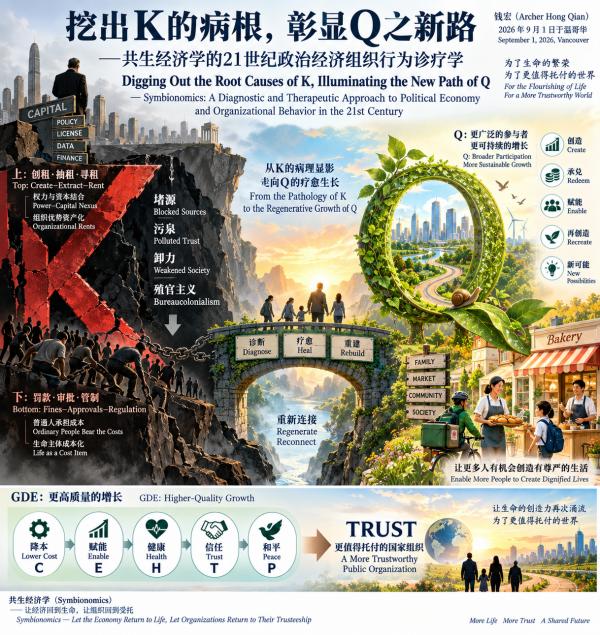
更重要的是,K张开并不等于经济体已经失去自愈力。AI、高科技向上本身也可以降低成本、扩散能力、改善生活;有的经济体出现分化后,仍能纠偏、修复、重新连接。共生经济学因此修正现行K型经济模式的理论描述:K型经济不只是现行经济理论描述的一幅贫富分化、公私混淆、左右摇摆、东西对立图景,它还可能是组织病理的显影图——当资本越来越依附行政、牌照、数据和算法等组织位置生钱,活生生的人却被流量、债务、税费和组织成本不断数据化、成本化,Reproductive Officialdom 又持续繁殖并演化为 Bureaucolonialism,生命便会“堵源”、权力会“污泉”、社会会“卸力”,真正受损的是经济体原本可以把K重新拉回来的纠偏、修复与自愈能力。
诊断K,当然不是为了停留在K。一个经济机体只要仍然具有纠偏、修复和自愈能力,分化就可能重新进入连接,失衡就可能重新生成平衡,创造出来的价值也可能重新承兑为生命能力。本文因此在诊断K型经济的同时,尝试打开另一个尚待专门展开的概念:Q型经济(Q-shaped Economy)。为什么是Q,而不是O?因为健康的经济生命从来不是一个封闭的圆。Q的圆环,是价值创造—价值承兑—生命赋能—再创造的良性循环;Q伸出去的那一笔,则是动态平衡中继续发生的突破、创新与新可能。K,是病理的显影;Q,是疗愈的生长。本文仍以K型经济的病理诊疗为主,Q型经济只作为诊疗过程中逐渐发生的去脉;它从现象到理论的完整展开,留待另文专论。
更进一步说,Q还是诊疗之后打开的出路。它的圆环不是少数优势部门的自我循环,而是让越来越多生命主体、家庭、企业、社区与组织都能够进入价值创造—价值承兑—生命赋能—再创造的转动;伸出去的那一笔,则使这种全员转动始终向创新、突破和新的可能开放。
一、钱没有腿:K是怎样长出来的
城里有一家小面包店。每天清晨五点,老板娘开灯,面粉送到后门,师傅揉面,七点以后居民来买早餐,送餐员把三明治送进附近写字楼。没有谁命令这一切发生。老板娘想把面包做好,面粉商、师傅、送餐员各自为生活行动,顾客有自己的需要,彼此一连接,经济就发生了。
上班族喜欢低糖面包,老板娘便改配方;卖得好,多请一个人,卖不好,自己承担损失。隔壁咖啡店开张,既竞争,也带来客流。财富就从这些不起眼的思想、行动、交换与连接中一点点长出来。共生经济学把它叫作:生命自组织连接能量源。
钱当然重要。但钱没有腿,资本也不会半夜自己爬到K的上端去。真正会思想、会冒险、会创造、会交换、会连接的,是人。
后来,街角来了一家大型连锁店。面包未必更好,却能拿到更便宜的贷款、更好的铺位,还进入产业扶持计划。老板娘也去申请,填表、补材料、开证明,一道程序接着一道程序。她花在研究规定上的时间越来越多,连锁店却有律师、财务和专门部门处理这一切。两家都叫“市场主体”,却已经不站在同一块地面上。
老板娘赚一块钱,要先做好一个面包;另一边,有些钱已经开始从位置里长出来。土地、信贷、牌照、批文、项目、准入,本来是组织社会生活的工具,一旦接近这些资源配置节点本身就能稳定产生收益,组织优势便开始承兑为财富。司马迁所谓“货殖”,原本是通有无、担风险、积财富的生活能力;当财富越来越依赖组织位置而不是创造新价值,“货殖”便变了味。位置开始生钱,K向上的一笔有了额外推力。
再看那个每天来取三明治的送餐员。平台知道他在哪里、哪条路最快、几分钟必须送到,也知道迟到该扣多少钱。技术提高了效率,他却跑得更快。时间、路线、信用、注意力都可以计算,最后连人也被叫作“人力资源”。煤炭是资源,石油是资源,土地是资源——人怎么也成了资源?
现代人当然不是戴着镣铐修城墙的刑徒;可一个活生生的人,如果越来越多地被计算成劳动力、人工成本、税源、流量、数据、用户和偿债能力,生命也会一点点进入别人的成本表。这就是共生经济学重新提出“刑徒经济”的原因。
一边,组织优势资产化;另一边,生命主体成本化。K的两笔,看似向两个方向走,原来可能记在同一本账上。
二、官位官阶为什么会繁殖:从堵源、污泉到卸力
老板娘终于忍不住问:开一家小店,为什么要经过这么多程序?很多年前出了一个问题,于是成立一个办公室;后来又有问题,再增加一个部门;部门需要人员,人员需要预算,预算又需要工作来证明。两个部门管到一起,再设协调机构;监管太复杂,企业抱怨,于是又设一个机构帮助企业理解监管。
一家面包店没有顾客会关门,一个公共机构完成使命却未必自动消失。于是出现一种奇特的繁殖:官位复制官位,机构派生机构,程序产生程序,监管召唤监管。这就是 Reproductive Officialdom。
偶尔发生,它只是官僚冗余;当组织越来越为了自己的延续而扩张,反过来占据生命和社会原本可以自行活动的空间,它就成了我所说的 Bureaucolonialism——殖官主义。殖官主义并不等于政府大。城市需要政府,食品安全需要检查,合同需要法律,欺诈需要制止,纠纷需要法院。关键在于:组织还在帮助人解决问题,还是人越来越需要为组织本身解决问题?
老板娘本来想的是怎样把面包做好,现在越来越多时间用来通过审批——这叫堵源。公共权力本来来自人民托付,应当有来源、有边界、有责任、有承兑;项目失败只剩“投入还不够”,程序出错只回答“系统就是这样”,机器作了决定却找不到责任人——受孞的泉水便开始浑浊,这叫污泉。居民原本可以自己商量停车、照顾孩子、举办市集,后来越来越多事情都要找部门、填表、等批复;政府越来越忙,居民却越来越不会自己办事——这叫卸力。
堵源,生命越来越难以自己创造;污泉,公共权力越来越难以承兑责任;卸力,社会越来越失去自己恢复平衡的能力。K型经济真正危险的地方,也正在这里。
贫富差距并非无法医治,技术进步也天然会有人先走一步。真正的分水岭,是出了问题以后还能不能改:错误政策能不能撤,失败机构能不能关,企业能不能破产,法院能不能纠错,人民能不能重新选择,社会能不能重新组织起来?
正常,不是永远不生病;正常,是生命仍有发现疾病、纠正偏差、修复损伤和恢复平衡的能力。只要这些能力还在,K张开以后仍有机会重新合拢;如果 Reproductive Officialdom 不断复制,Bureaucolonialism 持续堵源、污泉、卸力,货殖经济越来越向上抽取,刑徒经济越来越向下转嫁成本,K就从收入分配图变成了组织病理留下的影像。
而恢复平衡也不是回到原点。生命每经历一次纠偏和修复,都可能产生新的连接、新的能力与新的创造。Q的形态已经隐约显现:循环之中生成新的平衡,平衡之中又伸出突破的一笔。
三、孰公孰私的诊疗学
孰公孰私的问题,是一个自古以来,特别是近一个多世纪以来,困扰人们,并造成千百万人头落地,而且最近又大有甚嚣尘上之势的问题。这自然成为Symbionomics(共生经济学)讨论诊疗K型经济时,不能回避的病理学问题。
首先,发现不公并不困难。皮凯蒂能够从资本收益与经济增长的长期分岔中发现不公,今天的新一代政治人物也很容易从住房、医疗、教育、工资和财富差距中发现不公,并把这种不满转化为政治动员。真正困难的,从来不是指出“这里不公平”,而是找到不公为什么发生,又怎样解决它而不制造新的不公、新的冲突和新的组织成本。
问题恰恰出在这里。几百年来,人们太容易把复杂的财富关系压缩成“公”与“私”的对立:财富集中于私人一端,便向富人加税,由公共权力重新分配;再往前一步,资本与劳动被划成两个敌对阶级,便通过阶级斗争改变所有权。前者比后者文明得多,却仍然容易困在同一种认知回路里:先把财富分化理解为公私之间“谁拿多了”,再用更强的组织力量重新决定“谁应该拿多少”。
中国官方长期用“五六七八九”概括所谓的民营经济,承认:民营经济贡献了50%以上的税收、60%以上的国内生产总值、70%以上的技术创新成果、80%以上的城镇劳动就业,以及90%以上的企业数量。难道创造如此巨大的税收、生产、创新和就业,养活亿万家庭,又为公共财政提供重要税源的民营经济,只因为产权叫“民营”,就只是“私”?反过来,国营经济即使名义上叫“公”,如果占有乃至垄断更多自然资源、资本资产资源,特别是政策、牌照、信贷、准入等组织资源,却不能相应创造价值、降低社会成本、增加就业和推动创新,难道只因为所有权写着一个“公”字,就天然代表了“公”?
这里还必须避免一个统计上的误读:“五六七八九”的其余比例并不能简单全部倒推为国营经济,因为现实经济还包括外资、集体、混合所有制等不同主体。恰恰因此,拿所有制标签预先裁定“孰公孰私”(另一个更具模糊性的标签是“自己人与非自己人”,暂且存而不论),本身就越来越失去解释力。
共生经济学所说的“公”,首先是一种公共价值的发生与承兑关系。一众所谓民营企业,创造技术、提供就业、缴纳税收、降低亿万人的生活成本,它创造的价值,当然具有公共性;一众所谓国有企业,承担基础设施、公共安全、基础研究以及市场一时难以有效承担的长期责任,同样可以创造公共价值。问题不在门牌上写着“公”还是“私”,而在它究竟创造了什么、承兑了什么、占用了什么,又让谁承担了成本。
共生经济学因此对把复杂公私关系简单化以后形成的“加税套路”和“阶级斗争套路”明确说Stopping!
不是因为财富分配不存在不公,也不是因为富人、资本和企业不应承担公共责任,而是因为这两种套路都没有挖到K型经济的病根儿:财富究竟怎样创造?价值怎样承兑?组织凭什么取得资源和权力?K为什么不断张开?把K重新拉回来的生命力量为什么会衰减?这些问题没有回答,便急于用财富转移和敌我动员下药,治疗本身就可能成为新的病灶。
阶级斗争把生命主体重新编入敌我组织,用冲突解决分配,直接增加巨大的政治、经济和社会组织成本;把不断加税、监管和再分配当作解决不公的主要办法,则可能形成另一种循环:税收需要征管,征管需要机构,机构需要预算,预算又需要税收;监管召唤监管,程序产生程序,组织成本继续由社会承兑。一个容易直接破坏生命自组织连接,另一个可能为 Reproductive Officialdom 提供新的繁殖理由。没有找到K的病根儿,反而加重组织机体的癌变。
更麻烦的是,这可能形成“两头蚀本”:一头,以越来越高的税负和制度成本压向创造、投资、创业和就业,堵塞生产财富的生命自组织连接能量源;另一头,为征税、监管、审批、转移支付不断增加机构、人员、程序和预算,进一步提高政府、企业乃至社区的组织成本,污泉、卸力。原来为了治疗K,最后却可能一边削弱创造财富的生命能力,一边扩大需要财富供养的组织。
这也是为什么,面对今天美国以及全球重新出现的“民主社会主义”、共产主义和各种以财富冲突进行政治动员的回潮,共生经济学不能回避这个现实。经济压力越大,K的下端越痛苦,“向富人拿回来”“让国家替你解决”“重新分配就是公平”越容易成为简单而富有感染力的答案。但是,政治动员能够利用病痛,并不等于找到了病根,反而成为新的病灶;承诺重新切蛋糕,也不等于知道蛋糕为什么越来越难由更多生命共同创造。
“公”不能获得GDE豁免,“私”也不能被预先判罪。GDE=Σ(GDP?×η?)要求无论国营、民营,无论政府支出、企业投资,无论加税还是减税,都必须经过生命效能系数η?的过滤:有没有降本?有没有赋能?有没有增进健康、孞托与和平?有没有把组织取得的资源重新承兑为生命能力?
所以,“孰公孰私”不能再由所有制名称预先回答。公,要看创造的价值有没有向公众承兑;私,要看组织取得的资源有没有被少数位置占有和抽取。政府可以创造公共价值,也可以与众争利;企业可以追求利润,也可以通过创新、就业和降本产生巨大的公共价值。不以公私标签判断经济健康,而以生命效能和受托关系诊断组织行为,这就是共生经济学的“孰公孰私诊疗学”。
这样的诊疗,也不以重新分配一个既有存量为终点,而要让价值重新进入创造—承兑—赋能—再创造的生命循环。
四、从“形、式、机、病”进入共生经济学诊疗
由此可见,K型经济不只是现行经济理论描述的一幅贫富分化、公私混淆、左右摇摆、东西对立图景。
K是财富分化的“形”;货殖经济与刑徒经济是它运行的“式”;Reproductive Officialdom 是组织不断复制自身的“机”;Bureaucolonialism 则是组织反过来殖占生命与社会的“病”。
而且,一个经济体病到什么程度,还要看三件事情:人民、公民、国民的生命自组织连接能量源还通不通,政府、司法、议会的权力自组织连接受孞泉还清不清,社会、社区、社群的权利自组织连接平衡力还足不足。
这三项检验,进一步展开为共生经济学从主体重构、增长诊断、效能测度、价值承兑到组织孞托的诊疗链条。
主体重构:从“经济人”到“仨自组织人”
共生经济学首先把经济学中的“人”重新还原为活生生的人。
人当然会计算利益,却不只是一个追求效用最大化的“理性经济人”。人会思想、选择、行动、创造,也会与他人连接、合作、竞争、立约,在不断发生的关系中生成新的价值。由此,从“经济人”丰满为具有心智、行为、制度以及政治、经济、文化三位一体自组织能力的“仨自组织人”(组织共生人),劳动价值也随之扩展到心智、交互秩序、共生权、技术与开放所生成的 Minds Values。
主体重构,首先带来价值重构。
增长诊断:K型经济为什么是一种病態
人找回来了,增长也就不能只剩下一条GDP曲线。
工厂增加产量,城市增加楼宇,政府增加投资,平台增加用户,政绩烂尾工程等,都可以形成GDP;可是,如果家庭负担越来越重,中小企业生存越来越难,年轻人的创造空间越来越窄,社会孞托不断流失,数字的增长与生命的生活便发生了错位。我们正在讨论的K型经济,正是这种经济病態的一种现实呈现:一端继续向上,另一端不断承压,财富增长与生命效能开始分岔。
增长诊断,由此进入经济病理。
K型经济的组织病理与诊疗——通源、清泉、蓄力
诊断/重建维度 | 殖官主义与K型经济病理图 | 共生经济学的诊疗之道 | 生命参量与“源、泉、力”检验 |
表观之“形”(K) | 财富增长与生命效能发生分岔:一端组织优势、资本与资产不断向上承兑,另一端生命成本持续增加,形成增长与生活的错位。 | 让增长重新承兑为生命效能,使财富创造、价值承兑与生活进步重新连接。 | GDE=Σ(GDP?×η?):以η?过滤无效GDP,并从降本(C)、赋能(E)、健康(H)、孞托(T)、和平(P)检验增长的生命效能。 |
运行之“式” | 货殖经济与刑徒经济同时发生:组织位置越来越能够承兑财富,活生生的人则被算法、流量、债务、税费与劳动成本不断成本化。 | 恢复“仨自组织人”(组织共生人)的主体位置,让政治、经济、文化三位一体的自组织连接重新成为价值发生的源头。 | 价值承兑(Value Acceptance):货币回到价值关系,既承兑组织运行,也要充分承兑亿万生命创造价值的能力。 |
增殖之“机” | Reproductive Officialdom:官位复制官位,官阶繁衍官阶,机构派生机构,程序产生程序,监管召唤监管,预算证明预算。 | 阻断组织节点的自我繁殖,使完成使命的机构能够退出,失败政策能够撤销,错误能够纠正,责任能够得到承兑。 | 受孞泉(Trust Spring):公共权力有来源、有边界、有责任、有承兑;政府、司法、议会重新回到受孞位置。 |
组织之“病”(病理学) | Bureaucolonialism(殖官主义):组织从受托者反客为主,把自身存在、扩张和延续变成目的,进而殖占生命、市场与社会的自组织空间。 | 重建组织孞托:生命是目的,组织是受托;通源、清泉、蓄力,恢复 Live and let live 交互主体共生秩序的纠偏、修复与自愈能力。 | 平衡力(Counter-balances):家庭、市场、社会、社区、社群保持自组织、自协调、自修复能力,使行政权力始终处于社会平衡之中。 |
“形—式—机—病”的诊断完成以后,共生经济学所要恢复的,是经济机体自身的生命能力:源重新流动,泉重新清澈,社会重新蓄力;价值创造得到承兑,承兑又转化为生命赋能,获得能力的生命继续创造新的价值。这个过程开始呈现出Q的形态。
Q不是封闭循环的O。它首先有一个不断生成的生命循环:创造 → 承兑 → 赋能 → 再创造。但每一轮循环都可能产生过去没有的知识、技术、组织连接和生活方式,于是循环不会闭合为O,而会伸出新的一笔。这一笔,就是创新,也是生命没有被既有秩序封闭的证明。从K到Q所发生的,是共生经济学从病理诊断进入机体疗愈,再从机体疗愈进入生命生长。
皮凯蒂的 r > g 在这里恰好提供了一把参照尺:它说明资本收益可能跑在整体经济增长之前,却没有回答这个“g”本身是不是有效增长。共生经济学用 GDE=Σ(GDP?×η?)把问题再推进一步:η?不是给GDP换一个名字,而是让每一项经济活动接受生命效能检验。能够降本、赋能,增进健康、孞托与和平的GDP,被赋予正向效能;主要依靠债务堆积、冲突升级、组织冗余和修补旧损伤形成的GDP,其效能就要被折减甚至抵消。于是,增长率不再天然等于生活进步,K的诊断也从“谁得到更多”进入“什么增长值得留下”。
效能测度:从GDP进入GDE生命参量
GDP能够告诉我们生产和交易增加了多少,却不能充分告诉我们,为这些增长付出了多少生命成本。共生经济学因此提出 GDE=Σ(GDP?×η?):以η?作为每一项经济活动的生命效能系数,把GDP放回降本(C)、赋能(E)、健康(H)、孞托(T)、和平(P)这些生命参量中衡量,过滤无效乃至反效的GDP。
同样增加一亿美元GDP,一种增长降低连接成本、释放人的创造力、改善健康与孞托;另一种增长却来自更多债务、冲突、监管成本,甚至为了修补前一次增长留下的问题再次增加支出。数字同样向上,生命得到的东西却完全不同。
效能测度,由财富数量进入生命参量。
GDE的意义也由此不止于过滤无效GDP。η?还在检验一项增长有没有形成下一轮生命创造的条件:今天的降本能不能释放明天的创造空间,今天的赋能能不能生成新的行动能力,今天的健康能不能增强修复与成长,今天的孞托能不能促成新的连接,今天的和平能不能使竞争、合作与创新免于相互毁灭。当增长不仅产生结果,而且生成下一轮创造的条件,Q的循环便开始发生。
而Q能否真正转起来,还要看这种生成能力能否从少数优势节点扩散到更多生命主体。少数产业高速增长、少数组织不断突破,并不等于整个经济机体已经形成Q;只有当更多人能够进入创造、获得承兑、得到赋能并继续创造,增长才开始具有“全员转动”的生命意义。
价值承兑:财富怎样回到创造价值的生命
然而,价值被创造出来、被测量出来,还不等于它已经回到创造价值的生命。
一个人的思想变成技术,劳动变成产品,人与人的合作变成企业,千万人的交互又可以生成平台、数据和新的市场价值。于是一个过去常常被货币理论遮住的问题出现了:这些价值由谁确认,通过什么凭证交换,最后由谁承兑?
货币由此不仅是交易媒介和财富符号,也成为价值发生以后在人与人、人与组织之间流动的承兑凭证。
K的两笔在这里又碰到了一起:一端能够把土地、牌照、信贷、数据、权力和组织位置不断承兑为财富,另一端却可能不断用劳动、税费、债务、时间乃至未来收入承兑组织运行的成本。
价值承兑,把货币重新连接到生命创造的价值。
承兑如果到消费为止,价值运动仍可能结束;承兑如果转化为更好的生活、更充分的时间、更丰富的知识、更低的连接成本和更强的创造能力,它便重新回到生命,成为下一轮价值创造的起点。于是,价值不只是完成一次交换,而开始形成Q的循环。
这也意味着,K上端的繁荣不能一概视为病理。AI、高科技如果把新的知识、工具和创造能力扩散给普通人,降低学习、交易和组织连接成本,本身就是生命效能的增加;真正值得诊断的,是组织位置是否逐渐替代价值创造,收益是否持续向上承兑,而成本与风险却不断向下转嫁。
可是,承兑不会凭空发生。银行在承兑,企业在承兑,政府在承兑,平台也在承兑。谁获得了资源和权力,谁就必须回答一个更深的问题:你凭什么获得,又向谁负责?
政府、企业、银行、平台、社区乃至今天越来越深入生活的AI,归根到底都发生于生命的连接需要。人们之所以创造组织,是为了降低彼此连接的成本,扩大合作与创造的可能。
这里便出现了组织孞托。
组织孞托:生命有所托付,组织有所承兑
组织帮助生命降本、赋能,扩大创造和连接,它就是生命的资产;组织一旦把自己的存在、扩张和延续变成目的,事情就可能倒过来——生命开始为组织服务。
组织孞托因此还有一层更深的意义:它既维持连接,又不能封闭连接;既形成秩序,又不能把秩序本身变成目的。一个健康组织的价值,不只是把已有事情组织得更有效率,还在于给生命留下超出既有组织、创造新连接和新可能的空间。Q之所以不是O,根本上就在这里:组织形成圆环,生命伸出那一笔。
Reproductive Officialdom 由此获得繁殖空间:官位复制官位,机构派生机构,程序产生程序,监管召唤监管;当这种组织繁殖进一步占用生命的时间、财富、权利和自组织空间,甚至“官位、官阶大一统”,那么与所谓资本主义、社会主义、民族(国家主义)交叉勾兑的殖官主义(Bureaucolonialism)“货殖经济”“刑徒经济”也必然会不同形式不同程度发生。
其表观形式之一,就是所谓“K型经济模式”。
于是,收入分配、政治观念、组织关系,不知不觉走向了“生命是目的,组织是受托”的反面,一个国家(民国)或地区(家国-邦國-黨國),便走到了需要改革或革命来“重建组织孞托”。
当今世界,放眼望去,毫不夸张地说,各个国家政治、经济、组织行为,都面临自身特有的“重建组织孞托”的历史任务。
改革或革命的方向,不只是传统的政权更迭,不只是左右、东西谁赢谁输?而是要看:政府是否操纵经济“与众争利”?企业是否垄断市场阻碍竞争和创新?普通人是不是更容易工作、创业和连接?家庭生活成本有没有下降?公共权力出了问题以后有没有人承担责任?社区和社会还能不能自己解决原本可以自己解决的事情?
重建组织孞托的考验,当K型样式出现时,组织有没有纠偏、修复和自愈的能力?
这些问题,只能进入一个个真实国家、一项项真实改革、一家家企业和一个个普通人的生活,接受现实检验。
Symbionomics从主体重构(价值)出发,经过增长诊断(病理)、效能测度(参量)、价值承兑(货币)、组织孞托(重建),最终进入现实实践(样本),形成一条不断发生的关系:
生命创造价值,增长呈现结果,效能检验得失,货币承兑价值,组织承担责任,现实检验一切。
说到底,经济学走了几百年,问题可以越来越复杂,最后检验它的却仍然是生活:
经济发展以后,生命是不是活得更好?
带着这样的立场、观点和方法回到现实,我们发现,阿根廷、美国和中国,呈现的三种K型经济样本,以及正在发生的改变,值得特别关注和剖析。
这张病理图落到现实,便不再只是抽象的“形、式、机、病”。阿根廷、美国、中国正在以不同病程和不同改革方向,回答同一道重建组织孞托的考题。
五、从小 q 到大 Q:从货值经济进入共生经济
说到Q型经济(Q-Economy),熟悉经济学史的人或许会想到1981年诺贝尔经济学奖得主詹姆斯·托宾(James Tobin)于1969年提出的 q 理论(Tobin’s q Theory)。
托宾的小写 q,讨论的是企业投资与资本价值之间的关系。其基本含义,是以企业资本的市场价值与资本重置成本之比来观察投资动力。当资本的市场价值高于重新购置或建造这些资本的成本时,企业便更有动力增加投资;反之,投资动力就会减弱。
Q-Economy并非托宾 q 理论的延伸,也不是把小写 q 简单放大成大写 Q。然而,二者隔着半个多世纪,却形成了一个很有意味的历史呼应:托宾问的是资本怎样获得再投资的转动力,Q-Economy追问的则是生命怎样获得再创造的转动力。
这也恰好划出了小写 q 与大写 Q 的理论边界。
托宾的小写 q,仍然发生在货值经济的范畴之内。资本通过市场获得估值,市场估值影响企业投资,新的投资又进入资本增殖。它关心的中心仍然是资本,以及资本怎样通过市场价值信号实现更有效的配置与再投资。
Q-Economy的大写 Q,则进入共生经济的范畴。资本当然仍然重要,但资本不再是经济价值运动的最终目的,而回到它应有的位置:成为生命创造、连接和再创造所使用的一种资源。经济真正需要保持转动力的,不只是资本,而是一个个会思想、会行动、会创造、会连接的生命。
因此,两种转动呈现出不同的经济逻辑:
货值经济:资本 → 市场估值 → 再投资;
共生经济:生命 → 创造 → 价值承兑 → 生命赋能 → 再创造。
这里的关键变化发生在“承兑”。生命创造出来的价值,如果不能得到发现、确认和承兑,创造就可能在中途断裂;价值即使得到货币承兑,如果承兑只是完成一次交换、消费或资本积累,也未必能够重新转化为生命能力。只有当承兑进一步成为时间、知识、健康、收入、机会、连接和创造条件,重新回到生命,下一轮创造才真正获得转动力。
这也正是本文前面诊断K型经济时不断遇到的问题:K的危险,不只是财富向两端分化,而是价值创造与价值承兑发生断裂,承兑又与生命赋能发生断裂。少数资本、技术和组织节点可以高速转动,越来越多生命却逐渐失去进入下一轮创造的能力,经济机体便可能越来越失去纠偏、修复与自愈的力量。
Q所要重新接通的,正是这些断裂。
所以,大写Q并不排斥资本,也不否定市场价值,而是把资本和市场重新放回生命创造—价值承兑—生命赋能的更大关系之中。资本能够帮助生命创造,它就获得生命效能;市场能够使价值获得更充分的发现与承兑,它就成为Q循环的重要连接机制;组织能够降低成本、扩大连接、释放创造力,它就成为生命有所托付、又有所承兑的组织资产。
由此,从小写 q 到大写 Q,发生的并不只是研究对象从资本扩大到生命,更是经济范式边界的一次推进:
从 Capital q 到 Life Q;从资本转动力走向生命转动力;从货值经济走向共生经济。
这样再回头看K与Q,两条线也就交汇起来。
横向看,是K → Q:从价值创造、承兑与赋能的断裂,走向重新连接、动态平衡与持续生成。
纵向看,是q → Q:从资本获得市场估值以后怎样继续投资,走向生命创造价值以后怎样获得承兑、重新赋能并继续创造。
K让我们看见断裂,Tobin’s q让我们看见资本如何转动,而Q-Economy要让生命重新转动起来。
Q型经济(Q-Economy),就是让越来越多生命重新获得创造的转动力,使创造获得承兑、承兑重新赋能生命,并使一个Mind进入Minds,在持续交互中生成新价值、新关系与新可能的经济形态。
六、三种K,三种正在发生的改变
阿根廷:电锯砍下去,生命能不能重新长起来?
阿根廷首先把问题以近乎失控的方式暴露出来。长期财政赤字、货币超发、补贴、管制和公共组织膨胀相互纠缠,政府越来越需要财政和货币维持组织运行,普通人的工资、储蓄和生活却不断替这种运行承兑成本。米莱接手时,通胀已经超过200%,贫困率一度超过50%,货币越来越难以承担正常的生活尺度。
米莱的“电锯改革”,表面上砍的是政府部门、财政赤字、补贴、管制和行政成本,实际上触到了K背后的组织关系:那些依靠预算、审批、牌照和公共权力取得资源的节点,还能不能继续自行繁殖?政府究竟是在帮助人民创造财富,还是越来越需要人民创造财富来供养政府?两年多以后,通胀已降至约30%,财政连续出现基本盈余,贫困率也从50%以上降到30%以下。电锯砍下去当然会疼,失业、非正规就业、工资调整仍在考验改革;真正值得观察的,是削减下来的组织成本能不能进一步转化为生命自组织的空间。砍只是手段,通源才是目的;财政平衡只是开始,生命能不能重新长起来才是检验。
如果财政稳定最终释放创业、投资、家庭生活和社会自组织空间,改革便不再只是把K拉回来,而开始恢复价值创造重新循环、生命能力继续生长的Q能力。
美国:清理组织淤积,也要防止制造新的淤积
美国的K发生在完全不同的体量和社会基础上。美国拥有世界上最发达的资本市场、科技创新体系和深厚的社会自组织传统,科技、金融和资产可以迅速向上,住房、医疗、教育、债务以及普通家庭生活成本却可能在另一端持续承压。AI公司可以在短时间创造巨额市值,一家普通小企业面对的融资、税费、监管和人工成本,却未必因此下降。
美国这张K还有一个不能忽略的特点:高科技上扬并非只把财富留在K的上端。互联网、智能手机直到今天的生成式AI,也在把过去只有大型机构才能拥有的知识处理、写作、编程、设计和组织能力部分扩散给普通人。这说明K的两臂并非天然彼此隔绝;上端的创新若能持续向生活承兑,就可能反过来增强生命自组织的“源”和社会修复的“力”。
美国尤其值得观察的是,AI和高科技能否把上端突破形成的新能力不断向生活扩散。创新本身正是Q伸出去的那一笔;能否通过价值承兑重新进入亿万生命,再生成下一轮创新,则决定这一笔能不能重新带动整个循环。
川普的常识新政与米莱的电锯改革,在政治意向上有一个重要交点:削减某些已经自我繁殖的官僚节点、行政程序和监管成本,把空间还给企业、家庭和社会。但是,美国也把另一道考题摆在眼前:裁掉一个部门,并不等于组织总成本已经下降;取消一种监管,新的关税、债务、战争和产业保护也可能增加另一种成本。2026年美国联邦债务已经突破40万亿美元,8月私人部门新增就业只有3.8万人,制造业还减少了1.7万个岗位。GDE恰好要算GDP没有算完的这笔账:改革最后有没有真正降本、赋能,增加健康、孞托与和平?
阿根廷更像在危机中给已经堵塞的水道动手术:源被财政货币失序挤压,泉被长期组织失信污染,力受通胀与管制侵蚀;美国则是在一个仍有强大生命活力的成熟经济体里清理不断生长的组织淤积,源仍强,泉有淤积,力仍保持较强的自愈能力。两种病程不同,却都必须接受同一把生命效能之尺的检验。
中国:强大的制造能力,为什么没有充分承兑为生活能力?
中国并不缺少Q伸出去的那一笔。强大的制造能力、基础设施能力以及不断成长的高科技产业,显示出巨大的组织能力与突破能力。更值得诊疗的问题,是:谁在转动,又有多少生命主体能够一起转动?
如果生产高速转动而生活承兑不足,投资高速转动而家庭消费能力不足,大型组织高速转动而中小企业与社会自组织空间不足,技术不断突破而普通人的创造能力没有同步释放,那么经济机体仍可能表现为一种不完整的转动:有Q伸出去的突破之笔,却没有形成Q的全员生命循环。
中国的K又是另一种样子。几十年工业化形成了强大的制造能力、基础设施、完整产业链和庞大的工程技术队伍。即使房地产深度调整、国内需求偏弱,高端制造、新能源汽车、电池、机器人、电子产品和出口仍然可以保持很强的生产能力。问题也因此更加醒目:为什么如此强大的生产能力,没有更加充分地承兑为普通人的生活能力?
一边,是先进制造、出口产业以及能够获得土地、信贷、牌照、项目、补贴和政策资源的组织继续向上;另一边,是房地产收缩、传统产业困难、民营中小企业承压,以及失业、灵活就业、收入预期下降和消费不足。中国的K由此不仅表现为财富差距,也表现为生产能力与生活能力、组织能力与生命活力之间的分岔。
曾经支撑“中国制造”的一个重要条件,是庞大的低成本劳动力。所谓“低人权优势”,说穿了,就是把人的工资、保障、工作时间乃至生活条件更多地作为生产成本计算。它在工业化阶段能够形成价格竞争力,也留下了一笔迟早要承兑的生活账:生产率提高以后创造出来的价值,能不能相应变成人的收入、保障、时间和生活?到了自动化、机器人和AI时代,一条高度自动化生产线可以增加数倍产值,却未必增加多少就业;一部分劳动密集型产业又向成本更低的地区转移。那些曾经以“低成本”参与全球化的人,甚至可能连作为“低成本”的机会也在减少。生命被成本化以后,又可能被技术进一步排除在成本之外。
K的另一端,土地、信贷、牌照、审批、项目、国有资源、产业政策和市场准入,可以通过权力与资本的结合形成组织优势;组织优势又可以进一步承兑为财富。权贵寻租由此不只是一部分人的道德问题,而成为一种经济关系:位置本身开始生钱。位置越值钱,人们越会争夺位置;位置能够配置的资源越多,围绕位置生长出来的机构、程序、审批、监管和利益节点也越多。
Reproductive Officialdom 就这样进入经济循环:官位复制官位,官阶繁衍官阶,机构派生机构,程序产生程序,监管召唤监管,预算证明预算。一边,组织优势资产化;另一边,生命主体成本化。权贵寻租向上,失业大军向下;货殖经济向上,刑徒经济向下。两条线向相反方向伸展,正好写出了一个K。
更麻烦的是,这个K还可能自己强化自己。国内消费不足,便进一步依赖投资和出口;投资和出口越重要,信贷、补贴和产业政策越向生产端集中;生产能力继续提高,家庭收入和消费能力却未必得到同比例承兑;内需仍然不足,于是又需要新的投资、项目、补贴和出口寻找增长。机器越来越先进,产品越来越丰富,生产能力越来越强,把生产能力承兑为生活能力的机制却可能越来越弱。
如果仍然主要沿着原有行政、信贷、项目和产业组织渠道治疗这种K,本来用于治病的资源,又可能沿着制造K的组织关系流动,反过来成为K继续扩大的营养。堵源、污泉、卸力一旦相互强化,K最危险的地方也就显现出来:它不仅制造分化,还会削弱把分化重新拉回来的纠偏、修复和自愈能力。
中国已经拥有令人惊叹的生产能力,下一步更重要的是能不能把这种能力充分承兑为亿万生命主体的创造能力、收入能力、消费能力和生活能力。改革如果只是换一项政策、一批项目、一个增长点,原来的组织关系没有改变,K还会换一种形式回来;革命如果只是政权更迭、左右互换,生命仍然服务于组织,同样没有走出殖官主义。真正具有建设性意义的改革或革命,是通源、清泉、蓄力,重建组织孞托。再不进入“重建组织孞托”的改革或革命,中国经济就难以逃脱K型魔咒。
中国并不缺少Q伸出去的“一笔”:制造、工程、数字技术与产业创新都具有强大的突破能力。更深的考验,是这些突破能不能通过收入、消费、时间、社会保障、创业机会和生命赋能重新进入循环;如果突破不断发生而承兑循环不能形成,强大的创新能力仍可能继续表现为K的张开。
七、三种K,归到同一张生命账本
阿根廷、美国、中国的三种K,呈现了殖官主义在不同政治经济条件下发生、积累与改变的三种现实形态。阿根廷的问题已经逼近财政、货币和基本生活秩序,米莱用“电锯”切除吞噬生命资源的组织成本;美国仍有强大的市场、社会与制度自愈能力,川普的常识新政试图清理长期积累的殖官节点,同时也必须接受GDE对关税、债务、战争以及新增组织成本的检验;中国则在强大的生产能力和组织动员能力之下,集中暴露出货殖经济向上、刑徒经济向下,生产能力与生活能力不能充分承兑的K型病態。
三种K,三种病程,三种正在发生的改变,最后都落到了源、泉、力。源堵了,生命创造价值的空间收缩;泉污了,公共权力的受孞与责任承兑发生错位;力卸了,社会自身纠偏、修复和恢复平衡的能力衰退。改革或革命有没有真正发生,不能只看政权、政策和口号发生了什么变化,还要看它有没有重新通源、清泉、蓄力,有没有把组织重新放回生命的受托位置。
共生经济学所谓“诊疗”,归根到底,就是诊断什么力量使生命失去自愈能力,又怎样把这种能力重新还给生命。
由此看,皮凯蒂的 r > g 与共生经济学并非简单的谁替代谁:前者提醒我们资本收益与整体增长可能长期错位,后者则把诊断推进到GDP的效能、价值的承兑和组织的自愈。皮凯蒂算清了财富分化的“病状账”;共生经济学继续追问,什么样的组织关系使病状固化,又怎样让机体重新具备把K拉回来的能力。
K真正成为一种经济病態,也不在于上下两条线一时分开。经济发展本来就会产生行业兴衰、技术替代、企业成败和财富流动。真正危险的是,把两条线重新拉回来的力量也被组织自己吃掉了:依靠组织优势生存的企业不能退出,失败的政策不能纠正,完成使命的机构不能关闭,公共权力不能承兑错误,社会不能重新组织被破坏的连接,普通人越来越难通过思想、劳动、创业和创新改变自己的处境。
阿根廷、美国、中国三种K型经济样本的共生经济学诊断对比
诊断维度 | AR 阿根廷(米莱“电锯改革”) | US 美国(川普“常识新政”) | CN 中国(生产生活“K型病態”) |
K型核心病症 | 财政—货币—组织失序相互强化:长期财政赤字、管制膨胀与货币失信,使普通人的工资、储蓄和生活不断承兑组织运行成本。 | 成熟体制中的组织淤积与生活成本分岔:科技、资本、资产向上聚集,住房、医疗、教育、债务及普通家庭生活成本持续承压。 | 生产能力与生活能力、组织能力与生命活力分岔:强大制造与技术能力,没有充分承兑为普通人的收入、就业、消费与生活保障。 |
K字上半部 | 依附组织与通胀的资产端:预算、补贴、管制及资产价格使部分组织和资产持有者获得相对优势。 | 科技、金融、资本与资产端:AI、金融及虚拟资产快速创造财富,并向少数资本和组织节点聚集。 | 组织优势资产化:先进制造、出口产业,以及能够获得土地、信贷、牌照、补贴、项目和产业政策资源的组织向上。 |
K字下半部 | 替财政—货币失序承兑成本的生命端:失业、非正规就业、实际收入与储蓄受损的普通人。 | 生活成本承压的生命端:普通家庭、中小企业及就业增长放缓者,承受住房、医疗、教育、债务、税费、融资与人工成本。 | 生命主体成本化:民营中小企业、传统产业劳动者、失业与灵活就业者;低成本劳动优势衰减后,又面临自动化与产业转移。 |
“源、泉、力”受损现状 | 源被财政货币失序挤压,泉被长期组织失信污染,力受通胀与管制侵蚀;改革正在尝试清理堵塞。 | 源仍强,泉有淤积,力仍有较强自愈能力;真正考验是清除旧组织成本时,会不会由关税、债务、战争及产业保护产生新的组织成本。 | 堵源、污泉、卸力相互强化:位置生钱与权贵寻租推动组织节点繁殖;资源沿组织优势流动,生命与社会自组织空间受到挤压。 |
重建组织孞托的方向 | 电锯只是手段,通源才是目的。削减组织成本、恢复财政货币孞托,最终要承兑为生命自组织空间。 | 清淤而不造新淤。削减自我繁殖的殖官节点,并以GDE检验改革是否真正降本、赋能,增加健康、孞托与和平。 | 改革或革命必须进入重建组织孞托。通源、清泉、蓄力,把强大的生产能力、技术能力和组织能力重新承兑为生命能力。 |
这使共生经济学从K型经济中得到一个比“贫富差距”更深的认识:经济健康的重要标志,是自愈能力。正常,不是永远不生病;正常,是生命仍有发现疾病、纠正偏差、修复损伤和恢复平衡的能力。只要这种能力还在,K张开以后仍有机会重新合拢;一旦源、泉、力同时受损,K就会从经济现象固化为组织病理。
但是,生命的自愈从来不只是复原。伤口愈合以后,生命继续生长;失衡重新获得平衡以后,新的连接仍会发生。经济机体也是如此。自愈,使K不再固化;生长,使经济进一步发生为Q。Q的圆环保存创造—承兑—赋能—再创造的动态平衡;Q伸出去的一笔,则把每一轮循环带向尚未发生的新价值、新技术、新连接和新生活。O完成循环,Q从循环中出发。
所谓“全员转动”,并不是人人同速、同量、同结果,而是连接不断、承兑不堵,让越来越多生命主体保有进入创造循环的机会与能力。差异、竞争和突破因此不必被消灭,反而成为动态平衡继续生长的动力。
八、世界下一步:从增长竞争走向生命效能竞争
K型经济的三种现实样本,也把共生经济学的诊疗对象从“经济增长”进一步推向21世纪政治、经济与组织行为本身。
过去两百多年,人们反复争论市场自由还是政府管控、资本主义还是社会主义、左还是右、东方还是西方。进入数字—量子时代,AI、机器人、平台、算法、资本与公共权力正在以前所未有的速度重新组合,任何一种组织都可能降低连接成本,也都可能形成新的垄断、控制和殖占。旧标签越来越难以单独回答一个更现实的问题:这些力量最后究竟让生命更能创造、更能连接,还是让生命越来越成为组织的资源?
阿根廷的改革提醒我们,宏观稳定可以把被通胀和财政失序吞掉的时间重新还给生活;美国的改革提醒我们,成熟制度也必须持续清理自身不断繁殖的组织成本;中国的K则提醒我们,强大的生产、技术和组织能力,如果不能充分承兑为生命能力,增长本身仍可能继续制造新的失衡。三种样本共同把“增长”推进到了“效能”,把“分配”推进到了“承兑”,把“制度”推进到了“组织孞托”。
AI时代还会把这道题推得更深。机器可以替代越来越多劳动,算法可以管理越来越多行为,资本和数据可以在极少数节点聚集前所未有的力量。如果新增价值仍然主要沿着既有组织位置向上承兑,越来越多生命却在就业、收入和社会连接中向下承压,K可能比工业时代张得更快。反过来,如果AI真正用于降低知识、交易、教育、医疗、创业和组织连接成本,让普通人获得过去只有大型组织才能拥有的能力,它也可能成为重新通源、清泉、蓄力的重要力量。
世界下一轮真正值得竞争的,由此不只是GDP、芯片、关税、资本和军费,也不只是政府究竟大一点还是小一点。更深的竞争,是谁能够用更低的组织成本释放更多生命创造力,谁能够把技术进步更充分地承兑为生活进步,谁能够在发生错误以后更快纠偏、修复、自愈。
这也是《共生经济学概论》从主体重构、增长诊断、效能测度、价值承兑、组织孞托走向现实实践以后,K型经济给予它的反向验证和新的理论营养:财富不是终点,组织也不是终点;生命才是经济发生的原点,也是检验经济结果的终点。
从这个意义上说,K型经济是21世纪经济病理显影的一种形;Q型经济则提示另一种可能:经济不再以增长数字不断向上为唯一方向,也不以财富重新分配以后形成静态均衡为终点,而是在生命创造、价值承兑、组织孞托和生活赋能之间不断循环,每一次循环又向新的创造开放。K让我们看见病从哪里发生,Q让我们看见生命还可以向哪里生长。Q型经济究竟已经以哪些现象发生,它与循环经济、福利经济、增长理论以及传统均衡理论有什么根本区别,GDE、价值承兑与组织孞托怎样构成它的理论基础——这些问题已经超出本文对K型经济进行病理诊疗的范围,值得另文从现象到理论专门展开。
这也使Q对那些“生产很强、组织很强、突破很强,却尚未充分承兑为生活能力和广泛创造能力”的经济形态具有特别的诊疗意义:真正的强,不只是少数节点转得更快,而是让整个生命经济拥有转起来、接得上、再创造并不断伸出新枝的能力。
城里的那家面包店,第二天清晨五点还是会亮灯。老板娘仍然要判断顾客喜欢什么,师傅仍然要揉面,送餐员仍然要穿过街道。世界经济无论变得多么庞大复杂,真正让生活发生的,依然是一个个会思想、会行动、会创造、会连接的生命。
让他们把更多时间用来做面包,而不是研究批文;让年轻人更愿意创造一个位置,而不是争夺一个位置;让公共权力重新成为清澈的受孞之泉,让家庭、市场、社区和社群重新拥有组织自己生活的力量。
源通,泉清,力足,K即使张开,也有重新合拢的生命能力。
而重新合拢并非回到原点:生命一旦恢复循环、平衡与创造,就会从既有秩序中继续伸出新的一笔——由K的病理显影,走向Q的疗愈生长。
而理论只有重新进入正在发生的世界,才真正完成一次承兑。就在K的病理越来越清晰、Q的生长开始显现之际,从米莱的“电锯改革”、川普的“常识新政”,到刚刚发表的G20阿什维尔主席声明及南美和欧洲各国选举动向,一个更大的现实问题也自然生长出来:重建国家组织孞托,将成为不同国家以不同方式共同面对的新时代主题与使命!
生命是目的,组织是受托。
这就是重建组织孞托,也是共生经济学面对K型经济给出的因应之道。
Digging Out the Root Causes of K, Illuminating the New Path of Q
—A Symbionomic Diagnostic and Therapeutic Study of Political, Economic, and Organizational Behavior in the 21st Century
Archer Hong Qian
Vancouver, September 1, 2026
Prelude
The K-shaped Economic Model is commonly used to describe sharp divergence during economic recovery: the upward arm represents AI, high technology, financial assets, advantaged sectors, and affluent groups that continue to prosper, while the downward arm represents traditional industries, SMEs, and lower- and middle-income groups under pressure from debt, employment, and living costs.
The conventional K-shaped narrative first sees the “fork.” Thomas Piketty, through r > g—the proposition that the return on capital can remain above the rate of economic growth—produced an influential account of wealth divergence. Symbionomics asks one question further: how much of g is genuinely effective growth? GDE = Σ(GDP? × η?) subjects every component of GDP to a life-effectiveness coefficient η?. Growth that reduces costs, empowers life, improves health, generates trust, and advances peace cannot be treated as equivalent to GDP produced by debt, conflict, regulatory expansion, or repeated spending to repair old damage.
More importantly, the opening of K does not mean that an economy has lost its capacity for self-healing. AI and high technology can themselves reduce costs, diffuse capabilities, and improve life; economies that diverge can still correct, repair, and reconnect. Symbionomics therefore revises the usual description of K: it is not merely a picture of wealth divergence, public-private confusion, Left-Right oscillation, or East-West opposition. It may also be an image of organizational pathology. When capital increasingly makes money through privileged organizational positions—administration, licenses, data, algorithms—while living persons are continually datafied and costed through traffic, debt, taxes, fees, and organizational burdens, Reproductive Officialdom can evolve into Bureaucolonialism. Life’s source becomes blocked, the spring of public power becomes polluted, society is disempowered, and what is damaged most deeply is the economy’s original capacity to correct, repair, and heal itself.
To diagnose K is not to remain inside K. So long as an economic organism retains the capacity for correction, repair, and self-healing, divergence can reconnect, imbalance can generate a new balance, and created value can again be redeemed into the capabilities of life. While diagnosing K, this essay therefore opens another concept that deserves fuller treatment elsewhere: the Q-shaped Economy. Why Q rather than O? Because a healthy economic life is never a closed circle. Q’s ring is the virtuous circulation of Value Creation → Value Redemption → Life Empowerment → Re-creation; the stroke extending outward is the breakthrough, innovation, and new possibility that continues to emerge within dynamic balance. K is the manifestation of pathology; Q is the growth of healing.
Q is therefore also the path opened after diagnosis and treatment. Its circle is not the self-circulation of a few advantaged sectors, but a movement in which more living subjects, families, enterprises, communities, and organizations can enter the circulation of creation, redemption, empowerment, and re-creation. Its outward stroke keeps this broad participation open to innovation, breakthrough, and new possibilities.
I. Money Has No Legs: How Does K Grow?
There is a small bakery in the city. At five every morning, the owner turns on the lights; flour arrives at the back door; the baker kneads the dough; after seven, residents come for breakfast; delivery riders carry sandwiches to nearby offices. No one commands all this to happen. The owner wants to make good bread; the flour supplier, baker, and rider act for their own lives; customers have their own needs. Once these lives connect, an economy happens.
Office workers begin to prefer low-sugar bread, so the owner changes the recipe. If sales rise, she hires another person; if they fall, she bears the loss. A coffee shop opens next door, competing with her but also bringing foot traffic. Wealth grows little by little from these ordinary acts of mind, action, exchange, and connection. Symbionomics calls this the self-organizing connective energy source of life.
Money matters, of course. But money has no legs. Capital does not climb to the upper arm of K by itself at midnight. The beings that think, take risks, create, exchange, and connect are people.
Then a large chain store arrives at the corner. Its bread may not be better, yet it can obtain cheaper credit, better locations, and access to industrial-support programs. The bakery owner applies too: forms, supplementary materials, certificates, one procedure after another. She spends more and more time studying rules, while the chain has lawyers, accountants, and specialized departments. Both are called “market entities,” yet they no longer stand on the same ground.
To earn one dollar, the bakery owner must first make a loaf of bread. Elsewhere, some money begins to grow from position itself. Land, credit, licenses, approvals, projects, and market access were originally tools for organizing social life. Once proximity to these resource-allocation nodes can itself generate stable returns, organizational advantage begins to be redeemed into wealth. Sima Qian’s ancient idea of huozhi originally referred to the living capacity to circulate goods, bear risk, and accumulate wealth. When wealth increasingly depends on organizational position rather than the creation of new value, huozhi changes character. Position begins to make money, giving the upward stroke of K an additional force.
Now look at the delivery rider. The platform knows where he is, which route is fastest, how many minutes he has, and how much to deduct if he is late. Technology raises efficiency, yet he runs faster. Time, route, credit, and attention can all be calculated, until the person himself is called a “human resource.” Coal is a resource, oil is a resource, land is a resource—but how did a human being become a resource?
Modern people are not convicts in shackles building city walls. Yet when a living person is increasingly calculated as labor power, labor cost, tax source, traffic, data, user, and debt-servicing capacity, life gradually enters someone else’s cost sheet. This is why Symbionomics reintroduces the concept of the Convict Economy. On one side, organizational advantage is assetized; on the other, living subjects are costed. The two strokes of K appear to move in opposite directions, yet they may be entries in the same ledger.
II. Why Do Official Positions Reproduce? From Blocking the Source and Polluting the Spring to Disempowering Society
The bakery owner finally asks: why must opening a small shop pass through so many procedures? Years ago, a problem appeared, so an office was created. Another problem appeared, so another department was added. Departments require personnel; personnel require budgets; budgets require work to justify them. When two departments overlap, a coordinating body is established. When regulation becomes too complicated and businesses complain, another agency is created to help businesses understand the regulation.
A bakery without customers closes. A public agency that completes its mission does not necessarily disappear. A peculiar reproduction can therefore occur: official positions replicate official positions, agencies generate agencies, procedures generate procedures, regulation summons regulation. This is Reproductive Officialdom.
Occasionally, it is merely bureaucratic redundancy. But when organization increasingly expands for the sake of its own continuation and occupies the space in which life and society could have acted for themselves, it becomes what I call Bureaucolonialism. Bureaucolonialism does not simply mean “big government.” Cities need government; food safety requires inspection; contracts need law; fraud must be stopped; disputes need courts. The decisive question is whether organization is still helping people solve problems, or whether people increasingly have to solve problems for the organization itself.
The bakery owner once thought mainly about making better bread; now she spends more time passing approvals. This is Blocking the Source. Public power originates in the people’s entrustment and should have a source, boundaries, responsibility, and redemption. When failed projects are answered only with “investment was insufficient,” procedural errors with “that is how the system works,” and machine decisions with no responsible person to be found, the entrusted spring of public power becomes turbid. This is Polluting the Spring. Residents once could negotiate parking, care for children, and organize a street market themselves; later, more and more matters require departments, forms, and approvals. Government becomes busier while residents become less able to organize their own affairs. This is Disempowering Society.
Blocking the source makes it harder for life to create; polluting the spring makes it harder for public power to redeem responsibility; disempowering society weakens its capacity to restore balance. This is where the K-shaped economy becomes truly dangerous. Inequality is not incurable, and technological progress naturally allows some to move first. The real dividing line is whether, after problems occur, they can still be corrected: can bad policies be withdrawn, failed institutions closed, firms allowed to fail, courts correct mistakes, people choose again, and society reorganize itself?
Normality does not mean never becoming ill. It means that life retains the capacity to discover disease, correct deviation, repair damage, and restore balance. If these capacities remain, K can reopen and later close again. If Reproductive Officialdom continues reproducing and Bureaucolonialism keeps blocking the source, polluting the spring, and disempowering society—while the Mercantile Economy extracts upward and the Convict Economy shifts costs downward—K ceases to be merely an income-distribution graph and becomes the image left by organizational pathology. Yet restored balance is not a return to the starting point. Every correction and repair can generate new connections, new capacities, and new creation. The form of Q is already faintly visible: new balance generated within circulation, and a new stroke of breakthrough growing from balance.
III. A Diagnostic and Therapeutic Study of Public and Private
The question of what is public and what is private has troubled people for centuries, especially over the last hundred years, and has helped produce conflicts in which millions lost their lives. Its renewed intensity today makes it unavoidable in a Symbionomic diagnosis of K.
Discovering unfairness is not difficult. Piketty can identify injustice through the long divergence between returns to capital and economic growth; a new generation of political figures can easily identify dissatisfaction in housing, healthcare, education, wages, and wealth gaps and turn it into political mobilization. The harder task is to identify why injustice occurs and how to remedy it without creating new injustice, new conflict, and new organizational cost.
For centuries, complex wealth relations have too easily been compressed into a public-private opposition. When wealth concentrates privately, tax the rich and redistribute through public power; take another step, divide capital and labor into hostile classes and change ownership through class struggle. The former is far more civilized than the latter, yet both can remain trapped in a similar cognitive loop: first interpret divergence as a question of who has taken too much, then use stronger organizational power to decide who should receive how much.
China’s official “five-six-seven-eight-nine” shorthand for the private economy acknowledges that private firms contribute more than 50 percent of tax revenue, more than 60 percent of GDP, more than 70 percent of technological innovation, more than 80 percent of urban employment, and more than 90 percent of the number of enterprises. If an economy creates such tax revenue, production, innovation, and employment, supports hundreds of millions of families, and supplies major public revenues, can it be dismissed as merely “private” because its ownership is privately registered? Conversely, if a state-owned enterprise occupies or monopolizes natural resources, capital assets, policy privileges, licenses, credit, and access without creating corresponding value, lowering social costs, expanding employment, or advancing innovation, does the word “public” in its ownership automatically make it public in substance?
The remaining shares in the “five-six-seven-eight-nine” formula cannot simply be assigned to state ownership, because foreign-invested, collective, mixed-ownership, and other entities also exist. This itself shows the declining explanatory power of deciding “public or private” in advance through ownership labels.
For Symbionomics, the public is first a relationship in which public value is generated and redeemed. Private enterprises that create technology, employment, tax revenue, and lower living costs generate public value. State-owned enterprises that bear responsibilities for infrastructure, public security, basic research, and long-term tasks that markets cannot yet effectively undertake can likewise generate public value. The issue is not the label on the door but what is created, what is redeemed, what resources are occupied, and who bears the cost.
Symbionomics therefore says “Stopping!” to the routine of treating higher taxation or class struggle as automatic answers to a simplified public-private problem. This is not because distributional injustice does not exist, or because the wealthy, capital, and enterprises should bear no public responsibility. It is because neither routine reaches the root of K: How is wealth created? How is value redeemed? On what grounds do organizations obtain resources and power? Why does K continue to open? Why does the life-force capable of drawing it back weaken? If these questions remain unanswered, rushing to prescribe wealth transfers or enemy-based mobilization can turn treatment itself into a new lesion.
Class struggle reorganizes living subjects into hostile camps and uses conflict to settle distribution, imposing enormous political, economic, and social organizational costs. Treating ever-higher taxes, regulation, and redistribution as the principal cure can produce another cycle: taxation requires administration; administration requires institutions; institutions require budgets; budgets require taxes. Regulation summons regulation, procedures generate procedures, and society continues to redeem organizational costs. One route can directly damage life’s self-organizing connections; the other can provide Reproductive Officialdom with new reasons to reproduce.
The result may be a two-ended loss: one end presses rising tax and institutional costs onto creation, investment, entrepreneurship, and employment, blocking the self-organizing energy source that produces wealth; the other end adds agencies, personnel, procedures, and budgets to taxation, regulation, approval, and transfers, further raising the organizational costs of government, business, and community. A treatment originally intended to cure K may weaken the capacity to create wealth while expanding the organization that must be supported by wealth.
Thus Symbionomics cannot avoid the contemporary revival, in the United States and elsewhere, of democratic socialism, communism, and other political mobilizations built around wealth conflict. The more painful the lower arm of K becomes, the more emotionally compelling slogans such as “take it back from the rich,” “let the state solve it,” or “redistribution is justice” become. But political mobilization can exploit pain without identifying its cause; promising to recut the cake does not explain why it is becoming harder for more lives to create the cake together.
The “public” receives no exemption from GDE, and the “private” receives no prior conviction. GDE = Σ(GDP? × η?) requires state-owned and private activity, government spending and business investment, tax increases and tax cuts alike to pass through η?: Does it reduce costs? Empower life? Improve health, trust, and peace? Does it redeem organizationally acquired resources back into life capability? Public and private must therefore be judged by value creation, redemption, life effectiveness, and trusteeship—not by ownership labels alone. The endpoint is not redistribution of a fixed stock, but the restoration of the living cycle of Creation → Redemption → Empowerment → Re-creation.
IV. From “Form, Mode, Mechanism, Disease” into Symbionomic Diagnosis and Therapy
K is the form of wealth divergence; the Mercantile Economy and Convict Economy are its modes of operation; Reproductive Officialdom is the mechanism by which organization reproduces itself; Bureaucolonialism is the disease in which organization turns back and colonizes life and society.
How ill an economy has become can be tested through three questions: Is the self-organizing connective energy source of people and citizens still flowing? Is the entrusted spring of governmental, judicial, and legislative power still clear? Is the counter-balancing force of society, communities, and social groups still strong? These tests unfold into a Symbionomic therapeutic chain from reconstruction of the subject, growth diagnosis, effectiveness measurement, and value redemption to Organizational Trust.
Subject reconstruction begins by returning the “human” of economics to a living person. Human beings calculate interests, but they are not merely rational utility maximizers. They think, choose, act, create, connect, cooperate, compete, make covenants, and generate new value in relationships. The “economic man” is thus enriched into the self-organizing person whose mind, behavior, institutions, politics, economy, and culture are interwoven. Labor value accordingly expands toward Minds Values generated by mind, interactive order, symbiotic rights, technology, and openness.
Once the person returns, growth can no longer be reduced to a GDP curve. Factories, buildings, public investment, platforms, and even failed prestige projects can all add to GDP. But if household burdens rise, SMEs become harder to sustain, young people lose creative space, and social trust erodes, numerical growth diverges from lived life. K is one manifestation of this pathology: wealth growth and life effectiveness split apart.
The diagnostic table can be summarized as follows. Form (K): wealth growth diverges from life effectiveness; therapy reconnects growth to life effectiveness through GDE and C-E-H-T-P. Mode: Mercantile and Convict Economies assetize organizational position and cost living persons; therapy restores the self-organizing subject and Value Redemption. Mechanism: Reproductive Officialdom makes positions, agencies, procedures, regulations, and budgets reproduce themselves; therapy enables completed institutions to exit, failed policies to be withdrawn, mistakes corrected, and responsibility redeemed. Disease: Bureaucolonialism converts the trustee into a master and colonizes the self-organizing space of life, markets, and society; therapy rebuilds Organizational Trust—life is the purpose, organization the trustee—by opening the source, clearing the spring, and restoring society’s counter-balancing force.
After the diagnosis of form, mode, mechanism, and disease, Symbionomics seeks to restore the organism’s own life capacities. The source flows again; the spring becomes clear; society regains strength. Value creation is redeemed; redemption becomes life empowerment; empowered life creates again. This process begins to take the form of Q.
Q is not a closed O. It contains a continually generated life cycle—Creation → Redemption → Empowerment → Re-creation—but every cycle can generate knowledge, technology, organizational connections, and ways of life that did not previously exist. The circle therefore does not close into O; it extends a new stroke. That stroke is innovation and proof that life has not been sealed inside an existing order. The movement from K to Q is a movement from pathological diagnosis to healing, and from healing to growth.
Piketty’s r > g offers a useful reference point. It shows that returns to capital can outrun aggregate growth, but it does not tell us whether g itself is effective growth. GDE advances the question: η? subjects each economic activity to a life-effectiveness test. GDP that reduces costs, empowers, and increases health, trust, and peace receives positive effectiveness; GDP built mainly from debt accumulation, escalating conflict, organizational redundancy, or repeated repair of old damage must be discounted or even offset. Growth rates therefore cease to be automatically identical with progress in life. K diagnosis moves from “who gets more?” to “what growth deserves to remain?”
GDP tells us how much production and exchange have increased, but not enough about the life cost paid for that increase. GDE therefore places GDP back inside the life parameters C, E, H, T, and P. The same additional hundred million dollars of GDP can either lower connection costs, release creativity, improve health and trust—or arise from more debt, conflict, regulatory cost, and expenditure required to repair the damage of previous growth. The number rises in both cases; what life receives is entirely different.
GDE is more than a filter for ineffective GDP. η? asks whether today’s growth generates the conditions for tomorrow’s creation: whether cost reduction opens creative space, empowerment generates new agency, health strengthens repair and growth, trust enables new connection, and peace allows competition, cooperation, and innovation without mutual destruction. When growth produces not only results but the conditions for the next round of creation, Q begins to turn.
For Q truly to turn, this generative capacity must spread beyond a few advantaged nodes. A few fast-growing industries or breakthrough organizations do not constitute Q. Only when more people can enter creation, receive redemption, gain empowerment, and continue creating does growth acquire the living meaning of broad participation.
Value Redemption asks how wealth returns to the life that created value. A thought becomes technology, labor becomes a product, cooperation becomes an enterprise, and the interactions of millions generate platforms, data, and new market value. Who recognizes these values, through what certificates are they exchanged, and who finally redeems them? Money is not merely a medium of exchange or a symbol of wealth; it is also a certificate through which value, once generated, moves between persons and organizations.
The two arms of K meet again here. One side can continually redeem land, licenses, credit, data, power, and organizational position into wealth; the other may continually redeem the costs of organizational operation through labor, taxes, fees, debt, time, and even future income. Value Redemption reconnects money with the value created by life.
If redemption ends with consumption, value movement may still terminate. If redemption becomes better life, more time, richer knowledge, lower connection costs, and stronger creative capacity, it returns to life and becomes the starting point of another round of value creation. This is how value begins to form the Q cycle.
The prosperity of K’s upper arm is therefore not inherently pathological. If AI and high technology diffuse knowledge, tools, and creative capabilities to ordinary people and lower the costs of learning, transactions, and organizational connection, they increase life effectiveness. What requires diagnosis is whether organizational position gradually replaces value creation, whether returns continue to be redeemed upward while costs and risks are continually shifted downward.
Redemption does not occur in a vacuum. Banks redeem, firms redeem, governments redeem, platforms redeem. Whoever receives resources and power must answer: On what grounds did you receive them, and to whom are you responsible? Governments, firms, banks, platforms, communities, and AI all ultimately arise from the human need for connection. People create organizations to reduce the costs of connecting and enlarge the possibilities of cooperation and creation. Here Organizational Trust appears.
Organizational Trust means that life entrusts and organization redeems. An organization that lowers costs, empowers life, and enlarges creation and connection is an asset of life. Once it makes its own existence, expansion, and continuation the purpose, the relation can reverse and life begins to serve organization. A healthy organization must maintain connection without closing it, create order without making order itself the end, and leave life room to create connections and possibilities beyond the existing organization. This is why Q is not O: organization forms the circle; life extends the stroke.
When Reproductive Officialdom expands into the time, wealth, rights, and self-organizing space of life, Bureaucolonialism—in different mixtures with capitalism, socialism, and nationalism—can generate Mercantile and Convict Economies. One visible form is K. Income distribution, political ideas, and organizational relations then drift toward the opposite of “life is the purpose, organization is the trustee,” until a country or region reaches the point where reform or revolution must rebuild Organizational Trust.
Across today’s world, different countries face their own historical task of rebuilding Organizational Trust. The direction of reform or revolution cannot be judged only by regime change or by who wins between Left and Right, East and West. We must ask whether government competes with the people for economic gain, whether firms monopolize markets and obstruct competition and innovation, whether ordinary people can more easily work, start businesses, and connect, whether family living costs fall, whether someone bears responsibility when public power errs, and whether communities and society can still solve matters they once solved for themselves. The test is whether, when a K-shaped pattern appears, the organization still has the capacity to correct, repair, and heal itself.
These questions can only be tested in real countries, real reforms, real enterprises, and ordinary lives. Symbionomics proceeds from subject reconstruction (value), through growth diagnosis (pathology), effectiveness measurement (parameters), Value Redemption (money), and Organizational Trust (reconstruction), into real-world practice (cases): life creates value; growth displays results; effectiveness tests gains and losses; money redeems value; organization bears responsibility; reality tests everything. In the end, after centuries of economics, the final test remains life: after economic development, are lives actually better?
V. From Small q to Capital Q: From the Commodity-Value Economy to the Symbiotic Economy
When speaking of the Q-Economy, readers familiar with the history of economics may naturally think of the q theory proposed in 1969 by James Tobin, who received the Nobel Prize in Economic Sciences in 1981.
Tobin’s lowercase q concerns the relationship between corporate investment and the value of capital. In its basic formulation, it looks at the ratio between the market value of a firm’s capital and its replacement cost as an indicator of investment incentives. When the market value of capital exceeds the cost of replacing or reproducing that capital, firms have a stronger incentive to invest; when it falls below that cost, the incentive to invest weakens.
The Q-Economy is not an extension of Tobin’s q, nor is it simply a matter of enlarging a lowercase q into an uppercase Q. Yet across more than half a century, the two form a meaningful historical resonance: Tobin asks how capital acquires the momentum for reinvestment; the Q-Economy asks how life regains the momentum for renewed creation.
This is also where the theoretical boundary between lowercase q and uppercase Q becomes clear.
Tobin’s lowercase q still operates within the domain of the commodity-value economy. Capital receives a valuation through the market; market valuation influences corporate investment; and new investment re-enters the process of capital accumulation. Its central concern remains capital—and how capital can be more effectively allocated and reinvested through market-value signals.
The uppercase Q of the Q-Economy enters the domain of the symbiotic economy. Capital remains important, but it is no longer the ultimate end of economic value movement. It returns to its proper place: a resource used by life for creation, connection, and renewed creation. What an economy ultimately needs to keep in motion is not merely capital, but living persons who think, act, create, and connect.
The two forms of movement therefore embody different economic logics:
Commodity-Value Economy: Capital → Market Valuation → Reinvestment
Symbiotic Economy: Life → Creation → Value Acceptance → Life Empowerment → Re-Creation
The crucial transformation occurs at value acceptance. If the value created by life cannot be discovered, recognized, and accepted, the process of creation may be interrupted midway. Even when value receives monetary acceptance, if that acceptance ends merely in an exchange, consumption, or capital accumulation, it may still fail to return to life as renewed capability. Only when acceptance is further transformed into time, knowledge, health, income, opportunity, connection, and the conditions for creation—and thereby returns to life—does the next round of creation truly acquire its momentum.
This is precisely the problem repeatedly encountered in the preceding diagnosis of the K-shaped economy. The danger of K lies not merely in wealth diverging toward two ends, but in the rupture between value creation and value acceptance, followed by another rupture between acceptance and life empowerment. A small number of capital, technological, and organizational nodes may rotate at high speed, while growing numbers of living subjects gradually lose the capacity to enter the next round of creation. The economic organism may then progressively lose its ability to correct deviations, repair damage, and heal itself.
What Q seeks to reconnect are precisely these ruptures.
The uppercase Q therefore neither excludes capital nor denies market value. It relocates both capital and the market within the larger relationship of life creation—value acceptance—life empowerment. When capital helps life create, it acquires life efficacy. When markets enable value to be more fully discovered and accepted, they become an important connecting mechanism within the Q cycle. When organizations lower costs, expand connections, and release creative capacity, they become organizational assets to which life can entrust itself and from which it can receive fulfillment in return.
The movement from lowercase q to uppercase Q, therefore, is more than an expansion of the object of inquiry from capital to life. It marks an advance across the boundary between two economic paradigms:
From Capital q to Life Q;
from the momentum of capital to the creative momentum of life;
from the commodity-value economy to the symbiotic economy.
Seen in this light, the two trajectories—K to Q and q to Q—converge.
Horizontally, there is K → Q: from ruptures among value creation, acceptance, and empowerment toward reconnection, dynamic balance, and continuous generation.
Historically and vertically, there is q → Q: from asking how capital, once given a market valuation, can continue into further investment, to asking how life, once it has created value, can receive acceptance, be re-empowered, and continue creating.
K allows us to see the rupture. Tobin’s q allows us to see how capital moves. The Q-Economy seeks to set life in motion again.
The Q-Economy is an economic form that enables ever more lives to regain the momentum for creation; allows creation to receive value acceptance and acceptance to re-empower life; and enables one Mind to enter Minds, generating new value, new relationships, and new possibilities through continuous intersubjective interaction.
VI. Three Ks, Three Changes Now Underway
Argentina first exposed the problem in near-crisis form. Long-running fiscal deficits, monetary expansion, subsidies, controls, and expanding public organization became entangled; government increasingly needed fiscal and monetary resources to maintain itself, while ordinary wages, savings, and lives redeemed the cost. Milei’s “chainsaw reform” appears to cut departments, deficits, subsidies, controls, and administrative costs, but it also touches the organizational relationship beneath K: can nodes dependent on budgets, approvals, licenses, and public power continue to reproduce themselves? Is government helping people create wealth, or increasingly requiring people to create wealth to support government?
By the time of this essay, inflation had fallen dramatically from crisis levels, fiscal accounts had moved into primary surplus, and poverty had retreated from its peak, although unemployment, informal work, and wage adjustment continued to test the reform. The decisive question is whether reduced organizational costs can become new space for life’s self-organization. Cutting is only the means; reopening the source is the purpose. Fiscal balance is only a beginning; whether life can grow again is the test. If stability releases entrepreneurship, investment, family life, and social self-organization, reform begins not merely to draw K back but to restore Q’s capacity for value creation to circulate and life to keep growing.
The United States presents a different K. It has exceptionally developed capital markets, technological innovation, and deep traditions of social self-organization. Technology, finance, and assets can rise rapidly while housing, healthcare, education, debt, and household costs remain under pressure. AI companies can create enormous valuations while financing, taxes, regulation, and labor costs for an ordinary small business do not necessarily fall.
Yet the upward arm of America’s K does not simply retain wealth at the top. From the internet and smartphones to generative AI, capabilities once available only to large institutions—knowledge processing, writing, coding, design, organization—have partly diffused to ordinary people. This shows that K’s arms are not naturally sealed from one another. If innovation at the top continues to be redeemed into life, it can strengthen the source of self-organization and society’s capacity for repair. Innovation itself is Q’s outward stroke; whether it can re-enter millions of lives through redemption and generate another round of innovation determines whether the stroke can drive the whole cycle.
Trump’s common-sense agenda and Milei’s chainsaw reform share one political intention: remove some self-reproducing bureaucratic nodes, procedures, and regulatory costs, and return space to firms, families, and society. Yet America also presents another test: abolishing a department does not prove total organizational cost has fallen; tariffs, debt, war, and industrial protection can create new costs. GDE therefore asks what GDP does not finish counting: does reform actually reduce costs, empower, improve health, generate trust, and advance peace? Argentina resembles surgery on a blocked waterway in crisis; America resembles clearing organizational silt from a mature economy whose source remains strong and whose self-healing force remains substantial. Different disease courses must face the same measure of life effectiveness.
China does not lack Q’s outward stroke. Its manufacturing capacity, infrastructure, and growing high-tech industries demonstrate enormous organizational and breakthrough capacity. The therapeutic question is: who is turning, and how many living subjects can turn together? If production turns rapidly while life receives inadequate redemption, investment turns rapidly while household consumption remains weak, large organizations turn rapidly while SMEs and social self-organization lack space, and technology breaks through while ordinary creative capacity is not released in parallel, the economy may display an incomplete rotation: Q’s stroke of breakthrough without Q’s broad life cycle.
China’s K is therefore also a divergence between productive capacity and living capacity, organizational capacity and life vitality. Advanced manufacturing, export industries, and organizations able to obtain land, credit, licenses, projects, subsidies, and policy resources can move upward; property contraction, difficulties in traditional industries, pressure on private SMEs, unemployment, flexible work, weaker income expectations, and insufficient consumption weigh downward.
A major condition of China’s manufacturing rise was an enormous supply of low-cost labor. What has sometimes been called a “low human-rights advantage” means, in plain terms, treating wages, protections, working time, and living conditions more heavily as production costs. It could produce price competitiveness during industrialization, but it also left a life account that eventually had to be redeemed: after productivity rises, can the value created become people’s income, security, time, and life? In the age of automation, robotics, and AI, a highly automated line can multiply output without multiplying jobs; labor-intensive production can move to still-lower-cost regions. People once incorporated into globalization as “low cost” may even lose the opportunity to be low cost. Life, once costed, can then be excluded by technology from the cost structure altogether.
At the other end of K, land, credit, licenses, approvals, projects, state resources, industrial policy, and market access can form organizational advantage through the combination of power and capital, and that advantage can be redeemed into wealth. Elite rent seeking is therefore not merely a moral failing of individuals; it becomes an economic relationship in which position itself makes money. The more valuable the position, the more people compete for it; the more resources it allocates, the more agencies, procedures, approvals, regulations, and interest nodes grow around it. Reproductive Officialdom enters the economic cycle: organizational advantage is assetized upward while living subjects are costed downward. Rent seeking rises; unemployment falls; the Mercantile Economy moves upward and the Convict Economy downward. The two lines write a K.
This K can reinforce itself. Weak domestic consumption encourages greater reliance on investment and exports; the greater their importance, the more credit, subsidies, and industrial policy concentrate on the production side; productive capacity rises while household income and consumption are not redeemed proportionally; domestic demand remains weak, generating another round of investment, projects, subsidies, and export dependence. Machines become more advanced and products more abundant, while the mechanism that redeems production capacity into living capacity weakens.
If treatment continues mainly through the same administrative, credit, project, and industrial channels that helped form the K, therapeutic resources may flow along the organizational relationships that produced the disease and nourish further expansion of K. When blocking the source, polluting the spring, and disempowering society reinforce one another, K not only creates divergence; it weakens the capacity to correct and heal divergence. China already possesses remarkable productive capacity. The next question is whether it can redeem that capacity into the creative, income, consumption, and living capabilities of hundreds of millions of living subjects. Reform that merely changes a policy, a batch of projects, or a growth point without changing the organizational relationship will see K return in another form. Revolution that merely changes regimes or reverses Left and Right while life still serves organization likewise fails to leave Bureaucolonialism. Constructive reform or revolution must reopen the source, clear the spring, restore social strength, and rebuild Organizational Trust.
VIII. Three Ks Return to the Same Ledger of Life
Argentina, the United States, and China display three forms in which Bureaucolonialism occurs, accumulates, and changes under different political-economic conditions. Argentina approached disorder in fiscal, monetary, and basic living arrangements and responded by cutting organizational costs; the United States retains powerful market, social, and institutional self-healing capacities while attempting to clear accumulated bureaucratic nodes, and must also submit tariffs, debt, war, and newly created organizational costs to GDE; China, beneath formidable productive and mobilizational capacities, concentrates the divergence between an upward Mercantile Economy, a downward Convict Economy, and insufficient redemption of production capacity into living capacity.
Three Ks, three disease courses, three changes underway—all return to Source, Spring, and Force. When the source is blocked, the space in which life creates value contracts. When the spring is polluted, the entrustment and responsibility-redemption of public power become misaligned. When society is disempowered, its own capacity for correction, repair, and restored balance declines. Reform or revolution cannot be judged merely by changes in governments, policies, or slogans; it must be judged by whether it reopens the source, clears the spring, restores social force, and returns organization to its entrusted position under life.
Symbionomic “therapy,” in the final analysis, diagnoses what causes life to lose its self-healing capacity and asks how that capacity can be returned to life. Piketty’s r > g and Symbionomics are therefore not simple substitutes. The former warns that capital returns and aggregate growth can remain misaligned; the latter pushes diagnosis toward GDP effectiveness, Value Redemption, and organizational self-healing. Piketty calculates the symptom account of wealth divergence; Symbionomics asks what organizational relations make the symptoms rigid and how the organism can regain the capacity to draw K back.
K becomes pathological not because its two arms temporarily separate. Economic development naturally produces industrial rise and decline, technological substitution, business success and failure, and movements of wealth. The true danger is that the forces capable of drawing the arms back are themselves consumed by organization: firms dependent on organizational privilege cannot exit, failed policies cannot be corrected, institutions that completed their missions cannot close, public power cannot redeem its mistakes, society cannot reorganize damaged connections, and ordinary people find it increasingly difficult to change their circumstances through mind, labor, entrepreneurship, and innovation.
The comparative diagnosis can therefore be summarized this way. Argentina: fiscal-monetary-organizational disorder, with reform seeking to reduce organizational costs and restore fiscal and monetary trust so that life can regain self-organizing space. United States: organizational silt and household-cost divergence in a mature system, with the task of clearing old costs without creating new ones and testing reform through C-E-H-T-P. China: divergence between productive and living capacity, with the task of rebuilding Organizational Trust so that production, technology, and organizational capability are redeemed into life capability.
This yields a deeper criterion of economic health than inequality alone: self-healing capacity. Normality is not the absence of illness; it is the capacity to discover disease, correct deviation, repair damage, and restore balance. If this capacity remains, K can close after opening. Once source, spring, and force are simultaneously damaged, K hardens from an economic phenomenon into organizational pathology.
But life’s self-healing is never mere restoration. After a wound heals, life keeps growing; after imbalance regains balance, new connections still occur. The same is true of the economic organism. Self-healing prevents K from hardening; growth allows the economy to become Q. Q’s ring preserves the dynamic balance of Creation → Redemption → Empowerment → Re-creation; its outward stroke carries every cycle toward new value, technology, connection, and life not yet realized. O completes a circle; Q departs from the circle.
“Broad participation” does not mean that everyone moves at the same speed, produces the same quantity, or receives the same result. It means that connections remain open and redemption remains unblocked, so that more living subjects retain the opportunity and capacity to enter the creative cycle. Difference, competition, and breakthrough need not be eliminated; they can become the forces through which dynamic balance continues to grow.
VII. The World’s Next Step: From Competition in Growth to Competition in Life Effectiveness
The three real-world K cases push Symbionomic diagnosis beyond “economic growth” toward political, economic, and organizational behavior itself in the twenty-first century. For more than two hundred years, people have repeatedly argued over market freedom versus government control, capitalism versus socialism, Left versus Right, East versus West. In the digital-quantum age, AI, robots, platforms, algorithms, capital, and public power are recombining at unprecedented speed. Any organization can lower connection costs; any can also create new monopoly, control, and colonization. Old labels alone increasingly fail to answer the more practical question: do these forces ultimately enable life to create and connect more, or make life increasingly into an organizational resource?
Argentina reminds us that macroeconomic stability can return to life time consumed by inflation and fiscal disorder. America reminds us that mature institutions must continually clear the organizational costs they themselves reproduce. China reminds us that formidable productive, technological, and organizational capacity, if not sufficiently redeemed into life capability, can allow growth itself to create new imbalance. Together, the three cases advance “growth” toward “effectiveness,” “distribution” toward “redemption,” and “institutions” toward “Organizational Trust.”
The AI age deepens the question. Machines can replace more labor, algorithms can manage more behavior, and capital and data can concentrate unprecedented power in very few nodes. If new value continues to be redeemed mainly upward through existing organizational positions while more lives bear downward pressure in employment, income, and social connection, K may open faster than in the industrial age. Conversely, if AI truly lowers the costs of knowledge, transactions, education, healthcare, entrepreneurship, and organizational connection, giving ordinary people capabilities once reserved for large organizations, it can become an important force for reopening the source, clearing the spring, and restoring social strength.
The next competition worth having is therefore not only over GDP, chips, tariffs, capital, and military expenditure, nor merely over whether government should be larger or smaller. The deeper competition is over who can release more life creativity with lower organizational costs; who can more fully redeem technological progress into progress in life; and who can correct, repair, and heal faster after mistakes occur.
This is also the reverse verification and new theoretical nourishment that K provides to SYMBIONOMICS: AN OVERVIEW as it moves from subject reconstruction, growth diagnosis, effectiveness measurement, Value Redemption, and Organizational Trust into real practice: wealth is not the endpoint, and organization is not the endpoint. Life is the point from which the economy occurs and the point at which its results must finally be tested.
In this sense, the K-shaped economy is one form in which twenty-first-century economic pathology becomes visible; the Q-shaped economy points toward another possibility. The economy no longer takes an ever-rising growth number as its only direction, nor a static equilibrium after redistribution as its endpoint. Instead, it continually circulates among life creation, Value Redemption, Organizational Trust, and life empowerment, while every cycle remains open to new creation. K lets us see where disease occurs; Q lets us see where life can still grow. What phenomena already embody Q, how Q differs fundamentally from the circular economy, welfare economics, growth theory, and conventional equilibrium theory, and how GDE, Value Redemption, and Organizational Trust constitute its theoretical foundations—these questions go beyond this essay’s pathological diagnosis of K and deserve a separate treatment from phenomenon to theory.
This gives Q particular therapeutic significance for economic forms in which “production is strong, organization is strong, breakthrough is strong, yet these strengths have not been sufficiently redeemed into living capacity and broad creative capacity.” Genuine strength is not merely that a few nodes turn faster, but that the whole life-economy can turn, connect, re-create, and continuously extend new branches.
The bakery in the city will still turn on its lights at five the next morning. The owner will still judge what customers like; the baker will still knead dough; the delivery rider will still cross the streets. However vast and complex the world economy becomes, what actually makes life happen remains individual living beings who think, act, create, and connect.
Let them spend more time making bread rather than studying approval documents. Let young people become more willing to create a position rather than fight for a position. Let public power become a clear spring of trusteeship again. Let families, markets, communities, and social groups regain the strength to organize their own lives.
When the source flows, the spring is clear, and society has strength, K—even when it opens—retains the living capacity to close again. Yet closing does not mean returning to the starting point. Once life restores circulation, balance, and creation, it continues to extend a new stroke from the existing order—from K’s pathological manifestation toward Q’s regenerative healing and growth.
Theory, however, completes a redemption only when it re-enters the world that is actually happening. Just as the pathology of K is becoming clearer and the growth of Q begins to appear, a larger real-world issue is naturally emerging—from Milei’s “chainsaw reform” and Trump’s “common-sense agenda” to the newly issued G20 Asheville Chair’s Statement and electoral trends across South America and Europe: rebuilding Organizational Trust in the state will become a theme and mission of the new era that different countries confront in different ways.
Life is the purpose; organization is the trustee.
This is the rebuilding of Organizational Trust, and it is the Symbionomic response to the K-shaped economy.