从“苍蝇再小也是肉”说起
从“苍蝇再小也是肉”说起
Starting from “Even a Fly Is Meat”
——从“吃饭财政”到“重建组织信托”
— From a “Meal-Finance State” to Rebuilding Organizational Trust
钱 宏(Archer Hong Qian)
“苍蝇再小也是肉。”这原本是一句民间俗语。
可是,当这句话进入基层财政和行政执法领域,就一点也不好笑了。
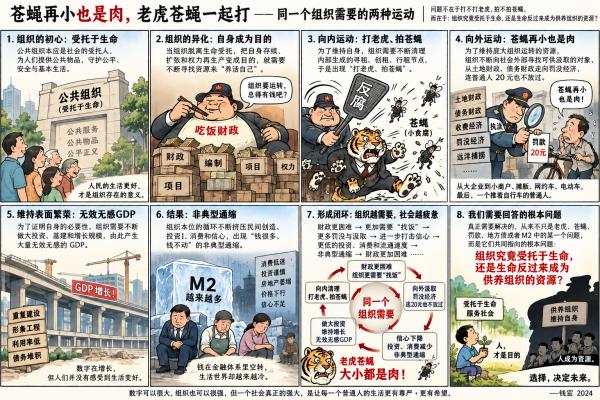
近日网络流传一则基层执法事件:两名普通人步行推着自行车,却被要求缴纳 20 元罚款。更刺眼的是,被罚人看到,执法人员手里还拿着一叠准备好的罚款票据。
一个个案的事实当然需要核实。
但它提出的问题,却值得认真追问:
一个拥有庞大 GDP、庞大 M2、庞大财政体系和庞大行政机器的经济体,为什么会出现基层组织连普通人口袋里的 20 元都不肯放过的现象?
20 元很小。
但正因为小,问题才大。
几千万、几个亿的罚没,还可以包装成重大案件;当财政汲取开始深入街头、小店、摊贩、电动车,甚至一个推着自行车走路的普通人,说明问题已经进入社会生活的毛细血管。
这时候,“苍蝇再小也是肉”,就成为观察一个经济体的微型切片。
它逼着我们重新追问:
GDP 究竟增长了什么?
财政究竟供养了什么?
组织究竟在为生命服务,还是开始反过来向生命索取?
也正是在这个意义上,海峡两岸提供了一个无法回避的现实比较。比较必须落在具体事实上:权力有没有边界?财政怎样运行?医疗怎样承兑?产权能不能得到保护?组织究竟是受托于生命,还是要求生命供养组织?
这些都可以观察、可以核算、可以比较。谁已经解决的问题,就是尚未解决者可以学习的经验。
一、20 元背后,是一整个财政结构
中国大陆今天许多基层财政困境,当然不能简单归咎于某一个警察、城管或者
基层干部。
如果只骂基层人员,反而把问题看小了。
问题首先发生在组织结构内部。
1994 年分税制改革重新划分了中央与地方收入来源和支出责任,显著增强了
中央财政汲取和宏观调控能力;与此同时,大量教育、医疗、社会保障、城市运行、
地方行政、公共安全和基础设施事务仍主要落在地方。
此后虽然不断建立和扩大中央对地方转移支付,并持续调整中央与地方财政事
权与支出责任,但地方财政收入、支出责任和发展任务之间的张力并没有消失。
我对这一问题的注意,其实早在1990年代就开始了。当时,一位在省政府担任副秘书长的朋友跟我谈财政运行,曾用四个字概括他所看到的现象:“财政空转”。这个说法给我留下了很深的印象。
差不多在同一时期,朱镕基则公开说出了另外四个字:“吃饭财政”。1998年3月19日,在就任国务院总理后的记者招待会上,他谈到科教兴国为什么缺钱时直言:“政府机关庞大,‘吃饭财政’,把钱都吃光了。”
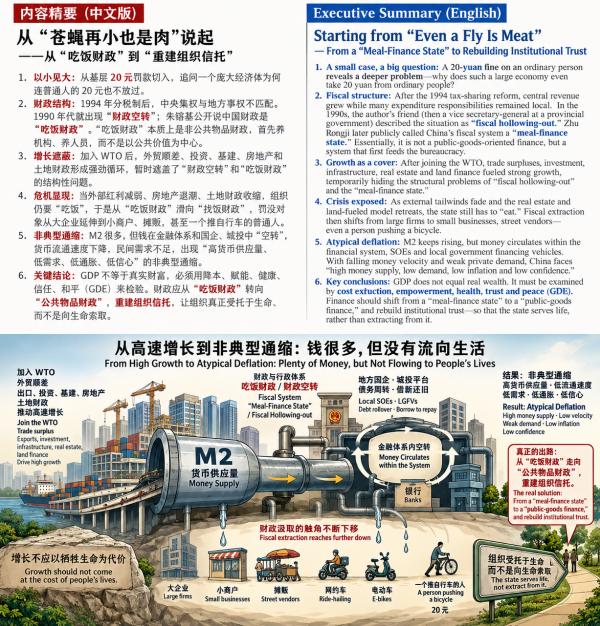
“财政空转”与“吃饭财政”放在一起,恰好揭示了当时中国财政转型中的一个深层问题。所谓“吃饭财政”,说到底,就是还没有真正转向以提供公共物品、承兑公共价值为中心的“公共物品财政”。财政首先要养机构、养人员、维持行政组织自身运转,然后才谈还有多少资源能够用于社会公共需要。
两者的差别,不只是钱花在哪里,而是财政逻辑的起点不同:“吃饭财政”首先问,这么大的组织靠什么养活?“公共物品财政”首先问,社会为什么需要这个组织,它用受托的税收和公共资源提供了什么个人与市场不能有效提供的公共物品?
后来中国加入WTO,世界市场向中国制造业大规模打开,持续的外贸顺差带来了巨大的外部需求和资金来源。出口、投资、基建、房地产、土地财政相互推动,形成了强劲的增长循环。这种“制度外部性”给大陆带来了巨大的发展机会,也在相当长时期内遮盖了“财政空转”和“吃饭财政”没有完成根本转型的问题。
外部需求强劲的时候,出口创造现金流,投资扩大产能,基建吸收资金,房地产与土地财政又把资产价格、银行信用和地方财政连接起来。大量投资和基建性消费,使庞大的组织成本看起来可以被增长不断消化。可一旦外部红利减弱、房地产退潮、土地财政收缩,过去被高速增长遮蔽的问题便重新浮出水面:行政机器仍然要“吃饭”,债务仍然要偿还,融资平台仍然要周转,而能够创造新增现金流的地方却越来越少。
于是,“吃饭财政”就可能进一步滑向“找饭财政”。土地是饭,融资是饭,收费是饭,罚没也可能成为饭。真正需要完成的财政转型,不是再寻找下一种更大的“饭”,而是从“吃饭财政”走向“公共物品财政”,从组织本位财政走向生命受托财政。
地方怎么办?
过去二十多年,一条非常重要的解决路径就是:土地。
卖地——融资——基建——城市扩张——土地升值——继续卖地——继续融资。
地方融资平台、城投债、房地产开发和大规模基础设施投资,由此逐渐形成相互支撑的循环。
房地产上涨时期,这套机器显得异常强大。
GDP 增长。
城市扩大。
地价上涨。
财政扩张。
银行资产负债表扩张。
所有人似乎都在同一条向上的曲线上。
可是,一个最简单的问题迟早会出现:
如果土地卖不动了呢?
卖地收入会下降。
债务却不会自动消失。
房地产可以萎缩,行政机器却不会自动缩小。
融资平台仍然要还本付息。
基层公务体系仍然每天需要工资、办公、车辆以及各种运行费用。
过去被土地增值遮蔽的巨大组织成本,于是开始裸露出来。
到了这一步,一个危险的转变便可能发生:组织从创造、维护公共价值,转向寻找能够提供现金流的对象。
这就是组织信托开始倒置的地方。
二、GDP 最大的问题,不一定是假,而是它没有告诉你毁掉了什么
人们常说大陆存在大量“无效 GDP”。
这个说法需要讲得准确一点。
问题未必首先在 GDP 数字“造假”。
更深的问题是:
GDP 这个指标本来就不能完整回答一个社会究竟增加了多少真实财富。
GDP 计算一定时期新生产的最终产品和服务。
于是,一个地方投入巨资建设利用率极低甚至规划错误的工程,会形成当期经济活动;后来拆除、改造、重新建设,又会产生新的生产和投资活动。
可是,前面被浪费掉的资本、材料、土地、时间、环境资源以及机会成本,并不会像企业资产负债表上的损失那样,从 GDP 中逐项对称扣除。
于是便可能出现一种非常荒诞的情形:
社会越来越忙,投资越来越大,债务越来越多,GDP 也越来越高,而真正能够改善生活的净财富增加却越来越慢。
所以,我一直认为,GDP 需要接受 GDE(Gross Domestic Energy / Efficiency)的检验。
经济活动不能因为“动起来”就自动获得价值。
它必须继续回答:
有没有降本(C)?
有没有赋能(E)?
有没有增加健康(H)?
有没有生成信任(T)?
有没有促进和平(P)?
忙碌不等于创造。
投资不等于财富。
花钱不等于赋能。
GDP 增长,更不自动等于生命处境改善。
三、从“远洋捕捞”到 20 元:财政汲取开始寻找越来越小的对象
当土地财政衰退、债务压力上升以后,一个更加值得警惕的现象出现了:
罚没越来越容易受到财政激励的污染。
正常社会当然需要行政执法,也必然存在罚款。
真正的问题不是有没有罚款。
问题是:罚款究竟是维护规则的结果,还是逐渐异化为维持组织现金流的手段?
近年来舆论所说的“远洋捕捞”,就是一种极端表现:某些地方执法、司法机关跨区域查封、冻结、扣押甚至罚没外地民营企业资产。
真正受到伤害的不只是某一家企业。
更重要的是整个社会对于一个问题的预期:
“我今天合法创造出来的财富,明天还安不安全?”
一旦这个预期被破坏,企业家的理性反应就会发生改变。
少投资。
少扩张。
少雇人。
资产外移。
甚至干脆退出。
而当能够提供大额财政收入的对象越来越少,财政压力又可能继续沿着组织链条向下传导。
企业。
商户。
摊贩。
网约车。
电动车。
最后,一个推自行车的人。
20 元。
金额越来越小,触角越来越密。
这才是“苍蝇再小也是肉”真正令人不安的地方:财政汲取已经开始寻找社会生活中越来越微小的对象。
四、大陆的“非典型通缩”:为什么物价跌了,钱却变多了?
这条从“财政空转”“吃饭财政”一路延伸到投资、基建、土地和债务的历史线索,也帮助我们理解大陆今天一个更加反常的经济现象:物价承压,钱却越来越多。
在经典的经济学常识中,通缩(Deflation)通常伴随着货币与信用收缩。1930年代大萧条留给人的典型印象,就是银行倒闭、信用坍塌、市场缺钱。但大陆近年来呈现出的图景不同:M2规模巨大,银行体系流动性充裕,居民存款增加;与此同时,CPI和PPI长期在低位徘徊,房地产萎缩,民营投资谨慎,普通人的生活感受却越来越“冷”。
这正是大陆的“非典型通缩”:不是简单的货币总量不足,而是高货币供应量与低需求、低信心、低流通速度同时存在。
钱去哪了?
一个重要去向,就是金融体系与国有组织体系内部的“空转”。新增流动性并没有充分进入能够产生新价值、新收入和新消费的生活循环,而是相当一部分进入地方国企、城投平台和大型企业的债务周转:借新还旧、展期续贷、维持既有资产负债表。钱在银行、国企、城投和财政关联体系之间转动,却没有等比例转化为民营企业的新投资、居民的新收入和社会的新需求。
这与1990年代已经出现的“财政空转”具有内在连续性。加入WTO以后,巨大的外贸顺差和外部市场需求一度为这一结构注入强劲动力:出口创造现金流,投资扩大产能,基建吸收资金,房地产和土地财政再把资产价格与地方财政连接起来。外部增长红利使内部的组织成本和低效循环能够在更大的增长中被吸收、被遮盖。
可是,当外贸与外部环境不再能够像过去那样持续提供增量红利,房地产和土地财政也不能继续托举增长,原有循环便显出另一面:钱仍然可以被创造出来,却越来越难进入真正的价值生成。
为什么“钱生不了钱”?
因为真正承担分散创造的民营企业不敢轻易投资,普通居民对就业、医疗、养老、住房和未来收入的预期转弱,选择增加储蓄,把钱锁进银行;地方国企和城投获得的资金,又有相当部分用于维持旧债和既有项目,而不是生成新的高回报价值。
于是形成一种特殊的冻结:金融体系里的钱越来越多,生活世界里的钱却越来越不肯转动。
货币数量增加,并不等于货币有效流通。只要货币流通速度(Velocity of Money)持续下降,同样一元钱一年之内完成的交易、收入和价值承兑次数越来越少,名义上的巨额M2就可能与现实中的需求不足同时存在。
这就是“高货币供应量”之下的需求型通缩压力,也是大陆“非典型通缩”最值得注意的地方。
传统货币政策于是会遇到一个非常棘手的问题:继续放钱,并不自动等于继续创造需求。如果组织信托没有恢复,企业不敢投资,家庭不敢消费,地方融资只是借新还旧,那么新增货币还可能继续进入原有循环,进一步放大“钱很多、钱不动”的悖论。
但共生经济学还要继续追问:钱为什么不动?
货币不是存在银行体系里就自然形成经济活力。货币只有在人相信未来的时候才会流动。
企业家相信投资能够得到稳定回报,才会投资。家庭相信未来收入稳定,才敢消费。年轻人相信努力能够改善生活,才敢买房、结婚、生育、创业。财产所有者相信法律能够稳定保护他的财产,才愿意把储蓄变成长周期投资。
反过来,如果企业担心不可预测的行政干预;如果家庭担心就业、医疗、养老;如果普通人连一张罚单会从哪里冒出来都无法形成稳定预期,那么最理性的行为是什么?
不是投资。不是消费。而是:不动。
钱进入银行。企业停止扩张。家庭推迟消费。年轻人推迟人生计划。资本寻找更加安全的地方。
这不只是缺钱。更深处是:缺信。
货币流通速度下降的背后,是价值承兑关系受阻;价值承兑关系受阻的背后,又是组织信托下降。由此形成一个恶性循环:组织缺钱——继续融资与汲取——企业和居民预期转弱——投资消费下降——货币流通速度下降——价格与收入承压——财政收入进一步困难——组织更加缺钱。
这才是大陆“非典型通缩”真正危险的地方。它不是单纯的价格问题,而是财政、金融、组织信托与生命预期彼此锁死以后形成的恶性经济循环。
五、再看台湾:真正值得研究的不只是“硅盾”
台湾近年来因为 AI、先进制程和半导体产业获得新的增长动力。
人们喜欢谈“硅盾”,喜欢谈台积电。
可是,真正值得大陆研究的台湾,远远不只有台积电。
还有一个不那么耀眼,却更加深入普通人生活的东西:
组织信托。
台湾的政府当然会犯错。
台湾也有官僚主义,也有腐败,也有行政争议。
关键从来不是有没有坏人。
现代制度真正解决的问题,是:
坏人也不能想干什么就干什么,好人也不能因为自认为动机正确就拥有无限权力。
公共权力必须有来源。
行政行为必须有法律依据。
罚款可以申诉。
政府可以被告。
预算必须接受监督。
官员必须接受议会、媒体、司法和选民检验。
这里发生的是公共组织性质的改变:
权力不是组织自己的。
财政不是组织自己的。
国家也不是哪个执政者、政党或者官僚集团自己的。
公共组织拥有的,只是社会托付给它、并且附带边界与责任的权力。
这就是组织信托。
六、全民健保:真正值得学习的是怎样把大组织做成低成本受托组织
台湾全民健康保险尤其值得研究。
它采用单一保险人制度,由一个公共保险体系统一筹资、统一购买医疗服务。
它真正重要的地方,不只是“福利”。
而是:
组织方式改变以后,大量本来可能耗散在重复保险行政、核保、广告、支付摩擦和多头博弈中的成本被压缩下来,再转化成普通人的医疗可及性。
这恰恰符合共生经济学的一个基本逻辑:
降本,就是赋能。
好的公共组织,不应该用自己拥有多少机构、多少人员、多少预算证明伟大。
恰恰相反:
用越小的组织摩擦承兑越大的公共价值,才是组织效能。
台湾全民健保当然还有自己的问题:
人口老龄化。
医护人员负担。
部分支付标准。
财务可持续性。
这些都需要继续改革。
但这与另一个更加基础的问题不同:
普通人会不会因为生病而失去基本生活保障?
前者是一个已经建立起来的组织信托怎样继续改进的问题。
后者则是组织信托有没有真正建立的问题。
这个区别,非常重要。
七、台湾也要继续改革,但这不能抵消大陆向台湾学习的现实方向
台湾今天并非没有严重问题。
半导体与 AI 产业创造的大量财富,怎样更多承兑为普通人的工资和生活改善?
高房价怎样缓解?
高科技产业与传统制造业、服务业之间的收入落差怎样缩小?
年轻人的住房负担怎样下降?
全民健保怎样在老龄化时代继续维持品质与财政平衡?
这些都是台湾必须继续面对的问题。
指出这些问题,并不是为了做一个“两边各打五十大板”的平衡。
因为本文真正讨论的是另一个问题:
就现代公共组织的性质而言,台湾已经建立起来的组织信托经验,有没有值得大陆学习的地方?
答案非常明确:
有。
而且大陆今天重建组织信托,已经绕不过这一历史大考。
八、大陆真正绕不过去的历史大考:重建组织信托
土地财政只是症状。
地方债只是症状。
罚没经济也是症状。
甚至“远洋捕捞”和街头 20 元罚款,都只是组织病理走到末梢以后出现的症状。
真正的问题发生在更深处:
公共组织究竟为什么存在?
如果这个问题没有改变,那么今天堵住罚没创收,明天可能出现另一种收费创收;
今天整顿“远洋捕捞”,明天可能产生另一种财政汲取;
今天反掉一批贪官,明天还会生成新的寻租节点。
因为只要组织把自己的存续、扩张和权力再生产变成目的,它就必然不断寻找新的资源供养自己。
这就是:
组织信托倒置(Trusteeship Inversion)。所以,大陆今天真正绕不过去的历史大考,不只是反腐,不只是化债,不只是刺激消费,也不只是再进行一次中央地方财政调整。
所有这些改革,最终都必须汇聚到一个更加根本的转向:
重建组织信托。
让政府重新回到受托者的位置。
让权力成为受托权力。
让财政成为受托财政。
让公共资产成为受托资产。
让行政组织重新成为服务生命、降低社会成本、维护价值承兑的受托组织。
否则,财政改革可能最终只是组织内部重新分钱;
机构改革可能只是重新组合机构;
反腐可能变成周期性的组织清洗;
而数字政府甚至可能把过去效率较低的权力扩张,升级为更加高效的数字化权力扩张。
技术可以提高组织效率,却不能自动改变组织性质。
这也是 AI 时代真正值得警惕的地方。
九、31 个实际行政辖区都治理好了吗?
到这里,一个极其朴素的问题就无法绕开了。
中国大陆现有 31 个由北京实际行政管辖的省、自治区、直辖市。
那么:
这 31 个地方都治理好了吗?
地方债解决了吗?
土地财政摆脱了吗?
基层罚没创收消失了吗?
民营企业家的产权安全得到稳定保障了吗?
居民普遍获得低成本、高品质、有尊严的医疗保障了吗?
公共财政真正成为透明的受托财政了吗?
公权力真正建立起不可任意越过的法律边界了吗?
如果这些发生在自己实际行政辖区内、直接关系十四亿人每天生活的问题还没有解决,为什么国家最重要的政治注意力之一,反而长期放在:
怎样去治理台湾?
这个问题尤其值得那些鼓吹“武统”的人回答。
战争需要多少钱?
军备需要多少钱?
战后治理需要多少钱?
产业链断裂需要付出多少代价?
贸易、金融、科技、人员伤亡又需要付出多少代价?
甚至有人喊出令人毛骨悚然的“留岛不留人”。
那么只需要问一句:
如果连人都不要了,还要那个岛干什么?
国家存在的目的,究竟是保护生命,还是为了地图上的一块颜色,可以把生命本身当作代价?
这已经不只是战略问题。
这是文明常识。
十、“和统”同样需要接受组织信托的检验
“武统”如此,“和统”也不能因为前面有一个“和”字,就天然获得正当性。
如果“和”意味着长期和平交往、增加连接、减少敌意、尊重台湾人民已经形成的生活方式,那么当然值得珍惜。
但如果所谓“和统”,实际意味着通过政治渗透、经济收买、组织控制等方式逐步改变台湾现有制度性质,最终仍然是要把台湾纳入大陆现有的组织逻辑,那么它与本文所说的“向台湾学习”,方向恰恰相反。
真正需要发生的变化,不是:
怎样把台湾改造成大陆。
而是:
大陆怎样首先改变自己。
大陆真正紧迫的历史任务,不是再去增加自己治理的土地,而是首先把自己实际治理的 31 个省级行政区建设成现代正常文明社会应该有的样子。
让警察不需要寻找 20 元罚款维持组织运行;
让地方政府不需要依赖卖地维持财政;
让企业家不必担心不可预测的罚没;
让居民敢消费;
让年轻人敢规划未来;
让医疗成为生命保障,而不是家庭命运的赌博;
让财政接受监督;
让权力知道边界;
让政府重新成为受托组织。
统一不能替代治理。
把另一个地方纳入行政版图,也不能解决现有 31 个实际行政辖区已经存在的组织问题。
如果组织性质没有改变,不过是把原有问题扩大到新的地方。
十一、台湾不是大陆的“核心利益”,向台湾学习才是大陆的“核心利益”
于是,我们终于可以重新审视那个被重复了几十年的政治命题:究竟什么才是大陆真正的核心利益?
十四亿人的生命安全是不是核心利益?财产安全是不是核心利益?年轻人能够就业、成家、生育、创造,是不是核心利益?企业家敢投资、敢创造,是不是核心利益?地方政府摆脱土地财政、债务依赖和罚没冲动,是不是核心利益?公共权力受到约束、财政受到监督、社会重新生成组织信托,是不是核心利益?
当然是。
而且这些利益不是地图上的抽象概念。它们每天发生在十四亿人的生活里。
因此,我们有必要把那句已经说了几十年的话重新翻转过来:
台湾不是大陆的“核心利益”。
向台湾学习,才是大陆的“核心利益”。
这句话的重点不在台湾,而在大陆自身。
台湾至少证明了一件极其重要的事情:华人社会并不存在无法建立现代组织信托的文化宿命。
华人社会可以建立覆盖全民的单一保险人医疗制度;可以让行政权受到司法、议会、媒体和公民监督;可以让私人企业在相对稳定的产权预期中成长;可以通过制度程序更换执政者,而国家不因此崩溃;也可以在这样的环境中成长出进入全球先进产业核心的企业。
这才是台湾对于大陆最重要的现实意义。
台湾首先不应该被看成一个等待大陆“解决”的对象。它更应该被看成一个已经发生在中国文明内部的现代组织经验。
这也不是我今天面对台海紧张才形成的看法。2008年观察台湾大选以后,我就形成了一个此后一直没有改变的基本判断:大陆先把自己的事情弄好,再谈什么“台湾问题”。
十八年过去,今天回头看,我反而觉得这句话还说得保守了。因为问题并不仅仅是谁先谁后的问题。
如果所谓“台湾问题”,指的是一个等待大陆最终加以“解决”的政治对象,那么我今天愿意把这个判断说得更加明确:
世界上早已经根本不存在所谓的“台湾问题”。
台湾在那里。两千多万人在那里生活。政府、议会、司法、军队、货币、税收、选举、全民健保、企业与社会组织,都已经在那里持续运行。台湾与美国、日本、欧洲、大陆以及世界各地,每天都在发生贸易、投资、旅行、教育、科技与文化往来。
这是一个已经存在、已经生活、已经自行运行数十年的现实。现实本身并没有等待谁去“解决”。
所谓“台湾问题”,很大程度上是把一个已经存在的生活现实,重新装进一个由别人规定、等待别人解决的政治问题框架。
所以,我2008年说“大陆先把自己的事情弄好”,并不是说:等大陆治理好了,再去解决台湾。如果这样理解,仍然没有跳出原来的问题框架。
真正应该反过来问:大陆如果真的把自己治理好了,为什么还需要“解决台湾”?
大陆实际治理的31个省、自治区、直辖市,已经足够广大;十四亿人的生活,已经足够重要。地方债、土地财政、青年就业、房地产、医疗养老、民营企业信心、基层罚没、“远洋捕捞”、产权安全、数字权力边界,以及AI进入公共治理以后可能产生的新型组织控制——哪一件不是大陆自己迫切需要解决的问题?
归根到底,还是那一道绕不过去的历史大考:重建组织信托。
所以,“向台湾学习才是大陆的核心利益”并不是一句两岸友好的外交辞令,而是一种政治注意力的转向:不要再把一个已经自行生活的台湾不断制造成大陆必须解决的“核心问题”;先把大陆自己的事情弄好,先把自己实际治理的31个省级行政区治理成现代正常文明国家应有的样子。
如果大陆因为主权叙事而拒绝看见台湾已经形成的组织信托经验,甚至为了所谓“解决台湾问题”而毁掉这一经验,那么损失的不只是台湾,也是大陆自己。
十二、不要让台湾问题横亘在中美合作之间
一旦看清这一点,中美关系中一个长期被固化的问题也应该重新审视:为什么一个本来就不需要被制造出来的“台湾问题”,必须长期横亘在中美之间,甚至成为最危险的战争引信?
这不是一个无关紧要的措辞问题。一个假问题一旦被国家机器长期当成真问题,就会制造真实成本。
为了“解决台湾问题”,大陆需要持续投入军备、外交、宣传和统战资源;美国据此强化印太军事部署、科技限制和供应链重组;台湾则被推向更强的安全焦虑和军事准备。一个被不断强化的政治预设,最终反过来塑造现实:彼此猜疑,彼此设防,彼此把对方越来越多的行为解释为敌意。
结果不只是台海危险。
大陆整个国际环境都会因此受到牵连。
周边国家会重新计算安全距离;资本会重新计算地缘风险;企业会重新安排供应链;科技合作会被安全逻辑切割;人员、教育与民间交往也会受到政治气候挤压。原本可以谈贸易的问题,被安全化;原本可以合作的科技,被阵营化;原本可以保持差异的国家关系,被一步一步推向敌我化。
这笔机会成本巨大,而且最终仍然由普通人的就业、收入、消费、企业经营和发展机会承担。
中美之间真正的大事太多了。
AI、生命科学、贸易、金融稳定、能源、气候、太空、核风险、全球公共卫生——哪一件不直接关系中国十四亿人的未来?哪一件不需要世界上两个最有能力影响二十一世纪进程的大国保持基本合作?
如果一种“核心利益”叙事最后产生的实际效果,是中国增加军备,美国增加围堵,台湾增加军事化,东亚增加战争风险,中美科技与贸易合作不断被侵蚀,大陆自己的国际环境不断恶化,那么就必须追问:这个“核心利益”究竟保护了多少真实利益,又消耗了多少真实利益,耽误了多少正事啊?!
国家利益不能脱离人的生活独立存在。
如果一种国家利益叙事不断增加十四亿人的战争风险、贸易成本、科技脱钩成本和发展成本,那么这个叙事本身就必须接受重新检验。
所以,问题已经不是怎样让“台湾问题”少影响一点中美关系,而是应该进一步问:为什么还要让一个被人为维持的假问题继续占据中美关系的中心?
世界上早已不存在一个等待大陆去“解决”的所谓“台湾问题”;真正存在的是两岸之间一个个具体问题,也是中美之间一个个具体问题。贸易问题就谈贸易,安全问题就谈安全,人员往来就解决人员往来,技术规则就谈技术规则。发生什么问题,就解决什么问题。
不要先制造一个包罗一切的“台湾问题”,再让所有现实利益都为这个抽象命题让路。
大陆真正需要的,不是让台湾成为中美博弈的中心,而是为自己争取一个更和平、更开放、更有利于发展和重建组织信托的国际环境。
中国需要发展,美国也需要发展。中美之间当然会竞争,也会有冲突,但竞争没有理由必然走向敌对,差异更没有理由把两个核大国推向战争。
台湾完全没有必要成为中美战争的引信,更不应该成为大陆搞坏整个国际环境的支点。把台湾从一个必须“解决”的假问题中解放出来,也就是把大陆自己从这个政治执念制造的巨大成本中解放出来。
大陆真正需要解决的问题,在大陆自己;大陆真正需要重建的,是组织信托;大陆真正需要争取的,是能够让十四亿人继续创造、交易、学习、生活并与世界保持连接的和平环境。
十三、那20元钱,最后问的是:国家究竟为了什么?
于是,我们又回到了文章开头的20元。
与庞大的GDP相比,它小得几乎看不见。
但正是这20元,把宏观经济、财政结构、行政权力、组织信托和一个普通人的生命处境全部连接起来了。
一个拥有庞大GDP、庞大M2、世界级制造能力、核武器、航天工程和人工智能技术的国家,如果基层组织最后仍然需要寻找普通人口袋里的20元,那么真正需要重新检验的,就不只是经济增长。
而是:组织究竟为了什么?
政府究竟是生命委托出来的组织,还是生命必须供养的权力机器?
国家究竟以十四亿人的生命展开为目的,还是十四亿人反过来成为国家机器运行的资源?
所以,大陆今天真正紧迫的历史大考,不是怎样治理台湾,而是怎样治理好自己。更准确地说:怎样重建组织信托。
大陆实际治理的31个省级行政区,已经提供了足够广阔的改革天地。财政需要改革,医疗需要改革,产权保护需要改革,中央地方关系需要改革,行政问责需要改革,数字权力需要建立边界,AI时代的政府更需要重新确立自己的受托性质。
这些事情哪一件不比想着怎样再去治理台湾更加迫切?
所以:
台湾不是大陆的“核心利益”。
向台湾学习,才是大陆的“核心利益”。
学习的不是一个政治标签,更不是照搬一种制度名称。真正需要学习的是现代公共组织最根本的一条文明原则:权力是受托的。
财政是受托的。政府是受托的。国家最终也是为了生命而组织起来的。
如果这一点不能建立,那么拥有更多土地,并不会自动带来更好的治理。
如果这一点能够建立,很多今天看似无法解决的问题,反而会出现新的可能。
因此,真正值得发生的政治转向是:从想着怎样治理台湾,转向首先治理好自己;从争夺一个岛,转向重建31个实际行政辖区的组织信托;从证明国家能够控制多少土地,转向证明公共组织能够得到多少生命的信托;从让一个假“台湾问题”绑架中美关系、恶化大陆国际环境,转向中美共同解决二十一世纪真正的大问题。
这才是那20元钱最终逼我们回答的问题。
苍蝇再小也是肉。
但国家再大,也不能靠吃生命维持自己。
生命,才是国家不能牺牲的核心利益。
Starting from “Even a Fly Is Meat”
— From a “Meal-Finance State” to Rebuilding Organizational Trust
Archer Hong Qian
“Even a fly is meat.” It was originally just a folk saying.
But when this saying enters the realm of grassroots public finance and administrative law enforcement, it is no longer funny at all.
Recently, a grassroots enforcement incident circulated online: two ordinary people were walking while pushing their bicycles, yet they were reportedly required to pay a fine of RMB 20. More strikingly, the people being fined noticed that the enforcement officers were holding a stack of pre-prepared fine receipts.
The facts of any individual case, of course, need to be verified.
But the question it raises deserves serious attention:
Why would an economy with an enormous GDP, an enormous M2 money supply, an enormous fiscal system, and an enormous administrative apparatus reach a point where grassroots organizations would not even let go of the 20 yuan in an ordinary person’s pocket?
Twenty yuan is very little.
But precisely because it is so little, the question is so large.
Confiscations and fines involving tens of millions or hundreds of millions can still be packaged as major cases. But when fiscal extraction begins penetrating streets, small shops, vendors, electric bicycles, and even an ordinary person simply walking while pushing a bicycle, it means that the problem has entered the capillaries of everyday social life.
At that point, “even a fly is meat” becomes a microscopic cross-section through which an entire economy can be observed.
It forces us to ask again:
What, exactly, has GDP growth increased?
What, exactly, does the fiscal system sustain?
Do organizations exist to serve life, or have they begun to extract resources from life in order to sustain themselves?
It is in this sense that the two sides of the Taiwan Strait offer an unavoidable real-world comparison. The comparison must be grounded in concrete realities: Does public power have boundaries? How does the fiscal system operate? How is healthcare value fulfilled? Can property rights be protected? Are organizations entrusted by life, or is life required to sustain organizations?
These are all observable, measurable, and comparable questions.
Where one side has already solved a problem, its experience can be studied by the side that has not.
I. Behind Twenty Yuan Lies an Entire Fiscal Structure
Many of the fiscal difficulties facing grassroots governments in mainland China today cannot simply be blamed on an individual police officer, urban-management officer, or local official.
If we merely blame grassroots personnel, we make the problem smaller than it really is.
The problem begins within the organizational structure itself.
The 1994 tax-sharing reform reallocated revenue sources and expenditure responsibilities between the central and local governments. It significantly strengthened the central government’s fiscal capacity and macroeconomic control. At the same time, however, much of the responsibility for education, healthcare, social security, urban operations, local administration, public safety, and infrastructure remained at the local level.
Although central-to-local transfer payments were subsequently established and expanded, and fiscal responsibilities and expenditure responsibilities continued to be adjusted, the tension among local revenues, spending obligations, and development responsibilities never disappeared.
My attention to this issue actually began in the 1990s.
At that time, a friend who served as a deputy secretary-general in a provincial government spoke with me about fiscal operations. He summarized what he was observing in four Chinese characters:
“Fiscal hollowing-out” — 财政空转.
The phrase left a deep impression on me.
At roughly the same time, Zhu Rongji publicly used another four-character expression:
“Meal-finance state” — 吃饭财政.
On March 19, 1998, at the press conference following his appointment as Premier of the State Council, Zhu spoke about why China lacked sufficient resources to implement its strategy of revitalizing the country through science and education. He put it bluntly:
“Government agencies are bloated. It is a ‘meal-finance state’; all the money has been eaten up.”
“Fiscal hollowing-out” and the “meal-finance state,” taken together, exposed a deeper problem in China’s fiscal transition at the time.
A “meal-finance state,” in essence, is a fiscal system that has not truly completed the transition toward public-goods finance centered on providing public goods and fulfilling public value.
Fiscal resources first have to feed institutions, personnel, and the administrative machinery itself. Only afterward does the question arise of how much remains available for the public needs of society.
The difference is not simply where the money is spent.
The difference lies in the starting point of fiscal logic.
A “meal-finance state” first asks:
How can such a large organization be fed?
Public-goods finance first asks:
Why does society need this organization in the first place, and what public goods—goods that individuals and markets cannot efficiently provide—does it deliver with the taxes and public resources entrusted to it?
China later joined the WTO, and global markets opened on a massive scale to Chinese manufacturing. Sustained trade surpluses brought enormous external demand and financial resources.
Exports, investment, infrastructure, real estate, and land finance reinforced one another, creating a powerful cycle of growth.
This “institutional externality” created enormous development opportunities for mainland China. But for a considerable period, it also concealed the fact that the underlying problems of “fiscal hollowing-out” and the “meal-finance state” had never completed their fundamental transformation.
When external demand was strong, exports generated cash flow, investment expanded production capacity, infrastructure absorbed capital, while real estate and land finance connected asset prices, bank credit, and local government finance.
Massive investment and infrastructure-driven consumption made enormous organizational costs appear capable of being continuously absorbed by growth.
But once the external dividend weakened, real estate retreated, and land-finance revenues contracted, the problems previously concealed by rapid growth resurfaced:
The administrative apparatus still had to “eat.”
Debts still had to be repaid.
Local government financing vehicles still had to roll over their obligations.
Yet the places capable of generating new cash flow became fewer and fewer.
At that point, the “meal-finance state” can slide further into a “find-a-meal fiscal system.”
Land becomes food.
Financing becomes food.
Fees become food.
Fines and confiscations can also become food.
The fiscal transformation that truly needs to occur, therefore, is not to find the next larger “meal.”
It is to move from a “meal-finance state” to public-goods finance, and from organization-centered finance toward life-entrusted finance.
What, then, could local governments do?
Over the past two decades, one extremely important answer was:
Land.
Sell land — finance — build infrastructure — expand cities — raise land values — sell more land — borrow more — build more.
Local government financing vehicles, municipal investment bonds, real estate development, and large-scale infrastructure investment gradually formed a mutually reinforcing cycle.
During the real estate boom, this machine looked extraordinarily powerful.
GDP grew.
Cities expanded.
Land prices rose.
Fiscal revenues expanded.
Bank balance sheets expanded.
Everyone seemed to be riding the same upward curve.
But sooner or later, one very simple question had to arise:
What happens when the land can no longer be sold?
Land-sale revenue declines.
Debt does not automatically disappear.
Real estate can contract, but the administrative apparatus does not automatically shrink.
Financing vehicles still have principal and interest to repay.
Grassroots bureaucratic systems still require salaries, offices, vehicles, and operating expenses every day.
The enormous organizational costs previously concealed by rising land values are suddenly exposed.
At this point, a dangerous transformation can occur:
Organizations shift from creating and maintaining public value toward searching for objects capable of providing cash flow.
This is where organizational trust begins to invert.
II. The Greatest Problem with GDP May Not Be That It Is False, but That It Does Not Tell You What Has Been Destroyed
People often speak of large amounts of “ineffective GDP” in mainland China.
That claim needs to be stated more precisely.
The first problem is not necessarily that GDP statistics are “fabricated.”
The deeper problem is this:
GDP, by its very nature, cannot fully tell us how much genuine wealth a society has actually created.
GDP measures the final goods and services produced within a given period.
Thus, if a locality spends enormous sums building a project with extremely low utilization—or even one based on mistaken planning—the construction still generates economic activity during that period.
If the project is later demolished, reconstructed, or redesigned, that process generates still more production and investment activity.
Yet the capital, materials, land, time, environmental resources, and opportunity costs wasted in the first round are not symmetrically deducted from GDP as losses in the way they would appear on a corporate balance sheet.
An absurd situation can therefore emerge:
Society becomes busier and busier.
Investment becomes larger and larger.
Debt becomes heavier and heavier.
GDP becomes higher and higher.
Yet the net increase in wealth that actually improves people’s lives grows more and more slowly.
This is why I have long argued that GDP must be examined through GDE — Gross Domestic Energy / Efficiency.
Economic activity does not automatically acquire value merely because something is “moving.”
It must answer further questions:
Has it reduced costs — C?
Has it empowered life — E?
Has it improved health — H?
Has it generated trust — T?
Has it promoted peace — P?
Busyness is not the same as creation.
Investment is not the same as wealth.
Spending money is not the same as empowerment.
And GDP growth certainly does not automatically mean an improvement in the condition of life.
III. From “Deep-Sea Fishing” to Twenty Yuan: Fiscal Extraction Searches for Ever Smaller Targets
As land finance declines and debt pressure increases, another development deserves even greater vigilance:
Fines and confiscations become increasingly vulnerable to fiscal incentives.
A normal society obviously needs administrative law enforcement, and fines will necessarily exist.
The real question is not whether fines exist.
The question is:
Are fines the consequence of enforcing rules, or are they gradually becoming a means of maintaining organizational cash flow?
The phenomenon popularly described in recent years as “deep-sea fishing” is an extreme manifestation: some local law-enforcement or judicial authorities cross jurisdictional boundaries to seize, freeze, impound, or confiscate the assets of private enterprises located elsewhere.
The damage is not limited to one company.
More important is what happens to society’s expectations regarding one fundamental question:
“Will the wealth I legally create today still be safe tomorrow?”
Once that expectation is destroyed, the rational response of entrepreneurs changes.
Invest less.
Expand less.
Hire fewer people.
Move assets elsewhere.
Or simply exit.
And as the number of targets capable of generating large fiscal revenues decreases, fiscal pressure can continue traveling downward through the organizational chain.
Enterprises.
Small businesses.
Street vendors.
Ride-hailing drivers.
Electric bicycles.
And finally:
A person pushing a bicycle.
Twenty yuan.
The amounts become smaller and smaller.
The reach becomes denser and denser.
This is what makes “even a fly is meat” truly disturbing:
Fiscal extraction has begun searching for increasingly tiny targets within everyday social life.
IV. Mainland China’s “Atypical Deflation”: Why Are Prices Falling While There Is More Money?
This historical line—from “fiscal hollowing-out” and the “meal-finance state” through investment, infrastructure, land, and debt—also helps explain an even more unusual phenomenon in mainland China today:
Prices are under downward pressure, while the amount of money keeps increasing.
In conventional economic understanding, deflation is usually associated with contraction in money and credit.
The classic image inherited from the Great Depression of the 1930s is one of bank failures, collapsing credit, and a market starved of money.
But mainland China in recent years presents a different picture.
M2 is enormous.
The banking system has ample liquidity.
Household deposits are rising.
At the same time, CPI and PPI have remained at low levels, real estate has contracted, private investment is cautious, and ordinary people increasingly feel an economic chill.
This is what I call mainland China’s “atypical deflation.”
It is not simply a shortage of money.
It is the simultaneous existence of:
high money supply, low demand, low confidence, and low money velocity.
So where has the money gone?
One important destination is the “hollow circulation” inside the financial system and the state-owned organizational system.
New liquidity does not sufficiently enter the living economic cycle where it could generate new value, new income, and new consumption.
Instead, a considerable portion enters the debt turnover of local state-owned enterprises, local government financing vehicles, and large enterprises:
Borrowing new money to repay old debt.
Extending maturities.
Rolling over loans.
Maintaining existing balance sheets.
Money circulates among banks, state-owned enterprises, LGFVs, and fiscal networks, but it does not translate proportionately into new private investment, new household income, and new social demand.
This has an internal continuity with the “fiscal hollowing-out” already observed in the 1990s.
After China joined the WTO, enormous trade surpluses and external market demand injected powerful momentum into this structure.
Exports generated cash flow.
Investment expanded capacity.
Infrastructure absorbed capital.
Real estate and land finance connected asset prices back to local government finance.
External growth dividends allowed internal organizational costs and inefficient circulation to be absorbed—and concealed—within a much larger growth process.
But when foreign trade and the external environment can no longer continuously provide the same incremental dividends, while real estate and land finance can no longer support growth as before, the other side of the old cycle becomes visible:
Money can still be created, but it becomes increasingly difficult for that money to enter genuine value generation.
Why can money no longer “make money”?
Because private enterprises—the dispersed creators of economic value—hesitate to invest.
Ordinary households, facing weaker expectations regarding employment, healthcare, pensions, housing, and future income, increase their savings and lock money into banks.
Meanwhile, a significant share of the funding received by local SOEs and LGFVs is used to sustain old debts and existing projects rather than generate new, high-return value.
A peculiar freeze therefore emerges:
There is more and more money inside the financial system, yet money in the world of everyday life becomes less and less willing to move.
An increase in the quantity of money does not mean an increase in effective monetary circulation.
If the velocity of money continues to fall, the same yuan completes fewer transactions, income payments, and acts of value fulfillment over the course of a year.
An enormous nominal M2 can therefore coexist with severe weakness in real demand.
This is the demand-side deflationary pressure beneath a high money supply, and it is the most important feature of mainland China’s “atypical deflation.”
Traditional monetary policy then encounters an extremely difficult problem:
Releasing more money does not automatically create more demand.
If organizational trust has not recovered, enterprises will remain reluctant to invest.
Households will remain reluctant to consume.
If local financing is primarily used to roll over existing debt, newly created money may simply re-enter the old circuit and further intensify the paradox of:
“A lot of money, but money does not move.”
Symbionomics therefore asks a further question:
Why does money not move?
Money does not automatically generate economic vitality simply because it exists inside the banking system.
Money moves only when people believe in the future.
Entrepreneurs invest when they believe investment can produce stable returns.
Families consume when they believe future income is reasonably secure.
Young people buy homes, marry, have children, and start businesses when they believe effort can improve their lives.
Property owners transform savings into long-term investment when they believe the law will reliably protect their property.
Conversely, if enterprises fear unpredictable administrative intervention;
if families fear unemployment, medical expenses, and old age;
if ordinary people cannot even form stable expectations about where the next fine might come from—
what is the most rational response?
Not investment.
Not consumption.
But:
Do nothing.
Money goes into banks.
Enterprises stop expanding.
Families postpone consumption.
Young people postpone life plans.
Capital searches for safer places.
This is not merely a shortage of money.
At a deeper level, it is:
a shortage of trust.
Behind declining money velocity lies an obstruction in the relationships through which value is fulfilled.
Behind that obstruction lies the decline of organizational trust.
An adverse cycle therefore takes shape:
Organizations lack money
→ continue borrowing and extracting
→ expectations among enterprises and households weaken
→ investment and consumption decline
→ money velocity falls
→ prices and incomes come under pressure
→ fiscal revenues become still more difficult
→ organizations face still greater shortages of money.
This is the real danger of mainland China’s “atypical deflation.”
It is not merely a problem of prices.
It is a vicious economic cycle formed when public finance, finance, organizational trust, and expectations about life become locked together.
V. Looking Again at Taiwan: What Deserves Study Is More Than the “Silicon Shield”
In recent years, Taiwan has gained new growth momentum from AI, advanced semiconductor manufacturing, and related industries.
People like to talk about the “silicon shield.”
They like to talk about TSMC.
But what mainland China should study in Taiwan goes far beyond TSMC.
There is something less glamorous, yet much more deeply embedded in ordinary people’s lives:
organizational trust.
Taiwan’s government certainly makes mistakes.
Taiwan has bureaucracy.
It has corruption.
It has administrative disputes.
The key question has never been whether bad people exist.
What modern institutions actually solve is this:
Bad people cannot simply do whatever they want, and good people do not acquire unlimited power merely because they believe their intentions are good.
Public power must have a legitimate source.
Administrative actions must have a legal basis.
Fines can be appealed.
The government can be sued.
Budgets must be supervised.
Officials must face scrutiny from the legislature, the media, the judiciary, and voters.
What has occurred here is a transformation in the nature of public organization:
Power does not belong to the organization itself.
Fiscal resources do not belong to the organization itself.
The state does not belong to any particular ruler, political party, or bureaucratic group.
What a public organization possesses is only power entrusted to it by society—and that power comes with boundaries and responsibilities.
This is organizational trust.
VI. National Health Insurance: What Truly Deserves Study Is How to Make a Large Organization a Low-Cost Trustee
Taiwan’s National Health Insurance deserves particular attention.
It uses a single-payer system in which one public insurance system pools funding and purchases medical services.
Its real significance is not simply that it provides “welfare.”
The deeper point is this:
By changing the organizational structure, a large amount of cost that might otherwise be dissipated through duplicated insurance administration, underwriting, advertising, payment friction, and multi-party bargaining can be compressed and transformed into greater healthcare accessibility for ordinary people.
This corresponds precisely to one of the fundamental principles of Symbionomics:
Reducing costs is empowerment.
A good public organization should not prove its greatness by showing how many agencies it possesses, how many people it employs, or how large its budget has become.
Quite the opposite:
The greater the public value fulfilled with the smaller the organizational friction, the greater the organizational efficiency.
Taiwan’s National Health Insurance certainly has its own problems:
Population aging.
The workload of medical personnel.
Certain reimbursement rates.
Long-term financial sustainability.
All of these require continuing reform.
But these questions are fundamentally different from another, more basic question:
Will ordinary people lose the foundations of their lives simply because they become ill?
The former concerns how an organizational trust system that has already been established can continue to improve.
The latter concerns whether organizational trust has genuinely been established at all.
That distinction matters enormously.
VII. Taiwan Must Continue to Reform, but That Does Not Cancel the Direction in Which the Mainland Needs to Learn from Taiwan
Taiwan today is not without serious problems.
How can more of the enormous wealth generated by semiconductors and AI be fulfilled in the form of higher wages and better lives for ordinary people?
How can high housing prices be eased?
How can income disparities between high-tech industries and traditional manufacturing and services be reduced?
How can the housing burden on young people be lowered?
How can National Health Insurance maintain quality and financial balance in an aging society?
These are all problems Taiwan must continue to confront.
Pointing them out is not an attempt to manufacture a “fifty blows for each side” rhetorical balance.
The real question of this essay is different:
In terms of the nature of modern public organization, does Taiwan possess experience in organizational trust that mainland China can learn from?
The answer is unequivocal:
Yes.
And rebuilding organizational trust has already become a historical test that mainland China cannot avoid.
VIII. Mainland China’s Unavoidable Historical Test: Rebuilding Organizational Trust
Land finance is only a symptom.
Local government debt is only a symptom.
A fine-and-confiscation economy is also only a symptom.
Even “deep-sea fishing” and a twenty-yuan street fine are merely symptoms appearing at the capillary end of organizational pathology.
The real problem lies deeper:
Why does a public organization exist?
If the answer to this question does not change, stopping fine-based revenue today may simply produce another form of fee-based revenue tomorrow.
Stopping “deep-sea fishing” today may produce another method of fiscal extraction tomorrow.
Removing one group of corrupt officials today may simply allow new rent-seeking nodes to emerge tomorrow.
As long as an organization turns its own survival, expansion, and reproduction of power into its purpose, it will inevitably continue searching for new resources with which to sustain itself.
This is:
Trusteeship Inversion.
Therefore, the historical test mainland China cannot avoid is not merely anti-corruption.
It is not merely debt restructuring.
It is not merely stimulating consumption.
Nor is it merely another adjustment in central-local fiscal relations.
All of these reforms must ultimately converge upon a more fundamental transformation:
Rebuilding organizational trust.
Return government to the position of trustee.
Make public power entrusted power.
Make public finance entrusted finance.
Make public assets entrusted assets.
Return administrative organizations to their proper nature as trustees that serve life, reduce social costs, and maintain the fulfillment of value.
Otherwise, fiscal reform may simply become another internal redistribution of money among organizations.
Institutional reform may merely rearrange institutions.
Anti-corruption may become a periodic organizational purge.
And digital government may upgrade what was once relatively inefficient expansion of power into a far more efficient form of digitally empowered expansion.
Technology can increase organizational efficiency.
It cannot automatically change organizational nature.
That is precisely what deserves vigilance in the age of AI.
IX. Have the 31 Jurisdictions Actually Governed by Beijing All Been Governed Well?
At this point, an extremely simple question becomes impossible to avoid.
Mainland China currently has 31 provinces, autonomous regions, and municipalities under Beijing’s actual administrative jurisdiction.
So:
Have these 31 places all been governed well?
Has local government debt been resolved?
Has dependence on land finance ended?
Has grassroots fine-based revenue disappeared?
Do private entrepreneurs enjoy stable protection of their property?
Do residents broadly enjoy affordable, high-quality, dignified healthcare protection?
Has public finance truly become transparent, entrusted finance?
Has public power genuinely acquired legal boundaries that cannot be crossed arbitrarily?
If these problems—problems occurring within the territory already under actual administration and directly affecting the daily lives of 1.4 billion people—remain unresolved, why should one of the country’s most important political preoccupations instead be:
How to govern Taiwan?
Those advocating “unification by force” should especially answer this question.
How much would war cost?
How much would military preparation cost?
How much would postwar governance cost?
What would the destruction of industrial and supply chains cost?
What would be the cost to trade, finance, technology, and human life?
Some people have even shouted the chilling slogan:
“Keep the island, not the people.”
Then one need ask only a single question:
If you do not even want the people, what do you want the island for?
Does the state exist to protect life?
Or can life itself be sacrificed merely for a patch of color on a map?
This is no longer simply a strategic question.
It is civilizational common sense.
X. “Peaceful Unification” Must Also Be Tested by Organizational Trust
What applies to “unification by force” also applies to “peaceful unification.”
The presence of the word “peaceful” does not automatically make something legitimate.
If “peace” means long-term peaceful interaction, increasing connections, reducing hostility, and respecting the way of life already formed by the people of Taiwan, then it is certainly worth cherishing.
But if so-called “peaceful unification” actually means gradually changing the nature of Taiwan’s existing institutions through political infiltration, economic inducement, or organizational control, with the ultimate goal of incorporating Taiwan into the mainland’s existing organizational logic, then its direction is precisely the opposite of what this essay means by:
learning from Taiwan.
The change that truly needs to happen is not:
How can Taiwan be transformed into the mainland?
It is:
How can the mainland first transform itself?
The mainland’s urgent historical task is not to increase the amount of territory it governs.
It is first to build the 31 provincial-level jurisdictions it already governs into what a modern, normal, civilized society should look like.
Let police officers have no need to search for twenty-yuan fines to sustain organizational operations.
Let local governments have no need to depend on selling land to sustain public finance.
Let entrepreneurs no longer fear unpredictable confiscation.
Let residents dare to consume.
Let young people dare to plan their futures.
Let healthcare become protection for life rather than a gamble over a family’s destiny.
Let public finance be subject to supervision.
Let power know its boundaries.
Let government once again become an entrusted organization.
Unification cannot substitute for governance.
Bringing another place into an administrative map cannot solve the organizational problems already existing within the 31 jurisdictions under actual administration.
If the nature of the organization does not change, the result is simply to extend existing problems into a new place.
XI. Taiwan Is Not the Mainland’s “Core Interest”; Learning from Taiwan Is the Mainland’s “Core Interest”
We can therefore finally reexamine a political proposition repeated for decades:
What, exactly, are the mainland’s real core interests?
Is the safety of 1.4 billion lives a core interest?
Is property security a core interest?
Is the ability of young people to find work, form families, have children, and create a core interest?
Is the confidence of entrepreneurs to invest and create a core interest?
Is freeing local governments from dependence on land finance, debt, and the impulse to extract revenue through fines a core interest?
Is constraining public power, supervising public finance, and regenerating organizational trust a core interest?
Of course.
And these interests are not abstract concepts drawn on a map.
They occur every day in the lives of 1.4 billion people.
We therefore need to turn around a sentence that has been repeated for decades:
Taiwan is not the mainland’s “core interest.”
Learning from Taiwan is the mainland’s “core interest.”
The point of this statement is not Taiwan.
The point is the mainland itself.
Taiwan demonstrates at least one extremely important fact:
There is no cultural destiny preventing a Chinese-speaking society from establishing modern organizational trust.
A Chinese-speaking society can establish a single-payer healthcare system covering the entire population.
It can subject administrative power to scrutiny by the judiciary, legislature, media, and citizens.
It can allow private enterprises to grow under relatively stable expectations of property protection.
It can replace governing parties through institutional procedures without causing the state to collapse.
And within such an environment, it can also produce companies operating at the center of the world’s most advanced industries.
This is Taiwan’s most important practical significance for mainland China.
Taiwan should not first be regarded as an object waiting for the mainland to “solve.”
It should be understood as a modern organizational experience that has already emerged within Chinese civilization.
Nor is this a view I formed only today in response to current tensions across the Taiwan Strait.
After observing Taiwan’s presidential election in 2008, I arrived at a basic judgment that I have not changed since:
The mainland should first put its own house in order before talking about any “Taiwan problem.”
Eighteen years later, I now think that statement was still too conservative.
Because the question is no longer merely which should come first.
If the so-called “Taiwan problem” means a political object waiting to be ultimately “solved” by the mainland, then today I would state my judgment even more clearly:
There has long ceased to be any so-called “Taiwan problem” in that sense.
Taiwan is there.
More than twenty million people live there.
Its government, legislature, judiciary, military, currency, taxation, elections, National Health Insurance, enterprises, and social organizations have all been operating there continuously.
Every day Taiwan conducts trade, investment, travel, education, technology exchange, and cultural interaction with the United States, Japan, Europe, mainland China, and the rest of the world.
This is a reality that already exists, already lives, and has been operating on its own for decades.
Reality itself is not waiting for someone to “solve” it.
To a considerable extent, the so-called “Taiwan problem” takes an already existing reality of life and places it back inside a political framework defined by someone else—a framework in which Taiwan is turned into a “problem” waiting for someone else to resolve.
So when I said in 2008 that “the mainland should first put its own house in order,” I did not mean:
Once the mainland has governed itself well, it can then go and solve Taiwan.
That interpretation would remain trapped inside the original framework.
The real question should be reversed:
If the mainland truly governs itself well, why would it still need to “solve Taiwan”?
The 31 provinces, autonomous regions, and municipalities actually governed by the mainland already constitute an enormous territory.
The lives of 1.4 billion people are already important enough.
Local government debt, land finance, youth employment, real estate, healthcare and pensions, confidence among private enterprises, grassroots fine-based extraction, “deep-sea fishing,” property security, the boundaries of digital power, and the new forms of organizational control that may arise when AI enters public governance—
which one of these is not an urgent problem for the mainland itself?
Ultimately, we return to the same unavoidable historical test:
rebuilding organizational trust.
Therefore, “learning from Taiwan is the mainland’s core interest” is not a diplomatic slogan of cross-Strait goodwill.
It represents a shift in political attention:
Stop repeatedly manufacturing an already self-governing Taiwan into a “core problem” that the mainland must solve.
First put the mainland’s own affairs in order.
First govern the 31 provincial-level jurisdictions already under its actual administration in the way a modern, normal, civilized country should.
If the mainland refuses, because of a sovereignty narrative, to recognize the organizational-trust experience that has already emerged in Taiwan—and even destroys that experience in the name of “solving the Taiwan problem”—the loss would belong not only to Taiwan.
It would also be a loss to the mainland itself.
XII. Do Not Let the “Taiwan Problem” Stand Across China-U.S. Cooperation
Once this is understood, another long-solidified issue in China-U.S. relations deserves reconsideration:
Why must a “Taiwan problem” that did not need to be manufactured in the first place remain permanently lodged between China and the United States—and even become one of the most dangerous possible triggers of war?
This is not an insignificant question of wording.
Once a false problem is treated by state machinery as a real problem for long enough, it generates real costs.
In order to “solve the Taiwan problem,” the mainland must continuously devote resources to military preparation, diplomacy, propaganda, and united-front activities.
The United States responds by strengthening Indo-Pacific military deployment, technological restrictions, and supply-chain restructuring.
Taiwan, in turn, is pushed toward greater security anxiety and military preparation.
A political premise that is continuously reinforced eventually begins reshaping reality itself:
Mutual suspicion.
Mutual defense.
Each side increasingly interpreting the other side’s actions as hostile.
The result is not merely greater danger in the Taiwan Strait.
The mainland’s entire international environment becomes entangled in the consequences.
Neighboring countries recalculate their security distance.
Capital recalculates geopolitical risk.
Companies reorganize supply chains.
Technological cooperation is fragmented by security logic.
People-to-people contact, education, and social interaction are squeezed by the political climate.
Issues that could have remained matters of trade become securitized.
Technologies that could have remained fields of cooperation become divided into geopolitical camps.
Relations among countries that could have accommodated differences are gradually pushed toward friend-enemy confrontation.
The opportunity cost is enormous.
And ultimately, it is still paid through the employment, income, consumption, business opportunities, and development prospects of ordinary people.
There are too many truly important matters between China and the United States.
AI.
Life sciences.
Trade.
Financial stability.
Energy.
Climate.
Space.
Nuclear risk.
Global public health.
Which one of these does not directly affect the future of 1.4 billion Chinese people?
Which one does not require at least a basic degree of cooperation between the two countries with perhaps the greatest capacity to shape the course of the twenty-first century?
If the actual result of a “core interest” narrative is that China increases military expenditure, the United States increases containment, Taiwan becomes more militarized, East Asia faces greater war risk, China-U.S. technological and trade cooperation continues to erode, and the mainland’s own international environment steadily deteriorates, then one must ask:
How many real interests has this “core interest” actually protected?
How many real interests has it consumed?
And how many important things has it delayed?
National interests cannot exist independently of human life.
If a narrative of national interest continually increases the risks of war, trade costs, technological decoupling, and development costs borne by 1.4 billion people, then the narrative itself must be reexamined.
So the question is no longer how to make the “Taiwan problem” interfere a little less with China-U.S. relations.
We should ask something more fundamental:
Why should an artificially sustained false problem continue occupying the center of China-U.S. relations at all?
There is no longer a “Taiwan problem” waiting for the mainland to “solve.”
What actually exists are specific problems between the two sides of the Taiwan Strait, and specific problems between China and the United States.
If it is a trade problem, discuss trade.
If it is a security problem, discuss security.
If it concerns people-to-people exchanges, solve the concrete problems of people-to-people exchanges.
If it concerns technology rules, discuss technology rules.
Whatever problem actually occurs, solve that problem.
Do not first manufacture an all-encompassing “Taiwan problem” and then require every real interest to yield to that abstraction.
What the mainland truly needs is not to make Taiwan the center of China-U.S. rivalry.
It needs to secure for itself a more peaceful, more open international environment—one more conducive to development and to rebuilding organizational trust.
China needs development.
The United States also needs development.
China and the United States will certainly compete, and conflicts will certainly occur.
But competition does not have to become hostility.
Differences certainly do not require two nuclear powers to move toward war.
Taiwan has no need whatsoever to become the fuse of a China-U.S. war.
Still less should it become the fulcrum through which the mainland damages its entire international environment.
Freeing Taiwan from a false problem that supposedly must be “solved” also means freeing the mainland itself from the enormous costs created by this political fixation.
The problems the mainland truly needs to solve are within the mainland itself.
What the mainland truly needs to rebuild is organizational trust.
What the mainland truly needs to secure is a peaceful environment in which 1.4 billion people can continue to create, trade, learn, live, and remain connected with the world.
XIII. In the End, That Twenty Yuan Asks One Question: What Is the State For?
And so we return to the twenty yuan at the beginning of this essay.
Compared with an enormous GDP, it is almost invisible.
Yet precisely this twenty yuan connects macroeconomics, fiscal structure, administrative power, organizational trust, and the life of an ordinary person.
If a country possesses an enormous GDP, an enormous M2 money supply, world-class manufacturing capacity, nuclear weapons, a space program, and artificial intelligence technologies, yet its grassroots organizations still find themselves searching for twenty yuan in the pocket of an ordinary person, then what needs to be reexamined is no longer merely economic growth.
The question becomes:
What is an organization for?
Is government an organization entrusted into existence by life?
Or is it a machine of power that life must continuously feed?
Does the state exist for the unfolding of 1.4 billion lives?
Or do 1.4 billion people become resources for maintaining the operation of the state machinery?
Therefore, the mainland’s truly urgent historical test today is not how to govern Taiwan.
It is how to govern itself well.
More precisely:
How to rebuild organizational trust.
The 31 provincial-level jurisdictions actually governed by the mainland already provide an enormous field for reform.
Public finance needs reform.
Healthcare needs reform.
Property protection needs reform.
Central-local relations need reform.
Administrative accountability needs reform.
Digital power needs boundaries.
And in the age of AI, government needs even more urgently to reestablish its own nature as a trustee.
Which one of these tasks is less urgent than thinking about how to govern Taiwan?
Therefore:
Taiwan is not the mainland’s “core interest.”
Learning from Taiwan is the mainland’s “core interest.”
What should be learned is not a political label.
Nor is it the mechanical copying of an institutional name.
What truly needs to be learned is the most fundamental civilizational principle of modern public organization:
Power is entrusted.
Public finance is entrusted.
Government is entrusted.
And ultimately, the state itself is organized for life.
If this principle cannot be established, possessing more territory will not automatically produce better governance.
If this principle can be established, many problems that today appear insoluble may instead open into new possibilities.
The political transformation truly worth pursuing, therefore, is:
from thinking about how to govern Taiwan
to first governing oneself well;
from competing for an island
to rebuilding organizational trust across the 31 jurisdictions already under actual administration;
from proving how much territory a state can control
to proving how much trust public organizations can earn from life;
from allowing a false “Taiwan problem” to hijack China-U.S. relations and worsen the mainland’s international environment
to enabling China and the United States to address together the real problems of the twenty-first century.
That is the question the twenty yuan ultimately forces us to answer.
Even a fly is meat.
But no matter how large a state becomes, it cannot sustain itself by consuming life.
Life is the core interest that the state must never sacrifice.