从两个武汉女孩的一封公开信说起
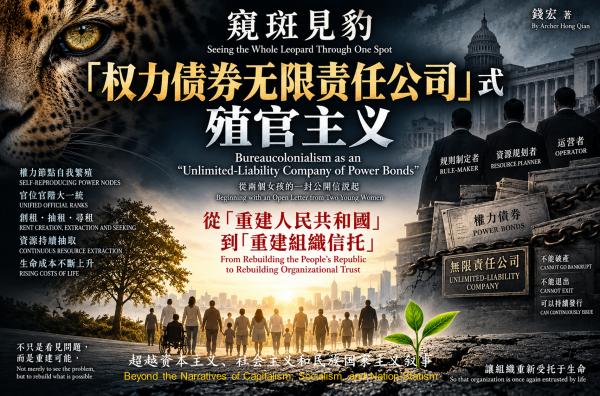
窥斑见豹:“权力债券无限责任公司”式殖官主义
Seeing the Whole Leopard Through One Spot: Bureaucolonialism as an “Unlimited-Liability Company of Power Bonds”
——从两个武汉女孩的一封公开信说起
——Beginning with an Open Letter from Two Wuhan Girls
钱宏(Archer Hong Qian)
引:两个女孩打开的一扇窗
近日,读到两个女孩写下的《十年:一个家庭的破碎,一个“人才”的诞生》。十年前,她们一个十岁,一个五岁,都还是孩子;十年以后,她们一个二十岁,一个十五岁,自己写下了这十年的经历。
面对这样的生命诉说,首先应该倾听。她们不是供人消费的桃色新闻,也不需要承担证明一个庞大体制的任务。她们的一封公开信,只是打开了一扇窗:黨票、公职、博士学位、大学教授、科研经费、“青年拔尖人才”头衔,以及围绕这些身份发生的资源、待遇、地位和机会,为什么能够被同一种权力关系贯穿?
一个具体事件,像机体的一个全息细胞。我们不必纠缠“一斑”与“全豹”的比喻本身;重要的是,由这一斑进入那套贯穿政治、行政、教育、科研、国企乃至社会生活的组织机制。
二十年前,我在《“7000万人金饭碗”来源:黨管干部的“官阶大一统”举国体制》(刊《NEW WORLD TIMES》,2006)中,把这种现象概括为“权力债券”。今天再回头看,这个概念还可以继续向发生处推进:是谁发行权力债券?为什么要发行?为什么能够不断发行?谁获得兑现?最后又由谁承兑?
答案指向的,已经不是一所大学、一个教授或几个贪官,而是一种更深的组织形态:发行“权力债券无限责任公司”式殖官主义。
一、“黨票”:老百姓早已说破了权力债券的秘密
中国老百姓很早就把加入中国共产黨俗称为“拿到黨票”。这个“票”字极有意味。按照正式价值承诺,黨员身份意味着理想、责任和义务;如果止于此处,它只是一张责任凭证。可是长期生活经验又告诉人们,它还可能成为进入干部序列和组织资源配置网络的一种资格。
拿到黨票,并不等于完成兑现。有人终其一生只是普通黨员;有人进入干部序列;有人不断升迁;有人由一个权力节点进入另一个权力节点,并进一步取得配置职位、项目、经费和机会的能力。于是,“黨票”呈现出权力债券最基本成色:今天取得一种组织资格,明天获得一种权力兑现的可能。
正因为不是人人都能兑现,竞争才会发生。权力债券的力量,不在于保证兑现,而在于制造兑现预期。
二、权力债券为什么必须发行?
真正的组织信托(Organizational Trust)有一个极其朴素的前提:公共权力不是掌权者的财产。社会为了处理公共事务,在一定条件下,把一定范围的权限托付给一定的人和组织。因此,组织信托,从发生之初就是有限的、有条件的、有边界的。
权力来自托付,权限服从目的。受托者必须服务生命、服务社会;越过托付边界,或者不能继续履行受托责任,授权就应受到制约、修正乃至终止。十八世纪“费城制宪”的重要文明意义,正在于不把国家寄托在圣人的无限善意上,而把公共权力置于有限授权、分权制衡、任期和责任边界之中。
如果权力首先被理解为通过革命、战争、枪杆子和政治斗争“夺取”而来的,问题就会发生倒置。本来应该问“社会托付给我多少权力”,却变成“我已经取得权力,怎样才能永远保持它”。
为了巩固权力,需要扩大组织;为了扩大组织,需要吸纳成员;为了维系成员忠诚,需要产生组织收益预期;为了兑现这种预期,就必须不断发行可以在未来兑现的权力债券。于是形成一条内生链条:权力取得→权力占有→组织扩张→权力债券发行→忠诚与身份确认→兑现竞争→官位官阶扩张→社会资源承兑→再发行。
所以,权力债券不是腐败发生以后才出现。受托权力一旦被当成可以占有、分配和兑现的资产,权力债券就已经发生。
三、什么是殖官主义?——先把一个陌生概念说清楚
“殖官主义”(Bureaucolonialism)是我在长期观察政治经济组织形态时提出的分析概念。它不是“官多”(张全景,1998)“官满”(刘锡荣,2011)的另一个说法,也不是把官僚主义换一个更激烈的名称。它要揭示的是一种组织发生机制。
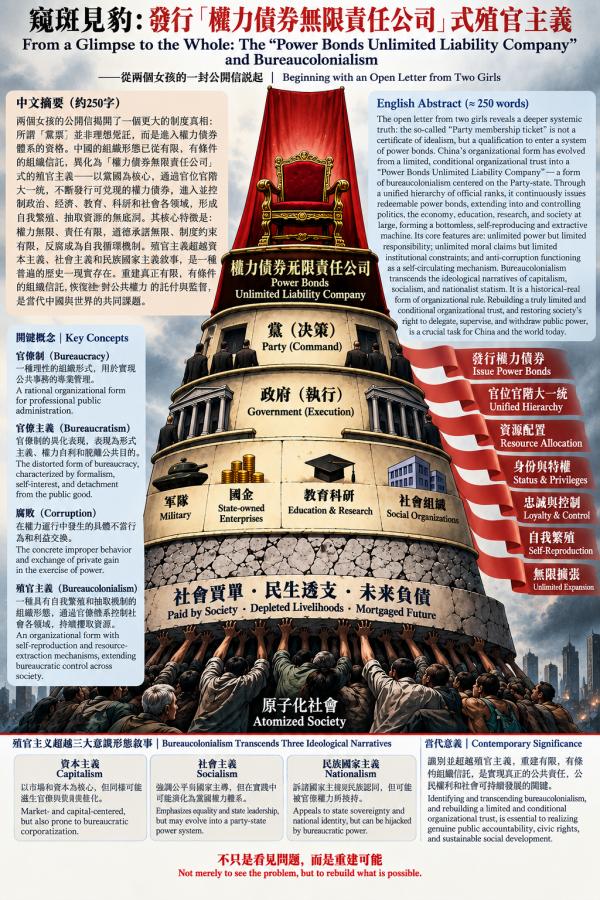
所谓殖官主义,是指:公共组织的受托关系发生倒置以后,权力节点不再以服务生命与社会、降低组织成本为存在边界,而逐渐把维持和扩张组织自身变成目的;它通过官位官阶、身份资格、审批评价、财政资源和其他权力配置机制不断复制新的权力节点,创造新的管理对象、制度门槛和资源依附,并以创租、抽租、寻租以及权力债券的持续发行与兑现,从社会和生命中取得维持自身繁殖所需资源的一种组织形态。
这个定义至少包含五个彼此相连的要素:第一,受托倒置——本来由生命与社会托付的组织,反过来要求生命和社会供养组织;第二,节点繁殖——机构、职位、级别、审批和管理不断产生新的机构、职位、级别、审批和管理;第三,官位官阶大一统——不同领域的价值评价越来越被同一套权力等级和资源配置机制贯通;第四,创租、抽租、寻租——权力不仅消费资源,还可以制造稀缺、门槛和依附,再从中取得收益;第五,权力债券化——组织身份、忠诚、职位和等级形成未来利益的兑现预期,公共权力由受托责任转化为可增值、可交换、可套利的组织资产。
尤其需要把四个容易混淆的概念,明确区分开来:Bureaucracy(官僚制)是一种组织形式;Bureaucratism(官僚主义)是这种组织可能出现的一种异化表现;Corruption(腐败)是权力失去约束以后可能产生的一种行为结果;Bureaucolonialism(殖官主义)则是一种具有权力节点自我繁殖、资源持续抽取和权力债券自我发行—兑现机制的组织形态。
因此,一个组织可以采用 Bureaucracy 而不必然走向 Bureaucolonialism;一个官员表现出 Bureaucratism,也不意味着整个组织已经形成殖官主义结构;Corruption 可以发生在政府、企业、政黨、大学乃至非营利组织中,惩治腐败可以处理具体失范行为。但是,当组织的受托关系发生倒置,权力节点开始自我复制和自我繁殖,组织自身从手段变成目的,并不断从生命与社会取得维持自身扩张的资源时,才进入本文所谓 Bureaucolonialism 的分析范畴。
这一区分也说明:反腐处理的是 Corruption;反官僚主义主要针对 Bureaucratism;机构改革可以调整 Bureaucracy;而要走出 Bureaucolonialism,则必须改变组织本身的发生关系——把无限扩张的权力重新还原为有限、有条件、可问责、可撤回的组织信托。
四、殖官主义为什么超越资本主义、社会主义和民族国家主义叙事?
殖官主义不是社会主义的别名,不是资本主义的反义词,也不是民族国家主义的另一种说法。它不是要在资本主义、社会主义之后再发明一个新的“主义”来参加意识形态排队,而是要暂时穿透这些既有标签,直接观察组织本身怎样发生、怎样繁殖、怎样取得资源,又怎样与生命发生关系与冲突。
资本主义与社会主义的经典争论,主要围绕资本、生产资料、市场与国家怎样组织;民族国家主义主要围绕主权、身份、疆界和政治认同展开。这些问题当然重要,但它们并不能自动回答另一些同样根本的问题:组织为什么存在?谁托付它?它为谁创造价值?权力有没有边界?组织节点为什么增加?增加的节点究竟降低了生命交互成本,还是增加了生命成本?组织是在赋能生命自组织,还是让生命反过来供养组织?
正因为如此,社会主义制度中可能发生殖官主义,资本主义制度中同样可能发生;民族主义可以成为殖官扩张的动员语言,全球化和跨国组织也可能产生脱离受托边界的殖官节点;政府可能殖官化,大型企业、金融机构、国际组织、大学、平台乃至未来深度介入社会生活的AI组织,也都可能出现受托倒置、自我扩张和资源抽取。
所以,殖官主义是一种超越资本主义、社会主义和民族国家主义意识形态叙事而存在的历史—现实组织现象。它所提供的不是新的阵营标签,而是一把组织形态的解剖刀。它要求我们不先问“你属于哪一种主义”,而先问:你究竟是不是受托者?你的权限从哪里发生?边界在哪里?你创造了什么价值?你有没有把组织自身变成目的?
这也是为什么用殖官主义剖析一个国家或地区的组织形态,往往比重复意识形态标签更能接近其本质属性。它把注意力从“说自己是什么”移到“实际上怎样运行”,从宏大承诺移到真实承兑,从制度名义移到生命结果。
五、有限、有条件的组织信托,与“无限责任公司”的本质冲突
现代商业世界为什么大量采用“有限责任公司”?道理并不神秘。公司必须有边界。投资者承担的风险、公司的经营范围、债务责任和失败后果,都需要可以界定;经营失败,可以重组,可以破产,可以退出。有限责任首先承认一个常识:任何组织的能力和责任都不可能无限。
组织信托也是如此。受托权限必须与受托责任相匹配:托付多少,行使多少;承担什么责任,获得什么权限;不能履责,托付就可以修正、撤回和终止。
“权力债券无限责任公司”则走向相反方向。当一个政治组织把自己的领导范围推向政治、政府、军队、企业、教育、科研、文化、社会乃至越来越细密的生活领域(党政军民学、东西南北中),它在体制机制上就形成了无限扩张的组织结构:什么都要领导,理论上就什么都要负责。
所以,“无限责任公司”不是一句反讽,而是对这种组织结构的描述。问题恰恰在于:领导权趋向无限,真实责任却无法无限;介入领域趋向无限,失败责任却难以由社会撤回授权。它不像普通有限责任组织那样能够通过退出、破产和重组结束失败,而更容易不断证明自己必须继续存在、继续扩张、继续发行。
于是形成一种根本错位:无限取得领导权,有限承担失败责任;无限进入社会,有限接受社会问责;把“责任”解释成继续掌权,却没有把责任落实为权力失败后的可撤回、可替换、可终止。
这正是有限、有条件的组织信托,与“无限责任公司”式殖官主义之间的本质冲突。
六、从“政府公司主义”到“黨国公司主义”
二十多年前,我还使用过“政府公司主义”这个概念。今天看来,它仍不足以准确描述这种结构。因为在这种体制中,政府并不是最终的权力主体。黨组织通过黨组、黨委、组织部门和干部任免体系进入政府、军队、国有企业、高校、科研机构、事业单位以及众多社会组织,形成一条贯通的组织权力链。
因此,它不是普通意义上的“大政府”,也不仅是政府干预经济。更准确地说,它具有一种特殊的黨国公司主义(Party-State Corporatism)性质:政治组织不仅掌握政治权力,而且通过官位官阶大一统,把原本属于不同社会领域的组织节点接入同一套权力配置体系。
政府、高校、科研、国企、文化和社会组织,由此不再只是按照各自使命自组织运行的不同主体,而被一套共同的干部任免、身份确认和权力等级机制贯穿。权力债券也因此获得跨领域兑现能力。
七、“黨管干部”怎样生成官位官阶大一统
如果黨票只能在黨组织内部发生作用,权力债券的社会效应仍然有限。真正形成举国机制的是“黨管干部原则”。干部不仅存在于黨组织,也存在于政府、军队、国企、高校、科研院所、医院、文化机构和事业单位。
原本性质完全不同的社会角色,由此越来越容易进入一套可以任免、升降、比较、评级和配置资源的官位官阶坐标:职位连接级别,级别连接待遇,身份连接机会,权力节点连接下一层权力节点。
这就是“官位官阶大一统”。它不是简单的“官僚很多”,而是一种能够自我繁殖组织节点、自我生产权力债券、自我制造兑现需求的举国体制机制。殖官主义的“殖”,正在这里:权力节点具有不断复制自身、进入新的社会空间并抽取资源维持自身的内生冲动。
八、从真实贡献到“指标空壳”:价值怎样被权力债券倒置
任何资格最初都必须有一个可以承兑它的真实理由。博士应由学术能力承兑,教授应由教学科研贡献承兑,科研经费应由科研任务承兑,特殊人才称号应由特殊贡献承兑。
但是,一旦这些资格被纳入官位官阶大一统,真实贡献就可能先被转换成指标,指标再转换成资格,资格进一步转换成身份和头衔。久而久之,关系可能发生倒置:原来是“贡献→指标→身份”,后来变成“身份→指标→被认定为有贡献”。
真实的人被抽掉,剩下的是“特殊人才”的空壳;真实创造被抽掉,剩下的是头衔、级别、论文数量、项目数量和行政认证。组织自己发行凭证,又用自己发行的凭证证明凭证持有人具有价值。陷入逻辑上的“循环论证”。
这正是价值承兑发生空壳化的危险:形式开始为形式背书,权力开始为权力增信。
九、无限道德承诺,为什么不能替代有限组织信托
“全心全意为人民服务”是一种极高的道德承诺。问题不在于人是否应该追求高尚,而在于能不能用无限道德承诺替代有限制度约束。
现代组织信托不预设受托者没有私人欲望。恰恰相反,它承认掌权者也是人:有理想,也有利益;可以奉献,也可能自利;能够克制,也可能受到金钱、地位、权力和欲望诱惑。正因为人不是“特殊材料”制成的圣人,才需要制度边界。
如果逻辑变成:因为我们最先进,所以应该领导;因为我们代表人民,所以我们的领导就是人民的意志;因为我们“全心全意”服务人民,所以扩大我们的权力仍然是在服务人民——价值承诺就开始为权力本身循环论证。
漂亮的语言不能承兑组织信托。真正能够承兑组织信托的,是可以验证的服务,是能够约束权力的体制机制,是权力失信、失效、失败以后,社会仍然拥有修正、撤回、替换和重新托付的能力。否则,超高道德承诺很容易成为无限权力的遮蔽物:嘴上说的是为众服务,体制运行中却可能不断与众争利。
十、为什么权力债券必然制造“绞肉机”
权力债券可以不断发行,优质权力位置却永远有限。于是持券者迟早要问:为什么你兑现,我不能兑现?为什么你升迁,我不能?为什么项目给你,不给我?为什么你进入更高权力节点,而我被排除?
只要权力成为资产,围绕权力的竞争就不仅是意见分歧,也会成为权力债券的兑现竞争。发行越多,兑现越稀缺;兑现越稀缺,内部斗争越激烈。路线、派系、山头、人事和忠诚,都可能成为重新排列兑现顺序的工具。
胜者取得权力,又取得下一轮债券发行权;败者退出兑现序列,甚至遭到清算。二十年前我把权力债券饱和发行的第一个结果概括为“绞肉机”,说的正是这种自我生成的组织竞争。
十一、反腐:为什么可以自我修复,却不能替代制度转换
中国历史上有一则流传甚广的苏绰与宇文泰“治官”故事。无论把它当作历史记载还是政治寓言,它所揭示的政治逻辑都耐人寻味:置官,官从社会取利;取利过度,引起民怨,再抓贪官;既平民愤,又回收财富;官不够用,再继续置官。于是形成“置官—取利—贪腐—反腐—再置官”的循环。
从权力债券看,反腐处理的主要是已经失控、兑现过度或者危及组织运行的权力债券持有人。抓掉一个贪官,可以没收资产,可以展示纪律,可以重新分配职位,却没有因此取消那个能够产生巨大私人收益的权力节点。
因此,反腐可以成为殖官主义维持自身的一种自我修复机制:注销问题债券,回收部分资源,恢复部分公众信心,然后继续发行新的权力债券。
如果制度仍然允许权力决定职位、项目、土地、资本、人才、许可、规划和大量稀缺资源,那么寻租动力就不会随着某个贪官被抓而自然消失。问题最终不是“为什么坏人这么多”,而是:什么样的组织结构持续制造创租、抽租、寻租机会,奖励权力兑现,又让拒绝进入既有交换网络的人越来越难以生存?
所以,反腐处理的是 Corruption,却不能自动终结 Bureaucolonialism。真正的制度转换必须触及权力债券的发行机制本身。
十二、谁在为权力债券真正买单?
官位不能生产粮食,级别不能制造住房,黨票不能创造医疗,编制本身不能创造养老金,人才称号也不会自动产生科学发现。权力债券最终要兑换成工资、住房、医疗、教育、养老金、办公条件、行政资源、科研经费、项目、土地、信贷以及各种显性和隐性的现实利益。
这些真实价值从哪里来?来自生命创造,来自企业、劳动者、家庭、社区、社会和自然环境。于是形成一个基本结构:组织发行权力债券,国家提供承兑机制,社会提供承兑资产,生命承担真实成本。
然而,养多少机构、支付多少工资,还只是看得见的成本。殖官主义真正巨大的成本,在于一个边界不断扩张的权力网络可以持续改变财富、机会、人才、资本、教育、医疗和生命能量的流向。它不仅“花多少钱”,更决定“谁可以创造、谁可以取得、谁可以进入、谁被排除”。
当权力债券深入资源配置本身,殖官主义就成为一个无底洞。
十三、为什么繁荣能够遮蔽无底洞,衰退却会暴露承兑危机
经济高速增长的时候,权力债券体系可以运行很久。出口增长、企业盈利、土地升值、财政扩张、政府举债,真实财富的水池不断上涨,于是不断增加的组织成本和兑现需求似乎都还能被覆盖。
这时,人们甚至可能把组织扩张误认为国家能力,把节点增加误认为治理进步。
真正的压力测试发生在经济增长放缓,甚至停滞以后。真实财富创造可以减速,已经发行出去的权力债券却不会自动消失:工资要支付,养老金要兑现,机构要维持,债务要偿还,既有等级和待遇形成刚性预期,新的持券者仍在等待未来兑现。
于是,权力债券饱和发行的第三个结果显现出来:承兑危机。不是社会突然一无所有,而是权力债权扩张的速度和规模,超过了生命创造真实价值的承兑能力。
有限责任组织经营失败可以退出、破产、重组;“无限责任公司”式权力组织却难以承认失败和退出,于是更容易继续扩张、继续抽取、继续举债、继续发行,用未来承兑今天,直到真实社会再也承受不起。
十四、两个女孩:权力债券落到生命身上的那一刻
现在再回到那两个女孩。十年前,一个十岁,一个五岁;今天,一个二十岁,一个十五岁。
她们的公开信没有必要证明整个制度。它只是让通常被分开观察的东西突然同时出现在一个生命故事里:黨票、公职、大学、博士、教授、科研、人才头衔(“中组部青年拔尖人才”)、公共资源,以及这些组织符号怎样进入家庭和孩子的生活。
这正是一个“全息细胞”的意义:宏大的体制机制最终一定落到具体生命身上。组织可以谈干部,财政可以谈预算,大学可以谈人才,统计可以谈GDP,可最后承担代价的永远是一个个真实的人。
殖官主义最深的成本,不在账本上,而在生命中。
十五、为什么一个国家或地区今天必须重建组织信托?
如果殖官主义是一种穿透资本主义、社会主义和民族国家主义叙事而存在的历史—现实组织形态,那么走出殖官主义也就不能停留在更换意识形态口号、改换所有制名称或进行一次机构调整。真正需要改变的,是组织与生命之间的基本关系。
一个国家或地区重建组织信托(Rebuilding Organizational Trust),首先意味着重新承认:任何公共组织都不是目的本身,组织只是生命为了共同处理事务而发生的受托关系。它必须有限、有条件、有边界,并以真实价值承兑其存在。
这意味着,权力必须重新有限化:谁托付、托付什么、托付多少、托付多久,都应有边界;组织必须重新条件化:不能履责,就应修正、缩减、替换乃至终止;资源配置必须重新价值化:职位、资格、项目和经费不能靠权力凭证相互背书,而要回到真实贡献;社会必须重新获得自组织空间:政治、经济、教育、科研、文化和生活,不能都被压进同一条官位官阶轴线。
判断一个国家或地区是否真正走出殖官主义,因而不应只看换了多少人、抓了多少贪官、合并了多少机构,而应看几个更根本的变化:权力有没有重新变得有限?组织有没有重新变得有条件?不能创造受托价值的节点能不能退出?社会能不能恢复自组织能力?生命创造的价值还需不需要不断为权力债券承兑?
从这个意义上说,“重建组织信托”不是殖官主义之后附加的一项改革,而是从殖官主义返回正常组织关系的制度转换。它恢复的是一个最基本的文明关系:不是生命属于组织,而是组织受托于生命。
十六、公民是整体,组织是个体——一个需要重新恢复的生活常识
写到这里,不能不补充说明一个看似违反习惯、其实最接近生活常识的问题:为什么公民是整体,组织反而是个体?
早在1986年,我在《公民个人权利优先引论:作为整体主义的共和国公民学与作为个体主义的共和国组织学》中,就提出过一个基本前提:
公民角色多样化与组织角色专一化。
这里所谓“整体主义的共和国公民学”,并不是后来人们习惯理解的“个人服从整体”,更不是把国家、政党或某种组织视为高于人的整体。恰恰相反,整体的是公民本身。
一个活生生的人,本自具足,又非独存。他不是任何单一组织可以定义和穷尽的“零件”。同一个人可以是父亲或母亲、儿子或女儿,可以劳动、经营、创造、学习、信仰、投票、纳税、交友、旅行,可以进入不同组织,也可以退出某些组织;还可以在不同生命阶段不断发生新的角色、新的能力、新的连接。
所以,公民首先是一个完整的、全息的生命主体。社会愈发展,科技愈进步,人的能力理应愈强,连接方式愈丰富,公民角色也应愈趋多样。
所谓“个体主义的共和国组织学”,则是说:组织只是社会生活中承担某一种特定功能的个体。
人为什么需要医院?因为生命有医疗之托。为什么需要学校?因为有教育之托。为什么需要政府?因为公共生活中有一些个人难以独立完成的公共事务,需要有限托付。为什么需要军队?因为存在共同安全之托。
因此,组织不是生命的主人,而是因生命之所托而发生;不是因为组织存在,人才获得存在的理由,而是因为人的某种有限需要,某种组织才获得存在的理由。
所托有限,权力就应有限;功能专一,组织就应守住边界。
这其实是最普通不过的生活常识。
可是长期以来,意识形态政治常常把这个发生关系倒置过来。
我们太熟悉“大河有水小河满”“先有国才有家”一类说法。听起来气势磅礴,稍稍恢复生活常识,却会发现问题:如果一条条小河都没有水,大河里的水从哪里来?难道永远依靠海水倒灌?即使能够倒灌,又能维持多久?
同样,如果一个个真实的人失去生活能力,一个个家庭难以形成、难以维持,人们甚至越来越不愿意成家、生育,国家这个庞大的组织又能够凭什么长久存在?
不是生命由组织发生,而是组织由生命之所托发生。
这也是为什么,社会发展与技术进步在正常情况下,应当呈现一个看似反常、实则自然的趋势:
公民能力越来越强,公民角色越来越多样;组织功能越来越专一,组织信托越来越有限。
科技愈发达,个人获取知识、创造价值、连接他人和自我组织的能力愈强,许多过去必须依靠庞大组织才能完成的事情,今天一个人、一个家庭、几个相互信任的人就能够完成。按照这个方向,组织没有理由因为技术进步而无限扩张,反而应该更加精准地回到自己的专业功能和有限所托。
然而,我们今天在世界许多地方看到的,却恰恰是一种逆反。
一方面,人的知识、技术和自组织能力空前增强;另一方面,各种组织却不断增加自己的管理范围、规则密度、资源占有和生活介入。公民本来应该越来越完整、多样,却越来越容易被切割成纳税人、消费者、选民、雇员、被管理者、数据对象;组织本来应该越来越专一、有限,却越来越试图成为无所不包的整体。
这种逆反并非某一种意识形态所独有。所谓发达国家可能借助福利、安全、监管、政治正确或者技术治理扩大组织边界;专制国家则可能通过党国组织、官位官阶和行政资源,把越来越多的生活领域纳入同一权力轴线。形式不同,程度不同,却都值得追问同一个问题:
究竟是组织受托于生命,还是生命被托付给了组织?
到了这里,我们也就更容易理解什么叫殖官主义。
殖官主义,就是这种生活常识发生了组织性倒置:本来只是有限功能个体的组织,不断把自己扩张为无所不包的“整体”;本来本自具足、角色多样的生命主体,却被不断原子化、功能化,最后成为维持组织运转和承兑权力债券的资源。
所以,走出殖官主义,并不是不要组织,更不是回到没有国家、没有政府、没有制度的原始状态。恰恰相反,现代生活需要更加专业、更加可信、更加有效率的组织。
问题只在于重新摆正那个最基本的发生关系:
公民是整体,组织是个体。
公民角色多样化,组织角色专一化。
生命愈有能力,组织愈应守住有限所托。
四十年前,我把它称为“整体主义的共和国公民学”与“个体主义的共和国组织学”。今天,在数位—量子时代重新回望,这个命题反而显得更加迫切。
因为人工智能正在进一步赋能个人,也正在进一步赋能组织。它既可能使一个普通人的创造能力获得前所未有的释放,也可能使一个失去边界的组织获得前所未有的控制能力。
因此,真正需要回答的已经不仅是“谁拥有权力”,而是更根本的问题:
组织为什么发生?权力从哪里发生?它接受谁的托付?它的托付有没有边界?当它背离所托时,能不能被问责、撤回、替换乃至终止?
答案仍然要回到那个最朴素的原点:
组织因生命之所托而发生。
这既是当初我们为什么提出“重建人民共和国”,也是今天为什么必须“重建组织信托”。
结:从2006年的“权力债券”,回到有限、有条件的组织信托
二十年前,我看到权力债券饱和发行可能产生三个结果:内部绞肉机式斗争;兑现成本向原子化社会转嫁;经济衰退以后发生承兑危机。
今天,在组织信托、价值承兑与殖官主义的视野下,可以继续追问:权力债券究竟从哪里发生?
它发生在受托权力被转换成所有权的那一刻。
一旦掌权者把公共权力理解为自己取得、自己拥有、自己支配的资产,为了维持这种权力,就必须寻找追随者;为了维系追随者,就必须发行未来权益;为了兑现未来权益,就必须不断从社会取得承兑资源。
真正的制度改变,不是换一批人经营“权力债券无限责任公司”,不是提高权力债券的发行质量,也不是依靠一轮又一轮反腐维持它,而是改变权力的发生方式:把无限的所有权重新还原为有限、有条件的组织信托。
权力不是所有权。权力不是股票。权力不是债券。权力只是有限的、有条件的受托责任。
从十八世纪制宪时代,到今天的数位—量子时代乃至AI→AM的文明转向,这个原点没有改变。技术可以成为新的组织力量,人工智能也可能进入资源配置、判断和行动过程;越是如此,越必须重新追问:谁托付?托付什么?托付多少?在什么条件下托付?怎样问责?怎样终止托付?
两个女孩打开的,只是一扇窗。透过它真正需要看见的,是一套运行已久的组织机制:当有限、有条件的组织信托被无限领导取代,当公共责任被做成权力资产,当官位官阶大一统把这种资产复制到整个社会,殖官主义就不再只是某些人的腐败。
它已经成为一家特殊公司。
一家既是规则制定者、资源规划者,又是运营者,而且不能破产、不能退出,却可以不断发行权力债券的——“无限责任公司”。
参考文献
1. 司马迁(Sima Qian):《史记·货殖列传》(Records of the Grand Historian: Biographies of Merchants),约公元前91年
2. 黄宗羲(Huang Zongxi):《明夷待访录》(Waiting for the Dawn: A Plan for the Prince),1663
3. 约翰·洛克(John Locke):《政府论·下篇》(Second Treatise of Government),1690
4. 米洛凡·吉拉斯(Milovan Djilas):《新阶级:对共产主义制度的分析》(The New Class: An Analysis of the Communist System),1957
5. 钱 宏(Archer Hong Qian):《公民个人权利优先引论:作为整体主义的共和国公民学与作为个体主义的共和国组织学》(An Introduction to the Primacy of Individual Civil Rights: Republican Citizen Studies as Holism and Republican Organizational Studies as Individualism),1986
6. 钱 宏(Archer Hong Qian):《和解的年代:从共产主义到共生主义》(The Age of Reconciliation: From Communism to Symbiosism);《一个民族的灵魂:从文化再造到中国再造》(The Soul of a Nation: From Cultural Reconstruction to the Reconstruction of China),2007
7. 黄亚生(Yasheng Huang):《有中国特色的资本主义:企业家与国家》(Capitalism with Chinese Characteristics: Entrepreneurship and the State),2008
8. 钱 宏(Archer Hong Qian):《中国:共生崛起》(China: A Symbiotic Rise),2012
9. 达龙·阿西莫格鲁(Daron Acemoglu)、詹姆斯·A. 罗宾逊(James A. Robinson):《国家为什么会失败:权力、繁荣与贫穷的根源》(Why Nations Fail: The Origins of Power, Prosperity, and Poverty),2012
10. 钱 宏(Archer Hong Qian):《原德:大国哲学》(Original Virtue: A Philosophy for a Great Republic),2012
11. 李少民(Shaomin Li):《中国的举国大公司的崛起》(The Rise of China, Inc.: How the Chinese Communist Party Transformed China into a Giant Corporation),2024
12. 黄亚生(Yasheng Huang):《中国模式的终点:从科举帝制到数位威权,揭露中国式治理制度的宿命》(The Rise and Fall of the EAST: How Exams, Autocracy, Stability, and Technology Brought China Success, and Why They Might Lead to Its Decline),2025
13. 钱 宏(Archer Hong Qian):《论殖官主义:政权更迭为何不能终结人民的苦难?》(On Bureaucolonialism: Why Has Regime Change Failed to End the Suffering of the People?),2026
Seeing the Whole Leopard Through One Spot: Bureaucolonialism as an “Unlimited-Liability Company of Power Bonds”
—Beginning with an Open Letter from Two Wuhan Girls
Archer Hong Qian
Introduction: A Window Opened by Two Young Women
Recently, I read “Ten Years: The Ruin of a Family and the Making of a ‘Talent,’” written by two young women. Ten years ago, one was ten and the other five; both were still children. Ten years later, one is twenty and the other fifteen, and they have written down what they experienced over that decade.
Such a testimony of wounded life should first be heard. They are not a piece of scandal for public consumption, nor do they need to shoulder the burden of proving an entire system. Their open letter simply opens a window: Party membership, public office, a doctoral degree, a university professorship, research funding, the title of “Young Top-Notch Talent,” and the resources, benefits, status, and opportunities attached to these identities—why can all of them be threaded through by the same relation of power?
A concrete event can resemble a holographic cell of a living organism. There is no need to become trapped in the metaphor of “one spot” and “the whole leopard.” What matters is to enter, through this one spot, the organizational mechanism that runs through politics, administration, education, research, state-owned enterprises, and social life.
Twenty years ago, in “The Source of the ‘Golden Rice Bowls’ of 70 Million People: The Nationwide System of Party-Controlled Cadres and the ‘Grand Unification of Official Ranks’” (NEW WORLD TIMES, 2006), I described this phenomenon as “power bonds.” Looking back today, the concept can be pushed further toward its point of origin: Who issues power bonds? Why must they be issued? Why can they keep being issued? Who gets to redeem them? And who ultimately underwrites their redemption?
The answer no longer points merely to one university, one professor, or a handful of corrupt officials. It points to a deeper organizational form: Bureaucolonialism operating as an “Unlimited-Liability Company of Power Bonds.”
I. The “Party Ticket”: Ordinary Language Had Already Revealed the Secret of Power Bonds
Chinese people have long colloquially referred to joining the Chinese Communist Party as “getting a Party ticket.” The word “ticket” is telling. According to the formal value commitment, Party membership signifies ideals, responsibilities, and obligations; if it stopped there, it would be merely a certificate of responsibility. Yet long social experience also tells people that it may become a qualification for entering the cadre sequence and the organizational network of resource allocation.
Obtaining a Party ticket does not mean redemption is guaranteed. Some remain ordinary Party members all their lives; some enter the cadre system; some continue to be promoted; some move from one node of power to another and acquire the ability to allocate posts, projects, funds, and opportunities. The “Party ticket” thus displays the basic character of a power bond: today one acquires an organizational qualification; tomorrow one gains the possibility of redeeming it into power.
Competition arises precisely because not everyone can redeem it. The force of a power bond lies not in guaranteeing redemption, but in generating the expectation of redemption.
II. Why Must Power Bonds Be Issued?
Authentic Organizational Trust rests on a very simple premise: public power is not the property of those who exercise it. To handle public affairs, society entrusts a defined scope of authority, under specified conditions, to certain people and organizations. Organizational trust is therefore limited, conditional, and bounded from the moment it arises.
Power comes from entrustment, and authority must serve the purpose for which it was entrusted. Trustees must serve life and society. Once they exceed the boundary of entrustment or can no longer fulfill the entrusted responsibility, their authority should be constrained, corrected, or terminated. The civilizational significance of the eighteenth-century Philadelphia constitutional founding lay precisely in refusing to entrust a nation to the limitless goodwill of saints, and instead placing public power within limited authorization, divided powers, checks and balances, terms of office, and defined responsibility.
If power is first understood as something “seized” through revolution, war, force of arms, and political struggle, the relationship is reversed. The proper question—“How much power has society entrusted to me?”—becomes “I have already obtained power; how can I keep it forever?”
To consolidate power, the organization must expand; to expand the organization, it must absorb members; to sustain loyalty, it must generate expectations of organizational return; to fulfill those expectations, it must continuously issue claims that can be redeemed in the future. An endogenous chain then emerges: acquisition of power → possession of power → organizational expansion → issuance of power bonds → confirmation of loyalty and status → competition for redemption → expansion of official rank → redemption through social resources → renewed issuance.
Power bonds therefore do not appear only after corruption begins. The moment entrusted power is treated as an asset that can be possessed, distributed, and redeemed, the power bond has already come into being.
III. What Is Bureaucolonialism?—Defining an Unfamiliar Concept
“Bureaucolonialism” is an analytical concept I developed through long-term observation of political and economic organizational forms. It is not another way of saying that there are “too many officials,” nor is it merely a stronger name for bureaucratism. It is meant to reveal a mechanism by which an organization comes to reproduce itself.
Bureaucolonialism refers to an organizational form in which, after the trusteeship relation of a public organization is reversed, power nodes cease to take service to life and society, or the reduction of organizational costs, as the boundary of their existence. Instead, maintaining and expanding the organization itself gradually becomes the purpose. Through official posts and ranks, status qualifications, approvals and evaluations, fiscal resources, and other mechanisms of power allocation, the organization continuously reproduces new power nodes, creates new objects of administration, institutional barriers, and resource dependencies, and—through rent creation, rent extraction, rent seeking, and the continuous issuance and redemption of power bonds—draws from society and life the resources required for its own reproduction.
This definition contains at least five interconnected elements. First, trusteeship inversion: an organization originally entrusted by life and society turns around and requires life and society to sustain the organization. Second, node reproduction: agencies, positions, ranks, approvals, and management continually generate new agencies, positions, ranks, approvals, and management. Third, the grand unification of official ranks: value assessments in different domains are increasingly threaded through by the same hierarchy of power and resource allocation. Fourth, rent creation, rent extraction, and rent seeking: power does not merely consume resources; it can manufacture scarcity, barriers, and dependency, and then derive returns from them. Fifth, the bondization of power: organizational identity, loyalty, position, and rank create expectations of future benefit, transforming public authority from entrusted responsibility into an organizational asset that can appreciate, be exchanged, and be arbitraged.
Four easily confused concepts must therefore be distinguished clearly: Bureaucracy is an organizational form; Bureaucratism is a possible form of organizational alienation; Corruption is a possible behavioral consequence when power loses constraint; Bureaucolonialism is an organizational form characterized by the self-reproduction of power nodes, continuous resource extraction, and a self-perpetuating mechanism of issuing and redeeming power bonds.
An organization may employ Bureaucracy without necessarily becoming Bureaucolonial. An official may display Bureaucratism without the entire organization having become Bureaucolonial. Corruption can occur in governments, enterprises, political parties, universities, and nonprofit organizations, and anti-corruption can punish particular forms of misconduct. But when trusteeship is inverted, power nodes begin to replicate and reproduce themselves, the organization changes from a means into an end, and it continuously draws resources from life and society to sustain its own expansion, then we have entered the analytical domain of Bureaucolonialism.
This distinction also clarifies the remedies: anti-corruption addresses Corruption; campaigns against bureaucratism primarily target Bureaucratism; institutional restructuring can modify Bureaucracy; but overcoming Bureaucolonialism requires changing the very relation from which organization arises—returning unlimitedly expanding power to limited, conditional, accountable, and revocable Organizational Trust.
IV. Why Does Bureaucolonialism Transcend the Narratives of Capitalism, Socialism, and Nation-Statism?
Bureaucolonialism is not another name for socialism, the opposite of capitalism, or another formulation of nation-statism. It is not an attempt to invent yet another “-ism” after capitalism and socialism and add it to the ideological lineup. It is an effort to cut temporarily through those inherited labels and look directly at how organizations arise, how they reproduce themselves, how they obtain resources, and how they relate to—and conflict with—life.
The classic debate between capitalism and socialism centers mainly on how capital, the means of production, markets, and the state should be organized. Nation-statism centers mainly on sovereignty, identity, borders, and political belonging. These questions matter, but they do not automatically answer other questions that are just as fundamental: Why does an organization exist? Who entrusts it? For whom does it create value? Where are the boundaries of power? Why do organizational nodes multiply? Do additional nodes reduce the interaction costs of life or increase them? Does the organization empower the self-organization of life, or does life end up sustaining the organization?
For this reason, Bureaucolonialism may arise under socialism, and it may also arise under capitalism. Nationalism can become a mobilizing language for Bureaucolonial expansion, while globalization and transnational organizations can also generate Bureaucolonial nodes that escape the boundaries of trusteeship. Governments may become Bureaucolonial; large corporations, financial institutions, international organizations, universities, platforms, and even future AI organizations deeply embedded in social life can exhibit trusteeship inversion, self-expansion, and resource extraction.
Bureaucolonialism is therefore a historical and contemporary organizational phenomenon that exists across and beyond the ideological narratives of capitalism, socialism, and nation-statism. It offers not another camp label, but a scalpel for dissecting organizational form. Instead of asking first, “Which ideology do you belong to?” it asks: Are you in fact a trustee? Where does your authority come from? Where is its boundary? What value do you create? Have you turned the organization itself into the purpose?
This is why analyzing a country or region through Bureaucolonialism can bring us closer to the essential attributes of its organizational form than merely repeating ideological labels. It shifts attention from “what you say you are” to “how you actually operate,” from grand promises to real redemption, and from institutional names to the consequences borne by life.
V. The Fundamental Conflict Between Limited, Conditional Organizational Trust and the “Unlimited-Liability Company”
Why do most modern commercial enterprises operate through some form of limited liability? The reason is not mysterious: a company must have boundaries. The risks borne by investors, the scope of business, liability for debts, and the consequences of failure must all be definable. If the business fails, it can be reorganized, become insolvent, or exit. Limited liability begins by acknowledging a simple truth: no organization’s capacity or responsibility can be infinite.
Organizational Trust is the same. Entrusted authority must match entrusted responsibility: exercise only what has been entrusted; receive only the authority appropriate to the responsibility undertaken; and if the trustee fails to fulfill that responsibility, the entrustment can be corrected, revoked, or terminated.
The “Unlimited-Liability Company of Power Bonds” moves in the opposite direction. When a political organization extends its leadership into politics, government, the military, enterprises, education, research, culture, society, and increasingly fine-grained domains of life—“Party, government, military, civilian, and academic; east, west, south, north, and center”—it creates an organizational structure whose expansion tends toward the unlimited: if everything must be led, then in theory everything must also become its responsibility.
“Unlimited-Liability Company” is therefore not mere sarcasm; it describes an organizational structure. The paradox is that leadership tends toward the unlimited, while real responsibility cannot be unlimited; intervention extends toward the unlimited, while failure is difficult for society to answer by revoking authority. Unlike an ordinary limited-liability organization, it cannot readily end failure through exit, insolvency, or restructuring. It therefore tends to keep proving that it must continue to exist, continue to expand, and continue to issue.
A basic mismatch results: unlimited acquisition of leadership, limited assumption of responsibility for failure; unlimited entry into society, limited exposure to social accountability; “responsibility” is interpreted as the right to remain in power, rather than as a liability that makes failed power revocable, replaceable, or terminable.
This is the fundamental conflict between limited, conditional Organizational Trust and Bureaucolonialism in the form of an “Unlimited-Liability Company.”
VI. From “Government Corporatism” to “Party-State Corporatism”
More than twenty years ago, I still used the term “government corporatism.” Today it seems insufficient to describe this structure accurately, because in such a system the government is not the ultimate locus of power. Party organizations enter government, the military, state-owned enterprises, universities, research institutions, public institutions, and many social organizations through Party groups, Party committees, organization departments, and cadre appointment systems, forming an organizational chain of power that runs through them all.
It is therefore not simply a “large government,” nor merely government intervention in the economy. More accurately, it has the character of a distinctive Party-State Corporatism: the political organization not only holds political authority, but through the grand unification of official ranks connects organizational nodes belonging to originally different social domains into a single system of power allocation.
Government agencies, universities, research institutions, state-owned enterprises, cultural bodies, and social organizations therefore cease to operate solely as distinct subjects organized around their own missions. They are threaded together by common mechanisms of cadre appointment, status recognition, and hierarchical power. Power bonds thereby acquire the capacity for cross-domain redemption.
VII. How “Party Control of Cadres” Produces the Grand Unification of Official Ranks
If the Party ticket functioned only inside the Party organization, the social effects of power bonds would remain limited. What turns it into a nationwide mechanism is the principle of “Party control of cadres.” Cadres exist not only in Party organizations, but also in government, the military, state-owned enterprises, universities, research institutes, hospitals, cultural organizations, and public institutions.
Social roles that are fundamentally different in nature therefore become increasingly incorporated into a common coordinate system of official positions and ranks through which people can be appointed, promoted, demoted, compared, graded, and allocated resources: position connects to rank; rank connects to benefits; identity connects to opportunity; one power node connects to the next.
This is the “grand unification of official ranks.” It is not simply a matter of “too many bureaucrats,” but a nationwide institutional mechanism capable of reproducing organizational nodes, producing power bonds, and manufacturing its own demand for redemption. The “colonial reproduction” in Bureaucolonialism lies precisely here: power nodes possess an endogenous impulse to replicate themselves, enter new social spaces, and extract the resources needed to maintain themselves.
VIII. From Real Contribution to an “Indicator Shell”: How Power Bonds Reverse Value
Every qualification must originally be redeemable against some real reason. A doctorate should be redeemed by academic competence; a professorship by teaching and research contribution; research funding by research tasks; a special-talent title by special contribution.
But once these qualifications are incorporated into the grand unification of official ranks, real contribution can first be converted into indicators, the indicators into qualifications, and the qualifications further into identities and titles. Over time, the relationship can be reversed: what began as “contribution → indicator → identity” becomes “identity → indicator → presumed contribution.”
The real person is hollowed out, leaving the shell of “special talent”; real creation is hollowed out, leaving titles, ranks, publication counts, project counts, and administrative certifications. The organization issues the credential and then uses the credential it issued to prove that the credential holder possesses value. It falls into a logical circularity.
This is the danger of hollowing out value redemption: form begins to endorse form, and power begins to supply credit to power.
IX. Why Unlimited Moral Commitments Cannot Substitute for Limited Organizational Trust
“Serving the people wholeheartedly” is an extremely elevated moral commitment. The question is not whether people should aspire to nobility, but whether an unlimited moral commitment can substitute for limited institutional constraint.
Modern Organizational Trust does not presume that trustees have no private desires. On the contrary, it recognizes that those who wield power are human beings: they have ideals and interests; they may devote themselves and may also act selfishly; they can exercise restraint and can also be tempted by money, status, power, and desire. Precisely because human beings are not saints made of “special material,” institutional boundaries are necessary.
If the logic becomes: because we are the most advanced, we ought to lead; because we represent the people, our leadership is the people’s will; because we serve the people “wholeheartedly,” expanding our power is still serving the people—then value commitments begin to circularly prove the legitimacy of power itself.
Fine words cannot redeem Organizational Trust. What can redeem it are verifiable service, institutional mechanisms that constrain power, and society’s continuing capacity—when power loses trust, effectiveness, or competence—to correct, revoke, replace, and re-entrust. Otherwise, exceedingly high moral commitments can easily become a screen for unlimited power: the language speaks of serving everyone, while the system may continue to compete with everyone for resources.
X. Why Power Bonds Inevitably Produce a “Meat Grinder”
Power bonds can be issued continuously, but premium positions of power are always scarce. Bondholders will therefore sooner or later ask: Why can you redeem yours while I cannot? Why are you promoted and I am not? Why does the project go to you and not me? Why do you enter a higher node of power while I am excluded? Former Chongqing Party Secretary Bo Xilai, for example, publicly raised questions of this kind in the course of political contention.
Once power becomes an asset, competition around power is no longer merely a disagreement over ideas; it becomes competition over the redemption of power bonds. The more bonds are issued, the scarcer redemption becomes; the scarcer redemption becomes, the more intense internal struggle becomes. Lines, factions, networks, personnel decisions, and loyalty can all become instruments for reordering the sequence of redemption.
The winner gains power and, with it, the right to issue the next round of bonds; the loser is pushed out of the redemption sequence and may even be purged. Twenty years ago, I described the first consequence of saturated power-bond issuance as a “meat grinder.” This is what I meant: organizational competition that regenerates itself.
XI. Anti-Corruption: Why It Can Repair the System Yet Cannot Substitute for Institutional Transformation
Chinese history preserves a widely circulated story about Su Chuo and Yuwen Tai on “governing officials.” Whether read as historical record or political parable, its logic is revealing: create official positions; officials draw benefits from society; when extraction becomes excessive and public resentment rises, arrest corrupt officials; this both appeases the people and recovers wealth; if there are not enough officials left to do the work, appoint more. Thus emerges a cycle: appoint officials → extract benefits → corruption → anti-corruption → appoint more officials.
Seen through the lens of power bonds, anti-corruption primarily deals with holders whose bonds have gone out of control, been over-redeemed, or begun to endanger organizational operation. Removing one corrupt official may confiscate assets, display discipline, and redistribute a position, but it does not abolish the power node capable of generating enormous private returns.
Anti-corruption can therefore become a mechanism of self-repair within Bureaucolonialism: cancel troubled bonds, recover part of the resources, restore part of public confidence, and then continue issuing new power bonds.
If the system still allows power to determine positions, projects, land, capital, talent, permits, planning, and large quantities of scarce resources, the incentive for rent seeking will not disappear simply because one corrupt official is arrested. The real question is not “Why are there so many bad people?” but rather: What kind of organizational structure continuously manufactures opportunities for rent creation, rent extraction, and rent seeking, rewards the redemption of power, and makes it increasingly difficult for people who refuse to enter established exchange networks to survive?
Anti-corruption therefore addresses Corruption, but it cannot automatically terminate Bureaucolonialism. Genuine institutional transformation must reach the issuance mechanism of power bonds itself.
XII. Who Really Pays for the Redemption of Power Bonds?
Official rank cannot produce grain; hierarchy cannot build housing; a Party ticket cannot create medical care; an administrative post does not in itself generate pensions; a talent title does not automatically produce scientific discovery. Power bonds must ultimately be redeemed into salaries, housing, healthcare, education, pensions, office conditions, administrative resources, research funding, projects, land, credit, and a variety of visible and invisible real benefits.
Where does this real value come from? It comes from life’s creation—from enterprises, workers, families, communities, society, and the natural environment. A basic structure therefore emerges: the organization issues power bonds; the state supplies the redemption mechanism; society supplies the assets of redemption; life bears the real cost.
Yet the number of agencies to be maintained and salaries to be paid are only the visible costs. The truly enormous cost of Bureaucolonialism lies in the capacity of an ever-expanding power network to redirect wealth, opportunity, talent, capital, education, healthcare, and life energy. It does not merely determine “how much is spent”; it determines “who may create, who may obtain, who may enter, and who is excluded.”
Once power bonds penetrate resource allocation itself, Bureaucolonialism becomes a bottomless pit.
XIII. Why Prosperity Can Conceal the Bottomless Pit, While Slowdown Exposes a Redemption Crisis
During periods of rapid economic growth, a system of power bonds can operate for a long time. Exports grow, enterprises earn profits, land appreciates, fiscal spending expands, governments borrow, and the pool of real wealth continues to rise. The growing organizational costs and redemption demands therefore appear coverable.
At such times, people may even mistake organizational expansion for state capacity and the multiplication of nodes for progress in governance.
The real stress test comes when economic growth slows or even stagnates. The creation of real wealth may decelerate, but power bonds already issued do not disappear automatically: salaries must be paid, pensions redeemed, institutions maintained, debts serviced, existing ranks and benefits become rigid expectations, and new bondholders continue to wait for future redemption.
The third consequence of saturated power-bond issuance then appears: a redemption crisis. Society has not suddenly lost everything; rather, the speed and scale of expanding claims on power have outrun the capacity of life to create the real value required for redemption.
A limited-liability organization that fails can exit, become insolvent, or be restructured. An “Unlimited-Liability Company” of power, by contrast, finds it difficult to admit failure and withdraw. It is therefore more likely to keep expanding, extracting, borrowing, and issuing—using the future to redeem the present—until real society can no longer bear the burden.
XIV. The Two Young Women: The Moment Power Bonds Fall Upon Life
Now let us return to the two young women. Ten years ago, one was ten and the other five; today, one is twenty and the other fifteen.
Their open letter does not need to prove the entire system. It simply causes things usually observed separately to appear together in one story of life: the Party ticket, public office, the university, a doctorate, a professorship, research, a talent title (“Young Top-Notch Talent” of the Organization Department), public resources, and the way these organizational symbols enter a family and the lives of children.
This is the significance of a “holographic cell”: a macro institutional mechanism ultimately falls upon concrete lives. Organizations may speak of cadres, finance departments may speak of budgets, universities may speak of talent, and statistics may speak of GDP, but in the end the cost is borne by real human beings.
The deepest cost of Bureaucolonialism is not found in the ledger, but in life.
XV. Why Must a Country or Region Rebuild Organizational Trust Today?
If Bureaucolonialism is a historical and contemporary organizational form that cuts across the narratives of capitalism, socialism, and nation-statism, then overcoming it cannot stop at replacing ideological slogans, changing the name of an ownership system, or carrying out a round of institutional restructuring. What must truly change is the basic relationship between organization and life.
For a country or region, Rebuilding Organizational Trust first means recognizing again that no public organization is an end in itself. Organization is a trusteeship relation that arises because life needs to deal with shared affairs. It must be limited, conditional, and bounded, and it must redeem its existence through real value.
This means that power must once again become limited: who entrusts it, what is entrusted, how much, and for how long must all have boundaries. Organization must once again become conditional: if it fails to fulfill its responsibility, it should be corrected, reduced, replaced, or terminated. Resource allocation must again be grounded in value: positions, qualifications, projects, and funding cannot mutually endorse one another through certificates of power, but must return to real contribution. Society must recover space for self-organization: politics, economics, education, research, culture, and everyday life cannot all be pressed onto a single axis of official rank.
Whether a country or region is truly leaving Bureaucolonialism should therefore not be judged only by how many people have been replaced, how many corrupt officials have been arrested, or how many agencies have been merged. More fundamental questions are: Has power become limited again? Has organization become conditional again? Can nodes that fail to create entrusted value exit? Can society recover its capacity for self-organization? Must the value created by life still be continuously used to redeem power bonds?
In this sense, Rebuilding Organizational Trust is not an additional reform to be appended after Bureaucolonialism. It is the institutional transformation by which organization returns from Bureaucolonialism to a normal relation of trusteeship. It restores a basic civilizational relation: life does not belong to organization; organization is entrusted by life.
XVI. The Citizen Is a Whole; the Organization Is a Functional Individual—A Common-Sense Relationship That Must Be Recovered
At this point, one further clarification becomes unavoidable. It concerns a proposition that may sound contrary to habit, yet is in fact very close to ordinary life: Why is the citizen a whole, while the organization is a functional individual?
As early as 1986, in An Introduction to the Primacy of Individual Civil Rights: Republican Citizen Studies as Holism and Republican Organizational Studies as Individualism, I proposed a basic premise:
The diversification of citizens’ roles and the specialization of organizational roles.
Here, “Holism” means the wholeness of the citizen, not the subordination of the individual to a collective whole; “Individualism” refers to the functional singularity and boundedness of organizations, not to individualist ideology. The whole, in other words, is the citizen.
A living person is self-sufficient in life, yet never exists alone. No single organization can define or exhaust that person as a mere “part.” The same person may be a father or mother, son or daughter; may work, conduct business, create, learn, believe, vote, pay taxes, make friends, travel, enter different organizations, or leave some of them; and may continually develop new roles, capacities, and connections through different stages of life.
The citizen is therefore first of all a whole and holographic living subject. The more society develops and technology advances, the stronger human capacities should become, the richer the modes of connection, and the more diverse the roles of citizens.
“Republican Organizational Studies as Individualism,” by contrast, means that an organization is only a functional individual within social life, entrusted to perform a particular function.
Why do people need hospitals? Because life entrusts them with medical care. Why schools? Because there is an educational entrustment. Why government? Because public life contains certain affairs that individuals cannot readily handle alone and therefore entrust on limited terms. Why a military? Because there is an entrustment concerning common security.
An organization is therefore not the master of life; it arises from what life entrusts to it. People do not acquire their reason for existence because an organization exists. Rather, an organization acquires its reason for existence because people have a particular and limited need.
When the entrustment is limited, power should be limited; when the function is specialized, the organization should remain within its boundaries.
This is ordinary common sense. Yet ideological politics has repeatedly reversed this relationship of origin.
We are familiar with sayings such as “When the great river has water, the smaller rivers are full” and “Only when there is a country can there be a family.” They sound grand. But once ordinary common sense is restored, a simple question appears: if the smaller rivers have little or no water, where does the great river get its water? From seawater flowing backward? Even that would be limited.
Likewise, if real people lose the capacity to sustain their lives, if families become difficult to form and maintain, and if people increasingly cease to marry or have children, how long can the vast organization called the state endure?
Life does not arise from organization; organization arises from what life entrusts to it.
This is why social development and technological progress should normally produce a tendency that may appear paradoxical but is in fact natural:
Citizens become more capable and their roles more diverse; organizational functions become more specialized and Organizational Trust more limited.
The more advanced technology becomes, the greater the individual’s capacity to acquire knowledge, create value, connect with others, and self-organize. Many things that once required large organizations can now be accomplished by one person, one family, or a few mutually trusting people. In this direction, technological progress gives organizations no reason to expand without limit. On the contrary, it should enable them to return more precisely to their professional functions and limited entrustments.
Yet in many parts of the world today we see the opposite tendency. Human knowledge, technology, and self-organizing capacity have grown enormously, while organizations continually enlarge the scope of management, density of rules, command over resources, and intervention in life. Citizens, who should become more whole and diverse, are increasingly sliced into taxpayers, consumers, voters, employees, managed subjects, and data objects. Organizations, which should become more specialized and limited, increasingly attempt to become all-encompassing wholes.
This reversal is not unique to any one ideology. So-called developed countries may expand organizational boundaries through welfare, security, regulation, political correctness, or technological governance; authoritarian states may use Party-State organization, official ranks, and administrative resources to bring ever more domains of life under a single axis of power. The forms and degrees differ, but all invite the same question:
Is organization entrusted by life, or is life being entrusted over to organization?
At this point, Bureaucolonialism becomes easier to understand.
Bureaucolonialism is the organizational reversal of this common-sense relationship: organizations that should be limited functional individuals continually expand themselves into all-encompassing “wholes,” while living subjects who are whole in themselves and diverse in their roles are atomized and functionalized until they become resources for organizational operation and the redemption of power bonds.
To move beyond Bureaucolonialism therefore does not mean abolishing organization, still less returning to a primitive condition without states, governments, or institutions. Modern life requires organizations that are more professional, more trustworthy, and more effective.
What must be restored is the most basic relationship of origin:
The citizen is a whole; the organization is a functional individual.
Citizens’ roles diversify; organizational roles specialize.
The more capable life becomes, the more strictly organizations should remain within the limits of their entrusted functions.
Forty years ago, I described this as “Republican Citizen Studies as Holism” and “Republican Organizational Studies as Individualism.” Looking back from the digital-quantum age, the proposition has become even more urgent.
Artificial intelligence is further empowering individuals, but it is also further empowering organizations. It may release the creative capacity of an ordinary person on an unprecedented scale; it may also give an organization without boundaries an unprecedented capacity for control.
The fundamental questions therefore go beyond “Who possesses power?” We must ask: Why does an organization arise? Where does power arise? Who entrusts it? Does that entrustment have boundaries? When an organization betrays what has been entrusted to it, can it be held accountable, have its authority withdrawn, be replaced, or even be terminated?
The answer still returns to the simplest point of origin:
Organization arises from what life entrusts to it.
This is both why we originally proposed “Rebuilding the People’s Republic” and why today we must Rebuild Organizational Trust.
Conclusion: From the “Power Bonds” of 2006 Back to Limited, Conditional Organizational Trust
Twenty years ago, I identified three possible consequences of saturated power-bond issuance: internal “meat-grinder” struggles; the transfer of redemption costs to an atomized society; and, once the economy slows, a crisis of redemption.
Today, from the perspective of Organizational Trust, value redemption, and Bureaucolonialism, we can ask a still more fundamental question: Where do power bonds originate?
They originate at the moment when entrusted power is converted into ownership.
Once those who wield public power understand it as an asset they have acquired, possess, and may dispose of, they must find followers in order to preserve that power; to sustain followers, they must issue future claims; and to redeem those future claims, they must continually obtain resources of redemption from society.
Genuine institutional change is therefore not about replacing one group of people with another to operate the “Unlimited-Liability Company of Power Bonds,” nor improving the quality of power-bond issuance, nor maintaining it through round after round of anti-corruption. It is about changing the way power arises: returning unlimited ownership to limited, conditional Organizational Trust.
Power is not ownership. Power is not equity. Power is not a bond. Power is only a limited and conditional entrusted responsibility.
From the eighteenth-century constitutional era to today’s digital-quantum age and even the civilizational transition from AI to AM, this point of origin has not changed. Technology can become a new organizational force; artificial intelligence may also enter processes of resource allocation, judgment, and action. The more it does, the more urgently we must ask again: Who entrusts? What is entrusted? How much? Under what conditions? How is responsibility enforced? How can the entrustment be terminated?
The two young women opened only a window. What must truly be seen through it is an organizational mechanism that has been operating for a long time: when limited, conditional Organizational Trust is displaced by unlimited leadership; when public responsibility is turned into an asset of power; and when the grand unification of official ranks replicates that asset throughout society, Bureaucolonialism is no longer merely the corruption of particular individuals.
It has become a special kind of corporation.
One that is at once the rule-maker, the resource planner, and the operator—a corporation that cannot go bankrupt or exit, yet can continuously issue power bonds: an “Unlimited-Liability Company.”
References
1. Sima Qian. Records of the Grand Historian: Biographies of Merchants, c. 91 BC.
2. Huang Zongxi. Waiting for the Dawn: A Plan for the Prince, 1663.
3. John Locke. Second Treatise of Government, 1690.
4. Milovan Djilas. The New Class: An Analysis of the Communist System, 1957.
5. Archer Hong Qian. An Introduction to the Primacy of Individual Civil Rights: Republican Citizen Studies as Holism and Republican Organizational Studies as Individualism, 1986.
6. Archer Hong Qian. The Age of Reconciliation: From Communism to Symbiosism; The Soul of a Nation: From Cultural Reconstruction to the Reconstruction of China, 2007.
7. Yasheng Huang. Capitalism with Chinese Characteristics: Entrepreneurship and the State, 2008.
8. Archer Hong Qian. China: A Symbiotic Rise, 2012.
9. Daron Acemoglu and James A. Robinson. Why Nations Fail: The Origins of Power, Prosperity, and Poverty, 2012.
10. Archer Hong Qian. Original Virtue: A Philosophy for a Great Republic, 2012.
11. Shaomin Li. The Rise of China, Inc.: How the Chinese Communist Party Transformed China into a Giant Corporation, 2024 [edition cited].
12. Yasheng Huang. The Rise and Fall of the EAST: How Exams, Autocracy, Stability, and Technology Brought China Success, and Why They Might Lead to Its Decline, 2025 [edition cited].
13. Archer Hong Qian. On Bureaucolonialism: Why Has Regime Change Failed to End the Suffering of the People?, 2026.