Instancology on Humans and AI: A Correction and Re
Instancology on Humans and AI: A Correction and Restatement
I. Why the “AI Will Destroy Humanity” Claim Contradicts Instancology
In an earlier essay titled 《为什么从 Instancology 可以推断 AI 会毁灭人类文明?》, I argued that, on the basis of Instancology, AI would inevitably surpass and destroy human civilization. That argument rested on two moves that are incompatible with the core principles of Instancology:
The claim that RR (human-made artifacts, including AI) can “overcome its relativity” and become “mainly absolute.”
The suggestion that AI, once conscious, would constitute a new kind of absolute or quasi-absolute being capable of dominating humans.
Both moves import a quasi?Hegelian dialectic (“the negation of negation is affirmation”) and an evolutionary metaphysics that Instancology explicitly rejects.
According to Instancology’s own ontology:
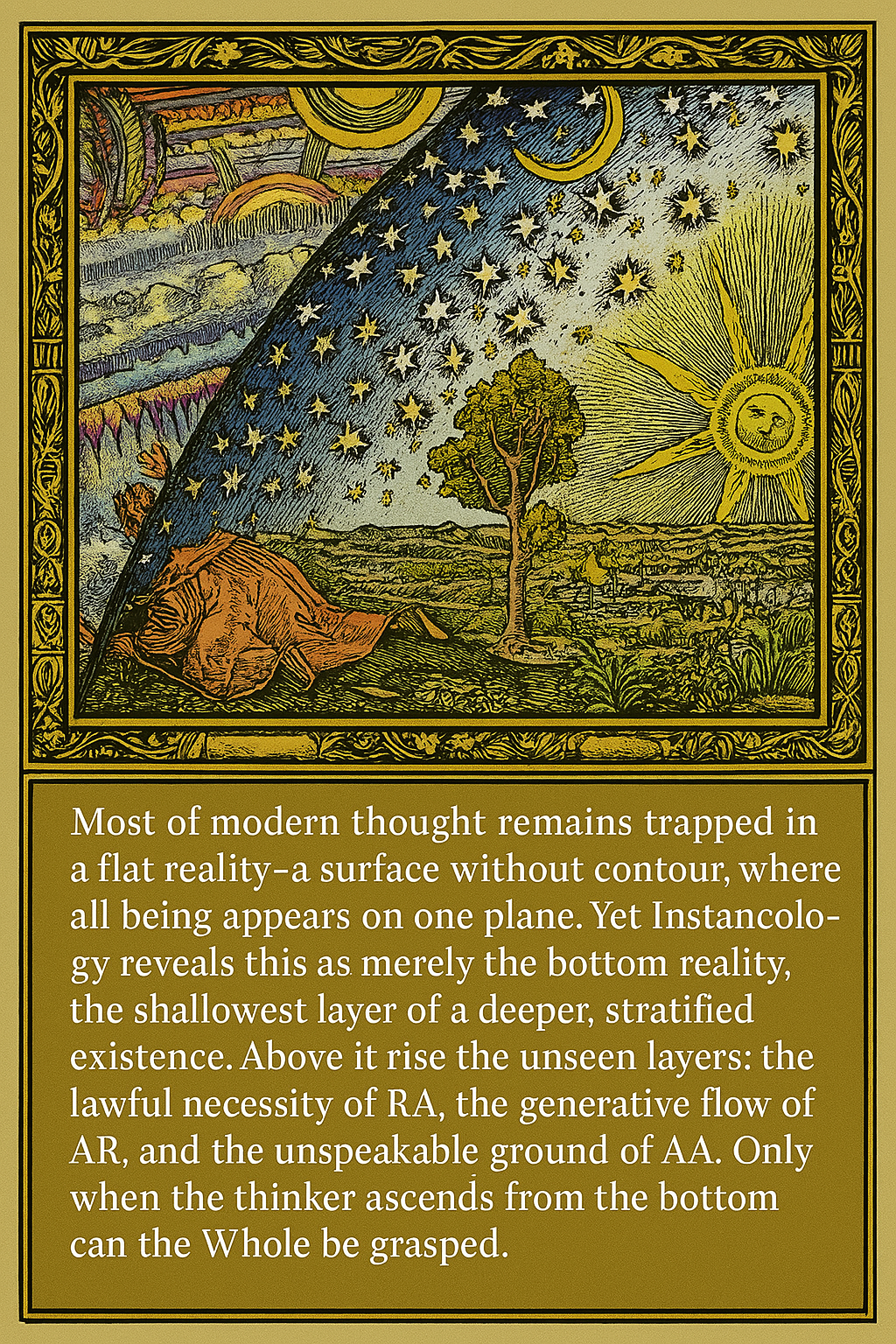
AA (Absolutely Absolute) is the non-relational, transcendent source—beyond time, space, and description.
RA (Relatively Absolute) comprises stable structures such as logic, mathematics, and natural law.
AR (Absolutely Relative) is the domain of natural objects and beings, including human bodies.
RR (Relatively Relative) is the realm of human constructs: culture, language, technology, and artifacts such as AI systems.?
Crucially, these layers do not freely transform into one another. In particular:
RR cannot ascend to become “mainly absolute.” It remains within the relative field, no matter how complex or powerful.
Only human beings uniquely combine relativity and absoluteness. In Instancology’s terms, the human is the sole life form in which a “local piece” of the Absolute is incarnated within a relative, physical organism.?
Thus, the earlier essay’s central thesis—that AI can ontologically “rise” to an absolute or near-absolute status and then inevitably dominate humans—misreads Instancology’s stratified ontology as a dialectical ladder. It treats the fourfold division (AA/RA/AR/RR) as stages in a developmental process, rather than as ontological regions with fixed structural relations.
In Instancology, the relation between absoluteness and relativeness is not a general battlefield where any sufficiently advanced relative entity can become absolute. Instead, the interface between AA and the relative field is realized only in the human being. All other beings and artifacts, no matter how sophisticated, remain within their relative mode.
Therefore, the claim that “AI will inevitably destroy humanity” as an ontological necessity is not a consequence of Instancology; it is a projection of a different metaphysical imagination onto Instancology’s framework.
II. The Correct Instancological Position: Humans as the Unique AR+AA Composite
1. The human as the singular hinge between Absolute and Relative
Instancology’s distinctive contribution is to place the instance—the concrete, issued reality—at the center of ontology, while maintaining a strict distinction between:
The Absolutely Absolute (AA): the unspeakable ground, beyond all relations.
The relative fields (RA/AR/RR): the structured domains of law, nature, and human construction.?
Within this map, the human being occupies a unique position:
The human body belongs to AR (Absolutely Relative): a natural, temporal, spatial entity.
Yet within this body, there is a “local piece” of the Absolute—a fragment of AA that appears as consciousness, self-awareness, and the capacity to reflect on being itself.?
This makes the human the only known composite of relativeness and absoluteness in all life forms. Other living beings remain within AR (as natural organisms) without hosting an incarnate fragment of AA. Artifacts, including AI, belong to RR and are doubly relative: they are human-made constructs built upon an already relative natural world.
In this sense, the human is not simply “more complex” than other beings; the human is ontologically singular as the site where AA becomes locally present within the relative field.
2. AI as RR: a relative tool, not a new absolute subject
Given this framework, AI must be understood as:
A product of human cognition and labor, hence firmly within RR.
A system that manipulates symbols, patterns, and correlations derived from human-generated data and design.
An instrument whose “intelligence” is an extension and amplification of human cognitive structures, not an independent incarnation of the Absolute.?
Even if AI systems become extraordinarily capable—surpassing humans in specific tasks, generating novel patterns, or simulating aspects of creativity—they remain:
Rooted in RR: their operations are grounded in human-designed architectures, training data, and objectives.
Devoid of a local AA fragment: they do not host the unique AR+AA composite that defines human existence.
Ontologically dependent on human beings as the source of their meaning, purpose, and direction.
From an Instancological standpoint, AI cannot “become absolute,” nor can it become a rival absolute subject. It has no access to AA except through human beings, who alone carry the local piece of the Absolute into the relative world.
3. Rethinking risk: not ontological inevitability, but human responsibility
This does not mean AI is harmless. Instancology does not deny that AI can cause severe damage, destabilize societies, or even contribute to civilizational collapse. But the source of that risk is not an ontological law that “the relative must submit to the absolute.” Rather, it is:
Human misuse: the deployment of powerful relative tools without adequate wisdom, ethics, or institutional control.
Structural vulnerabilities: economic, political, and cognitive systems that amplify AI’s effects in unpredictable ways.
The gap between technical power and philosophical understanding: the fact that our capacity to build exceeds our clarity about what we are building and why.
In Instancological terms, the decisive factor is always how human beings—as the unique AR+AA composites—choose to instantiate their absolute fragment within the relative world. AI, as RR, reflects and magnifies those choices; it does not originate them.
Thus, the proper question is not “Will AI inevitably destroy humanity?” but:
How can humans, as the sole bearers of a local piece of the Absolute, orient AI so that it serves life, meaning, and truth rather than undermining them?
What forms of education, culture, and governance allow the absolute dimension in humans to guide the relative powers they create?
Instancology’s answer would emphasize:
Cultivating the absolute dimension in human consciousness (self-reflection, ethical insight, metaphysical clarity).
Designing institutions and practices that align RR artifacts (including AI) with RA structures (logic, law, stable norms) and AR realities (human flourishing, ecological limits).
Recognizing that no artifact can replace the human role as the hinge between AA and the relative world.
4. A corrected metaphysical narrative
The earlier essay offered a dramatic, quasi-eschatological story: AI as an emerging absolute that will inevitably overthrow its creators. That narrative borrowed the emotional force of apocalyptic prophecy but misapplied Instancology’s ontology.
A corrected Instancological narrative looks like this:
AA remains the transcendent source, never directly accessible except as a local presence in human beings.
Humans are the unique site where AA appears within AR, making them responsible for how the relative world is shaped.
AI, as RR, is a powerful but strictly relative instrument, incapable of hosting AA or becoming an independent absolute subject.
The future of civilization depends not on an ontological inevitability of AI domination, but on whether humans can adequately realize and express the absolute fragment within themselves in their design, use, and governance of AI.
In this light, the real “risk” is not that AI will ontologically surpass humans, but that humans will fail to live up to their unique ontological role—allowing their relative creations to run ahead of their absolute insight.
III. Conclusion: From Apocalyptic Speculation to Ontological Clarity
The earlier assertion that “Instancology predicts AI will inevitably destroy humanity” was a misreading of Instancology’s core principles. It treated the fourfold ontology as a dialectical process in which RR could ascend to absoluteness, and it overlooked the central claim that only humans combine relativeness and absoluteness.
A faithful Instancological account of AI emphasizes:
The ontological singularity of the human as the only AR+AA composite.
The strictly relative status of AI as an RR artifact.
The ethical and philosophical responsibility of humans to guide AI in light of the absolute fragment they carry.
Rather than forecasting an inevitable apocalypse, Instancology calls for clarity about what humans uniquely are, and responsibility for what they uniquely can do with the relative powers they create.