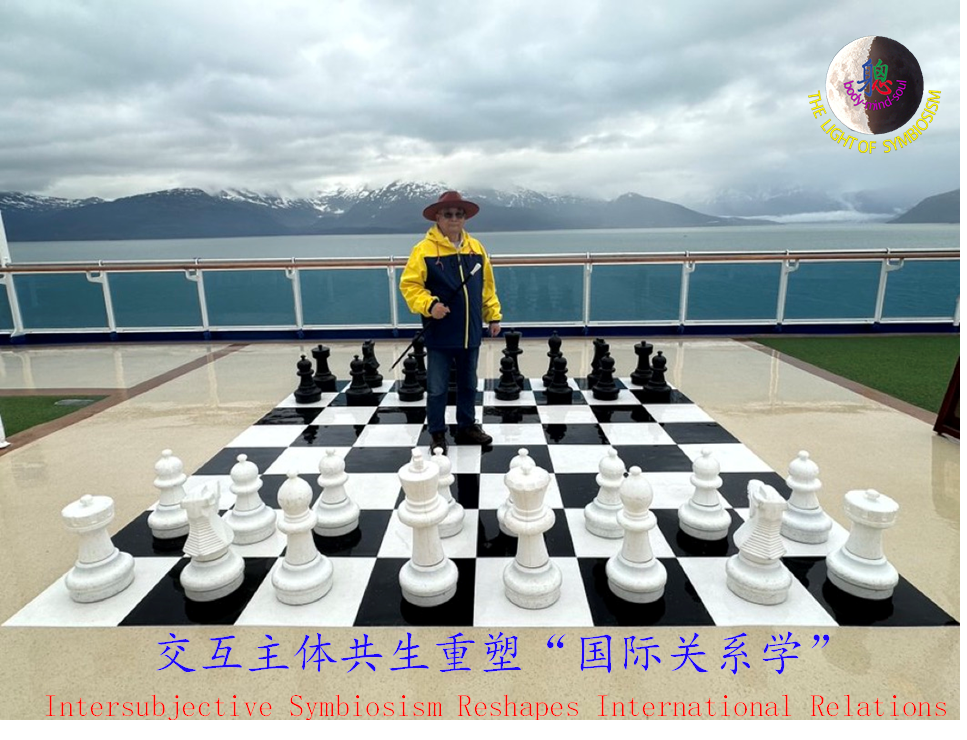
太平、繁荣得不耐烦
太平、繁荣得不耐烦
Growing Impatient with Peace and Prosperity
——两宋“远交近攻”成双违契的血训
—The Bloody Lesson of the Two Song Dynasties’ Twin Breaches of Covenant through “Befriending the Distant and Attacking the Near”
钱 宏(Archer Hong Qian)
2026年9月1日中于Vancouver
历史不会简单重复。
一千年前的宋、辽、金、蒙古,与今天的美国、加拿大以及全球贸易秩序,当然不能机械类比。
但是,历史有时候会留下某种很有意思的关系结构。
今天我们谈“贸易多元化”,谈“降低依赖”,谈开拓更远方的市场,本来都没有错。生命本来就应该扩大连接,经济活动也不应该把自己锁死在单一市场。
人有一种很奇怪的习惯:灾难来临的时候渴望太平,贫困的时候渴望繁荣;太平久了,繁荣久了,却又容易把已经得到的一切视为理所当然。
和平没有声音,战争才有声音;顺畅的贸易不制造英雄,冲突却最容易制造英雄;一份被几代人安安静静履行的契约,很少令人热血沸腾,“雪耻”“强硬”“重新伟大”却最容易激动人心。
于是,太平久了,也可能太平得不耐烦;繁荣久了,也可能繁荣得不耐烦。
真正危险的,往往正是这个时候:人开始低估已经拥有的财富,高估打破现状以后那个想象中的远方。
可是还有另外一个问题:
当一个已经运行多年、能够创造价值的近邻连接,因为摩擦,因为政治情绪,因为历史记忆,甚至因为某些人心里“不爽”,开始被当成必须摆脱的对象时,我们究竟应该修补它、重新谈判它,还是寻找一个更远方的力量来替代它,甚至帮助自己毁掉它?
中国历史上,北宋做过一次。
南宋后来又做了一次。
两次都有一个我们熟悉的名字:
远交近攻。
两次也都成功了。
北宋联合金,灭了辽。
南宋联合蒙古,灭了金。
可是两个宋最后也都亡在自己曾经联合的“远方”手里。
这就值得把故事重新讲一遍。
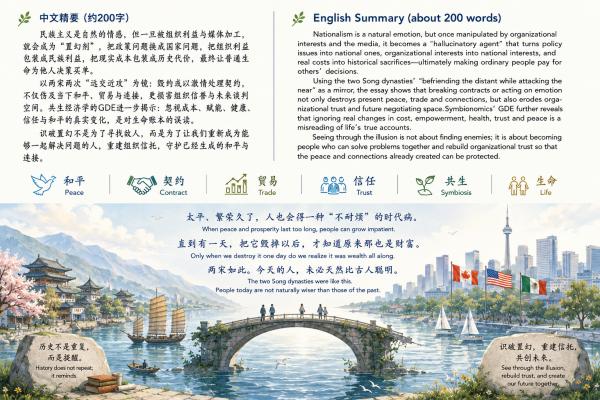
一、北宋:澶渊之盟守了一百多年,为什么不重新谈,却要联金灭辽?
公元1004年,宋辽之间又一次爆发大战。
辽军一路南下,兵临澶州。宋廷震动,甚至有人提出迁都。宰相寇准力主宋真宗亲征,宋军士气大振。
仗打到这里,双方其实都已经明白:
继续打下去,谁都要付出巨大的成本。
于是,谈。
1005年,宋辽达成了著名的澶渊之盟。
这个盟约今天读起来很有意思。
宋辽约为兄弟之国。
宋真宗年长,为兄;辽圣宗为弟。
双方确定边界,彼此约束,不再轻易越境用兵;宋每年向辽提供白银十万两、绢二十万匹,也就是后来经常被人说起的“岁币”;与此同时,双方开放榷场,开始大规模边境贸易。
只盯着“岁币”看,当然有人觉得不舒服:
堂堂大宋,为什么每年要给辽银子和丝绸?
可是,把政治情绪暂时放下来,把账本打开,看到的却是另一回事。
首先,是和平。
澶渊之盟以后,宋辽之间维持了一百多年大体和平。
原来杀人的边境,慢慢开始做生意。
商人来了。
羊马来了。
茶叶来了。
丝绸、瓷器、漆器、书籍也来了。
辽的优势产品主要是马匹、羊、骆驼、皮革、毛制品以及部分药材;宋的优势则在茶叶、丝绸、瓷器、漆器以及各种成熟的手工业产品。
特别是茶。
辽地以畜牧经济为主,肉食较多,对茶有很大的生活需求。宋朝发达的农业、手工业和商业体系,由此获得了巨大的市场。
于是出现了一件很有意思的事情:
宋朝一边付岁币,一边做生意;银绢出去了,相当一部分货币又随着辽人购买宋朝商品流了回来。
也就是说,不能只看政府账本上“付出去多少”,还要看整个生活账本发生了什么。
有贸易规模。
有贸易收益。
有边境繁荣。
有战争成本的大幅下降。
更重要的是,一百多年没有大规模战争。
如果把这些都放进共生经济学的GDE账本,澶渊之盟究竟“亏不亏”,答案就远没有“每年送了多少银子”那么简单。
一纸盟约,把战争边境变成了贸易边境。
这才是它真正创造的财富。
问题也恰恰发生在这里:一种财富一旦稳定存在得太久,人就容易不再把它当作财富。
一百多年没有大战,后来的人没有经历签约以前那种战争成本,便越来越容易只看见每年交出去的岁币,却看不见因为这份契约而不必支付的战争费用;只看见“不够痛快”,却看不见边境已经生长出来的市场、生活和孞托。
太平最大的悖论,或许就在这里:它越成功,人越容易忘记没有它会是什么样子。
而且,还有一件比贸易数字更重要的东西慢慢发生了:
契约开始变成组织孞托。
澶渊之盟不是宋朝单方面宣布的政策。
它是一份双方谈出来、双方签下来、双方承诺遵守的契约。
第一代人签。
第二代人守。
第三代人继续守。
一百多年过去以后,当初签约的人早已不在人世,但契约已经进入了几代人的生活。
边界在哪里,大家知道。
什么东西可以交易,大家知道。
发生摩擦找谁处理,也慢慢形成规则。
商人敢来,是因为相信明天不会突然开战。
百姓敢在边境安家,是因为相信今天签下的约明天还算数。
这时候,一纸盟约已经不只是一张纸。
它已经成为一种组织孞托资产。
当然,一百多年以后的人完全可以说:
当年的协议有些地方不合理了。
岁币是不是应该减少?
某些边界是不是应该调整?
贸易条件是不是应该修改?
燕云十六州的问题是不是应该重新讨论?
都可以。
不满意,可以再谈。
这恰恰就是契约精神。
契约精神从来不是祖宗签了一个字,子孙万代一个标点符号都不能改。
时代会变。
力量会变。
利益会变。
条款当然也可以变。
但是,改约与毁约是两回事。
你觉得旧约不合适,可以找原来的缔约方重新谈。
你提出条件。
我提出条件。
争。
吵。
讨价还价。
谈不拢再谈。
这本身就是组织孞托继续承兑的过程。
可是北宋后来选择了另外一条路。
辽的北方,女真金国迅速崛起。
北宋一些君臣一看:
机会来了。
既然辽一直让我们“不爽”,为什么不联合更远方的金,从南北两面夹击,把辽彻底消灭?
于是有了著名的:
联金灭辽。
因为辽横在宋金之间,双方甚至需要渡海联系,所以这个新的联盟又被称为“海上之盟”。
这就是典型的:
远交近攻。
从军事算盘上看,很漂亮。
从民族情绪上看,更痛快。
燕云旧恨可以雪。
百年岁币可以不再交。
堂堂大宋终于可以扬眉吐气。
如果朝廷内部本来还有各种矛盾,那么一个外部的“百年宿敌”,也很容易成为重新凝聚情绪的对象。
这正是历史中反复出现的一种现象:
内部的问题不好解释,外部的敌人最好解释。
现实治理需要承担责任,历史屈辱却最容易动员激情。
于是,原来应该问:
我们今天治理得怎么样?
慢慢变成:
我们什么时候雪耻?
原来应该问:
这份契约还有哪些地方需要重新谈?
慢慢变成:
为什么还要跟敌人谈?
民族主义置幻,就可能在这里发生。
太平得不耐烦,往往也就在这里开始。
已经拥有的和平因为天天存在,越来越没有政治戏剧性;尚未收回的故土、尚未雪洗的旧耻,却越来越适合制造历史激情。
于是,现实中已经获得的东西被贬值,想象中尚未获得的东西被升值。
这也是一种置幻。
但这里还有一个更深的问题:
毁约。
澶渊之盟已经运行了一百多年。
如果你认为它不合理,可以谈。
如果认为条款过时,可以改。
甚至如果认为已经无法继续,也应该面对缔约方处理彼此的契约关系。
可是,你根本不谈,却绕过自己的缔约方,去找更远方的第三者,准备把这个已经与你守约百余年的国家直接消灭——
那意味着什么?
意味着别人也会看。
金也会看。
今天你能够联合我,毁掉你与辽维持了一百多年的契约关系,那么明天呢?
你会不会再联合另外一个人,毁掉今天与我建立的关系?
这就是组织信誉。
也是组织孞托。
一个国家签下的约值多少钱,不只取决于纸上写了什么,更取决于别人相信你会不会承兑。
你自己可以因为一时利益、一时情绪、一时战略机会,把一份已经履行百年的契约抛掉,别人当然也会重新计算:
下一次与你签约,还能不能信?
所以,联金灭辽损伤的不只是宋辽关系。
它同时损伤了宋自己的组织信誉。
后来发生的事情,大家都知道。
辽真的灭了。
北宋的战略目标真的实现了。
可是,一个此前没有被认真计算的问题马上出现:
辽没有了,谁站在宋与金之间?
那个已经相处一百多年,彼此知道边界在哪里、贸易怎么做、发生摩擦怎么处理的辽消失以后,一个军事实力更强、双方尚未生成长期契约孞托的金,直接站到了北宋门口。
原来的远方,突然成了近邻。
接下来:
金兵南下。
开封陷落。
徽、钦二帝被俘。
靖康之变。
北宋亡。
最值得后人思考的甚至不是:
联金灭辽失败了。
恰恰相反。
联金灭辽成功了。
它成功消灭了北宋最想消灭的那个敌人。
但与此同时,也成功毁掉了一条运行百年的契约关系、一层地缘缓冲、一套贸易连接,以及经过几代人才生成的组织孞托。
战略目标实现了。
生活结果却走向了反面。
二、南宋:同一道题,为什么又答了一遍?
北宋亡后,赵宋南渡。
临安成为新的政治中心,南宋开始。
所谓“偏安”,一偏又是一百多年。
而且这一百多年并非一片衰败。江南经济继续发展,商业繁荣,城市扩张,海外贸易兴盛,文化也达到新的高度。
北边的金当然仍然令人不舒服。
双方打过。
谈过。
再打。
再谈。
有战争,也有和议。
有屈辱,也有现实。
但是随着时间过去,宋金之间同样逐渐形成了边界、贸易和一套彼此打交道的规则。
换句话说:
又有新的连接开始生成。
然后,历史像是故意给南宋出了一道北宋曾经做过的题。
金的更北方,又出现了一个更加强大的力量。
蒙古。
蒙古铁骑迅速崛起。
向西,一直打向欧洲。
向南,西夏挡不住。
金也越来越挡不住。
南宋朝廷一看:
机会又来了。
更令人感叹的是,北宋付过一次学费,并没有自动变成南宋的组织记忆。
北宋已经演示过一次“近邻消失、远方变近邻”;一百多年以后,当新的繁荣再次成为日常,新的“远方”再次出现,同一种诱惑竟然又有了吸引力。
历史发生过,不等于历史已经被学会。
北宋当年想借金灭辽。
今天我们为什么不能借蒙古灭金?
于是:
联蒙灭金。
还是那个熟悉的四个字:
远交近攻。
蒙古从北边打。
南宋从南边打。
夹击金国。
结果,又成功了。
1234年,金亡。
南宋百余年的宿敌终于消失。
可以庆祝了。
可是历史马上又问了南宋一个几乎与北宋当年完全一样的问题:
金没有了,谁站在你和蒙古之间?
没有了。
横扫欧亚大陆的蒙古,直接来到了南宋面前。
这里,同样不只有战略问题。
还有契约问题。
南宋如果认为与金之间原有的协议不公平,可以重新谈。
认为边界需要改变,可以谈。
认为对方违约,可以追究。
国际环境变化,也可以重新安排关系。
但是,一面生活在既有契约形成的秩序之中,一面联合更强大的第三方去消灭原来的缔约者,同样会产生一个无法回避的问题:
你的约,究竟还值多少钱?
第一次,北宋联金灭辽。
第二次,南宋联蒙灭金。
远方的盟友当然也会观察:
你当年怎样处理自己的近邻关系?
你怎样对待自己签下的约?
你为了眼前利益可以抛弃昨天的契约,那么今天我为什么要相信你明天不会这样对我?
这就是组织孞托的乘积效应。
它可以一层一层生长。
也可以一次一次流失。
金亡以后,南宋内部又出现收复故土的强烈情绪,于是有了“端平入洛”。
开封。
洛阳。
旧都。
故土。
这些词当然都具有巨大的历史感召力。
可是情感并不能代替战略。
历史记忆也不能代替现实力量的计算。
宋军最终败退。
宋蒙之间走向长期战争。
几十年以后,南宋也走到了尽头。
1279年,崖山。
南宋亡。
于是中国历史留下了一个令人唏嘘的对称:
北宋联金灭辽。
辽亡。
金成为新的近邻。
北宋亡于金。
南宋联蒙灭金。
金亡。
蒙古成为新的近邻。
南宋亡于蒙古。
当然,两宋的灭亡有极其复杂的政治、军事、财政和组织原因,绝不能简单归结为“远交近攻”四个字。
但如果因此就认为这两个故事没有留下任何可以辨认的关系结构,同样可惜。
它至少留下三个问题。
第一,远方为什么天然比近邻可靠?
距离并不会自动产生善意。
一个与你争过、打过、谈过、签过约、做过几十年甚至上百年生意的近邻,虽然有摩擦,却已经形成大量看不见的连接资产:
边界。
规则。
市场。
经验。
人员往来。
处理争议的方法。
以及彼此对对方行为边界的预期。
这些东西都不是一天形成的。
第二,旧约不满意,为什么不能重新谈?
契约当然不是永恒不变的。
真正的契约精神,恰恰包括重新谈判的能力。
环境变了,改。
利益变了,谈。
规则有漏洞,补。
条款不公平,重新议定。
重谈,是继续承认对方作为契约主体;毁约,却是在破坏契约本身。
这两者之间,差着一个组织孞托。
第三,毁约真的没有成本吗?
今天毁掉一份协议,表面上只处理了今天的问题。
实际上还在给未来所有可能与你签约的人发送一个信号:
我签下来的约,在环境改变、利益改变、情绪改变以后,还算不算数?
所以,毁约损失的不只是一个伙伴。
还可能是自己的信用。
而信用本身,就是资产。
三、从“远交近攻”回到今天:多元化究竟增加了什么?
讲到这里,就可以回到今天所谓的“贸易多元化”。
加拿大当然应该与欧洲做生意。
应该与亚洲做生意。
应该与日本、印度以及世界上一切能够创造价值的国家和地区建立新的贸易连接。
从共生经济学看,增加连接本来就是好事。
问题从来不是“要不要多元”。
而是:
多元究竟增加了什么?
增加了多少出口?
增加了多少收入?
创造了多少就业?
增加了多少新的高价值产业?
降低了多少单一市场风险?
同时,又增加了多少运输成本?
增加了多少供应链成本?
增加了多少制度摩擦?
失去的北美订单有没有被真正替代?
这些账,都应该算。
更不能忘记:
加拿大与美国之间已经形成的关系,也不只是今天两个政府签下的一张纸。
几十年的自由贸易安排、企业投资、产业链布局、能源网络、公路铁路、边境城市、家庭关系以及每天发生的巨大人员与商品流动,早已使一纸协议进入生活。
契约经过生活反复承兑,就会生成组织孞托。
因此,今天如果认为USMCA/CUSMA有些条款不公平——
谈。
美国提出修改,加拿大可以不同意。
加拿大有自己的要求,也可以提出。
墨西哥同样可以据理力争。
规则过时了,改。
原产地规则有漏洞,补。
利益分配不公平,重新谈。
这本来就是契约。
真正需要警惕的是:
不要把“不满意”变成“不谈”;不要把谈判变成敌我;不要把贸易争议变成民族尊严;更不要为了证明自己不依赖一个近邻,先损伤几十年才生成的连接与组织孞托。
北宋当年不满意澶渊之盟,当然有权重新谈。
南宋不满意与金的关系,也当然可以重新谈。
历史真正令人感叹的地方,就在于:
他们后来选择的都不是简单的“再谈一次”。
而是找来更远、更强大的力量,把眼前那个令人不舒服的近邻消灭掉。
近邻真的消失了。
远方也真的来了。
只是来的方式,与原来想象的不一样。
所以,两宋的故事并不是告诉今天的人:
不要开拓远方。
恰恰相反。
远方当然要交,新的连接当然要生长。
它真正留下的警示是:
不要为了拥抱尚未证明价值的远方,先毁掉已经能够创造价值的近邻连接;更不要忘记,一份经过时间反复承兑的契约,本身就是财富。
远,不等于多元。
近,也不等于依赖。
多,不等于效能。
强硬,更不等于国家利益。
旧约可以重谈,利益可以重算,关系可以调整;组织孞托一旦毁掉,再重建,却可能要用一代人的时间。
澶渊之盟签下一百多年以后,当年签字的人早已不在。
但他们留下的和平还在。
榷场还在。
商人还在。
边境生活还在。
这或许正是契约最有意思的地方:
签字的是一代人,承兑它的却可能是几代人的生活。
反过来也一样。
毁约的决定可能只需要几个人、几天时间;为毁约支付成本的,却可能是整个国家和后来的几代人。
这本账,值得算。
这份孞托,更值得珍惜。
太平、繁荣久了,人也会得一种“不耐烦”的时代病。
加拿大人可能因为厌恶川普,而把一个本来可以继续谈判的贸易问题置换成民族尊严问题;美国人也可能因为党争,把一个本来应该逐项计算成本与收益的政策问题,置换成“支持川普还是反对川普”的身份问题。两边看起来都很有原则,最后却可能做着同一件事:把政治人物放大,把生活账本缩小;把情绪放大,把已经生成几十年的和平、贸易、契约和组织孞托当成理所当然。
和平太久,人容易忘记和平的成本;贸易太顺,人容易忘记连接的价值;契约履行太久,人甚至会觉得契约本来就在那里。
直到有一天,把它毁掉以后,才知道原来那也是财富。
两宋如此。
今天的人,未必天然比古人聪明。
Growing Impatient with Peace and Prosperity
—The Bloody Lesson of the Two Song Dynasties’ Twin Breaches of Covenant through “Befriending the Distant and Attacking the Near”
Archer Hong Qian
Vancouver, September 1, 2026
History does not simply repeat itself.
The Song, Liao, Jin, and Mongol regimes of a thousand years ago obviously cannot be mechanically compared with today’s United States, Canada, or the global trading order.
Yet history sometimes leaves behind remarkably revealing patterns of relationships.
Today, we speak of “trade diversification,” “reducing dependence,” and opening markets farther afield. There is nothing inherently wrong with any of this. Life naturally seeks to expand its connections, and economic activity should not lock itself into a single market.
But human beings have a curious habit: when disaster strikes, they long for peace; when they are poor, they long for prosperity. Yet once peace has lasted long enough and prosperity has become familiar, people easily begin to take what they already have for granted.
Peace makes little noise; war makes plenty.
Smoothly functioning trade rarely creates heroes; conflict does.
A covenant quietly honored by generation after generation seldom stirs the blood, while words such as “avenge humiliation,” “stand firm,” and “make us great again” can easily ignite passion.
And so, after peace has lasted long enough, people may grow impatient with peace; after prosperity has lasted long enough, they may grow impatient with prosperity.
That is often precisely when danger begins: people start undervaluing the wealth they already possess and overvaluing the imagined distant future that supposedly lies beyond the existing order.
But there is another question.
When a relationship with a neighboring country has operated for many years and continues to create value, yet friction, political emotion, historical memory, or simply a feeling of resentment causes people to regard that relationship as something from which they must escape, what should they do?
Repair it?
Renegotiate it?
Or search for a more distant power to replace it—or even help destroy it?
Chinese history saw the Northern Song make one such choice.
The Southern Song later made another.
Both choices have a familiar name:
Befriend the distant and attack the near.
Both even succeeded.
The Northern Song allied with Jin and destroyed Liao.
The Southern Song allied with the Mongols and destroyed Jin.
Yet both Song dynasties ultimately fell to the very “distant” powers they had once enlisted as allies.
That makes the story worth telling again.
I. The Northern Song: After Honoring the Chanyuan Covenant for More Than a Century, Why Not Renegotiate It Instead of Allying with Jin to Destroy Liao?
In 1004, war again broke out between Song and Liao.
The Liao army advanced southward and reached Chanzhou. The Song court was shaken; some officials even proposed moving the capital. Chancellor Kou Zhun strongly urged Emperor Zhenzong to go personally to the front, greatly raising Song morale.
By this point, both sides understood something quite clearly:
If the war continued, both would pay an enormous price.
So they negotiated.
In 1005, Song and Liao reached the famous Chanyuan Covenant.
Read today, the agreement is fascinating.
Song and Liao established a relationship as brother states.
Emperor Zhenzong of Song, being the elder, was regarded as the elder brother; Emperor Shengzong of Liao as the younger.
The two sides established their boundaries and undertook not to cross them lightly with military force. Song agreed to provide Liao annually with 100,000 taels of silver and 200,000 bolts of silk—the so-called “annual payment” so often mentioned in later history. At the same time, the two sides opened border markets and began large-scale frontier trade.
If one looks only at the annual payment, discomfort is understandable:
Why should the mighty Song send silver and silk to Liao every year?
But set political emotion aside for a moment, open the ledger, and a different picture appears.
First came peace.
After the Chanyuan Covenant, Song and Liao maintained broad peace for more than a century.
A frontier where people had once killed one another gradually became a place where people did business.
Merchants came.
Sheep and horses came.
Tea came.
Silk, porcelain, lacquerware, and books came as well.
Liao’s comparative strengths lay mainly in horses, sheep, camels, leather, wool products, and certain medicinal materials. Song’s strengths lay in tea, silk, porcelain, lacquerware, and a wide range of sophisticated handicrafts.
Tea was particularly important.
The Liao economy was heavily pastoral and its people consumed considerable amounts of meat, creating a strong everyday demand for tea. Song’s highly developed agricultural, handicraft, and commercial economy thereby gained a large market.
Something quite interesting followed.
Song paid the annual silver and silk while simultaneously conducting trade. Silver and silk flowed outward, but a substantial amount of money flowed back as people in Liao purchased Song goods.
In other words, one cannot look only at how much the government ledger says was “paid out.”
One must look at what happened in the larger ledger of life.
There was trade.
There were gains from trade.
There was frontier prosperity.
There was a substantial reduction in the cost of war.
Most importantly, there was no large-scale war between the two sides for more than a century.
If all this were entered into the GDE ledger of Symbionomics, the question of whether the Chanyuan Covenant was a “loss” would be far more complicated than simply asking how much silver Song sent away each year.
A single covenant transformed a frontier of war into a frontier of trade.
That was the real wealth it created.
And this is precisely where the problem begins:
When a form of wealth exists steadily for too long, people easily cease to recognize it as wealth.
After more than a century without major war, later generations had never experienced the costs of war that had preceded the covenant. They could therefore see the annual silver leaving Song more readily than the military expenditure the covenant made unnecessary. They could see what felt “humiliating” more easily than the markets, everyday life, and trust that had grown along the frontier.
Perhaps this is the greatest paradox of peace:
The more successful peace becomes, the easier it is to forget what life would be like without it.
Meanwhile, something even more important than trade figures had slowly taken shape:
Covenant had begun to become organizational trust.
The Chanyuan Covenant was not a policy unilaterally proclaimed by Song.
It was an agreement negotiated by both sides, concluded by both sides, and promised by both sides.
The first generation signed it.
The second generation honored it.
The third generation continued to honor it.
More than a century later, those who had originally signed the agreement were long dead, yet the covenant had already entered the lives of several generations.
People knew where the boundary lay.
They knew what could be traded.
Rules had gradually emerged for dealing with friction.
Merchants dared to come because they believed war would not suddenly erupt tomorrow.
People dared to settle near the frontier because they believed that an agreement valid today would still count tomorrow.
At that point, the covenant was no longer merely a piece of paper.
It had become an asset of organizational trust.
Of course, people living a century later were entirely entitled to say:
Some provisions of the old agreement no longer make sense.
Should the annual payment be reduced?
Should certain boundaries be adjusted?
Should trade terms be revised?
Should the question of the Sixteen Prefectures of Yan and Yun be reopened?
All of these questions could be raised.
If you are dissatisfied, renegotiate.
That is precisely the spirit of covenant.
The spirit of covenant has never meant that once one’s ancestors sign a document, their descendants must preserve every comma forever.
Times change.
Power changes.
Interests change.
Terms can change as well.
But revising a covenant and destroying one are two different things.
If the old agreement no longer works for you, go back to the original contracting party and renegotiate.
You state your terms.
I state mine.
Argue.
Disagree.
Bargain.
If negotiations fail, negotiate again.
That process itself is the continuing redemption of organizational trust.
But the Northern Song eventually chose another path.
To the north of Liao, the Jurchen Jin state rose rapidly.
Some at the Northern Song court looked at the situation and thought:
Here is our opportunity.
If Liao has made us “unhappy” for so long, why not ally with the more distant Jin, attack Liao from north and south, and eliminate it altogether?
Thus came the famous policy:
Ally with Jin to destroy Liao.
Because Liao lay between Song and Jin, the two sides even had to communicate by sea. Their alliance therefore became known as the Alliance Conducted at Sea.
It was a classic case of:
Befriending the distant and attacking the near.
On the military ledger, it looked elegant.
In terms of nationalist emotion, it felt even better.
The old grievance over Yan and Yun could finally be avenged.
A century of annual payments could end.
The mighty Song could finally hold its head high.
And if the court already suffered from various internal tensions, an external “enemy of a hundred years” could easily become a focus around which political emotion might once again be consolidated.
History has seen this pattern repeatedly:
Internal problems are difficult to explain; external enemies are easy to explain.
Real governance requires responsibility.
Historical humiliation mobilizes passion much more easily.
So the question that should have been:
How well are we governing today?
Gradually becomes:
When will we avenge our humiliation?
And the question that should have been:
Which parts of this covenant need to be renegotiated?
Gradually becomes:
Why are we still negotiating with the enemy?
This is where nationalist illusion can begin.
And this is often where impatience with peace begins as well.
Peace already possessed becomes less and less politically dramatic precisely because it is there every day. Lost territory not yet recovered and old humiliations not yet avenged become increasingly useful for manufacturing historical passion.
Thus:
What has already been gained in reality is devalued, while what has not yet been gained in imagination is revalued upward.
That, too, is an illusion.
But an even deeper problem lies here:
Breaking covenant.
The Chanyuan Covenant had operated for more than a century.
If you believed it unreasonable, you could negotiate.
If its provisions had become outdated, you could revise them.
Even if you believed the relationship could no longer continue, you should still confront the other contracting party and deal with the contractual relationship between you.
But if you do not negotiate at all, and instead bypass your contracting partner to find a more distant third party with whom to destroy a country that has honored its covenant with you for more than a century—
what does that mean?
It means others are watching.
Jin is watching too.
Today you can ally with me to destroy the contractual relationship you maintained with Liao for more than a century.
What about tomorrow?
Might you ally with someone else to destroy the relationship you establish with me today?
That is organizational credibility.
It is also organizational trust.
The value of a covenant signed by a state depends not only on what is written on the paper, but also on whether others believe that the state will redeem what it has promised.
If, for temporary advantage, temporary emotion, or temporary strategic opportunity, you can cast aside an agreement honored for a century, others will naturally recalculate:
Can the next agreement I sign with you still be trusted?
Thus the alliance with Jin against Liao damaged more than Song–Liao relations.
It damaged Song’s own organizational credibility.
What happened next is well known.
Liao really was destroyed.
The Northern Song really did achieve its strategic objective.
But a question that had not been properly calculated immediately arose:
With Liao gone, who now stood between Song and Jin?
The Liao state—with which Song had lived for more than a century, knowing where the boundaries lay, how trade worked, and how disputes were handled—had disappeared.
In its place, a militarily stronger Jin, with which Song had never generated long-term covenantal trust, now stood directly at the Northern Song’s door.
The distant power suddenly became the neighbor.
Then came:
Jin armies moving south.
Kaifeng falling.
Emperors Huizong and Qinzong being captured.
The Jingkang catastrophe.
The fall of the Northern Song.
The most important point for later generations is not even that the alliance with Jin against Liao failed.
Quite the opposite.
It succeeded.
It successfully destroyed the enemy the Northern Song most wanted to destroy.
But in doing so, it also successfully destroyed a century-old contractual relationship, a geopolitical buffer, a network of trade connections, and organizational trust that had taken several generations to generate.
The strategic objective was achieved.
The outcome for life moved in the opposite direction.
II. The Southern Song: Why Did It Answer the Same Question the Same Way Again?
After the Northern Song fell, the Song court moved south.
Lin’an became the new political center, and the Southern Song began.
Its so-called “partial peace” lasted for more than a century.
And this was by no means a century of unbroken decline.
The economy of the Jiangnan region continued to develop. Commerce flourished. Cities expanded. Overseas trade prospered. Culture reached remarkable heights.
Jin to the north remained, of course, uncomfortable.
They fought.
They negotiated.
They fought again.
They negotiated again.
There was war.
There were peace agreements.
There was humiliation.
There was also reality.
But as time passed, Song and Jin gradually developed boundaries, trade, and rules for dealing with one another.
In other words:
New connections were again beginning to grow.
Then history seemed almost deliberately to present the Southern Song with a question the Northern Song had already answered.
Farther north of Jin, an even more powerful force appeared.
The Mongols.
Mongol cavalry rose rapidly.
Westward, they advanced deep into Europe.
Southward, Western Xia could not stop them.
Jin increasingly could not stop them either.
The Southern Song court looked at the situation:
Here was another opportunity.
What is even more striking is that the price already paid by the Northern Song did not automatically become the organizational memory of the Southern Song.
The Northern Song had already demonstrated once what happens when “the neighbor disappears and the distant power becomes the new neighbor.”
More than a century later, when a new prosperity had again become ordinary life and another “distant power” appeared, the same temptation somehow regained its appeal.
History having happened does not mean history has been learned.
The Northern Song had once sought to use Jin to destroy Liao.
Why could the Southern Song not use the Mongols to destroy Jin?
And so:
Ally with the Mongols to destroy Jin.
Again, the same familiar strategy:
Befriend the distant and attack the near.
The Mongols attacked from the north.
The Southern Song attacked from the south.
Together they struck Jin.
And once again—
they succeeded.
In 1234, Jin fell.
The Southern Song’s enemy of more than a century was finally gone.
Time to celebrate.
But history immediately asked the Southern Song almost exactly the same question it had once asked the Northern Song:
With Jin gone, who now stands between you and the Mongols?
No one.
The Mongol power sweeping across Eurasia now stood directly before the Southern Song.
And again, this was not merely a strategic problem.
There was also a contractual problem.
If the Southern Song believed its existing agreements with Jin were unfair, it could renegotiate them.
If boundaries needed changing, negotiate.
If Jin had breached an agreement, pursue the breach.
If the international environment had changed, rearrange the relationship.
But to live within an order created by existing agreements while simultaneously joining with a stronger third party to destroy the original contracting party raises an unavoidable question:
What, then, is your covenant worth?
The first time:
Northern Song allied with Jin to destroy Liao.
The second:
Southern Song allied with the Mongols to destroy Jin.
The distant ally would naturally observe:
How did you deal with your neighboring relationships in the past?
How did you treat the covenants you signed?
If you could abandon yesterday’s covenant for today’s immediate advantage, why should I believe that tomorrow you will not do the same to me?
This is the multiplicative effect of organizational trust.
It can grow layer by layer.
It can also be lost, one breach at a time.
After Jin fell, strong sentiment arose within the Southern Song for recovering former territory, leading to the campaign later known as the Duanping Entry into Luoyang.
Kaifeng.
Luoyang.
The old capitals.
The ancestral lands.
All of these words carried immense historical emotional power.
But emotion cannot substitute for strategy.
Historical memory cannot substitute for calculating the realities of power.
The Song forces eventually retreated in defeat.
Song and the Mongols entered a prolonged period of warfare.
Several decades later, the Southern Song too reached its end.
In 1279:
Yashan.
The Southern Song fell.
Chinese history thus left behind a striking symmetry:
Northern Song allied with Jin to destroy Liao.
Liao fell.
Jin became the new neighbor.
Northern Song fell to Jin.
Southern Song allied with the Mongols to destroy Jin.
Jin fell.
The Mongols became the new neighbor.
Southern Song fell to the Mongols.
Of course, the fall of the two Song dynasties had extraordinarily complex political, military, fiscal, and organizational causes. It cannot simply be reduced to the four-character strategy of “befriending the distant and attacking the near.”
But it would be equally unfortunate to conclude that these two stories therefore reveal no recognizable relational pattern.
They leave us with at least three questions.
First: Why should the distant power naturally be more trustworthy than the neighbor?
Distance does not automatically generate goodwill.
A neighbor with whom you have argued, fought, negotiated, signed agreements, and conducted business for decades or even centuries may create friction—but that relationship has also accumulated enormous invisible assets of connection:
Boundaries.
Rules.
Markets.
Experience.
Movement of people.
Ways of resolving disputes.
And expectations about the limits of one another’s behavior.
None of these arise overnight.
Second: If you are dissatisfied with an old covenant, why not renegotiate it?
A covenant is certainly not eternally immutable.
The true spirit of covenant includes precisely the capacity to renegotiate.
Circumstances change—revise.
Interests change—talk.
Rules contain loopholes—repair them.
Terms become unfair—renegotiate them.
Renegotiation continues to recognize the other side as a contracting subject; breaking covenant damages the covenantal relationship itself.
Between the two lies:
organizational trust.
Third: Is there really no cost to breaking covenant?
Destroying an agreement today may appear merely to solve today’s problem.
But it also sends a signal to everyone who may sign an agreement with you tomorrow:
When circumstances change, interests change, or emotions change, will the agreement you signed still count?
Thus breaking covenant may cost more than one partner.
It may cost your own credibility.
And credibility itself is an asset.
III. From “Befriending the Distant and Attacking the Near” Back to the Present: What Does Diversification Actually Add?
We can now return to today’s discussion of “trade diversification.”
Canada should, of course, trade with Europe.
It should trade with Asia.
It should build new trading connections with Japan, India, and every country or region in the world where value can be created.
From the perspective of Symbionomics, increasing connections is inherently a good thing.
The real question has never been:
Should we diversify?
The question is:
What does diversification actually add?
How much additional export volume?
How much additional income?
How many jobs?
How many new high-value industries?
How much single-market risk has actually been reduced?
At the same time:
How much additional transportation cost?
How much additional supply-chain cost?
How much additional institutional friction?
Have the North American orders that were lost actually been replaced?
All of these accounts should be calculated.
Nor should we forget:
The relationship already generated between Canada and the United States is not merely a sheet of paper signed by two governments today.
Decades of free-trade arrangements, business investment, supply-chain development, energy networks, roads and railways, border cities, family ties, and enormous daily movements of people and goods have already brought the written agreement into everyday life.
When covenant is repeatedly redeemed through life, it generates organizational trust.
So if Canada today believes that certain provisions of USMCA/CUSMA are unfair—
negotiate.
If the United States proposes revisions, Canada can disagree.
Canada can put forward its own demands.
Mexico can argue its own case.
If the rules are outdated, revise them.
If the rules of origin contain loopholes, fix them.
If the distribution of interests is unfair, renegotiate it.
That is what a covenant is for.
What we truly need to guard against is this:
Do not turn “dissatisfaction” into “refusal to talk.”
Do not turn negotiation into friend versus enemy.
Do not turn a trade dispute into a question of national dignity.
And above all, do not damage connections and organizational trust accumulated over decades merely to prove that you do not depend upon a neighbor.
The Northern Song was certainly entitled to renegotiate the Chanyuan Covenant if it was dissatisfied with it.
The Southern Song was likewise entitled to renegotiate its relationship with Jin.
What makes history so poignant is that neither ultimately chose simply to “talk one more time.”
Instead, each brought in a more distant and more powerful force to eliminate the uncomfortable neighbor in front of it.
The neighbor really did disappear.
The distant power really did arrive.
It simply arrived in a way quite different from what had been imagined.
The lesson of the two Song dynasties, therefore, is not:
Do not reach out to distant partners.
Quite the opposite.
Distant connections should certainly be developed.
New connections should certainly grow.
The real warning is this:
Do not destroy a neighboring connection already proven capable of creating value merely to embrace a distant relationship whose value has not yet been demonstrated. And never forget that a covenant repeatedly redeemed through time is itself a form of wealth.
Distant does not mean diversified.
Near does not mean dependent.
More does not mean more efficient.
Tougher does not mean better for the national interest.
Old agreements can be renegotiated.
Interests can be recalculated.
Relationships can be adjusted.
But once organizational trust is destroyed, rebuilding it may take a generation.
More than a century after the Chanyuan Covenant was signed, those who had put their names to it were long gone.
But the peace they left behind remained.
The border markets remained.
The merchants remained.
Life along the frontier remained.
Perhaps this is the most fascinating thing about a covenant:
One generation signs it; several generations may live by redeeming it.
The reverse is equally true.
A decision to break covenant may take only a few people and a few days.
The cost of that decision may be borne by an entire country—and by generations yet to come.
This account is worth calculating.
This trust is even more worth cherishing.
When peace and prosperity last long enough, people too can develop an age-old malady: impatience with what they already have.
Canadians may, out of dislike for Trump, turn a trade issue that could still be negotiated into a question of national dignity. Americans, caught in partisan conflict, may turn policies that should be evaluated item by item according to costs and benefits into an identity test of “support Trump or oppose Trump.”
Both sides may appear highly principled while ultimately doing the same thing:
magnifying political figures while shrinking the ledger of life; magnifying emotion while taking decades of accumulated peace, trade, covenant, and organizational trust for granted.
When peace lasts too long, people forget the cost of peace.
When trade flows too smoothly, people forget the value of connection.
When covenants have been honored for too long, people can even begin to imagine that the covenantal order was simply always there.
Until one day, after destroying it, they discover that it too was wealth.
The two Song dynasties learned this.
People today are not naturally wiser than those who lived in the past.