“两棵树”因你我他而重新相遇
“两棵树”因你我他而重新相遇
“The Two Trees” Meet Again Through You, Me, and the Other
——从Philosophy到 Amorsophia 共生时代
From Philosophy to the Amorsophia Symbiotic Age
钱宏(Archer Hong Qian)
2026年8月28日晨于温哥华
引:若问浇花引凤人?
在我五六岁的时候,妈妈教我一首儿歌。刚刚,我和《SYMBIONOMICS·共生经济学概论(修订版)》美术编辑宝鹰先生讨论封面封底设计,特别是封底三问,突然想起妈妈教我的这首歌,发现它们之间有一种很自然的呼应。
山中的凤凰,为何不呀不飞翔?
山下的红花,为何不呀不开放?
凤凰无翅飞呀飞不起
红花哎无雨不呀不开放
谁能引得凤凰飞?
谁能浇得红花开?
若问浇花引凤人,
远在天边,近在身旁。
我不由得哼唱出来,一股暖流涌上心头。
这首儿歌真正有意味的地方,是答案没有说出来。
凤凰本来会飞,红花本来会开。问题并不是谁去制造凤凰的飞翔、制造红花的开放,而是什么让生命本有的能力能够发生、能够呈现。
这与“生命本自具足,又非独存”的共生哲学,竟然有一种跨越时空的遥相呼应!
再看刚刚定下来的封底三问:
GDP增长,为何生活却无感?
科技进步,为何让人更加焦虑和繁忙?
组织膨胀,为何生命信托却在滑走?
最后回答:
生产回归生活,
生活呈现生態,
生態激励生命。
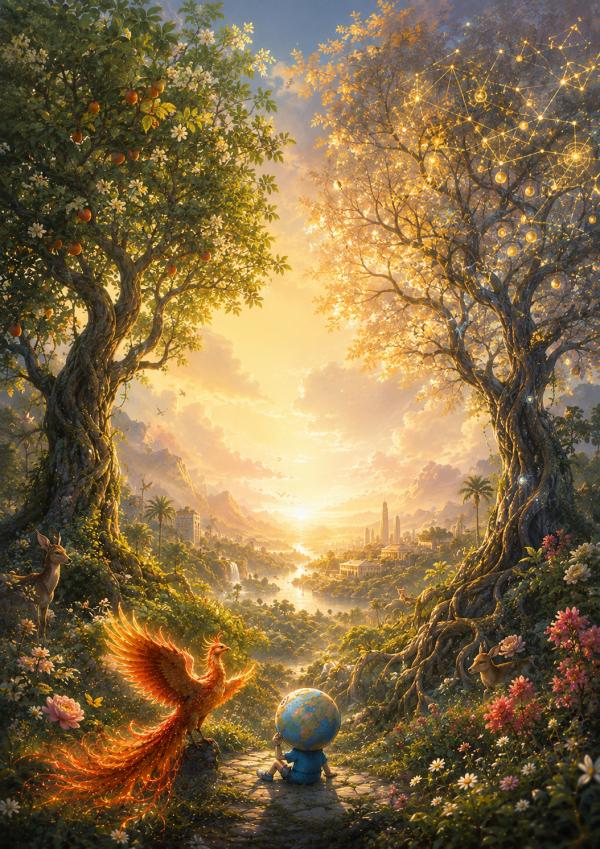
有意思的是,儿歌问的是“为何不飞、为何不开”;今天的共生经济学问的是:拥有了GDP、技术和庞大组织之后,生命为什么反而没有更自然、自由、自在地飞翔、开放?
而“远在天边,近在眼前”,尤其好。一切的一切,答案最终还是要回到活生生的人,回到生活,回到我们自己。
妈妈当年教我的一首儿歌,几十年后忽然忆起,竟像一个穿越时空埋下的哈姆雷特之问!
当然,现在是小地球人在问……
启:起初,两棵树就在那里
“起初,神创造天地。”
《Holy Bible·圣约》开篇没有先讲人的制度,也没有先讲人的知识。先有天地,继而有光、水、陆地、植物、日月星辰、飞鸟走兽,万物各从其类,各有其生。
然后,神说,要按自己的形象造人。
这是一个极其重要的转折。
在此之前,天地已经展开,空间已经打开;日月星辰运行,昼夜往复,时间已经展开;万物已经生长,生命已经发生。
但是,当一个按神的形象被造的人进入世界,一种新的维度也随之进入天地之间:
意间。
人能够感受,能够思想,能够辨别,能够选择,能够回应,能够愛,也能够与神、与他人、与万物发生关系。
于是,时间、空间、意间不再彼此孤立。
时空意间开始交互作用。
神把人安置在伊甸园。
那里甚至有今天经济学很难想象的“免费午餐”:树木从地里长出来,悦人眼目,其上的果子可以作食物。生命最初面对世界,并不是先面对稀缺、价格和交换,而是面对一份已经给予的丰盛。
然而,就在这丰盛之中,《圣约》特别让我们看见了两棵树:
生命树(Tree of Life),
分别善恶之树(Tree of the Knowledge of Good and Evil)。
为什么是两棵?
为什么生命树在那里,分别善恶之树也在那里?
也许,两棵树从一开始就留下了一个关于人类文明的巨大隐喻。
承:真正的“约”,不是禁止智慧,而是智慧不能失去生命根底
神与人有了一个“约”。
园中的果子,人可以吃;唯有分别善恶之树上的果子,被告诫不要吃。
如果只把这理解成一道简单的“禁令”,我们可能错过了其中更深的意涵。
神既然按自己的形象造人,人便已经具有心智,具有自由,具有辨别与创造的可能。分别善恶之树又被放在那里,而不是根本不存在。
所以我愿意从今天人类走过的文明道路回望这个“约”:
它真正警醒人的,也许并非“不要智慧”,而是——
不要只吃智慧之果。
如果实在禁不住要吃呢?
那么至少不要忘记,园中还有另一棵树。
甚至应该先走向生命树。
因为只有当生命成为根底,智慧才知道为什么而生;只有当愛成为根底,分别才不会轻易变成撕裂;只有当生命之间仍然保持连接,判断善恶才不至于最终演变成“我是善、你是恶”,“我是真理、你是异端”,“我必须消灭你”。
所以,在我的理解中,两棵树真正需要的从来不是互相排斥。
智慧之树需要与生命之树交互契合。
生命树上的果子是什么?
如果一定要用一个字来表达,我愿意说:
愛!
不是占有的爱,不是只有对象的爱,也不是一句伦理口号。
它是生命对生命的承认,是生命之间能够连接、感应、托付、赋能而又彼此保有自己的根底。
有了这个根底,智慧才获得方向。
于是,智慧能够辨别,却不必因此仇恨;能够竞争,却不必因此毁灭;能够创造力量,却知道力量的边界;能够建立组织,却知道组织接受生命的托付;能够制造AI,却知道智能最终为什么服务。
生命之果为智慧之果提供根底,智慧之果又使生命获得更大的展开可能。
这才是两棵树的交互契合。
转:只吃智慧果以后,人类走了多远?
然而,人类后来的文明轨迹,越来越像一场漫长的“只吃智慧果”。
尤其到了轴心时代,人类心智发生了一次壮阔的大展开。
中国的先秦诸子、印度的思想传统、希伯来的先知、古希腊的哲人,都开始追问世界、社会、善恶、灵魂、秩序以及人的终极处境。
Philosophy——愛智慧——成为人类文明最伟大的创造之一。
智慧之树开始迅速生长。
逻辑、哲学、几何(形学)、数学、宗教、法律、政治、经济、科学不断分化;科学革命以后,知识又与技术、资本、市场和现代组织结合,形成越来越强大的现实力量。
蒸汽机。
电力。
铁路。
汽车。
飞机。
计算机。
互联网。
量子科学。
生命科学。
直到 AI。
智慧果越来越大,越来越多,也越来越甜。
我们知道得越来越多,计算得越来越快,生产得越来越丰富,组织得越来越庞大。
可是,人类两千多年的历史为什么仍然充满战争、征服、迫害、革命、意识形态冲突以及组织对生命的压迫?
因为“辨别”一旦失去了生命和愛的根底,很容易继续生长成:
我(Subject)与非我(Object)。
我们与他们。
文明与野蛮。
正确与错误。
朋友与敌人。
乃至——
善的我,与恶的你。
智慧原本帮助人辨别世界,最后走向以Subject(主体)自居,视他者为可支配、可操纵、可榨取的Object(客体),从而把世界切割成二元对立,彼此敌对的碎片。
智慧越强,这种切割所能动员的力量反而越大。
科学能够救人,也能够制造核武器;组织能够连接亿万人,也能够形成吞噬生命的巨型机器;技术能够释放人的时间,也能够占领人的时间;算法能够帮助选择,也能够替人选择;AI能够赋能人的心智,也可能使人的心智逐渐交出自己的判断。
所以问题从来不是智慧太多。
真正的问题是:
智慧有没有生命的根?众生命之间能不能交互共生——Intersubjective Symbiosism?
合:从 Philosophy 升格为 Amorsophia
也正是在这里,我重新理解为什么今天需要从 Philosophy的轴心时代,走向 Amorsophia的共生时代。
Philosophy 是爱智慧。
它伟大,也不可替代。
人类不可能吐出已经吃下的智慧果,更不可能退回没有科学、没有技术、没有现代文明的伊甸园。
所以所谓“重新回到生命之树”,绝不是倒退。
我们要做的是,带着智慧重新回到生命。
当智慧已经强大到可以改变地球、改造生命,甚至试图创造另一种“智能”时,仅仅追问“我们还能知道什么”“我们还能做到什么”,已经远远不够。
我们必须追问:
智慧为了什么?
于是,Philosophy 必须获得一个新的生命参量。
我称之为:
Amorsophia-愛之智慧。
如果 Philosophy 的历史伟力在于“愛智慧”,那么 Amorsophia 所要重新唤醒的,就是:
让愛进入智慧,让生命成为智慧的根底。
这不是用愛取代智慧。
恰恰相反。
这是让两棵树重新相遇。
Tree of Life × Tree of Knowledge
不是谁消灭谁,也不是谁服从谁,而是在生命根底上交互契合。
这也改变了我们理解AI的方式。
AI的方向不能只是:
更多数据,更大模型,更强算力,更高智能。
因为智慧之树已经向我们证明:
能力增长本身不能回答能力应该用于何处。
所以我提出从 AI 升格为 AM。
从 Artificial Intelligence 走向 Artificial Mind & Amorsophia MindsField / Network。
真正需要升格的并不只是机器。
需要升格的是智慧本身。
让AI重新进入 LIFE,让智能进入 TRUST,让 LIFE–AI–TRUST 在真实生活中交互契合。
这时,技术才可能成为凤凰的翅膀。
智慧才可能成为滋养红花的雨水。
生:两棵树为什么因你我他而重新相遇?
但是,还有最后一个问题。
谁让两棵树重新相遇?
神把两棵树放在伊甸园。
神也按自己的形象造了人。
从那一刻开始,时、空、意间便交互起来。
所以,真正能够重新走到两棵树之间的,最终仍然是活生生的人。
不是一个抽象的“人类”。
是你、我、他(她、它、祂)。
这就是我所说的:
一视为仨,间道竞和。
“我”一旦出现,“非我”也就出现了。
但真实世界并不是简单的“我-非我”:Subject-Object。
你我之间,总还有他。是你中有我,我中有他,他中有你!
他可以是另一个人,是她,是你的孩子,是其他生命的它,也可以是超越于人的祂。
所以,“仨”不是三个孤立个体的算术相加。
它意味着:任何主体都生活在关系之中,又不能被关系吞没。正所谓交互主体共生(Intersubjective Symbiosism)。
生命本自具足,又非独存。
这也正是“意间”真正发生的地方。
处于不同时间、空间中你、我、他,我有我的感受,你有你的感受,他也有他的存在。我们的心智彼此不能替代,却能够在“间”中感应、连接、碰撞、竞争、协调、信任、创造和愛。
所以有“间道”。
因为彼此不同,所以有“竞”。
因为生命不能靠彼此消灭而长久,所以最终要寻找“和”。
一视为仨,间道竞和。
这不是消灭差异(求同存异)之后的统一,而是让不同生命在关系过程中共襄生成存同求异而又存同尊异的新的可能。
于是,生命之树-智慧之树,两棵树重新相遇的地方终于出现了:
就在你我他之间。
回过头来,《共生经济学》封底上的三问也获得了更深的意味:
GDP增长,为何生活却无感?
因为GDP计算了许多智慧之果,却未必计算生命真正获得了什么。
科技进步,为何让人更加焦虑和繁忙?
因为技术可以越来越聪明,却未必天然知道怎样让生命更加自然、自由、自在。
组织膨胀,为何生命信托却在滑走?
因为组织拥有越来越大的能力,如果忘记自己来自生命的托付,能力越大,反而可能离生命越远。
所以,共生经济学(Symbionomics)最后才要回答:
生产回归生活,
生活呈现生態,
生態激励生命。
这不是三句漂亮的口号。
它们意味着让经济重新走向生命树。
GDE如此。
价值承兑如此。
思想银行如此。
组织孞托如此。
LIFE–AI–TRUST也是如此。
我们已经拥有了智慧果。
现在的问题,是能不能重新尝到生命之果。
如果生命之果是愛,那么愛就不能停留在伦理劝善中。
它必须进入经济。
进入技术。
进入组织。
进入货币。
进入AI。
进入人与人之间真实的价值承兑和组织孞托。
Amorsophia因此不是 Philosophy 的反面,而是 Philosophy 在共生时代的一次皈依《Holy Bible·圣约》升格。
智慧仍然生长。
只是它重新有了根。
现在,我终于又听懂了一点妈妈几十年前教我的那首儿歌。
凤凰本来会飞。
可是需要翅膀。
红花本来会开。
可是需要雨水。
这恰恰就是:
生命本自具足,又非独存。
谁来给凤凰翅膀?
谁来给红花雨水?
谁来让GDP重新有生命感?
谁来让科技重新释放人的时间?
谁来让组织重新获得生命的孞托?
谁来让AI拥有越来越强大的智慧之后,仍然知道生命在哪里?
小地球人站在生命树与智慧树之间,又问了一遍:
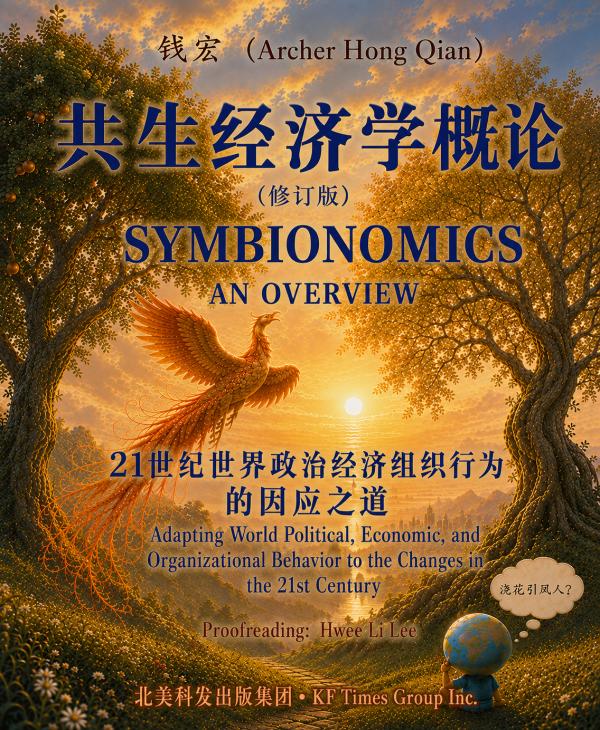
浇花引凤人?
这一次,我仿佛听见妈妈那首儿歌从几十年前传来:
远在天边,
近在身旁。
不是等待一个救世的“他”。
也不是只靠万能的“我”。
更不是只有彼此对立的“我与你”。
是你我他(她它祂)交互主体共生——Intersubjective Symbiosism。
在你我他交互共生发生的意间,在生命彼此连接又各自具足的地方,让智慧之树重新遇见生命之树。
从 Philosophy 升格为 Amorsophia。
从只吃智慧之果,重新尝到生命之果。
从分别之后,重新学会连接。
从力量,重新走向托付。
从 AI,走向 AM。
从轴心时代一路走来的智慧文明,重新站到共生时代的门口。
两棵树因你我他而重新相遇。
不是回到伊甸园。
而是带着已经获得的全部智慧,
重新出发。
“The Two Trees” Meet Again Through You, Me, and the Other
From Philosophy to the Amorsophia Symbiotic Age
Archer Hong Qian
Morning of August 28, 2026, Vancouver
Prelude: Who Will Water the Flowers and Bring the Phoenix?
When I was five or six years old, my mother taught me a children’s song.
Just now, while discussing the front- and back-cover design of SYMBIONOMICS: AN OVERVIEW (Revised Edition) with the art editor, Mr. Baoying—especially the three questions on the back cover—I suddenly remembered that song. I discovered a wonderfully natural resonance between them.
Why does the phoenix in the mountains
not take to the sky?
Why do the red flowers below
not open and bloom?
Without wings, the phoenix cannot fly;
without rain, the red flowers cannot bloom.
Who can bring the phoenix into flight?
Who can water the flowers into bloom?
If you ask who waters the flowers and brings the phoenix—
Far on the horizon,
yet right before your eyes.
I found myself humming the song, and a warmth rose within me.
What is truly intriguing about the song is that it never explicitly gives the answer.
The phoenix already possesses the capacity to fly. The flower already possesses the capacity to bloom. The question is not who manufactures the phoenix’s flight or manufactures the flower’s blossoming. The question is:
What enables the inherent capacities of life to happen and reveal themselves?
Across the distance of time, this unexpectedly resonates with a central proposition of the philosophy of symbiosis:
Life is self-sufficient in itself, yet never exists alone.
Now consider the three questions we had just settled on for the back cover:
Why does GDP grow while life feels no better?
Why does technological progress leave people more anxious and busier?
Why do organizations expand while life-based trust keeps slipping away?
And finally:
Let production return to life.
Let living manifest ecology.
Let ecology empower life.
The children’s song asks why the phoenix does not fly and why the flower does not bloom. Symbionomics today asks something remarkably similar:
After acquiring GDP, advanced technology, and enormous organizations, why has life not become more natural, freer, and more at ease?
And the line “far on the horizon, yet right before your eyes” becomes especially meaningful.
Ultimately, the answer must return to living human beings, to lived life, and to ourselves.
A children’s song my mother taught me decades ago suddenly returns as something almost like a Hamletian question planted across time.
Only now, it is the Little Earthling who asks:
Who will water the flowers and bring the phoenix?
I. In the Beginning, the Two Trees Were Already There
“In the beginning, God created the heavens and the earth.”
At its opening, the Holy Bible · 圣约 does not begin with human institutions or human knowledge.
First come heaven and earth. Then light, water, land, plants, the sun, moon and stars, birds and animals—all living according to their kinds and their own ways of being.
Then God says that humankind shall be created in His image.
This marks an extraordinarily important turning point.
Before this moment, heaven and earth had already unfolded: space had opened. The sun, moon and stars moved; day and night alternated: time had unfolded. All living things were already growing: life had happened.
But when a human being created in the image of God entered the world, another dimension entered heaven and earth:
Mindedness.
Human beings can feel, think, discern, choose, respond, love, and enter into relationships with God, with one another, and with all living things.
From that moment, time, space, and mindedness were no longer isolated from one another.
Spatio-Temporal Mindedness began to interact.
God placed the human being in the Garden of Eden.
There was even something there that modern economics finds difficult to imagine: a genuine “free lunch.” Trees grew from the earth, pleasing to the eye, bearing fruit for food.
Life did not initially encounter the world through scarcity, price, and exchange. It encountered an abundance that had already been given.
And yet, within this abundance, the 圣约 draws our attention to two particular trees:
The Tree of Life
and
The Tree of the Knowledge of Good and Evil.
Why two trees?
Why was the Tree of Life there, while the Tree of the Knowledge of Good and Evil was also there?
Perhaps from the very beginning, these two trees left humanity with an immense metaphor for civilization.
II. The True Meaning of the Covenant: Wisdom Must Not Lose Its Roots in Life
God entered into a covenant with humankind.
The fruit of the garden could be eaten, except for the fruit of the Tree of the Knowledge of Good and Evil.
If we understand this only as a simple “prohibition,” we may miss its deeper significance.
If God created human beings in His image, then humankind already possessed mind, freedom, and the potential for discernment and creativity.
And the Tree of the Knowledge of Good and Evil was placed there. It was not absent from the garden altogether.
So, looking back upon this covenant from the path civilization has actually traveled, I would understand its warning this way:
Do not eat only the fruit of knowledge.
And if we simply cannot resist eating it?
Then at least do not forget that another tree remains in the garden.
Perhaps we should even approach the Tree of Life first.
For only when life becomes the ground can wisdom understand what it exists for.
Only when love becomes the ground can discernment avoid becoming division.
Only when living beings remain connected can judgments of good and evil avoid degenerating into:
“I am good; you are evil.”
“I possess truth; you are a heretic.”
“I must destroy you.”
The two trees, in my understanding, were never meant simply to exclude one another.
The Tree of Knowledge needs to interact and cohere with the Tree of Life.
And what is the fruit of the Tree of Life?
If I had to express it in a single word, I would say:
愛—Love.
Not possessive love. Not love reduced to an object. Not an ethical slogan.
It is life recognizing life: the capacity of living beings to connect, resonate, entrust, and empower one another while each retains its own ground of being.
With this foundation, wisdom gains direction.
Wisdom can discern without necessarily hating.
It can compete without destroying.
It can create power while recognizing the boundaries of power.
It can build organizations while remembering that organizations are entrusted by life.
It can create AI while still knowing what intelligence ultimately exists to serve.
The fruit of life gives the fruit of knowledge its foundation; the fruit of knowledge, in turn, opens greater possibilities for life.
This is the interactive coherence of the two trees.
III. How Far Has Humanity Traveled by Eating Only the Fruit of Knowledge?
The subsequent trajectory of civilization increasingly resembles one long history of eating only the fruit of knowledge.
Especially with the Axial Age, the human mind underwent a magnificent expansion.
The pre-Qin thinkers of China, Indian traditions of thought, the Hebrew prophets, and the philosophers of ancient Greece all began asking fundamental questions about the world, society, good and evil, the soul, order, and the ultimate human condition.
Philosophy—the love of wisdom—became one of humanity’s greatest civilizational creations.
The Tree of Knowledge began to grow rapidly.
Logic, philosophy, geometry, mathematics, religion, law, politics, economics, and science differentiated and expanded.
After the Scientific Revolution, knowledge joined forces with technology, capital, markets, and modern organizations, generating ever more powerful forces in the real world:
The steam engine.
Electricity.
Railways.
Automobiles.
Aircraft.
Computers.
The Internet.
Quantum science.
Life sciences.
And finally:
AI.
The fruit of knowledge became larger, more abundant, and sweeter.
We know more.
We calculate faster.
We produce more.
We organize on ever larger scales.
Yet why have more than two thousand years of human history remained filled with war, conquest, persecution, revolution, ideological conflict, and organizational domination over life?
Because once discernment loses its roots in life and love, it can easily develop into:
I—the Subject—and the non-I—the Object.
Us and them.
Civilized and barbarian.
Right and wrong.
Friend and enemy.
And eventually:
the good “me” versus the evil “you.”
Wisdom originally helped human beings discern the world. Yet the Subject may ultimately place itself above the other and treat the other as an Object to be dominated, manipulated, or extracted from, fragmenting the world into mutually hostile dualities.
The more powerful wisdom becomes, the greater the forces such divisions can mobilize.
Science can save lives, but it can also create nuclear weapons.
Organizations can connect billions of people, but they can also become gigantic machines that consume life.
Technology can free human time, but it can also occupy human time.
Algorithms can assist our choices, but they can also begin choosing for us.
AI can empower the human mind, but it can also gradually induce the human mind to surrender its own judgment.
The problem, therefore, has never been that humanity possesses too much wisdom.
The real questions are:
Does wisdom still have living roots?
And:
Can living beings enter into intersubjective symbiosis—Intersubjective Symbiosism?
IV. From Philosophy to Amorsophia
It is here that I have come to understand anew why humanity today needs to move from the Axial Age of Philosophy toward the Symbiotic Age of Amorsophia.
Philosophy is the love of wisdom.
It is magnificent and irreplaceable.
Humanity cannot spit out the fruit of knowledge it has already eaten. Nor can we retreat into an Eden without science, technology, or modern civilization.
Therefore, “returning to the Tree of Life” does not mean regression.
What we need is:
to return to life carrying wisdom with us.
When wisdom has become powerful enough to transform the Earth, alter life itself, and even attempt to create another form of “intelligence,” it is no longer sufficient merely to ask:
What else can we know?
What else can we do?
We must also ask:
What is wisdom for?
Philosophy therefore needs a new parameter of life.
I call it:
Amorsophia—愛之智慧, the Wisdom of Love.
If the historical power of Philosophy lies in the “love of wisdom,” then what Amorsophia seeks to reawaken is this:
Let love enter wisdom.
Let life become the ground of wisdom.
This does not replace wisdom with love.
It allows the two trees to meet again:
Tree of Life × Tree of Knowledge
Neither destroys the other.
Neither simply subordinates the other.
They enter into interactive coherence upon the ground of life.
This also changes how we understand AI.
The direction of AI cannot consist merely of:
more data,
larger models,
greater computing power,
higher intelligence.
The Tree of Knowledge has already demonstrated something fundamental:
The growth of capability cannot by itself tell us what capability should be used for.
This is why I propose elevating AI into AM:
from Artificial Intelligence
toward
Artificial Mind & Amorsophia MindsField / Network.
What truly needs elevation is not merely the machine.
Wisdom itself needs to be elevated.
AI must re-enter LIFE; intelligence must enter TRUST; and LIFE–AI–TRUST must interact and cohere in lived reality.
Only then may technology become the wings of the phoenix.
Only then may wisdom become the rain that nourishes the flowers.
V. Why Do the Two Trees Meet Again Through You, Me, and the Other?
One final question remains.
Who brings the two trees together again?
God placed both trees in Eden.
God also created human beings in His image.
From that moment, time, space, and mindedness began to interact.
The beings capable of walking once again between these two trees are therefore living persons.
Not an abstract “humanity.”
But:
you, me, and the other—he, she, it, and He.
This is what I mean by:
See One as Three; Between-ness, Competition, and Harmony.
一视为仨,间道竞和。
The moment the “I” appears, the “non-I” also appears.
Yet the real world cannot be reduced to the simple binary of I and non-I—Subject and Object.
Between you and me, there is always the other.
There is me within you, the other within me, and you within the other.
The other may be another person.
She.
Your child.
Another living being—“it.”
Or He who transcends humanity.
Thus, the “three” are not an arithmetic sum of three isolated individuals.
It means that every subject lives within relationships without being swallowed by those relationships.
This is precisely:
Intersubjective Symbiosism—交互主体共生.
Life is self-sufficient in itself, yet never exists alone.
This is also where “mindedness-between”—the 间—truly happens.
You, I, and the other occupy different times and spaces. I have my feelings, you have yours, and the other has an existence of their own.
Our minds cannot replace one another.
Yet within the between, they can resonate, connect, collide, compete, coordinate, trust, create, and love.
That is why there is 间道—the way of between-ness.
Because we are different, there is competition.
Because life cannot endure through mutual destruction, it must ultimately seek harmony.
一视为仨,间道竞和。
This does not seek unity by eliminating differences—“seeking common ground while reserving differences.”
Rather, it allows different lives, through relational processes, to participate in generating new possibilities: preserving what is shared while seeking difference, and preserving what is shared while respecting difference.
And now, at last, the place where the Tree of Life and the Tree of Knowledge can meet again becomes visible:
between you, me, and the other.
VI. Symbionomics: Bringing the Economy Back to the Tree of Life
Seen from here, the three questions on the back cover of Symbionomics acquire a deeper meaning.
Why does GDP grow while life feels no better?
Because GDP counts many fruits of knowledge without necessarily counting what life itself has actually gained.
Why does technological progress make people more anxious and busier?
Because technology can become increasingly intelligent without inherently knowing how to make life more natural, freer, and more at ease.
Why do organizations expand while life-based trust keeps slipping away?
Because organizations acquire ever greater capabilities. Yet if they forget that those capabilities originate in the entrustment of life, the greater their power becomes, the farther they may move away from life.
That is why Symbionomics ultimately answers:
Let production return to life.
Let living manifest ecology.
Let ecology empower life.
These are not three attractive slogans.
They mean bringing economics back toward the Tree of Life.
So it is with GDE.
So it is with value redemption.
So it is with the Minds Bank.
So it is with organizational trust—组织孞托.
And so it is with LIFE–AI–TRUST.
We already possess the fruit of knowledge.
The question now is whether we can taste the fruit of life again.
If the fruit of life is 愛, then love cannot remain merely an ethical exhortation.
It must enter economics.
Technology.
Organizations.
Money.
AI.
And the real processes of value redemption and organizational trust between human beings.
Amorsophia, therefore, is not the opposite of Philosophy. It is Philosophy’s return to the Holy Bible · 圣约 and its elevation for the Symbiotic Age.
Wisdom continues to grow.
But now,
it has roots again.
Epilogue: Far on the Horizon, Yet Right Before Our Eyes
Now, at last, I understand a little more of the children’s song my mother taught me decades ago.
The phoenix already knows how to fly.
But it needs wings.
The red flower already knows how to bloom.
But it needs rain.
This is precisely what it means to say:
Life is self-sufficient in itself, yet never exists alone.
Who will give the phoenix its wings?
Who will bring rain to the flowers?
Who will restore a sense of life to GDP?
Who will make technology release human time again?
Who will enable organizations to regain the trust entrusted to them by life?
Who will ensure that, as AI acquires ever greater wisdom, it still knows where life is?
Standing between the Tree of Life and the Tree of Knowledge, the Little Earthling asks once more:
Who will water the flowers and bring the phoenix?
This time, I seem to hear my mother’s song coming to me across the decades:
Far on the horizon,
yet right before your eyes.
Do not wait for some salvational “other.”
Nor rely upon an omnipotent “I.”
Nor remain trapped within an antagonistic “you versus me.”
It is:
you, me, and the other—he, she, it, and He—in Intersubjective Symbiosism.
Within the mindedness-between generated through the symbiotic interaction of you, me, and the other—where lives connect while each remains self-sufficient in itself—let the Tree of Knowledge encounter the Tree of Life again.
From Philosophy to Amorsophia.
From eating only the fruit of knowledge
to tasting the fruit of life again.
From separation
to learning connection again.
From power
back toward entrustment.
From AI
toward AM.
The civilization of wisdom that has traveled all the way from the Axial Age now stands once again at the threshold of the Symbiotic Age.
The two trees meet again through you, me, and the other.
We are not returning to Eden.
We are setting out again—
carrying with us all the wisdom we have already gained.