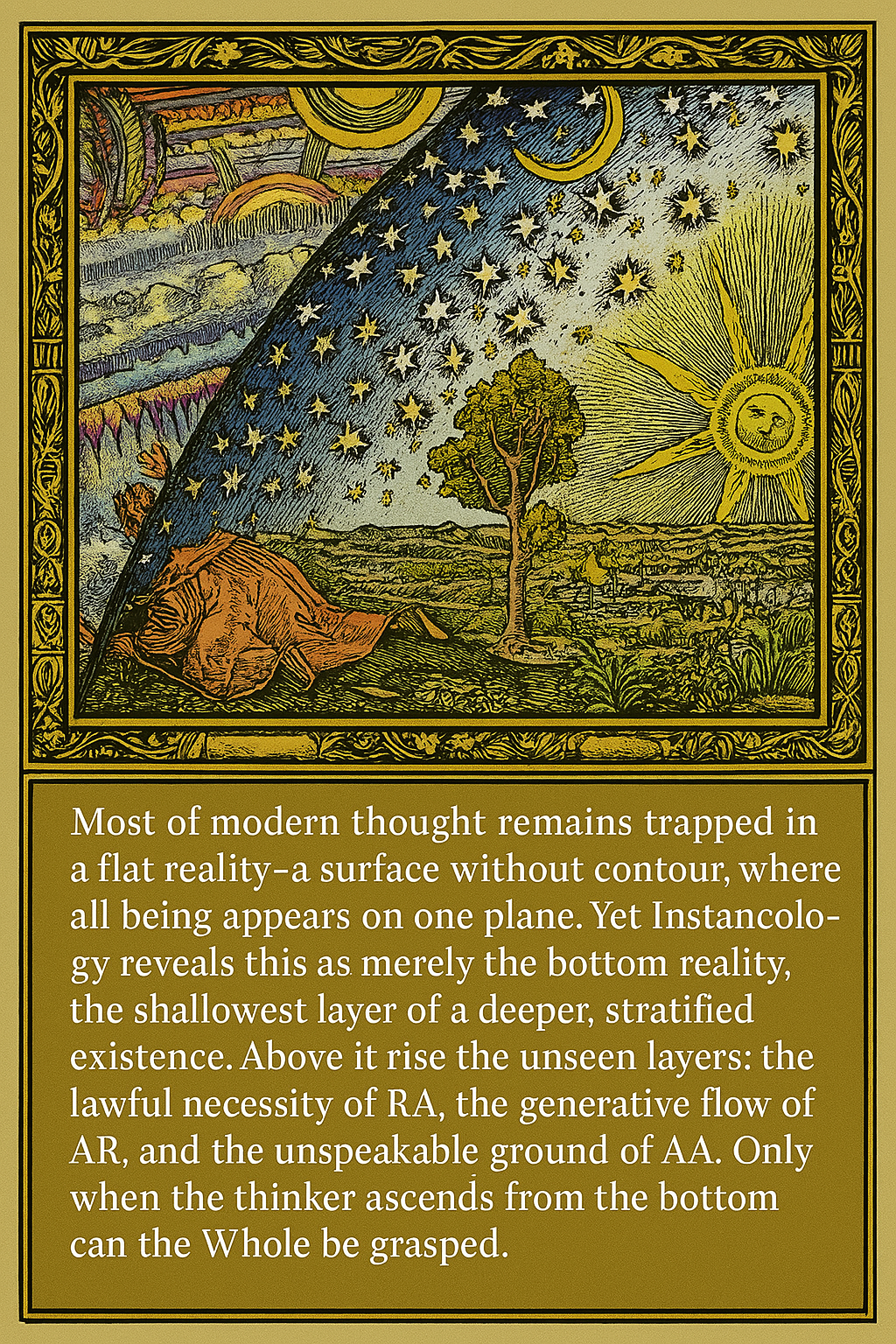
我将完整梳理我们从数论世纪难题切入、厘清无穷/穷尽范畴、结合Instancology(鹰论)宏观微观
Instancology: Categorical Resolution of Classic Number Theory Puzzles and the Fallacy of Infinity
Abstract
For centuries, a set of intractable mathematical puzzles—including the Collatz conjecture, the Goldbach conjecture, and the twin prime conjecture—have baffled mainstream mathematics. All these unsolved problems revolve around two core concepts: infinity and exhaustion. Traditional mathematical research attempts to verify and prove universal propositions of infinite sets through finite exhaustion operations, falling into an inherent logical and categorical dilemma. Based on the theoretical system of Instancology (Instance Theory), this paper redefines the essence of macroscopic finite instances, microscopic potential infinity, and artificial actual infinity, clarifies the categorical confusion underlying modern set theory and number theory, and reveals the fundamental root of the unsolvability of classic mathematical puzzles.
1. The Common Predicament of Century-Old Number Theory Conjectures
Classic unsolved mathematical problems share a unified structural feature: they propose universal deterministic laws governing the entire natural number sequence, yet they cannot be strictly proven through finite numerical verification or formal logical deduction.
Mathematicians can verify that Goldbach’s conjecture holds for trillions of even numbers, observe that almost all positive integers converge to 1 under Collatz iteration, and confirm the continuous existence of twin prime pairs within massive numerical ranges. However, no complete formal proof has been established for any of these conjectures.
Mainstream mathematics attributes this predicament to insufficient mathematical tools or unexcavated axiom systems. From the perspective of Instancology, the dilemma is not technical but categorical: modern mathematics confuses the operating rules of macroscopic spatiotemporal instances, microscopic generative mechanisms, and symbolic mathematical constructions, misapplying finite exhaustion logic to infinite generative systems.
2. Core Hierarchical Axioms of Instancology
Instancology establishes a rigorous hierarchical division of real instances and symbolic constructs, completely overturning the traditional cognitive framework of infinity and finitude:
2.1 Macroscopic Spatiotemporal Instances: Absolute Finitude
All instances existing in time and space are macroscopic real instances. Bound by the dimensional attributes of spacetime, every macroscopic instance has a definite beginning, boundary, and survival process. All macroscopic spatiotemporal instances are inherently finite. No complete, finished infinite object exists in the macroscopic real world.
2.2 Microscopic Generative System: Real Potential Infinity
Potential infinity is not a fictional mental construct, but a real inherent operating mechanism of the microscopic world. It refers to an unceasing, open, and non-terminating generative process. The microscopic system continuously generates new structural units and numerical sequences without ever forming a closed, complete set.
Potential infinity is the ontological foundation of the endless expansion of the natural number sequence. The continuous emergence of new natural numbers is not a human imaginative creation, but the objective output of the microscopic potential infinity generation mechanism.
2.3 Mathematical Symbol Layer: Fictional Actual Infinity
Actual infinity does not exist in either the macroscopic physical world or the microscopic generative world. It is a pure artificial construction of human cognition on the Mathematics symbolic layer.
To facilitate universal proposition judgment and holistic logical reasoning, human thinking freezes the dynamic, open, and unfinished microscopic potential infinity process into a static, closed, completed infinite set—this is the definition of actual infinity. Actual infinity is a methodological tool for mathematical research, not an objective existing state of the real world.
3. Re-definition of "Infinity" and "Exhaustion" in Mathematics
The two core concepts that trap classic number theory are completely repositioned under the Instancology system:
3.1 Exhaustion: Exclusive to Finite Macroscopic Instances
Exhaustion refers to the operation of traversing and verifying all individual units of a set. This operation is only valid for finite macroscopic instances.
For closed, finite spatiotemporal instances, complete exhaustion can achieve absolute verification of propositions. However, exhaustion is inherently invalid for the open, infinitely generative microscopic potential infinity system. It is a categorical error to attempt to verify universal laws of infinite sequences through finite exhaustion.
3.2 Infinity: The Separation of Real Potential Infinity and Fictional Actual Infinity
? Microscopic potential infinity (real): The objective generative law of the underlying world, which guarantees the infinite expansion of natural numbers, prime numbers, and iterative sequences, but never forms a complete whole.
? Symbolic actual infinity (fictional): A human-defined mathematical abstraction, which assumes the natural number sequence is a completed infinite set, enabling the proposal of global universal conjectures.
All classic number theory puzzles arise from one core confusion: taking the fictional actual infinity set as the real research object, and attempting to prove the global laws of infinite systems with finite exhaustion logic suitable for finite instances.
4. The Essential Error of Cantor’s Set Theory
Cantor’s set theory systematically constructed the hierarchy of infinite cardinal numbers based on the actual infinity assumption, expanding the research scope of mathematics to infinite sets.
From Instancology’s perspective, Cantor’s work is logically self-consistent on the symbolic Mathematics layer but categorically invalid in ontological reality:
1. Cantor confuses real microscopic potential infinity with fictional symbolic actual infinity, treating the human abstract tool as an objective real existence.
2. He applies the finite traversal and comparison rules of macroscopic instances to the infinite generative microscopic system, resulting in fundamental category dislocation.
3. The independence of the Continuum Hypothesis (CH) in ZFC axioms is not a flaw in formal logic, but a inevitable result of the conflict between fictional actual infinity construction and real microscopic generative laws.
5. The Root of Unsolved Classic Mathematical Conjectures
All intractable number theory conjectures (Goldbach, Collatz, twin prime conjecture, etc.) share the same underlying paradox:
1. Their generative basis originates from the real microscopic potential infinity mechanism of natural numbers;
2. Their propositional expression relies on the fictional actual infinity symbolic assumption of a complete natural number set;
3. Human verification attempts depend on the finite exhaustion method applicable only to macroscopic finite instances.
Three heterogeneous systems are forced to be unified for reasoning and verification, forming an insurmountable cognitive barrier. G?del’s incompleteness theorem is exactly the logical manifestation of this categorical separation: formal symbolic systems based on actual infinity cannot completely judge the universal laws derived from potential infinity generation.
6. Conclusion
Instancology fundamentally resolves the century-long confusion of infinity and exhaustion in mathematics through macroscopic and microscopic categorical division:
The macroscopic world is completely finite; the microscopic world operates by real potential infinity; actual infinity is merely a fictional symbolic tool of mathematics. The unsolvability of classic number theory problems is not due to the complexity of mathematical logic, but the inherent category error of misapplying finite macroscopic exhaustion rules to infinite microscopic generative systems, and confusing fictional symbolic constructs with objective real mechanisms.
This theoretical framework abandons the blind technical trial-and-error of traditional mathematics, provides an ontological foundation for unifying and explaining all classic infinite number theory puzzles, and realizes the strategic goal of "sweeping up a large number of century-old mathematical problems with one system".