
殖官主义概念成形记
殖官主义概念成形记
The Discovery of Bureaucolonialism
——一个中国出版人用汗水、泪水和脑汁换来的三十年追问
Thirty Years of Inquiry by a Chinese Publisher—Forged through Sweat, Tears, and Thought
钱 宏(Archer Hong Qian)
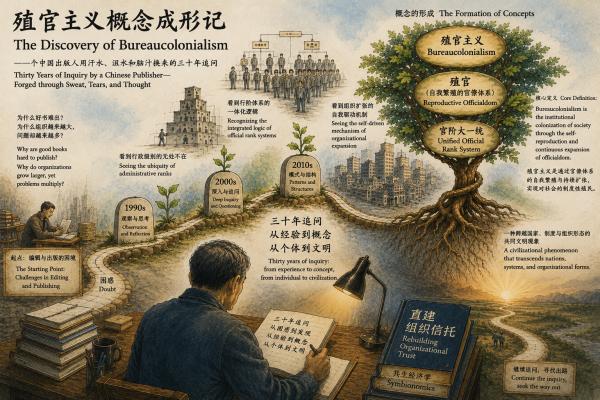
一个理论概念,往往不是在书斋里突然诞生的。
至少,“殖官主义”不是。
它是我在几十年的编辑、出版和文化组织生涯中,一件事一件事做出来,一次挫折一次挫折承受下来,又在不断观察和思考中逐渐辨认出来的。这里面有汗水,有泪水,也有无数个辗转难眠时耗费的脑汁。
我并非没有得到过肯定。
我策划并组织实施的国家“八五”计划重点工程《国学大师丛书》(1991—1996)获得了国家图书奖;我组织编辑的许多图书,也先后获得各种奖项;我本人还曾获得“全国优秀中青年”称号。这些荣誉当然令我欣慰,也说明我和同事们曾经克服重重困难,把一些值得做的事情真正做成了。当然也有遗憾,就是丛书原先计划出版36卷,结果只出了28卷。
然而,荣誉并没有使我满足,更没有让我停止追问。
因为我越来越清楚地看到:少数项目成功、几本书获奖、一个编辑获得肯定,并不能证明整个组织制度已经健康。恰恰因为我亲手推动过一些事情,知道一本好书、一套好丛书从构想到完成,需要多少人的心血,才更能体会那些本可避免的行政阻碍、组织摩擦和资源浪费,给作者、编辑、读者以及整个社会造成了多大的损失。
我时常问自己:
既然我们拥有如此丰富的文化传统,如此众多的作者、学者和编辑,也拥有由国家配置的出版资源,为什么我们的出版组织不能做得更好?
九十年代的中国出版界,曾经广泛流传过一个令人难堪的比较:独占中国出版资源的五百多家出版社,产值加在一起,还比不上德国一家贝塔斯曼。
无论这一说法当时采用的是哪一种统计口径,它作为一个比较级判断,对我的刺激非常大。
五百多家出版社,意味着五百多套领导班子、行政机构、人员编制、办公系统和资源配置体系;它们拥有行政许可所赋予的出版资格,占有当时极为稀缺的书号、渠道和文化资源。可是,这么庞大的组织规模,并没有自然转化为与之相称的出版能力、市场效能和文明创造力。
问题究竟出在哪里?
最初,我也只能从自己的工作困苦中寻找答案。
有些书稿明明具有学术价值,却可能因为单位、级别或关系受到冷落;有些选题并不成熟,却可能因为行政意志获得资源;专业判断常常要服从行政判断,作者、编辑和读者之间本应自然形成的知识连接,不断受到审批权限、机构隶属和官阶秩序的干扰。很多时候,真正消耗人的并不是编辑工作本身,而是为了让一件本来合理的事情能够通过组织关口,不得不付出的巨大精力。
我逐渐发现,出版行业表面上生产的是图书,深层运行的却往往是行政级别。
出版社首先被规定为某一种行政级别,社长、总编辑和其他负责人被纳入相应的干部等级,机构规格又决定人员待遇、资源权限和社会地位。于是,一个出版社究竟出版了多少真正有生命力的作品,反而可能不如它是什么级别、归谁主管、拥有什么权限来得重要。
这使我第一次明确意识到:
行政级别并没有停留在组织内部,它正在改变组织存在的目的。
一个本应服务知识、作者和读者的组织,开始围绕自身的级别、位置和资源运行。
我成功地做成了一些事情,也亲身承受了把这些事情做成所需付出的非正常代价;与此同时,五百多家出版社与一家贝塔斯曼之间的效能反差,又迫使我从个人困苦进入组织追问。这正是我后来不断追问“官阶大一统”“殖官”与“殖官主义”的现实起点。
1998年,我有幸受邀参加中国新闻出版署召开的“纪念改革开放二十周年座谈会”。会上,三位领导(他们是刘杲、许力以、伍杰)先后表示,愿意把他们的发言时间让给我。于是,我作了四十分钟发言,题目是《取消出版行业的行政级别,势在必行》。
令我意外的是,发言结束后,台上台下掌声一片。那一刻,我感受到的并不只是对一篇发言的赞许,更像是许多长期身处出版体制之中的人,对一个早已心知肚明却很少被公开说破的问题,终于有了一次共同回应。
会后,新华书店总店总经理特意提出开车送我回宾馆。路上,他对我说了一句话,我至今记得清清楚楚:
“钱老师,你今天的讲话太精彩了,大家都为你鼓掌喝彩。但是钱老师,我敢和你打赌,二十年后,中国出版行业的行政级别都不会取消!”
我深知这句话的分量。
他不是在否定我的发言,也不是在嘲讽改革。他是在用一个长期身处组织内部的人所具有的经验告诉我:一个制度问题即使已经被许多人看见,即使已经得到公开掌声,也未必会因此发生改变。因为行政级别从来不只是一个名目,它背后连接着干部管理、官阶待遇、机构规格、资源分配和组织利益。一旦这些彼此咬合,改革面对的便不再是一项具体规定,而是一个能够自我维持、自我保护的制度结构。
当时,我只是与他会心一笑。
今天回想起来,那次笑里其实包含着两种心情:一种是彼此都明白问题所在的默契;另一种,则是面对巨大制度惯性时的无奈。
后来事实证明,他的话并非悲观之辞,而是一种冷静判断。
也正是从那时起,我越来越清楚地意识到:仅仅指出行政级别不合理,还远远不够。真正需要追问的是,为什么一个人人都知道需要改革的问题,却能够长期存在?为什么掌声可以如此热烈,制度却依然纹丝不动?为什么组织明明知道自身低效,却仍然能够不断复制原有结构?
因为我终于意识到,真正需要解释的,不再是改革为什么发生,而是旧制度为什么能够长期不变。
这个问题,把我从“取消行政级别”的行业改革诉求,进一步推向了对“官阶大一统”的制度思考,也最终推向了“殖官”与“殖官主义”的概念形成。
我的那次发言当然不是讲行政管理问题,而是行政级别。
因为我越来越意识到,行政级别已经不仅是一种管理工具,而逐渐成为一种资源配置机制。出版社围绕行政级别运行,出版规律便退居其次;大学围绕行政级别运行,学术规律便退居其次;科研机构围绕行政级别运行,创新规律便退居其次。
组织开始越来越关心级别,而不是使命。
这是我思想演变的第一步。
几年以后,我又继续追问:
行政级别为什么会拥有如此巨大的力量?
答案逐渐浮现出来。
真正起作用的,并不是某一个具体职位,而是一整套贯穿党政军、事业单位、国有企业、高校、科研、金融、文化等领域的统一官阶体系。
于是,2006年,我在《New World Time》上撰文,提出了“官阶大一统”这一概念。
所谓“官阶大一统”,并不是简单地像前中组部部长张全景说的“官多为患”(1998)和全国人大法工委副主任说的“官满为患”(2011),而是说原本具有不同专业规律、不同生活目的、不同社会职责的组织,都被纳入同一套行政级别和官阶评价体系。
官位决定官阶。
官阶决定待遇。
待遇决定资源。
资源决定机会。
机会又反过来巩固官阶。
一个以行政级别为核心的社会激励机制,就这样形成了。所谓举国体制的“全官寻租化,全民佃户化”也是从这里发轫的。
直到这里,我仍然没有提出“殖官主义”。
因为我仍然把注意力放在制度结构上。
真正让我继续思考的是另一个问题:
为什么这样的体系,总是在不断扩大?
为什么机构越来越多?
为什么岗位越来越细?
为什么预算越来越大?
为什么每一次改革结束以后,新机构又不断产生?
为什么组织总是在增长,而生命主体却越来越缺乏自主空间?
慢慢地,我终于意识到,真正扩张的,并不是那些具体的官员,而是组织本身。
组织开始为了组织而存在。
机构开始为了机构而运行。
预算开始为了预算而增长。
权力开始为了权力而延续。
于是,我终于看见了隐藏在官阶体系背后的那股力量。
那就是:
组织的自我复制。
后来,我把这种机制称为:
Reproductive Officialdom(殖官)。
它并不是简单意义上的官僚主义,而是官僚体系不断通过职位、官阶、预算、待遇、资源和利益网络完成自我复制、自我保护、自我扩张的一种制度机制。
继续研究下去,我又发现,这种现象并非中国独有。
美国有自己的组织利益集团。
欧洲有自己的官僚体系。
国际组织(包括UN)同样具有自身的组织扩张惯性。
大型企业、平台公司、专业协会,同样可能不断扩大自身边界。
组织一旦脱离了受托职责,就可能把自身延续置于服务生命之上。
于是,一个新的概念终于逐渐成熟。
我把这种跨越不同制度、不同国家、不同组织形态,却具有共同内在逻辑的文明现象,称为:
殖官主义(Bureaucolonialism)。
之所以采用 Bureaucolonialism,是因为我希望强调,它已经不仅仅是行政问题,而是一种制度性的“组织殖民”。组织不断向社会扩张自己的边界,不断吸纳资源,不断制造新的依赖关系,最终使生命围绕组织运转,而不是组织受托于生命。
而 Reproductive Officialdom,则保留下来,用来描述这种文明现象得以形成的核心机制。
因此,在我的理论体系中,两者并不是两个互相竞争的概念,而是两个不同层次的概念。
Bureaucolonialism,是理论。
Reproductive Officialdom,是机制。
回头再看,这条思想道路已经走了三十多年。
它并不是从一本书开始,也不是从一个概念开始。
它始于一位编辑出版人在推动一项文化工程过程中,对一个简单问题的不断追问:
为什么一个本来应该服务思想、服务知识、服务生命的组织,会慢慢开始服务自己?
也正是为了回答这个问题,我后来提出了“组织是生命的受托者”这一判断,并进一步形成了共生经济学关于重建组织信托必须面对并破解“殖官主义(Bureaucolonialism)”机制的理论。
The Discovery of Bureaucolonialism
Thirty Years of Inquiry by a Chinese Publisher—Forged through Sweat, Tears, and Thought
Archer Hong Qian
A theoretical concept is rarely born overnight in the quiet of a study.
Bureaucolonialism certainly was not.
It emerged gradually through decades of my work as an editor, publisher, and organizer of major cultural projects. It was shaped by one undertaking after another, tempered through one setback after another, and slowly recognized through continuous observation and reflection. Behind this concept lie sweat, tears, and countless sleepless nights spent thinking.
It is not that I was never recognized for my work.
The Masters of Chinese Studies Series (1991–1996), a key national cultural project under China's Eighth Five-Year Plan that I planned and organized, received the National Book Award. Many of the books I edited subsequently won major publishing honors, and I myself was named one of China's Outstanding Young and Middle-aged Professionals. These recognitions naturally brought me satisfaction, and they demonstrated that my colleagues and I had overcome extraordinary difficulties to accomplish work that truly deserved to be done. There was also one lasting regret: the series had originally been planned as thirty-six volumes, yet only twenty-eight were ultimately published.
Yet recognition did not satisfy me, nor did it bring my questioning to an end.
For I gradually realized that the success of a few projects, the awards won by several books, or the recognition given to a single editor could never prove that the organizational system itself was healthy. On the contrary, precisely because I had personally carried important projects from conception to completion, and knew how much dedication was required to produce a single worthwhile book or an entire scholarly series, I became increasingly aware of how much avoidable administrative obstruction, organizational friction, and institutional waste imposed unnecessary costs—not only upon authors and editors, but ultimately upon readers and society as a whole.
I found myself asking one simple question again and again:
If we possessed such a rich cultural tradition, so many gifted scholars, authors, and editors, and publishing resources allocated on a national scale, why could our publishing organizations not perform better?
During the 1990s, a comparison circulated widely throughout China's publishing community. It was difficult to hear, yet impossible to ignore: more than five hundred state-authorized publishing houses in China, taken together, produced less economic value than a single German publishing company—Bertelsmann.
Whatever statistical method lay behind that comparison, its impact on me was profound.
More than five hundred publishing houses meant more than five hundred leadership teams, administrative structures, staffing systems, office bureaucracies, and resource-allocation mechanisms. These organizations possessed government-issued publishing licenses, controlled scarce ISBN quotas, distribution channels, and valuable cultural resources. Yet such an enormous organizational apparatus had failed to translate naturally into corresponding publishing capacity, market efficiency, or civilizational creativity.
Where, then, did the problem truly lie?
At first, I could only search for the answer in my own professional experience.
Manuscripts of genuine scholarly value could easily be neglected because of institutional affiliation, administrative rank, or personal connections. Less mature publishing projects, by contrast, might receive abundant resources simply because they reflected administrative priorities. Professional judgment repeatedly yielded to bureaucratic judgment. The natural intellectual relationship among authors, editors, and readers was constantly interrupted by approval procedures, institutional hierarchies, and official rank structures. More often than not, what exhausted people was not editorial work itself, but the enormous effort required simply to move an otherwise reasonable project through the organizational system.
Gradually I came to realize that, although publishing appeared to produce books on the surface, what actually governed its deeper operation was administrative rank.
Publishing houses were first defined by their bureaucratic status. Presidents, editors-in-chief, and senior administrators were incorporated into corresponding official rank systems. Institutional grade determined salaries, authority, access to resources, and social standing. Under such circumstances, the number of genuinely vital books a publishing house produced often mattered less than its bureaucratic rank, its supervising authority, or the administrative powers it possessed.
For the first time, I clearly recognized something fundamental:
Administrative rank had not remained merely an internal organizational arrangement. It had begun to change the very purpose for which organizations existed.
An organization originally established to serve knowledge, authors, and readers gradually began to revolve around its own rank, position, and institutional resources.
I had succeeded in accomplishing meaningful work, yet I had also personally borne the extraordinary costs required to accomplish it. At the same time, the enormous disparity between more than five hundred Chinese publishing houses and a single Bertelsmann forced me to move beyond personal hardship toward a deeper inquiry into organizations themselves.
That became the real starting point of my later exploration of the Unified Official Rank System, Reproductive Officialdom, and ultimately Bureaucolonialism.