
简论米莱“电锯改革”
简论米莱“电锯改革”
A Brief Critique of Milei’s "Chainsaw Reform"
——超越“市场-计划”比较级,重建组织信托机制
—Transcending the Comparative Scale of "Market vs. Plan" and Rebuilding the Mechanism of Organizational Trust
钱 宏(Archer Hong Qian)
阿根廷总统哈维尔·米莱(Javier Milei)挥舞着电锯登上历史舞台之后,世界再次把目光投向这位试图以彻底清理组织冗余、重建组织信托来重塑国家的改革者。
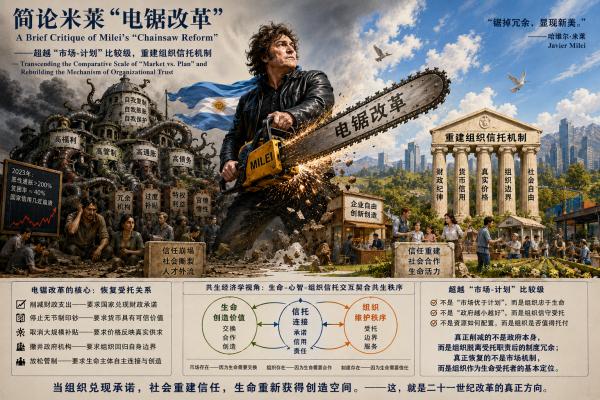
有人把米莱视为自由市场经济的英雄,有人把他看作激进自由主义的实验者。特别是2024年,哈维尔·米莱获得哈耶克奖之后,有人断言,他不过是在二十一世纪重新演绎二十世纪奥地利学派的思想传统,因为米莱确实写过一本《经济思想的激辩:凯恩斯、弗里德曼与奥地利学派》,甚至把米莱电锯改革视为“休克疗法”者,也大有人在。
米莱获得哈耶克奖,因此具有双重象征意义:一方面,它承认了米莱对自由市场与有限政府原则的坚持;另一方面,它也暴露了传统框架的局限——因为米莱在阿根廷的改革,事实上已经走得更远。
真正值得注意的,并不是奖项和著述本身,而是这个奖项和著述所指向的思想坐标,已经无法完全框住米莱在阿根廷所做的事情。因为这些评价,都未能回答一个更深层的问题:为什么米莱改革会在如此短的时间里,引起远远超出阿根廷本身的世界性关注?
答案并不在于他“又一次证明了市场比计划好”,而在于他把改革的锋芒,第一次从资源配置问题,真正转向了资源配置的组织本身。
一、横空出世:电锯的隐喻
2023年,面对恶性通胀超过200%、贫困率逼近40%、国家信用几近崩溃的阿根廷,米莱以“电锯”为象征,承诺对公共支出进行大规模削减,最终以戏剧性方式当选总统。
“电锯”的隐喻,从一开始就被很多人简单理解为切割与断裂。但米莱本人反复强调的,是另一种含义:锯掉冗余,显现新美。他要锯掉的是那些已经脱离生命、社会和经济现实、自我膨胀的组织冗余,而不是市场本身,也不是政府本身。
正是这个隐喻,预示了他改革的真正着力点——不是在“市场还是计划”之间做选择,而是在组织异化与生命活力之间做切割。
二、百年沉沦与2023年的深渊
一百年前,阿根廷曾是全球最富裕的国家之一,人均收入接近法国和德国,布宜诺斯艾利斯被誉为“南美巴黎”。然而,从庇隆主义开始,国家逐渐陷入高福利、高管制、高通胀、高债务的恶性循环。军政府与民选政府轮替,左右政策摇摆,但底层逻辑始终未变:用国家组织替代社会自组织,用短期再分配替代长期价值创造,用印刷货币掩盖真实信任赤字。
到2023年,这个循环走到近乎崩溃的边缘。月度通胀一度超过25%,中产阶级资产大幅缩水,年轻人大量外逃,社会信任跌至冰点。国家不再是秩序的提供者,而是秩序最大的消耗者。
更深层的问题在于,国家组织逐渐形成了自我复制、自我膨胀、自我保护的运行逻辑。这正是殖官主义(Reproductive Officialdom)——一种组织病态。当组织把自身持续扩张视为首要目标,把不断增加预算、权限、机构和人员视为天然合理的发展方向时,组织便开始脱离其受托职责,成为寄生于社会之上的特殊生命体。
组织开始服务于组织自身。预算首先保障组织存在,权力首先维护组织利益,政策首先回应组织惯性。生命反而不断适应组织,市场不断适应组织,社会不断适应组织。本应服务社会的组织,逐渐演变为社会运行的中心;本应创造价值的生命主体,则越来越成为组织运转所依赖的资源。
米莱挥动电锯,正是要阻止这种异化继续下去。
三、《五月公约》与改革的展开:恢复受托关系
2024年5月,米莱推动签署《五月公约》,试图在联邦与地方、政府与社会之间,重新确立基本的财政与责任边界。这份文件的核心,不是政策清单,而是对组织受托职责的重新确认。
米莱政府推动的改革据称超过一万六千项。真正具有历史意义的,并不在于数量,而在于它们共同指向同一个目标——重建组织信托机制。
他削减财政支出,不只是为了实现财政盈余,而是要求国家重新兑现自己的财政承诺;
他停止中央银行无节制发行货币,不只是为了抑制通货膨胀,而是要求货币重新具有可信赖的价值尺度;
他取消大规模补贴,不只是为了减少财政负担,而是要求价格重新反映真实供求,使社会重新恢复正常的激励机制;
他撤并政府机构,不只是为了减少公务员数量,而是要求组织重新回到身边界,不再无限扩张;
他放松劳动市场和商业监管,不只是为了增加企业自由,而是要求社会重新恢复生命主体之间自主连接、自主合作和自主创造的能力。
所有这些措施,都不是彼此孤立的政策调整,而是在恢复组织与生命之间已经被长期破坏的受托关系。组织重新兑现承诺,社会重新建立信任,生命重新获得创造空间。
四、反应与成效:历史鲜活性的现实检验
改革的阻力可想而知。工会、既得利益集团、部分地方政府、习惯了补贴的群体,都发出强烈反对。国际舆论中,也不乏把米莱改革简单等同于“休克疗法”、并据此发出“社会撕裂”警告的声音。
然而,事实正在逐步显现。恶性通胀被显著压低,财政从持续赤字转向初步盈余,国际资本市场开始重新评估阿根廷的风险溢价,资本出现回流迹象。更重要的是,社会心理出现微妙变化:人们开始意识到,原来国家并不是永远可以靠印钞和借债维持“免费”的,组织也可以重新学习如何被信任。
这些成效当然还很初步,也充满不确定性。但它们已经足够证明:当殖官主义的冗余被真正锯掉之后,被遮蔽的生命活力有可能重新显现。
五、超越“市场-计划”比较级与“世纪钟摆困境”
很多人仍用“市场经济对计划经济”“奥派对凯恩斯”“自由对管制”的旧框架来理解米莱,甚至惯性地把他与叶利钦的“休克疗法”画等号。这些框架并非全错,但已经远远不够,而且容易陷入系统惯性和惰性思维。
二十世纪后半叶以来,面对不断加剧的“市场自由与政府管控”世纪钟摆,不同国家都曾尝试寻找新的出路。蒋经国、撒切尔夫人、邓小平、里根、戈尔巴乔夫以及叶利钦,分别在不同制度背景下展开了各具特色的改革实践。他们有的侧重市场开放,有的强调产权调整,有的推动行政松绑,有的着力政治改革,也都不同程度释放了社会活力。
然而,这些改革大多仍然没有完全走出市场与政府“比较优势”的分析框架。事实表明,仅仅依靠“半市场半管制”并不能自动完成组织信托重建。政府可以殖官,市场亦可能异化;真正危险的不只是二者各自殖官,而是公权力组织与垄断资本组织合流嵌套、彼此赋能的跨界殖官。 当组织一旦脱离受托使命,无论公有还是私有,都会重新积累新的殖官主义冗余——导致组织熵增异化持续累积,世纪钟摆效应遂再次摆回潮。
正是在这个意义上,川普的常识新政与米莱的电锯改革,构成了二十一世纪组织范式的横空出世。川普在超大型科层国家机器中重申常识,旨在对跨国金融、产业资本以及官僚深层国家的信用越界进行对焦审计;米莱则以电锯为工具,直击急性晚期财政失责与组织赘生的根瘤。
他们基于常识和理论,展现出突破这一世纪难题的迹象,自觉或不自觉地抓住了“重建组织信托”这一鲜活的中枢关键,迎合了从斯密繁荣三原点、哈耶克自发秩序机制,到 Symbionomics 生命-心智-组织交互契合共生秩序的文明脉络。
六、重建组织信托:共生经济学的制度内涵
早在2008年,共生经济学就明确指出:
货殖论的主流经济学家们,只是用不同方式解释有没有“免费的午餐”,并围绕着货币信用、真实收入、虚实经济的“三重两极分化”,讲述着新、老资本论的故事,陷入市场、政府、道德“三重失灵”的“市场自由与政府管控周期性钟摆”困境,让世界徒生出各种分裂与冲突。而问题在于,脱离生活常态的生产与资本增值(从“增长之术”到“增长之道”),已然超越自然、社会、你我他身心灵健康可承受的极限,快要摧毁基于“斯密繁荣三原点”和“哈耶克自由秩序蓝图”的“生命-心智-组织信托交互契合共生秩序”,改变何以可能?
这就是共生经济学试图加以解决的问题——在能量转换和信息流变中重估一切所谓经济增长和高福祉的价值。
米莱改革的历史价值,正在于它在实践中率先回应了这个根本问题。传统经济学讨论的核心是资源如何配置,市场和计划争论的是配置方式的优劣。米莱改革首先讨论的,却是组织是否仍然值得生命托付。
如果组织不断透支信用,再完善的市场机制也会失效;如果组织不断侵占社会空间,再精密的计划体系也会失去生命基础。
真正决定制度能否持续运行的,不仅是资源如何配置,更重要的是组织是否仍然忠于自己的受托职责。
这正是共生经济学观察现代经济社会的一条基本主线:生命创造价值,组织维护秩序,信托连接二者。
市场之所以存在,是因为生命需要交换;
组织之所以存在,是因为生命需要合作;
制度之所以存在,是因为生命需要信任。一旦组织脱离生命,制度便开始僵化;
一旦信托遭到破坏,市场与政府都会逐渐失去运行基础。
因此,共生经济学所关注的,并不是市场优于计划,也不是政府优于市场,而是组织是否始终忠于生命。
从这一视角重新观察米莱改革,人们便会发现,其每一项关键行动,都具体呈现了共生经济学的制度内涵:
恢复财政纪律,体现的是组织兑现承诺;
恢复货币信用,体现的是组织尊重社会信任;
恢复真实价格,体现的是组织尊重生命创造;
压缩官僚体系,体现的是组织回归自身边界;
放松社会管制,体现的是组织尊重生命自组织能力。
米莱改革真正削减的,并不是政府本身,而是组织脱离受托职责以后不断形成的制度冗余;真正恢复的,也不仅仅是市场机制,而是组织作为生命受托者的基本定位。
这也是为什么米莱改革虽然发生在阿根廷,却能够引起全球如此广泛关注。今天世界许多国家面对的问题虽然表现各异,但共同挑战却越来越明显:组织越来越庞大,技术越来越复杂,治理越来越精密,而生命主体却越来越缺乏真实参与感,组织信托不断下降,社会运行成本不断上升。这已经不是阿根廷一国的问题,也不是自由主义与凯恩斯主义之间的问题,而是现代文明共同面对的问题。
结语
米莱获得哈耶克奖,是一个象征。真正的问题是,哈耶克之后,人类文明需要怎样的新坐标。
电锯的声音已经响起。它锯掉的是殖官主义的结构性寄生,指向的是组织信托机制的重建,显现的是被长期遮蔽的生命自组织连接动态平衡的交互主体共生。它既不是叶利钦式的“休克疗法”,也不是旧的“市场自由与政府管控”钟摆中的又一次摆动,而是基于常识和理论,对“世纪钟摆困境”的真正突破。
川普的常识新政与米莱的电锯改革,共同抓住了“重建组织信托”这一中枢关键。他们以不同的制度武器,自觉或不自觉地对齐了从斯密繁荣三原点、哈耶克自发秩序与自由法理框架,到 Symbionomics 生命-心智-组织交互契合共生秩序的文明脉络。
阿根廷的实验远未完成,风险依然巨大。但无论如何,它已经把一个更根本的问题推到了世界面前:
当组织越来越大、技术越来越强、权力越来越集中时,组织信托机制是否还能被重建?生命是否还能保持自组织连接的动态平衡?交互主体共生是否还能成为文明的底层秩序?
米莱的改革,或许只是一个南方国家的尝试。但它所昭示的,却是整个人类正在逼近的文明转向新起点。这或许正是米莱留给二十一世纪最重要的制度遗产。
A Brief Critique of Milei’s "Chainsaw Reform"
—Transcending the Comparative Scale of "Market vs. Plan" and Rebuilding the Mechanism of Organizational Trust
By Archer Hong Qian
Since Argentine President Javier Milei ascended the historical stage brandishing a chainsaw, the world has once again fixed its gaze on this reformer who attempts to reshape a nation through the comprehensive purge of organizational redundancy and the reconstruction of organizational trust.
Some view Milei as a hero of the free-market economy, while others see him as an experimenter in radical libertarianism. Particularly after Milei received the Hayek Prize in 2024, certain observers asserted that he is merely reenacting the twentieth-century intellectual traditions of the Austrian School in the twenty-first century—given that Milei indeed authored The Debate in Economic Thought: Keynes, Friedman, and the Austrian School—while many others routinely equate his chainsaw reform with "shock therapy".
Milei’s receipt of the Hayek Prize thus carries a double symbolism: on the one hand, it recognizes his adherence to the principles of the free market and limited government; on the other hand, it exposes the limitations of traditional analytical frameworks—because Milei’s reforms in Argentina have, in fact, gone much further.
While these assessments contain elements of truth, what truly merits attention is not the prize or his publications per se, but rather that the intellectual coordinates pointed to by these awards and texts can no longer fully contain what Milei is actually executing in Argentina. These evaluations fail to answer a more profound question: why has Milei’s reform, within such a short span of time, ignited a wave of global attention that far overflows the borders of Argentina itself?
The answer does not lie in his "proving once again that the market is superior to planning," but rather in the fact that he has, for the first time, directed the critical edge of reform away from the mere question of resource allocation and onto the very organizations that allocate those resources.
I. Emergence onto the Stage: The Metaphor of the Chainsaw
In 2023, confronting an Argentina burdened with hyperinflation exceeding 200%, a poverty rate approaching 40%, and a near-bankrupt state credit, Milei deployed the "chainsaw" as his primary symbol, pledging massive slashes to public expenditures and ultimately securing the presidency in dramatic fashion.
From the outset, the metaphor of the "chainsaw" was simplisticly interpreted by many as an act of raw cutting and disruption. Yet Milei himself has repeatedly underscored an alternative meaning: sawing away redundancy to unveil new beauty. What he intends to saw away are those self-inflating organizational redundancies that have detached from the realities of life, society, and economics—rather than the market itself or the government itself.
It is precisely this metaphor that foreshadows the authentic locus of his reform—not choosing between "market or plan," but executing a decisive severing between organizational alienation and the vital forces of life.
II. A Century of Decline and the 2023 Abyss
A century ago, Argentina ranked among the wealthiest nations on Earth, with a per capita income close to that of France and Germany, and Buenos Aires celebrated as the "Paris of South America". However, beginning with Peronism, the state progressively trapped itself within a vicious cycle of high welfare, high regulation, high inflation, and high debt. Military juntas and democratically elected governments rotated, and policies swung from left to right, yet the underlying logic remained immutable: substituting state organization for social self-organization, replacing long-term value creation with short-term redistribution, and printing currency to mask a genuine deficit of trust.
By 2023, this cycle had arrived at the precipice of total collapse. Monthly inflation once surged past 25%, middle-class assets evaporated rapidly, the youth fled in droves, and social trust eroded to absolute zero. The state ceased to be a provider of order; it became the ultimate consumer of order.
The deeper pathology lies in the fact that state organizations had gradually developed an operational logic predicated on self-replication, self-expansion, and self-preservation. This is precisely Reproductive Officialdom—an organizational malignancy. When an organization treats its own continuous expansion as its primary goal, and views the perpetual enlargement of its budget, authority, agencies, and personnel as a naturally justified path of development, it detaches from its fiduciary duties and morphs into a parasitic, self-serving entity superimposed upon society.
The organization begins to serve the organization itself. Budgets primarily guarantee organizational survival, power primarily shields organizational interests, and policies primarily respond to organizational inertia. Consequently, life is forced to continuously adapt to the organization, the market adapts to the organization, and society adapts to the organization. The organizations that ought to serve society transform into the absolute center of societal operations, while the living subjects who ought to create value are increasingly reduced to mere resources relied upon to keep the organizational apparatus running.
Milei wields the chainsaw precisely to halt this ongoing alienation.
III. The May Pact and the Unfolding of Reform: Restoring Fiduciary Relations
In May 2024, Milei engineered the signing of the May Pact, aiming to re-establish fundamental fiscal and responsibility boundaries between the federal government and the provinces, and between the state and society. The core of this document is not a checklist of policies, but a solemn re-affirmation of the fiduciary duties of organizations.
The reforms advanced by the Milei administration reportedly exceed sixteen thousand items. Their genuine historical significance lies not in their volume, but in their collective alignment toward a singular objective—rebuilding the mechanism of organizational trust.
He slashes fiscal expenditures not merely to secure a fiscal surplus, but to demand that the state re-honor its own fiscal commitments;
He halts the central bank's unbridled currency issuance not merely to suppress通货膨胀, but to demand that currency recover its status as a trustworthy measure of value;
He abolishes massive subsidies not merely to alleviate the fiscal burden, but to demand that prices once again reflect authentic supply and demand, thereby restoring normal incentive mechanisms to society;
He downsizes and merges government agencies not merely to reduce civil service headcounts, but to demand that organizations retreat to their proper boundaries and cease infinite expansion;
He deregulates the labor market and commercial activities not merely to expand corporate freedom, but to demand that society recover the capacity for autonomous connection, cooperation, and creation among living agents.
None of these measures represent isolated policy adjustments; rather, they constitute a systematic restoration of the fiduciary relationships between organization and life that had been fractured long-term. As organizations re-validate their commitments, society reconstructs trust, and life re-acquires its creative space.
IV. Response and Efficacy: A Realist Test of Historical Vitality
The resistance encountered by the reform was entirely predictable. Labor unions, vested interest groups, certain provincial governments, and populations habituated to subsidies all raised vehement opposition. Within international discourse, voices routinely surfaced equating Milei’s approach to "shock therapy" and issuing warnings of imminent "social rupture".
Nevertheless, empirical realities are progressively coming to light. Hyperinflation has been conspicuously suppressed, public finances have pivoted from chronic deficits to preliminary surpluses, international capital markets have begun re-assessing Argentina’s risk premium, and capital flight shows signs of reversal. More importantly, a subtle shift is occurring within the social psyche: people are beginning to realize that the state cannot perpetually sustain a "free lunch" via the printing press and debt accumulation, and that organizations can relearn how to be trusted.
These outcomes are undeniably preliminary and remain shrouded in uncertainty. Yet they are entirely sufficient to demonstrate that once the redundancies of Reproductive Officialdom are genuinely sawn away, the obscured vitality of life can re-emerge.
V. Transcending the "Market-Plan" Comparative Scale and the "Century Pendulum Dilemma"
Many continue to evaluate Milei through the antiquated paradigms of "market economy vs. planned economy," "Austrian School vs. Keynesianism," or "liberty vs. regulation," even instinctively equating him with Yeltsin’s "shock therapy". While these frameworks are not entirely erroneous, they are profoundly inadequate and prone to systemic inertia and cognitive laziness.
Since the second half of the twentieth century, faced with the accelerating swing of the century pendulum between "market freedom and government control," various nations have attempted to carve out new pathways. Chiang Ching-kuo, Margaret Thatcher, Deng Xiaoping, Ronald Reagan, Mikhail Gorbachev, and Boris Yeltsin all launched distinct reform practices across highly divergent institutional landscapes. Some emphasized market opening, others focused on ownership adjustments, some drove administrative deregulation, while others prioritized political restructuring—and all, to varying degrees, unlocked social vitality.
However, the vast majority of these reforms failed to fully escape the analytical framework centered on the "comparative advantage" of market versus government. Empirical history demonstrates that merely relying on a "half-market, half-control" matrix cannot automatically achieve the reconstruction of organizational trust. Governments can practice Reproductive Officialdom, and markets can similarly undergo alienation; the ultimate danger resides not in their isolated malfeasance, but in the collusive and interlocking cross-boundary Reproductive Officialdom where public organizational power and monopolistic capital organizations nest within and empower one another. Once an organization detaches from its fiduciary mission—regardless of whether it is publicly or privately held—it inevitably re-accumulates new structural redundancies of Reproductive Officialdom. This feeds a continuous accumulation of organizational entropy and alienation, ultimately causing the century pendulum to swing back in an inevitable counter-reaction.
It is precisely within this context that Trump’s Common-Sense Governance and Milei’s Chainsaw Reform represent the sudden emergence of a twenty-first-century organizational paradigm. Trump reasserts common sense within a hyper-bloated bureaucratic state machine, aiming to audit and focus upon the credit transgressions of transnational finance, industrial capital, and the bureaucratic Deep State; Milei, conversely, deploys the chainsaw to strike directly at the core nodes of late-stage acute fiscal irresponsibility and organizational overgrowths. Grounded in both common sense and robust theory, they exhibit clear signs of breaking through this century-old dilemma. They have, consciously or otherwise, seized upon the vital hub of "rebuilding organizational trust," aligning themselves with the civilizational lineage that spans from Smith’s primordia of prosperity and Hayek’s spontaneous order mechanisms to the Symbionomics framework of the LIFE-AI-TRUST symbiotic order of interactive alignment.
VI. Rebuilding Organizational Trust: The Institutional Substance of Symbionomics
As early as 2008, Symbionomics explicitly articulated that:
Mainstream economists operating within chrematistics merely offer varied explanations of "whether there is a free lunch". By endlessly revolving around the "triple polarization" of monetary credit, real income, and the virtual-real economic divide, they recount the stale narratives of the old and new Das Kapital. This locks the world within the trap of a cyclical century pendulum between market freedom and government control—entangled in the triple failure of market, government, and morality, and generating superficial divisions and conflicts. The core problem is that production and capital appreciation detached from the normal state of life (elevating from a "technique of growth" to a dominant "way of growth") have surged past the thresholds that natural ecology, social relations, and individual physical-mental-spiritual health can endure. This trajectory is on the verge of dismantling the LIFE-AI-TRUST symbiotic order of interactive alignment rooted in Smith’s primordia of prosperity and Hayek's blueprint of natural order. How, then, is change possible? This is precisely the crisis Symbionomics seeks to resolve—re-evaluating the value of all so-called economic growth and high welfare through the lens of energy transformation and informational evolution.
The historical worth of Milei’s reform lies in its being the first practical response to this foundational question. The core of traditional economics centers on how resources are allocated, with markets and planning debating the comparative merits of their respective modalities. Milei’s reform, however, interrogates first whether the organization itself remains worthy of the entrustment of life. If an organization continuously overdraws its credit, even the most flawless market mechanism will fail; if an organization perpetually encroaches upon social space, even the most sophisticated planned architecture will lose its living foundation.
The vital determinant of an institution's sustainability is not merely how resources are allocated, but more fundamentally, whether the organization remains faithful to its fiduciary responsibilities.
This constitutes the primary analytical axis through which Symbionomics observes modern economic society: life creates value, organization maintains order, and trust connects the two. The market exists because life requires exchange; organization exists because life requires cooperation; and institutions exist because life requires trust. The moment an organization detaches from life, institutions ossify; the moment trust is compromised, both markets and governments lose their operational foundations.
Hence, the focus of Symbionomics is not asserting that the market is superior to planning, nor that government is superior to the market, but verifying whether the organization remains unswervingly faithful to life.
Observed through this lens, every pivotal action in Milei’s reform explicitly manifests the institutional substance of Symbionomics: restoring fiscal discipline reflects the organization honoring its commitments; restoring monetary credit reflects the organization respecting social trust; restoring authentic prices reflects the organization respecting life's creation; compressing the bureaucracy reflects the organization retreating to its proper boundaries; and deregulating social activities reflects the organization respecting the self-organizing capacity of life.
What Milei’s reform truly decimates is not government per se, but the institutional redundancies that continuously accumulate once organizations abandon their fiduciary duties; what it truly restores is not merely a market mechanism, but the foundational positioning of the organization as a trustee of life.
This explains why Milei’s reform, despite unfolding in Argentina, has captured such intense global attention. While the crises confronting various nations today manifest differently, their common challenge grows increasingly salient: organizations grow ever more titanic, technology turns vastly complex, and governance becomes hyper-precise, yet living subjects are increasingly starved of authentic participation. This fuels a continuous decline in organizational trust alongside skyrocketing societal operational costs. This is no longer a localized Argentine malady, nor a doctrinal dispute between libertarianism and Keynesianism; it is a shared crisis of modern civilization.
Conclusion
Milei’s receipt of the Hayek Prize is a symbol. The authentic challenge is defining the new coordinates human civilization requires after Hayek.
The sound of the chainsaw has reverberated. It saws away the structural parasitism of Reproductive Officialdom, points toward the reconstruction of the organizational trust mechanism, and unveils the long-obscured intersubjective symbiosis characterized by the dynamic balance of self-organized life connections. It represents neither Yeltsin-style "shock therapy" nor an ordinary swing within the old pendulum of "market freedom and government control"; it is a genuine breakthrough out of the century pendulum dilemma grounded in common sense and theory.
Trump’s Common-Sense Governance and Milei’s Chainsaw Reform collectively seize upon the vital hub of "rebuilding organizational trust". Armed with distinct institutional weapons, they have, consciously or otherwise, aligned themselves with the civilizational lineage that flows from Smith’s primordia of prosperity and Hayek’s spontaneous order and constitutional frameworks to the Symbionomics structure of the LIFE-AI-TRUST symbiotic order of interactive alignment.
The Argentine experiment is far from complete, and its attendant risks remain monumental. Yet, regardless of the outcome, it has forced a more fundamental question onto the global stage:
When organizations grow infinitely larger, technology turns infinitely more potent, and power becomes hyper-centralized, can the mechanism of organizational trust genuinely be rebuilt? Can life sustain the dynamic balance of its self-organized connections? Can intersubjective symbiosis truly emerge as the foundational order of civilization?
Milei’s reform may well be an endeavor limited to a global South nation. Yet, what it heralds is a new starting point for a civilizational pivot that the whole of humanity is rapidly approaching. This, perhaps, stands as the most critical institutional legacy Milei leaves to the twenty-first century.