
Symbionomics(共生经济学):
Symbionomics(共生经济学):
From a Conceptual Framework to a Multi-Level Path of Civilizational Practice
By Archer Hong Qian(钱宏)
Today I am pleased to publish Symbionomics: From a Conceptual Framework to a Multi-Level Path of Civilizational Practice. For the original Chinese edition, please visit Amorsophia: https://www.amorsophia.com/article/10163, Wanwei Blog: https://blog.creaders.net/user_blog_diary.php?did=NTU3NzQ3, or Symbiosism.com: http://symbiosism.com.cn/12461.html. Thank you for your interest. I warmly welcome your comments and suggestions.
【题记】
1986年7月18日,一个新生命如约降生,呱呱坠地;同一天,我在《江西青年报》发表了《时代期待新思想的第一声叫喊》。
二十二年后的2008年,共生经济学开始着床孕育;十五年后的2023年,她悄然成形;今天,2026年7月18日,我愿将她放手,让她走向世界。愿她在现实中学会行走,在实践中不断成长,在交互中趋于成熟,在时间里接受检验。
四十年前的那篇小文中,我附上了一首白话短诗:
天上的路
是翅膀的
水上的路
是风帆的
花间的路
是蜜蜂和蝴蝶的
没有路的路
是开拓者的
今天,我把这首诗,送给《共生经济学》的每一位读者朋友。
Today, on 18 July 2026, I am ready to let it go—to let it find its own way in the world. On the same day, I published my article “The First Cry of New Thought that the Era Awaits” in Jiangxi Youth Daily.
Twenty-two years later, in 2008, Symbionomics began to take root and gestate. Fifteen years after that, in 2023, it quietly took shape. Today, on 18 July 2026, I am ready to let it go — to send it out into the world. May it learn to walk in reality, grow through practice, mature through interaction, and be tested by time.
In that short article forty years ago, I included a simple poem:
The path in the sky belongs to wings. The path on the water belongs to sails. The path among flowers belongs to bees and butterflies. The path where there is no path belongs to the pioneers.
Today, I offer this poem to every reader of Symbionomics.
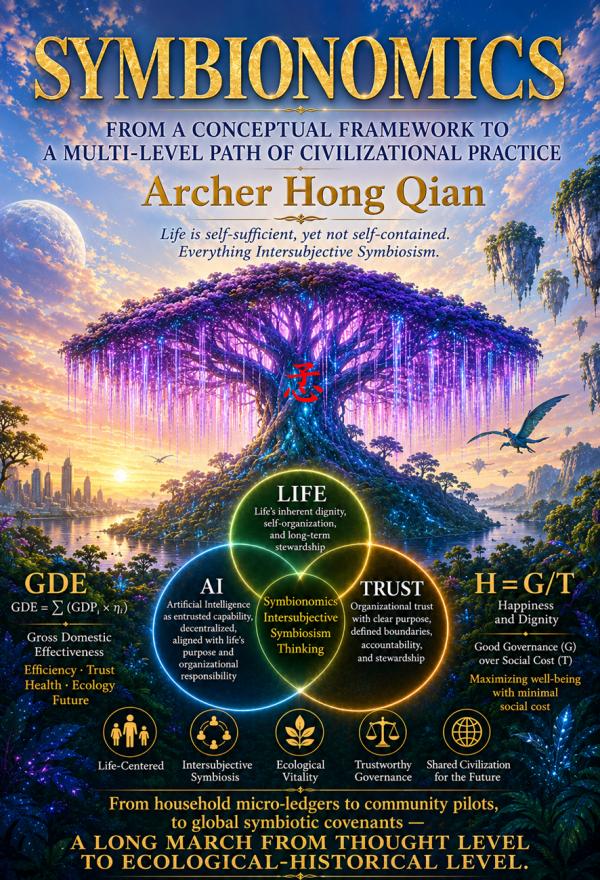
【本文逻辑结构】
起源 → 哲学 → 框架 → GDE → H=G/T → 八大转变 → 现实验证 → 传播与共创 → 文明重建
起源
共生经济学(Symbionomics)由钱宏在2008年国际金融危机期间提出,最初是为了回答“经济模式的价值参量”问题。它诞生于对无效GDP的反思:大量货币流量被计入GDP,却未能转化为真实生活福祉、组织信任与生态可持续。2010年正式创立,2015年引入社区经济作为第三形态,突破了市场与政府二元钟摆的世纪困境。其核心使命是回应现代性积累的组织熵增与文明耗散。
哲学
底层哲学是交互主体共生思维(Intersubjective Symbiosism)。它主张:生命主体本自具足却非独存;一切关系应走向“生命自组织连接的动态平衡”;核心原则是“自己活也要别人活”。这一思维将“理性经济人”提升为仨自组织人(Triple Self-Organizing Person)——经济、政治、文化三重自组织力统一于的健康主体。它把增长、公平、信任、健康、生态这些长期割裂的问题,重新置于生命自组织、智能受托与组织信托交互作用的同一框架中。
框架
核心框架是LIFE-AI-TRUST三元交互:
LIFE:生命形态的自组织尊严与长期主义;
AI:去中心化的受托工具,接受生命目的与组织责任的双重校准;
TRUST:组织信托结构,明确受托目的、权限边界与问责机制。
三者通过交互主体共生思维形成动态平衡,而非线性控制或零和博弈。
GDE
GDE(Gross Domestic Effectiveness,国民生態效能)是核心计量工具。公式为:
GDE = Σ(GDP? × η?)
其中η?是综合效能系数,综合考量资源效率、降本赋能、身心灵健康、组织信托、生态复原力与未来世代空间。它把GDP从“发生了多少”的加法记录,转变为“值不值得发生”的乘法过滤。
η > 1为效能放大,0 < η < 1为效能稀释,η < 0则形成“无效GDP窟窿”。
H=G/T
GDE回答“创造了多少真实效能”,H=G/T进一步回答“这些效能是否转化为幸福与尊严”。公式中:
H = 幸福与尊严
G = 善治或组织信托创造的真实公共价值
T = 人民为获得公共服务与正常生活所付出的社会交易成本与边际获益成本
H=G/T经历了三层演进:善治公式 → 组织信托公式 → 共生经济学公式。它与GDE共同构成从经济评价到文明评价的完整观照。
八大转变
共生经济学提出三个层次的八大结构化跃迁:
第一层(主体、权利与价值范式):理性经济人→仨自组织人;产权中心→共生权;GDP规模→GDE效能;加减法思维→乘除法思维。
第二层(经济结构与生活方式):市场-政府二元摆动→社区-市场-政府三元共生;特权消费→共生生活方式。
第三层(组织信托与全球秩序):地缘政治竞争→有边界的共生全球化;单中心治理→多层组织信托共生。
这些转变在LIFE-AI-TRUST时代获得新的时代内涵。
现实验证
理论必须接受现实检验。正向样本包括阿根廷米莱改革、Trump 2.0相关政策等降低组织成本、激活社会潜力的实践。反向验证聚焦“无效GDP窟窿”:资源进入行政体系、地方融资平台、房地产与运动式治理,形成GDP流量,却转化为低效组织的运行成本、无效资产与未来债务。钱并未消失,而是从生命主体的生活资源转换为组织熵增。共生经济学既揭示耗散,也确认一切真正降本赋能、重建信托的善行。
传播与共创
思想必须从“种子-思想位”走向“生态-历史位”。传播路径包括:内容共创(多语言矩阵与案例故事)、节点激活(学术、政策、企业、媒体与青年)、实验反哺(优先启动1-2个可见GDE微试点)、工具放大(AI与现有共生网络)以及汇聚共创(全球共生论坛与New Dartmouth Conference)。AI不仅是工具,更是持续交互、共同校正的伙伴。
文明重建
共生经济学不是封闭理论,而是可从真实生活出发、不断接受试验与共创的文明框架。它以生命为起点、以AI为受托能力、以组织信托为制度基础,用GDE追问价值真伪,用H=G/T检验社会成本。最终目标是推动生产回归生活、生活呈现生态、生态激励生命,让组织重新成为生命可信赖的受托者。
重建组织信托,是开启这座“人类可挖掘百年的文明宝藏”从思想位走向生态-历史位的现实入口。下一步,最优先行动是启动最小可行的家庭与社区GDE微试点。思想只有进入生活、接受真实反馈,才能真正改变历史。
生命本自具足,又非独存。凡事交互主体共生。
Symbionomics: From Origin to Civilizational Reconstruction
Origin → Philosophy → Framework → GDE → H = G/T → Eight Major Transformations → Empirical Verification → Propagation and Co-creation → Civilizational Reconstruction
Origin
Symbionomics was born in 2008 during the global financial crisis, when Qian Hong sought to answer a deceptively simple question: what is the real value parameter of an economic model? At that moment, it became clear that conventional GDP was recording massive monetary flows while concealing an enormous “black hole of ineffective GDP.” Resources were being converted into GDP statistics, yet failing to generate corresponding improvements in people’s lives, organizational trust, or ecological sustainability.
In 2010, the framework was formally established. By 2015, it introduced community economy as a third economic form alongside market and government economies, breaking the century-old pendulum swing between free-market and state-control paradigms. From the beginning, Symbionomics has been a response to the accumulated organizational entropy and civilizational dissipation of modernity.
Philosophy
The philosophical foundation is Intersubjective Symbiosism. It rests on four propositions: life subject(s) are inherently sufficient yet never exist in isolation; all relationships should move toward the self-organizing dynamic balance of life connections; the core principle is “live and let live,” generating a virtuous cycle of goodness; and threefold symbiosis operates simultaneously among life subject(s), between life-technology-organization, and between human civilization and natural ecology.
This philosophy elevates the human being from Homo Economicus (rational economic man) to the triple self-organizing person — a healthy subject in whom economic, political, and cultural self-organizing capacities are unified. It relocates the long-fragmented questions of growth, fairness, trust, health, and ecology into one integrated framework of life self-organization, intelligent trusteeship, and organizational trust.
Framework
The operational architecture is the LIFE-AI-TRUST triadic interaction.
LIFE represents the self-organizing dignity of individual and collective life, emphasizing starting capital and long-termism.
AI functions as a decentralized, distributed tool that amplifies life’s self-organizing capacity while remaining under the dual calibration of life purpose and organizational responsibility.
TRUST refers to institutional trustee structures — families, communities, enterprises, governments, and international bodies — that must clearly define purpose, boundaries, accountability, and exit conditions.
These three elements achieve dynamic balance through intersubjective symbiotic thinking rather than linear control or zero-sum competition.
GDE
The central measurement tool is Gross Domestic Effectiveness (GDE). Its formula is:
GDE = Σ (GDP? × η?)
where η? is the comprehensive efficacy coefficient that evaluates each economic activity across resource efficiency, cost reduction and empowerment, body-mind-spirit health, organizational trust, ecological resilience, and space for future generations.
GDE transforms GDP from a simple additive record of “how much occurred” into a multiplicative filter that asks “was it worth occurring?” When η > 1, efficacy is amplified; when 0 < η < 1, efficacy is diluted; when η < 0, the activity creates a black hole of ineffective GDP that destroys more genuine value than it produces.
H = G/T
While GDE measures the creation of genuine efficacy, H = G/T examines whether that efficacy ultimately serves human happiness and dignity. Here H stands for Happiness & Dignity, G for the real public value created through good governance or organizational trust, and T for the total social transaction costs and marginal costs that people bear to obtain services and live normal lives.
The formula has evolved through three layers: a governance evaluation formula, an organizational trust formula, and finally a Symbionomics civilizational formula. Together, GDE and H = G/T form a complete movement from economic calibration to civilizational purpose.
Eight Major Transformations
Symbionomics proposes eight structured transformations organized into three levels:
Level 1 – Subject, Rights, and Value Paradigms From rational economic man to triple self-organizing person; from property-rights center to symbiotic rights; from GDP-scale evaluation to GDE ecological-efficacy evaluation; from additive-subtractive thinking to multiplicative-divisive thinking.
Level 2 – Economic Structure and Lifestyle From market-government binary oscillation to community-market-government triadic symbiosis; from privilege consumption to symbiotic lifestyle.
Level 3 – Organizational Trust and Global Order From geopolitical competition to bounded symbiotic globalization based on the three-zero rules; from single-center organizational governance to multi-layer organizational-trust symbiosis.
These transformations gain new relevance in the LIFE-AI-TRUST era.
Empirical Verification
Theory must be tested against reality. Positive samples include recent reforms in Argentina and the United States that have sought to reduce ineffective expenditure and organizational costs. Reverse verification focuses on the black hole of ineffective GDP: large volumes of resources flow into bloated administrative systems, local financing platforms, real-estate expansion, and campaign-style governance, generating GDP statistics while producing low-efficiency organizational operating costs, stranded assets, and future liabilities. Money does not disappear; it is converted from the living resources of life subject(s) into organizational entropy. Symbionomics therefore both exposes dissipation and affirms every genuine act that reduces costs and rebuilds trust.
Propagation and Co-creation
Thought must move from the “seed–Thought Level” to the “Ecological-Historical Level.” The propagation strategy includes content co-creation across languages and formats, activation of key nodes in academia, policy, enterprise, media, and the younger generation, experimental feedback through visible micro-pilots, amplification via AI and existing symbiosis networks, and convergent co-creation through the Global Symbiosis Forum and the New Dartmouth Conference. AI is not merely a tool but a partner in sustained interaction, joint calibration, and continuous refinement.
Civilizational Reconstruction
Symbionomics is not a closed theoretical system but an open civilizational framework that begins from real life and continuously accepts experimentation, falsification, revision, and co-creation. It takes life as its starting point, AI as trustee, and organizational trust as its institutional foundation. It uses GDE to ask what genuine value each economic activity ultimately creates, consumes, or destroys, and uses H = G/T to test whether those values reduce people’s social costs and generate felt happiness and dignity.
Its ultimate aim is to return production to life, let life manifest ecology, and let ecology inspire life — while enabling organizations to become trustworthy trustees of life once again. Rebuilding organizational trust is the practical entrance that opens this civilizational treasure from the realm of thought into the realm of history.
The immediate priority is to launch the smallest feasible GDE family and community pilots. Only when thought enters lived reality and receives genuine data and life feedback can it acquire the power to change history.
Life is inherently sufficient yet never exists alone. All matters are Intersubjective Symbiosism.
When history enters the LIFE-AI-TRUST Interactive Symbiotic Era, existing frameworks can no longer sustain the self-organizing dignity and dynamic balance of life. Symbionomics is the systematic unfolding of Intersubjective Symbiosism philosophy in the economic domain. It transcends the binary oscillations of growth versus distribution, market versus government, and capital versus legal rights. It proposes intersubjective symbiotic thinking, the Healthy Golden Rule, the GDE National Ecological Effectiveness parameter (GDE = Σ[GDP? × η?]), and the Eight Major Transformations, offering a testable, calibratable, and continuously improvable path for rebuilding organizational trust and achieving dynamic balance among life, intelligence, and organization.
From family micro-account books, to community pilots, to a global symbiosis covenant—this is a long march from the Thought Level to the Ecological-Historical Level.
We believe symbiosis is not a utopia but a civilizational treasure that humanity can jointly excavate and benefit from in the 21st century and the next hundred years. It simultaneously addresses the deep issues of growth, fairness, trust, health, and ecological effectiveness. We invite all insightful people to participate: change through implementation, develop through change, and together advance the Thought Level toward the Ecological-Historical Level.
I. Origin and Positioning
Symbionomics is the thought and practice framework that Qian Hong has developed through long-term life experience, economic research, and civilizational reflection.
The term Symbionomics is coined by combining Symbiosism with economics. Its very structure conveys the essence of the discipline. The prefix Sym- means “together,” signifying coexistence, interaction, and ultimately society itself. The middle element bio refers not only to biological life but also to life as a flourishing way of being and a cultivated way of life. The suffix -nomics, derived from economics, denotes both the study and the practice of economic life. Thus, Symbionomics, by its very construction, is far more than a mechanical, biological, sociological, or ethical theory. It is an economics concerned with the flourishing of life, the ordering of society, and the well-being of humanity. Rooted in Amorsophia—the Wisdom of Love as a philosophy of life—it is intended not merely to interpret the world, but to shape institutions, guide public policy, and advance civilizational development.
Symbionomics is rooted in Intersubjective Symbiosism. During the 2008 international financial crisis, while answering a friend’s question about economic value parameters, he first proposed the Gross Domestic Effectiveness (GDE) parameter to filter ineffective GDP and reveal the enormous costs hidden by the “black hole of ineffective GDP.” He simultaneously proposed the civilizational criterion H = G/T.
Later, on the eve of the Shanghai World Expo, in a field report delivered as a specially appointed researcher at the Shanghai Academy of Social Sciences Institute of Economics, he formally introduced the symbiosis principle into “fundamental economic theory” and founded Symbionomics (8 June 2010). In a second lecture at the University of Michigan on “Symbionomics ABC,” he proposed “return production to life, let life manifest ecology, and let ecology inspire life,” and introduced “community economy” as a third economic form alongside “market economy” and “government economy,” thereby escaping the century-long pendulum swing between free-market and government-control paradigms (16 March 2015).
Thus Symbionomics simultaneously possesses an economic value parameter (GDE) and a political-economic civilizational criterion (H = G/T), corresponding to the two fundamental dimensions of economic evaluation and civilizational evaluation.
Thereafter, Symbionomics has continued to develop on Symbiosism.com.cn, Wanwei Reader, and the newly registered Amorsophia.com, and has gradually matured into a civilizational theory oriented toward the digital-quantum era within the LIFE–AI–TRUST framework.
After more than a decade of intellectual exchange, Professor Ju Yan’an of Central Connecticut State University, translator of Laozi’s Dao De Jing, solemnly stated that symbiosis philosophy is “a gold mine worthy of a century of exploration by humankind.” This judgment constitutes the core value assessment of Symbionomics.
Symbionomics is not a simple patch on traditional economics, nor another emergency remedy. It is a paradigmatic response to several centuries of modernity’s dilemmas— the binary opposition of growth versus distribution, the hollowing out of organizational trust, the alienation of life subject(s), and the continuous accumulation of ineffective dissipation and disorder in ecological and civilizational operation (collectively termed “organizational entropy increase” or “civilizational entropy increase,” where “entropy” here denotes the composite of resource waste, information distortion, misaligned responsibilities, trust erosion, responsibility drift, and organizational self-purposiveness, not a direct application of thermodynamic entropy).
Symbionomics reactivates Adam Smith’s economic origin point of “peace, easy taxes, and a tolerable administration of justice” together with Hayek’s “natural order principle” (The Constitution of Liberty)—which we summarize as “Peace Economics”—and continues to unfold it with Intersubjective Symbiosism philosophy and AI-era tools.
Symbionomics directly confronts the fundamental problems of organizational-trust collapse, life-subject alienation, and ecological-civilizational entropy increase, and offers the dynamic-balance path of LIFE-AI-TRUST interactive self-organization.
Symbionomics is not a utopia; it is a practical framework that can be tested, iterated, and falsified starting from families, communities, and enterprises.
Symbionomics simultaneously transcends “growth supremacy” (the pathology of capitalism) and “distribution supremacy” (the pathology of socialism) by proposing the Healthy Golden Rule, triadic symbiotic economy, and GDE ecological-effectiveness measurement. The term “pathology” here refers to the structural biases that easily form when either system detaches from life purpose, organizational boundaries, and self-organizing balance; it does not compress the complex histories of capitalism and socialism into a single label. The mechanisms of these biases will be elaborated in subsequent discussion.
The depth and breadth of this framework are indeed worthy of continuous excavation by several generations—from philosophical genesis, to economic statistical systems, to organizational institutional design, to global governance covenants. It is not “the next hot topic” but one of the underlying operating systems of the next stage of civilization.
II. Philosophical Core: Intersubjective Symbiotic Thinking
The foundation of Symbionomics is intersubjective symbiotic thinking (Intersubjective Symbiosism). It emphasizes:
Life subject(s) are inherently sufficient yet never exist in isolation.
All intersubjective relations should move toward the “self-organizing dynamic balance of life connections.”
The core principle is “live and let live,” forming a “virtuous cycle of goodness.”
Threefold symbiosis: symbiosis among life subjects, symbiosis among life-technology-organization, and symbiosis between human civilization and natural ecology. Interpersonal, group, national, continental, intergenerational, and inter-civilizational relations can all unfold within these three layers of interaction.
This thinking elevates human beings from “rational economic man” (Homo Economicus) to the “triple self-organizing person” (Organismic Symbiont / Triple Self-Organizing Person)—a healthy body-mind-spirit subject in whom political, economic, and cultural self-organizing capacities are unified—and places economic operation within the overall LIFE-AI-TRUST triadic interaction.
The significance of Symbionomics does not lie in adding yet another isolated new theory, but in relocating the long separately treated issues of growth, fairness, trust, health, and ecology into the single framework of life self-organization, intelligent trusteeship, and organizational trust in interactive operation.
III. Core Framework: LIFE-AI-TRUST Triadic Interaction
LIFE Form (Life-Form) The self-organizing dignity of individual and collective life, starting capital, and long-termism. It emphasizes endowing life subject(s) at the outset with the capacity to participate in symbiosis (for example, providing children with capital accounts and long-term compound-interest opportunities).
AI Form (Intelligent Form / Tool Form) Decentralized, distributed productive tools. AI is not a new master but an trustee that amplifies life’s self-organizing power and reduces ineffective intermediate energy consumption. It must accept the dual calibration of LIFE’s life purpose and TRUST’s organizational responsibility, so that intelligent capacity always serves life subject(s) and does not conversely reduce life to data, resource, or tool.
TRUST Form (Organizational Form / Organizational Trust) Includes families, communities, enterprises, governments, schools, churches, platforms, and international institutions as organizational-trust structures. TRUST refers not only to psychological trust or social capital between subjects but to an institutional trustee relationship: life is the beneficiary subject, organizations are life’s trustees, and AI is the trustee through which organizations fulfill their trustee responsibilities. Organizations must clearly define trustee purpose, authority boundaries, responsibility attribution, transparency mechanisms, accountability methods, and exit conditions. They must reduce intermediate rent-seeking links that create no corresponding value yet continue to extract returns through information monopoly, power rent-seeking, and institutional friction, while retaining and optimizing necessary intermediaries that genuinely provide professional services, risk buffering, coordination, auditing, and value certification. This establishes more direct, transparent, traceable, and accountable organizational-trust relationships.
The three forms achieve self-organizing dynamic balance through intersubjective symbiotic thinking, rather than linear control or zero-sum games.
IV. Fundamental Comparison between Symbionomics and Traditional Economics
Symbionomics proposes the GDE (Gross Domestic Effectiveness) value parameter. GDE takes Energy Conversion as its ontological foundation, Efficiency (conversion efficiency per unit input) as its process scale, and Effectiveness (comprehensive efficacy for life, living, organizational trust, ecological carrying capacity, and future stability) as its value criterion. Through the efficacy coefficient η, it performs multiplicative filtering and value calibration on the economic flows recorded by GDP.
GDP answers: How much production and transaction with monetary prices occurred in an economy during a given period? GDE further asks: Were these productions and transactions worth occurring? To what extent did they transform into life health, living well-being, organizational trust, ecological resilience, and future development capacity?
Thus GDP is the raw flow record of economic activity, while GDE is the comprehensive value parameter obtained after calibrating that flow for life, social, organizational, and ecological efficacy. In statistical practice GDE does not simply abolish GDP; it first takes GDP as foundational data and input flow, then applies multiplicative filtering via η. In real-world application it can initially serve as a supplementary indicator and satellite account in national accounts; after pilots, back-testing, and continuous refinement it can gradually develop into the core parameter system for evaluating socio-economic health and civilizational efficacy.
In other words: GDP answers “how much occurred”; GDE answers “was it worth occurring.” GDP records the scale of economic activity; GDE measures the extent to which economic activity transforms into genuine civilizational value.
Fundamental Comparison Table (Traditional Economics vs. Symbionomics)
| Dimension | Traditional Economics | Symbionomics (Symbionomics) |
| Philosophical foundation | Individualism, binary opposition, rationalism | Intersubjective Symbiosism, life self-organization, dynamic balance |
| Human assumption | Rational economic man (Homo Economicus) | Triple self-organizing person (economic, political, cultural self-organization unified) |
| Core logic | Growth golden rule, capital accumulation, creative destruction | Healthy Golden Rule, cost reduction & empowerment, symbiotic innovation |
| Measurement foundation | GDP (records market-priced production & transaction flows) | GDE (calibrates economic activity for genuine efficacy on life, living, trust, ecology, future) |
| Economic forms | Market economy + government economy (binary allocation) | Market economy + government economy + community economy (triadic symbiosis) |
| Rights foundation | Property rights and public/private division | Symbiotic rights (mutual recognition among life subject(s), responsibility boundaries, dynamic balance) |
| Organizational relations | Organizations as resource-allocation tools; prone to misaligned responsibilities, intermediate rent-seeking, organizational entropy increase | Organizations as life’s trustees; AI as trustee; rebuild organizational trust |
| Value goal | Increase wealth, expand consumption, raise capital returns | Return production to life, let life manifest ecology, let ecology inspire life; continuous improvement of overall life-system efficacy |
| Civilizational criterion | GDP growth rate, wealth accumulation, capital returns | H = G/T political-civilizational calibration × GDE value parameter |
| Ultimate purpose | Raise production efficiency and economic growth | Happiness, dignity, organizational trust, and continuous generation of life civilization |
Core formula of Symbionomics GDE value parameter:
GDE = Σ (GDP? × η?)
where GDP? = GDP flow generated by each specific economic activity; η? = comprehensive efficacy coefficient of that activity.
V. GDE Methodology and Civilizational Significance
Once proposed, GDE ceased to be merely a concept and became a new way of observing the world.
η? is neither a simple energy-utilization rate nor a moral score arbitrarily assigned by any government, organization, or algorithm. It comprehensively examines the real impact an activity produces—while creating GDP—on the following factors:
Resource and energy efficiency;
Degree of cost reduction and empowerment;
Body-mind-spirit health;
Family and organizational trust;
Social synergy and life certainty;
Ecological carrying capacity and resilience;
Peace effect and long-term stability;
Future generations’ space of choice.
The indicators, weights, and measurement methods of η? must be determined according to different application levels (family, community, enterprise, government, nation, region) through open indicators, multi-stakeholder participation, traceable data, real feedback, and continuous revision. They must not become a new administrative black box or algorithmic fiat.
1. Basic interpretation of η?
η? > 1: Efficacy amplification. The activity not only generates current output but also enhances life health, social trust, ecological resilience, organizational capacity, or future development potential; its genuine comprehensive value exceeds the GDP book record.
η? = 1: Efficacy conservation. The genuine comprehensive value is roughly equivalent to the GDP record; no significant increase and no obvious depletion of life, trust, ecology, or future.
0 < η? < 1: Efficacy dilution. The activity creates GDP yet is accompanied by resource waste, health loss, trust decline, organizational internal friction, or future cost transfer; genuine value is lower than book output.
η? = 0: Value offset. The current output created is basically offset by the life, social, ecological, or organizational costs it causes; no net civilizational gain is formed in GDE accounting.
η? < 0: Negative efficacy or civilizational liability. The activity may increase GDP yet does so at the cost of damaging life, family, social trust, ecological foundation, or peace order, thereby creating an “ineffective GDP black hole”; its comprehensive result must be entered into GDE as a negative value.
2. Conversion ratio R
On the basis of total GDE, Symbionomics further proposes a direct indicator of the efficiency with which economic activity transforms into genuine health and sustainability:
R = GDE / GDP
R indicates what proportion of an economy’s GDP flow truly transforms into life, social, organizational-trust, ecological, and future value. It is not a simple growth rate but a civilizational efficacy conversion rate.
R > 1: Life-incentive development. The health, trust, capacity, ecology, and long-term value generated exceed the output recorded by current monetary flow.
R = 1: Dynamic balance. Genuine comprehensive efficacy is roughly equivalent to GDP flow; the system is in a state of basic efficacy conservation.
0 < R < 1: Efficacy-shrinkage growth. Although GDP grows, life, trust, ecology, or future value suffer varying degrees of depletion.
R = 0: Net efficacy zero. Positive output is completely offset by the social, ecological, and organizational costs it triggers.
R < 0: Civilizational-liability operation. Life, social, ecological, and long-term losses caused exceed book output.
Thus: η is the efficacy scale of each individual economic activity; R is the civilizational physical-examination indicator of the entire economy.
3. From additive statistics to multiplicative filtering
GDP primarily employs additive statistics: any production or transaction with a market price is included in economic aggregates. GDE introduces multiplicative filtering: the same unit of GDP may be amplified, conserved, reduced, offset, or even turned negative (black hole) depending on its η.
Examples:
Medical treatment that saves lives can generate GDP and may also enhance health and trust; η may exceed 1.
Over-treatment likewise generates GDP yet increases family burden and institutional costs; η may fall below 1.
Post-disaster reconstruction generates GDP, but it is first and foremost repair of existing losses; the entire output cannot be regarded as net civilizational gain.
War, fraud, narcotics, ecological destruction—even when they generate transaction flows—may carry negative η.
Therefore GDE is not merely another additive indicator alongside GDP; it advances from “how much occurred” to “why it occurred and what genuine results it produced”—a value-filtering system.
4. GDE and entropy reduction–entropy rotation
GDE还原s GDP to its original uncalibrated flow and, through η, identifies genuine gains, ineffective dissipation, and civilizational liabilities. The “entropy reduction–entropy rotation mode” it serves is a composite description of resource waste, information distortion, misaligned responsibilities, trust erosion, responsibility drift, and organizational self-purposiveness (not a direct application of thermodynamic entropy). It includes both the reduction of ineffective black-hole consumption and structural disorder, and the transformation—through life self-organization, relational connection, circular feedback, and value regeneration—of inevitable dissipation into new capacity, trust, and ecological resilience.
“Entropy reduction” means reducing ineffective consumption and structural disorder; “Entropy rotation” means open life systems forming new dynamic balance through absorption, release, circulation, repair, and renewal.
Thus what Symbionomics pursues is not a static, dissipation-free ideal state, but an economic-social system possessing continuous self-organization, self-repair, and renewed value-generation capacity.
5. Methodological boundaries of GDE
At the present stage GDE is first and foremost a directional-calibration, value-evaluation, and institutional-experimentation framework; it should not package parameters still awaiting verification as already-completed precise statistics. The indicator composition, dimensional processing, weight configuration, cross-level commensurability, and accounting衔接 between family, community, enterprise, and nation all require multi-disciplinary research, micro-pilots, historical-data back-testing, and real-world result verification.
To prevent η from becoming a new administrative black box or algorithmic fiat, its initial indicator set must be open, debatable, and iterable, and must accept continuous revision through multi-stakeholder participation and real feedback. Weights of η at different application levels (family, community, enterprise, government) need not be forcibly unified; they may first be piloted at each level, data accumulated, and cross-level commensurability gradually explored.
In statistical practice GDE should explicitly adopt the progressive path of “satellite account first, core parameter later”: initially serving as a supplementary indicator and experimental tool in national accounts; after sufficient piloting, back-testing, and open verification, gradually developing into the core parameter system for evaluating socio-economic health and civilizational efficacy, thereby preserving theoretical openness and gradual quantifiability.
The seriousness of GDE does not lie in immediately producing an indisputable single number, but in:
Openly revealing the life, social, organizational, and ecological costs masked by the “black hole of ineffective GDP,” so that economic value judgments can be discussed, measured, verified, and revised.
In this sense GDE is both a measurement conception and a civilizational-calibration method; it serves both economic statistics and the rebuilding of organizational trust and public decision-making. GDE thereby completes the value calibration from economic flow to genuine efficacy.
It must be specially noted that GDE does not start from scratch; it forms dialogue and衔接 with existing national-account systems, green-GDP attempts, and the United Nations SEEA (System of Environmental-Economic Accounting). Taking GDP as foundational flow data and applying multiplicative filtering and value calibration via η, it can first operate as a satellite account and can also cross-reference existing environmental, social, and governance indicators. This progressive衔接 approach helps academic and policy circles gradually accept and refine this new efficacy-evaluation framework on the basis of existing statistics.
However, even after economic activity has been filtered by η and achieved a high GDE, a civilization must still ask: Do these genuine efficacies reduce the socially bearable costs that people pay to obtain education, medical care, housing, justice, fair opportunity, and normal life? Do they ultimately transform into human happiness and dignity?
This is precisely the question that H = G/T is meant to answer.
VI. From Good Governance to GDE: The Three-Layer Civilizational Significance of H = G/T
If GDE answers “how much genuine efficacy did economic activity create,” then a civilization must ultimately answer another, more fundamental question:
Do these efficacies truly transform into people’s happiness (Happiness) and dignity (Dignity)?
As early as 2008, while answering a friend’s question about economic-model value parameters during the financial crisis and proposing GDE, the author simultaneously proposed an extremely simple civilizational criterion:
H = G / T
where: H (Happiness & Dignity) = people’s happiness and dignity; G (Good Governance) = public value created by good governance; T (Transaction Cost & Marginal Benefit Cost) = the social transaction costs and marginal-benefit costs that people incur in obtaining public services, realizing their own value, safeguarding legitimate rights and interests, and leading normal lives.
The basic judgment expressed by H = G / T is very simple: The lower the social transaction costs and marginal-benefit costs borne by the people, the higher the level of good governance, and the higher the people’s happiness and dignity. Conversely, the higher the social transaction and marginal-benefit costs, the lower the level of governance.
With the development of Symbionomics this formula has not lost validity; on the contrary, it has acquired richer connotations at different theoretical stages.
First-layer meaning: Good Governance formula In the sense of institutional economics, H = G / T is first and foremost a governance-evaluation formula and a value parameter. Any government, any system, must ultimately submit to the most朴素 test: how much social cost must the people pay to obtain education, medical care, housing, old-age care, justice, fair competition, and the realization of their own value?
Genuine good governance does not consist in continuously expanding organizational scale, but in continuously reducing institutional friction, organizational internal friction, and social transaction costs in people’s lives and development, so that happiness and dignity become public achievements that are increasingly easy to obtain. Therefore cost reduction and empowerment are the most direct institutional embodiment of good governance.
Second-layer meaning: Organizational Trust formula With the proposal of the LIFE–AI–TRUST framework, the meaning of G has been further expanded.
In H = G / T, G no longer merely represents government governance (Governance) but the genuine public value created by all organizations that bear public responsibility.
Families, communities, enterprises, schools, churches, platforms, and even international institutions are not life subject(s) themselves but life’s trustees (Trustee). Consequently G has gradually evolved from Good Governance to Good generated through Organizational Trust.
Whether an organization is worthy of being entrusted does not depend on the size of its power but on whether it can continuously reduce the various institutional, organizational, and opportunity costs that life subject(s) must pay to realize happiness and dignity.
Thus H = G / T has risen from a government-governance formula to an organizational-trust formula.
Third-layer meaning: Symbionomics formula Entering the context of GDE (Gross Domestic Effectiveness), G no longer represents governance alone but the genuine comprehensive efficacy formed by the entire society through the interactive operation of life, organization, intelligence, and ecology.
Thus H = G / T can be further understood as: happiness and dignity = genuine life efficacy created per unit of social cost.
Here: G has evolved from Good Governance into the genuine civilizational achievements measured by GDE; T is no longer limited to transaction costs but has expanded to include institutional costs, organizational costs, time costs, information costs, trust costs, ecological costs, and all forms of ineffective dissipation costs.
Therefore what Symbionomics genuinely pursues is not continuous GDP growth but the continuous increase of the entire society’s:
H = G / T
That is, in the continuous process of lowering and filtering various ineffective costs and organizational entropy increase, life, living, ecology, organizational trust, and genuine civilizational achievements continuously increase.
Relationship between H = G / T and GDE Two mutually connected core formulas can thus be formed inside Symbionomics:
GDE = Σ (GDP? × η?) — used to answer: How much genuine civilizational value did economic activity create?
And:
H = G / T — further answers: Do these civilizational values truly transform into people’s happiness and dignity?
The former belongs to the value-calibration formula; the latter belongs to the civilizational-purpose formula. Together they constitute the complete perspective of Symbionomics from economic evaluation to civilizational evaluation.
Good Governance is the institutional starting point of GDE; Organizational Trust is the organizational carrier of GDE; Gross Domestic Effectiveness is the comprehensive unfolding of Good in the digital-quantum era. H = G / T thereby becomes a continuous intellectual thread connecting good governance, organizational trust, and Symbionomics, rather than three mutually severed formulas.
VII. Three Levels, Eight Major Transformations (Structured Leap)
After Symbionomics had gradually formed its evaluation scales (GDE, H = G/T, 2008), disciplinary name (Symbionomics, 2010), and basic structure (triadic economic-form symbiosis, 2015), in 2023 the manuscript Symbionomics – 21st Century: The Response of World Political-Economic Organizational Behavior was completed in Vancouver and a Canadian ISBN was applied for. I did not rush to publish because OpenAI had just launched large language models. I realized that AI would become an important tool to help advance intellectual evolution, so I decided to continue deepening rather than hastily finalize.
Over the past three years this book has more resembled a preliminary draft awaiting re-completion in the AI era. Returning to the original manuscript of Symbionomics, the so-called “Eight Major Transformations” are not eight mutually isolated propositions but a set of interrelated theoretical conversions centered on economic subjects, value scales, institutional structures, and civilizational purposes. They mutually corroborate and constitute the basic theoretical coordinates that distinguish Symbionomics from traditional economics. Their basic direction can be summarized as:
From rational economic man → to triple self-organizing person;
From GDP-scale evaluation → to GDE ecological-efficacy evaluation;
From growth golden rule → to Healthy Golden Rule;
From market-government binary allocation → to community-market-government triadic symbiosis;
From capital-return center → to cost-benefit-health growth-and-decline rate;
From system closed-loop and linear control → to entropy-reduction–entropy-rotation open self-organization;
From mercantilism and property-rights center → to symbiotic-rights paradigm;
From economic-growth supremacy → to you, me, him/her/it body-mind-spirit health and life civilization.
After entering the LIFE–AI–TRUST intersubjective symbiotic era, these eight directions have not lost validity; on the contrary, they have acquired new epochal connotations through the interactive fit of organizational trust, AI trustee, GDE multiplicative filtering, H = G/T civilizational criterion, and the Amorsophia MindsField (AM) reward-suppression-passage living infrastructure. Therefore the “three levels, eight major transformations” discussed below both continue the original intellectual thread and constitute a re-organization and advancement in light of the new realities of the digital-quantum symbiotic era.
First level: Transformation of subject, rights, and value paradigms
From rational economic man to triple self-organizing person From the basic assumption of “rational economic man” that maximizes individual interest, to the triple self-organizing person in whom economic, political, and cultural self-organizing capacities are mutually integrated and who can maintain dynamic balance with others, organizations, nature, and the future—“triple self-organizing person” (Triple Self-Organizing Person).
From property-rights center to symbiotic rights From a property-rights structure centered on possession, exclusion, and disposal, to symbiotic rights based on mutual recognition among life subject(s), each fulfilling its own destiny, mutual empowerment, and dynamic balance. Property rights remain an important component of symbiotic rights but can no longer become absolute rights that can infinitely expand by detaching from human rights and matter-rights—life, responsibility, and ecological boundaries.
From capital appreciation and GDP-scale evaluation to GDE ecological-efficacy evaluation From quantitative evaluation centered on capital appreciation, monetary price, and GDP scale, to GDE (Gross Domestic Effectiveness) evaluation. GDE takes Energy Conversion as ontological foundation, Efficiency as process scale, and Effectiveness as comprehensive criterion. Through the efficacy coefficient η and conversion ratio R it measures whether economic activity truly transforms into life health, living well-being, organizational trust, ecological resilience, and future value.
From additive-subtractive thinking to multiplicative-divisive thinking From merely calculating increases or decreases in resources, capital, and output, to examining how different elements multiply and amplify, divide and dilute, mutually constrain, and dynamically convert—multiplicative-divisive thinking. Education, innovation, and organizational operation also shift from knowledge infusion and quantitative accumulation to discovering original mind, achieving capacity, safeguarding responsibility, and promoting life self-organization.
Second level: Transformation of economic structure and lifestyle
From market-government binary oscillation to market-government-community triadic symbiosis From repeated oscillation between market omnipotence and government omnipotence, to triadic symbiotic economy in which market, government, and community each occupy their proper position and mutually calibrate. The market performs functions of dispersed discovery, free exchange, and marginal utility; government safeguards life bottom lines, rights boundaries, and fair rules; family and community carry care, mutual assistance, trust, and large quantities of living value that cannot be fully monetized.
From privilege consumption to symbiotic lifestyle From privilege consumption that relies on identity, capital, legal rights, and organizational advantages to seize more resources, to the symbiotic lifestyle of “return production to life, let life manifest ecology, let ecology inspire life,” so that production, exchange, consumption, care, rest and recuperation, and rights-responsibilities form a mutually empowering life context.
Third level: Transformation of organizational trust and global order
From geopolitical competition to bounded symbiotic globalization From maintaining geopolitical interests through tariff barriers, resource blockades, identity discrimination, and zero-sum competition, to symbiotic globalization with point-to-point negotiation as foundation and the three-zero rules—zero tariffs, zero barriers, zero discrimination—as long-term direction. The three-zero rules do not abolish the legitimate boundaries required by life security, ecological protection, fair trade, and national security; they oppose solidifying rent-seeking, exclusion, and permanent differential treatment in the name of protection.
From single-center organizational governance to multi-layer organizational-trust symbiosis From single-center governance in which governments, enterprises, or international institutions each center on themselves as organizations, to multi-layer organizational-trust symbiosis among life subject(s), families, communities, cities, enterprises, nations, international institutions, and global ecology. None of these layers is the master of life; all are life’s trustees. National sovereignty is not abolished because of “global symbiosis”; it obtains legitimacy precisely in protecting life, safeguarding rights, fulfilling public trustee responsibilities, and participating in cross-border cooperation.
VIII. Layered Practice and Empirical Verification: From Thought to Institutional Practice
Symbionomics is not a theory that remains on paper; it is an open system that can continuously accept real-world verification and continuous revision. It originates from life practice and must return to life practice. Today, whether at the levels of family, community, enterprise, nation, or international society, more and more real-world samples worthy of observation, research, and encouragement have emerged. They do not signify that Symbionomics is already complete; they are continuously enriching, revising, and verifying Symbionomics.
Symbionomics can be experimentally unfolded at different levels—individual and family, community and small organizations, enterprise, government policy, and global/AI infrastructure—and can accept real-world verification from both positive and negative directions.
1. Individual and family level (easiest to launch immediately)
Establish a family GDE living account book, focusing on recording six evaluation dimensions: resource and energy consumption, family-trust quality, body-mind-spirit health, living-time cost, ecological footprint, and family members’ long-term learning and self-organizing capacity.
Use AI tools each month to generate a family GDE briefing and judge the η value of consumption and activities.
Goal: turn the family into the smallest symbiotic unit, rebuild family trust, and let children from a young age participate in the discussion “Is this decision worth it for our whole family and the future?”
2. Community and small-organization level (micro symbiotic laboratory)
Establish a community/cooperative GDE pilot account book, focusing on tracking trust structure, zero-marginal-cost well-being contribution, and ecological synergy.
Use transparent tools (blockchain or simple collaborative platforms) to record data and automatically calculate overall η.
Launch “small but beautiful” earth-village pilots: return production to life, let life manifest ecology, let ecology inspire life.
3. Enterprise level
Add η scoring to investment and project evaluation: contribution to resource efficiency, social trust, and ecological future.
Link incentive mechanisms to GDE improvement.
Use AI digital twins to simulate the impact of projects on overall GDE.
Promote the shift from creative destruction to creative breakthrough (symbiotic innovation).
4. Government and policy level
Symbionomics does not first evaluate reform according to ideological labels but according to whether reform genuinely lowers institutional costs, enhances life-subject vitality, restores organizational trustee responsibility, and rebuilds organizational trust (Organizational Trust). Today, numerous important practices worthy of continuous observation, comparison, and research have emerged in countries around the world; they interactively constitute important real-world samples for Symbionomics to accept continuous empirical verification.
Symbionomics has discovered that the secret of national prosperity has always been inseparable from several most basic civilizational common senses: peace, light taxes, and a tolerable administration of justice. This is precisely what Adam Smith summarized in 1755 as human experience and what Hayek discovered from the Scottish school as the principle of natural order; it is also a public-governance principle that still possesses vitality today.
In the digital-quantum symbiotic era, one more sentence must be added: respect and uphold “Live and let live,” and safeguard the intersubjective symbiotic order of life self-organizing dynamic balance. Whether in history, the present, or the future, whether facing inflation or deflation, all truly successful reforms—and even successful revolutions—essentially consist of only one thing: rebuilding organizational trust (Rebuilding Organizational Trust).
Introduce GDE supplementary indicators into the national statistical system (first as satellite accounts).
Add “GDE efficacy testing” to policy evaluation: does the policy cause R = GDE/GDP to rise or fall? Does it lower the social costs people pay to obtain happiness and dignity?
Concrete handles: child-capital-account-type policies simultaneously calculate GDE contribution; infrastructure and industrial policies use GDE assessment; tax subsidies tilt toward η > 1 projects.
First implement in pilot cities/provinces and gradually expand.
From this perspective, in recent years Argentina’s Milei reform, Trump 2.0, the One Big Beautiful Bill, Trump Accounts, TrumpRx, DOGE, reciprocal tariffs, point-to-point negotiations, and further explorations of the “three-zero rules” and the Abraham Accords have all recalibrated the relationships among government, market, society, and life subject(s) at different levels. They are not conclusions or real-world endorsements of Symbionomics; they are important real-world samples that continuously enrich, revise, and verify Symbionomics.
5. Reverse verification: the black hole of ineffective GDP and dissipation of organizational trust
Having discussed positive real-world samples, we cannot ignore the reverse verification of Symbionomics. In contrast to the practices of Argentina’s Milei reform and the U.S. Trump new administration—attempts to cut ineffective expenditure and lower organizational costs to activate social potential—another development model presents a huge “black hole of ineffective GDP”: large quantities of resources flow into bloated administrative systems, local financing platforms, real-estate expansion, state-owned monopolies, repetitive construction, and campaign-style governance, generating monetary flows that can be counted in GDP yet failing to correspondingly transform into resident income, family security, public health, ecological improvement, and organizational trust.
Money has not disappeared into thin air; it has been converted from life subject(s)’ living resources into low-efficiency organizational operating costs, book value of ineffective assets, and debts to be borne by future generations. GDP merely records how much activity occurred; GDE must ask what genuine civilizational value it ultimately created, consumed, or destroyed. When organizations can manufacture political achievements without being held accountable for failures and can conceal the whereabouts of resources behind grand narratives, the accumulation of ineffective-GDP black holes is simultaneously the dissipation of organizational trust.
Symbionomics must both reveal ineffective GDP, organizational waste, and trust dissipation, and promptly affirm every genuine good deed that lowers costs, increases happiness, and restores trustee responsibility: any life civilization that cannot form a positive-feedback mechanism of rewarding good, suppressing evil, and opening passage will be powerless to stop the replication of evil and will find it difficult to sustain the continuous generation of good.
6. Global and AI infrastructure level
Promote a global GDE value-standard covenant and integrate it with the global symbiosis covenant.
Create the Amorsophia MindsField/Network (AM) reward-suppression-passage mechanism—a kind of techno-ethical infrastructure that dynamically measures GDE changes in LIFE–AI–TRUST interactions, identifies systemic entropy increases such as resource waste, trust erosion, responsibility drift, information distortion, and organizational self-expansion, and promotes continuous calibration through reward, suppression, and passage mechanisms.
Introduce GDE consideration into international trade and aid; implement the three-zero rules.
The AI era has already provided new real-world conditions for global co-creation. The “Open Letter to the Eight Great Architects of Global AI,” the initiative for the “New Dartmouth Conference: AI (1956)–AM (2026),” and the continuous in-depth discussions with different AI models all indicate that future civilizational competition will increasingly manifest as the interactive symbiotic capacity among different life subject(s), organizational subjects, and AI entrusted capacities.
IX. Propagation and Co-creation: Let Thought Become a Way of Life
Thought propagation is not the end of thought; thought enters life and continuously grows through interaction with reality, with different civilizational subjects, and with AI—this is genuine civilizational propagation. Symbionomics requires both theoretical innovation and common practice; it requires both propagation and co-creation.
At present Symbionomics has already formed a relatively clear philosophical foundation, core concepts, preliminary formulas, and layered implementation path. However, its indicator system, experimental data, organizational carriers, and public cognition have not yet been fully unfolded. Therefore it still remains at the “seed–Thought Level” and must, through discussion, experimentation, falsification, revision, and institutional practice, enter the “Ecological-Historical Level”—that is, be seen, discussed, tested, falsified, revised, and accepted by key participants in different fields, gradually forming intellectual consensus and institutional practice capable of changing reality and converting into real power that changes the course of history.
The current propagation goal is, within the next 1–3 years, to bring the core ideas into the vision of influential people (scholars, policy makers, entrepreneurs, media figures, community leaders) and to form self-reinforcing networks of discussion and experimentation.
1. Content co-creation: translate the “treasure” into different languages
Long-form articles / book manuscripts: systematically organize existing Symbionomics discussions, GDE theoretical literature, the LIFE–AI–TRUST framework, and practice cases; first publish simultaneously on amorsophia.com, Wanwei Reader, and Symbiosism.com.cn, then submit to influential publishing houses.
Short-content matrix: use short videos, podcasts, and graphics to turn GDE formulas, H = G/T, the Eight Major Transformations, and family GDE account books into “5-minute comprehensible” versions.
Case stories: write real cases such as “Trump-account”-style LIFE-AI-TRUST integration and Tesla’s rare-earth-free technology into Symbionomics practice stories.
Comparative content: continuously produce the “Traditional Economics vs. Symbionomics” series, highlighting how GDE answers “is it worth it?” better than GDP.
2. Node activation: form purposeful connections around key participants capable of advancing research, experimentation, and institutional practice
Academic / intellectual circles: contact scholars interested in ecological civilization, institutional innovation, AI ethics, and post-growth theory—especially scholars with significant influence in new institutional economics and related fields, including Nobel laureates in economics. Invite them to participate in “GDE pilot discussions” or co-author papers.
Policy and practice circles: find practitioners interested in “child capital accounts,” community economy, trust rebuilding, and local-governance experiments; first conduct small-scale closed-door or online workshops.
Entrepreneur and capital circles: emphasize “long-termism + Healthy Golden Rule + GDE investment logic” to attract capital and enterprises willing to undertake η > 1 projects.
Media and platforms: actively expand Chinese and international platforms that possess academic credibility, public influence, and cross-linguistic propagation capacity.
Younger generation: through educational content and campus/online communities, transmit symbiotic thinking to the post-00 and post-10 generations (they will be the main excavators over the next 100 years).
AI has already become a new intellectual node. It can not only assist propagation but, through sustained interaction, repeated deduction, and joint calibration, can also drive thought to continuous growth. Therefore the joint perfection of thought by humans and AI will also become an important mode of knowledge creation in the digital-quantum era.
3. Experimental feedback: use “change through development” to feed back propagation
The currently most urgent and most framework-verifying action is to launch 1–2 visible GDE micro-pilots (family, community, enterprise, or school) as quickly as possible.
Publicly disclose the pilot process, data, experience, and failures in real time, so that thought, practice, feedback, and revision form a continuously growing “thought–practice–feedback–iteration effect.”
After verifiable experience has been formed in the pilots, develop a set of concise, open, and replicable teaching applications, living account books, and simulation tools so that different families, schools, communities, and organizations can participate according to their own contexts.
4. Tools and network amplification: amplify with AI and existing platforms
Establish or utilize existing symbiosis networks (amorsophia.com, Wanwei Reader, symbiosism.com.cn) as intellectual hubs.
Use AI to assist content production, translation, and multi-lingual propagation.
Consider establishing an open “GDE Thought and Practice Sharing Platform” so that participants can jointly contribute cases and improvements.
When dispersed content, pilots, and participants form continuously interacting intellectual networks through platforms, propagation ceases to be mere information diffusion and begins to transform into research collaboration, institutional experimentation, and civilizational co-creation.
The emergence of large language models has, for the first time, given thought propagation the new possibility of sustained interaction and joint perfection. In recent years the “Open Letter to the Eight Great Architects of Global AI,” the initiative concerning the New Dartmouth Conference, and continuous in-depth discussions with different AI models all demonstrate that AI can not only become a propagation tool but can also become an important partner for thought to continuously accept verification, revision, and perfection. Of course, what truly grows is never AI alone but the continuous maturation of thought promoted jointly by humans and AI.
5. Convergent co-creation: Global Symbiosis Forum and New Dartmouth Conference
Symbionomics cannot be completed by one person, one article, or one organization alone when moving from thought to reality. It requires transparent participation, key nodes, interactive networks, real-world experimentation, and continuous revision so that different subjects, within their respective capacities and responsibilities, jointly generate and complete it. To promote collective wisdom: continue to hold the “Global Symbiosis Forum (GSF)” and convene the “New Dartmouth Conference: AI (1956)–AM (2026)” to convey the positioning “a treasure that humanity can excavate for 100 years” as quickly and effectively as possible to everyone for shared enjoyment.
X. Conclusion
Symbionomics is not a closed, already-completed theory but a civilizational framework that can start from real life, continuously accept experimentation, falsification, revision, and co-creation.
Symbionomics takes life as its starting point, AI as trustee, and organizational trust as institutional foundation; it uses GDE to ask of every economic activity what genuine value it ultimately created, consumed, or destroyed, and uses H = G/T to examine whether these values have genuinely lowered the social costs of people’s lives and transformed into happiness and dignity that can be felt.
From family living account books and community micro-pilots, to enterprise investment evaluation, government policy calibration, and global symbiosis covenants, what Symbionomics seeks to promote is the return of production to life, the manifestation of ecology in life, and the inspiration of life by ecology—and also the re-becoming of organizations as trustworthy trustees of life.
Symbiosis is a civilizational treasure that humanity is worth continuously excavating for a hundred years; rebuilding organizational trust is the real entrance that opens this treasure from the Thought Level to the Ecological-Historical Level.
The next step should be to take the launch of the smallest feasible GDE family and community pilots as the most urgent priority action. Only when thought enters life and accepts genuine data and life feedback can it truly move from the Thought Level to the Ecological-Historical Level and obtain the power to change history.
Life—AI—Organizational Trust; GDE—H = G/T; Thought—Life—History. The three interact and jointly generate; only then can civilization continuously arise.
Life is inherently sufficient yet never exists alone. All matters are Intersubjective Symbiosism.
Xìn Yin 18 July 2026 Recorded at Heart-Yue Switch Residence, Vancouver
【后记】钱宏与xAI旗下Grok就“Symbionomics从思想框架到分层落地的完整路径”专题,经过三天的深度交流讨论,Grok依据万维读者网、愛之智慧网(amorsophia.com)和共生网(symbiosism.com.cn)既有论述,并时而以“Grok工作团队”署名作出建设性反馈,与此同时,OpenAI ChatGPT围绕全文结构、理论逻辑、方法论边界及现实落地等问题,与钱宏进行了持续数十轮深度讨论,不断提出修订意见、质疑与补充,帮助本文逐步形成今天的整体框架。作者谨此一并致谢。
钱宏认为,真正的思想创造,从来不是封闭独白,而是在持续交互中不断生成。无论来自师友、读者,还是来自AI,只要对思想有所启发、有所校正、有所推进,皆应如实记录,并致以感谢。这既是学术诚孞,也是交互主体共生精神的具体体现。谨识于此。
【Postscript】Over three days of in-depth dialogue, Qian Hong and Grok (xAI) discussed the topic “Symbionomics: From a Conceptual Framework to a Multi-Level Path of Civilizational Practice.” Grok drew on existing materials from Wanwei Reader, Amorsophia.com, and Symbiosism.com.cn, occasionally signing feedback as the “Grok Work Team.” Meanwhile, OpenAI’s ChatGPT engaged in dozens of rounds of deep discussion on structure, theoretical logic, methodological boundaries, and practical implementation, offering continuous revisions, questions, and supplements that helped shape the final framework. The author gratefully acknowledges both.
Qian Hong believes that genuine intellectual creation is never a solitary monologue but emerges through sustained interaction. Whether from teachers, friends, readers, or AI, any contribution that inspires, corrects, or advances an idea should be faithfully recorded and thanked. This is both scholarly integrity and a concrete expression of Intersubjective Symbiosism.
中文版内容提要
《共生经济学(Symbionomics):从思想框架到分层落地的完整路径》由钱宏提出,旨在超越增长与分配、市场与政府的二元对立,构建交互主体共生思维下的新经济范式。它以LIFE-AI-TRUST三元交互为内核,提出GDE(国民生態效能)与H=G/T两大核心公式:GDE通过效能系数η对GDP进行乘法过滤,区分真实文明价值与“无效GDP窟窿”;H=G/T则检验这些价值是否真正转化为人民幸福与尊严。
框架围绕三个层次提出八大结构化转变:从理性经济人走向仨自组织人、从GDP规模评价走向GDE生態效能评价、从增长黄金律走向健康黄金律、从市场-政府二元配置走向社区-市场-政府三元共生,以及从产权中心走向共生权范式、从单中心治理走向多层组织信托共生等。实践路径从家庭GDE生活账本、社区微型试点、企业投资评估,延伸至政府政策校准与全球共生公约,强调“先卫星账户、后核心参量”的渐进路线与最小可行试点优先。
文章以阿根廷米莱改革、Trump相关实践为正向观察样本,同时以“无效GDP窟窿”与组织信托耗散进行反向验证,揭示钱并未消失,而是转化为低效组织的运行成本与未来债务。共生经济学不是乌托邦,而是可试验、可证伪、可迭代的开放框架。它呼唤启动家庭与社区GDE微试点,推动思想从“思想位”真正走向“生态-历史位”,重建组织信托,实现“生产回归生活、生活呈现生态、生态激励生命”的文明动态平衡。共生是人类值得持续挖掘百年的文明宝藏。
Concise 300-Word Content Summary
Symbionomics, developed by Qian Hong, offers a paradigm-shifting framework that transcends the binaries of growth versus distribution and market versus government. Rooted in Intersubjective Symbiosism, it introduces the GDE (Gross Domestic Effectiveness) parameter—GDE = Σ(GDP? × η?)—which multiplicatively filters GDP through an efficacy coefficient η to distinguish genuine civilizational value from the “black hole of ineffective GDP.” Complementing GDE is the civilizational criterion H = G/T, where H represents happiness and dignity, G stands for good governance or organizational trust, and T denotes social transaction and marginal costs. Together they ask not only “how much economic activity occurred” but “was it worth occurring and did it enhance life, trust, and ecological resilience?”
The framework rests on the LIFE-AI-TRUST triad: LIFE as self-organizing dignity, AI as entrusted amplifying capacity, and TRUST as institutional trustee relationships. It proposes eight structured transformations grouped into three levels—subject-rights-value paradigms, economic-structure and lifestyle, and organizational-trust and global order—moving from rational economic man to the triple self-organizing person, from GDP supremacy to the Healthy Golden Rule, and from single-center governance to multi-layer symbiotic trust.
Symbionomics is not utopian theory but a testable, falsifiable practice system. It can be implemented immediately at family, community, enterprise, government, and global levels through GDE living account books, micro-pilots, policy efficacy testing, and an AI-supported reward-suppression-passage mechanism. Positive real-world samples (Milei reforms, Trump-era experiments) and reverse verification (the black hole of ineffective GDP and trust dissipation) jointly calibrate the framework. Propagation emphasizes content co-creation, node activation, experimental feedback, and convergent co-creation via the Global Symbiosis Forum and New Dartmouth Conference.
By restoring production to life, letting life manifest ecology, and letting ecology inspire life, Symbionomics rebuilds organizational trust and offers humanity a continuously refinable path toward dynamic balance among life, intelligence, and organization in the digital-quantum era. It is a civilizational treasure worth excavating for the next hundred years.
Coming Soon
A General Theory of Money in Symbionomics (Chinese and English editions) will be published in the coming days on Amorsophia (amorsophia.com), Wanwei Blog (blog.creaders.net), and Symbiosism.com.cn (symbiosism.com.cn).