从托克维尔到数位-量子时代
从托克维尔到数位-量子时代
From Tocqueville to the Digital-Quantum Era
——论美国的民情、异化与信托的重建
—On the Reconstruction of America's M?urs, Alienation,and Trust
钱 宏(Archer Hong Qian)
2026年7月5日 于温哥华
一个问题
我昨天在《复兴“愛之智慧”,重建组织信托——250周年来,美利坚合众国为人类提供了怎样的制度坐标?》(amorsophia.com/article/10097)中,说到1787年《美国宪法》文本中没有出现“民主”(Democracy)一词,但经过大革命后的法国思想家托克维尔(Alexis de Tocqueville)却在1835年出版了《论美国的民主》,这是为什么?应该向读者有所交待。
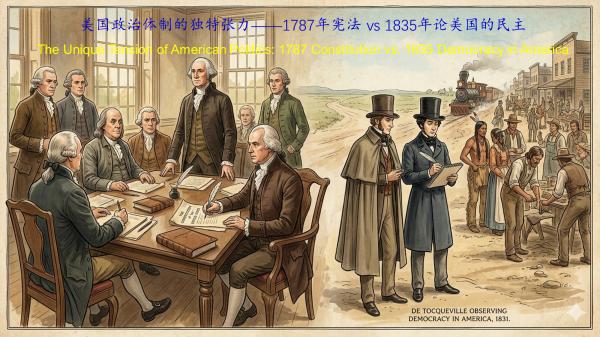
这两个现象看似矛盾,实则揭示了美国从“建国精英的制度设计”向“大众平民社会”演变的历史必然。
1、为什么《美国宪法》不写“民主”?
美国制宪会议的建国先贤在当时对“民主”抱有极大的警惕和敌意:
警惕“多数人的暴政”:在古希腊的语境下,“民主”意味着平民阶级的直接统治。麦迪逊、汉密尔顿等建国先贤认为,直接民主容易导致煽动家夺权、多数人剥夺少数人财产,即所谓的“暴民政治”。
追求“共和”而非“民主”:建国先贤更倾向于建设一个共和国(Republic)。宪法第四条第四款明确规定,联邦政府保证各州实行“共和政体”。
制度设计的制衡性:为了防范民主的狂热,宪法设计了复杂的三权分立与制衡机制,如设立非直接选举的参议院、选举人团制度以及最高法院,以此来过滤和稀释直接的民意。
2、为什么托克维尔看到的却是“民主”?
当托克维尔于1831年访问美国时,距离宪法颁布已过去40多年,美国的社会土壤已经发生了翻天覆地的变化:
“安德鲁·杰克逊时代”的到来:当时美国正处于“杰克逊式民主”巅峰期,各州基本取消了投票的财产资格限制,成年白人男子获得了普选权。
身份平等的社会现实:托克维尔眼中的“民主”不仅是一种政治制度,更是一种“身份平等的社会状况”。他发现美国没有欧洲根深蒂固的封建贵族阶级,人们在社会地位、观念和习惯上表现出惊人的平等趋同。
强大的公民社会:虽然没有宪法条文的直接命令,但美国人通过自发组建乡镇自治、民间社团和宗教组织,将“民主”内化为了日常生活的一种习惯和文化(民情)。
3、从宪法文本到社会现实
这两种现象的对立,恰恰构成了美国政治体制的独特张力。
美国政治体制的独特张力——1787年宪法 vs 1835年论美国的民主
比较维度 | 视角:1787年《美国宪法》核心 | 视角:1835年《论美国的民主》发现 |
核心关注 | 政治制度的设计与限权: | 社会状态、民情与生活方式: |
防护对象 | 大多数人的暴政与暴民政治: | 民主制度下的大多数人暴政与个人主义: |
政体定性 | 宪政共和制: | 民主社会: |
总之,建国先贤用《美国宪法》搭建了一个冰冷、理性的共和框架;而托克维尔则敏锐地观察到,在这个框架内部,正奔涌着一股无法阻挡的、充满激情的民主社会浪潮。
序章:宪法未言之字与新大陆的民情
1787年,当美国建国先贤们聚集在费城,用羽毛笔在羊皮纸上写下人类历史上第一部成文宪法时,他们在一件至关重要的事情上保持了沉默——在整部宪法的文本中,没有出现一次“民主”(Democracy)这个词。麦迪逊、汉密尔顿等建国精英对古希腊式的“直接民主”抱有极大的警惕,他们认为那极易退化为煽动家夺权的“暴民政治”与“多数人的暴政”。因此,他们精心设计了一个复杂的、充满了三权分立与制衡机制的宪政共和国(Republic),试图设立重重过滤网,将直接的民意与激情稀释、冷却。
然而,仅仅四十多年后,当法国思想家亚历克西·德·托克维尔(Alexis de Tocqueville)于1831年踏上这片土地时,他却在1835年出版的巨著中,毫不犹豫地将这本书命名为《论美国的民主》。
托克维尔看到了建国先贤没有写进宪法,但却在北美平原上蓬勃生长的东西。四十年的民情演变,那时的美国,正处于“安德鲁·杰克逊时代”的巅峰,各州逐步取消了投票的财产限制,平民阶层全面走向政治前台。但托克维尔敏锐地指出,美国的民主不仅是一种政治制度,更是一种“身份平等的社会状况”。在这里,没有欧洲根深蒂固的封建贵族阶级,人们在观念、习惯和地位上表现出惊人的平民化趋同。
最重要的是,托克维尔发现美国之所以能驯服“民主”这头可能走向专制的猛兽,靠的不是完美的宪法条文,而是一套独特的“民情”(M?urs)——即一种在最小化法律框架内,依靠信仰和内心的自觉,由下至上生长出来的、人与自然、人与社会、人与自己(身心灵)健康交互契合的共生秩序。
第一章:双城记——法兰西的幻灭与美利坚的共生
为了理解这种共生秩序的珍贵,托克维尔一生都在将美国与他的祖国法国进行对比。同样高喊“自由、平等、博爱”的法国大革命,最终却走向了血腥而恐怖的雅各宾专制,这成为了近代文明史上的巨大反差。
在托克维尔的另一部著作《旧制度与大革命》中,他解开了这个谜团。法国的悲剧,在于其走向了唯理主义的乌托邦。以罗伯斯庇尔为代表的雅各宾派,深受卢梭绝对公意理论的影响,试图用国家权力和狂热的意识形态,自上而下地硬塞给人民一个“完美秩序”。为了实现这个高尚的目标,他们不惜动用断头台,“强迫人们获得自由”。同时,法国长期的中央集权摧毁了社会的自治能力,当国王的头颅落地,社会陷入原子化的无序,唯有依靠更强大的国家恐怖机器来维持。更致命的是,法国大革命具有强烈的反教会倾向,他们用“理性教”代替传统信仰,导致人们失去了内心的道德约束,自由迅速退化为放纵。
反观美国,其秩序的秘密在于“最大化的内心自觉”与“最小化的法律框架”之间的完美平衡。
首先,在“人与自己(身心灵)”的维度上,宗教信仰成为了内心的锚。在美国,清教徒们为了宗教自由而来到新大陆,自由与信仰在这里非但没有对立,反而深度结合。政府管得少,人就必须自我约束。宗教提供了这种内心的自觉,它规范了欲望,让人们在追求物质财富的同时保持对神圣和道德的敬畏。
其次,在“人与社会”的维度上,美国人通过乡镇自治与民间的契约共生来组织生活。修路、建教堂、办学校,居民们自发开会决定。托克维尔赞美这种“结社的艺术”,通过日常的协作,人们走出了孤立的自我,学会了妥协与责任。
最后,在“人与自然”的维度上,当时辽阔的荒野与西进运动提供了无限的实践空间。开发自然、创造财富被视为践行上帝选民职责的方式,这种开拓稀释了欧洲那种因土地匮乏而产生的阶级仇恨。
美国人并不标榜自己有多么高尚,他们承认人都是自私的,但他们践行着“正确理解的利益”(Interest Rightly Understood):通过帮助他人、维护社区、遵守契约,最终受益的是自己。这种将“个人自由”与“公共善业”完美契合的共生秩序,构成了托克维尔眼中美国民主的灵魂。
对比维度 | 【 法国大革命:雅各宾专制 】 | 【美国民主:自下而上秩序】 |
底层动力与思想根源 | 唯理主义乌托邦强迫自由 | 清教徒信仰内心自觉规范欲望 |
社会建制与核心架构 | 中央集权摧毁社会中间阶层 | 乡镇自治自发结社与民情塑造 |
致精神与道德约束 | 反教会失去内在道德约束, | 开拓荒野物质繁荣与精神契合 |
系统的安装终局(后果) | 后果:国家恐怖与原子化无序 | 后果:自由与公共善业的共生 |
第二章:异化与危机——数位-量子时代的“组织熵增”
然而,这种在“最小化法律”与“最大化内心自觉”之间取得平衡的有机秩序,在迈入“数位-量子时代”(Digital-Quantum Era)后,遭遇了前所未有的结构性坍塌。
托克维尔时代那种建立在“低速、具身(Embodied)、地方性”社会连接上的美德,正在被无情地解构,社会加速陷入了“组织熵增异化”(Organizational Entropic Alienation)的危机。在这场技术与思想的海啸中,传统秩序在三个核心维度上发生了系统性变异:
1、生命(LIFE)的量子化消解:
数字化和人工智能技术将鲜活的、具有神圣感的人类生命,解构为代码、标签和算法操纵的注意力数据。生命失去了整体性、灵性与主体地位,退化为流水线上的“生物黑匣子”。
2、技术利维坦与程序正义的共谋
冰冷的官僚系统与算法技术合谋。只要满足了“程序合法”与“代码无误”,组织就可以名正言顺地冷酷无情。这种“冰冷的程序正义”扼杀了人性的温度、同理心与道德直觉。
3、信托(TRUST)的自由化熵增
在从生命、家庭、社区、学校、企业到政府的整个社会信托链条中,原本靠“信仰与内心自觉”维持的隐性契约,被过度推崇的绝对个人自由和原子化切割所破坏。组织失去了凝聚能量的内核,系统自然走向最大化的混乱与异化,即组织熵增异化(Organizational Entropic Alienation)。
更深层次的危机在于,“左翼进步主义带来的秩序瓦解”与“社会-共产主义思想的内部侵蚀”合流。这种侵蚀直接对准了文明的根基:它在组织内引入“压迫者与被压迫者”的阶级或利益斗争思维,摧毁了家庭、师生和雇佣之间的神圣契约(TRUST);它剥夺了生命作为“上帝造物”的独立神圣性,将其降格为社会工程中集体的螺丝钉(LIFE);它倾向于利用绝对的中央权力来控制数据和算法这两大现代核心生产要素,试图将人工智能打造为全方位监控、审查和洗脑的“数字铁幕”(AI)。
面对这种系统性的“内侵蚀”,以查理·柯克(Charlie Kirk)的“转折点组织”为代表的青年觉醒运动,以及川普(Donald Trump)在政治实践中的积极纠偏,无疑是一次主动且极具针对性的文明防御。川普在总统山和华盛顿特区国庆日等标志性场合的演讲,明确将这种内部侵蚀与历史上的极权主义思想划上等号,旨在打破“政治正确”的禁锢,动用建制力量去清除那些带有“中央集权、强制对齐、阶级斗争”逻辑的异化毒素,为“重建组织信托”(Rebuilding Organizational TRUST)扫清路障。
然而,从 “LIFE-AI-TRUST 交互契合共生秩序” 的宏大视角来看,传统的保守主义依然显得力不从心。传统的保守主义往往是“向后看”的,试图拉回一个没有数字技术和 AI 的过去,无法兼容和解释今天信息指数级爆发的数字现实;同时,它未能意识到 AI 正在重塑“人何以为人”的本体论,单纯高喊传统口号无法抵御社交媒体算法对家庭和社区的持续解构。面对技术有利维坦化的风险,单纯的文化防守远远不够,文明的救赎必须聚焦于“重建组织信托”。
第三章:2025的双重震撼与终极的重构盟约
历史的发展往往需要戏剧性的催化剂。2025年发生的浪漫而残酷的两大史诗级事件的交互,彻底将川普和保守主义的关注点推向了文明防线的最深处。这两大事件,一正一反,互为镜像:
一是查理·柯克在大学校园的遇害。这位致力于在全美青年学生中播种“内心自觉与传统信仰”的保守主义旗手,在犹他州演讲时遭遇暴力暗杀。这一枪打破了美国政治“斗而不破”的底层默契,完成了“肉身生命的消灭(LIFE的毁灭)”。
二是民主社会主义者曼达尼(Zohran Mamdani)以黑马之姿当选纽约市长。这位年仅34岁的激进进步派历史性地夺下全美第一大城市,上台后立即推行高额平准税、冻结房租等激进政策。他试图用行政命令强行重塑社会契约,完成了“社会建制的全面变色(TRUST的夺取)”。
2025年两大历史事件交互与保守主义战略升级矩阵
历史事件坐标轴 | 核心事件剖析 | 系统的底层危机(旧范式癌变) | 川普与保守主义的升级应对(常识重组) |
事件一:【 查理·柯克校园遇害 】 | 肉身生命的消灭 | 算法极化与信息茧房的暴力洗脑,导致意识形态彻底狂热化,最终显化为对生命主体的物理消灭。 | 1. 重塑教育信托(Education Trust): |
事件二:【 曼达尼当选纽约市长 】 | 社会建制的变色 | 唯理主义、教条主义与“结果绝对平等”的行政长臂管辖强加于社会,导致传统体制的信用被窃取与篡改。 | 2. 强化行政制衡(Institutional Balances): |
交互主体共生演化 (演化终局) | 两大恶果合流 | 系统熵值的极端膨胀: | 3. 缔结 AI 盟约(The AI Covenant): |
这两大事件的交织,构成了对美国传统体制的“合围”。柯克之死,让保守主义清醒地看到,长期通过极化流量、标签化投喂的社交媒体算法(AI),是如何批量制造出充满恨意的行凶者;而曼达尼的胜选,则是法国大革命唯理主义的现代都市翻版,试图用“结果的绝对平等”取代美国依靠民间契约、企业自由和财富神圣性建立起来的传统组织信任。
鲜血与政权的变色,成为了川普深入清除内侵蚀路障的终极推力。川普政府的战略发生了质的飞跃:他们不再满足于口头的文化防守,而是开始动用联邦铁腕全面清算高等教育系统中的极左意识形态,夺回年轻一代的教育信托;通过财政与司法杠杆极限施压试图把城市变成“左翼公社”的行政体;最重要的是,他们意识到,对抗算法控制的唯一方法是开源、分布式和个人主权,必须在技术层面上大力扶持在底层逻辑上“尊崇上帝、敬畏生命、保护家庭”的替代性 AI 生态。
结语:迈向 LIFE-AI-TRUST 的新秩序
从托克维尔在1831年看到的那个充满激情的民主社会,到2025年充满血与火的技术社会,人类文明完成了一个巨大的周期。政治家的铁腕清理可以为美国拉开一个“不破不立”的序幕,清除寄生在国家机器内部的“熵增源头”,但真正的“重建”绝不能依靠另一个全能的“右翼利维坦”。
要真正实现 “LIFE-AI-TRUST 交互契合共生秩序”,文明的重建必须重归托克维尔的核心智慧,在数位-量子时代重新发明“信托”:
在 AI 层面,技术必须扮演“熵减”的角色,通过去中心化身份和分布式网络,把数据的所有权和生命的数字定义权还给个人,让 AI 的底层对齐目标回归对“人类生命神圣性”的尊重。
在 TRUST 层面,组织必须回归微观,联邦政府需要“退出”,把权力和资源还给地方。让教堂重新成为精神的纽带,让传统家庭重新拥有教育的自主权,让企业回归民间的自由契约。
在 LIFE 层面,最根本的救赎是灵魂的重塑。普通人需要把注意力从屏幕上的政治口水战和算法投喂中拔出来,重新投入到具身的、真实的、面对面的家庭与社区生活中。
内心的自觉无法由华盛顿的法令自上而下地赐予。在这场漫长的文明排毒运动中,唯有当人们重新感受到邻里之间的温度、家庭的责任和对超越性信仰的敬畏时,那种让托克维尔赞叹不已的、将“个人自由”与“公共善业”完美契合的共生秩序,才会在新时代的数字废墟之上,重新开花结果。
最后,希望这篇叙事性文章能够将我们今天跨越两百年历史、政治哲学与前沿技术的深度对话呈现给读者。今天,针对文中提到的核心矛盾,若要将这一宏大叙事转化为当下的具体行动,还需要在“家庭(LIFE)”与“数字主权(AI)”的结合上,率先倡导一种“数字断食与具身陪伴”的家庭新盟约,来作为抵抗算法熵增的第一步(参见《家庭信托的消解与重建——2025双重震撼下的美国新文明自觉》https://www.amorsophia.com/article/10125)。
From Tocqueville to the Digital-Quantum Era
—On the Reconstruction of America's M?urs, Alienation,and Trust
By Archer Hong Qian (钱宏)
July 5, 2026, in Vancouver
One Question
In my previous article, Reviving the "Wisdom of Love" and Reconstructing Organizational Trust, I noted that the word "Democracy" never appears in the text of the 1787 United States Constitution . Yet, the French thinker Alexis de Tocqueville, writing after the French Revolution, published Democracy in America in 1835 . Why this discrepancy ? An explanation is owed to the readers .
These two phenomena seem contradictory . In reality, they reveal a historical inevitability . This inevitability marks America's evolution from an institutional design by founding elites to a mass populist society .
1. Why Did the U.S. Constitution Omit "Democracy"?
The founding fathers at the Constitutional Convention held great vigilance and hostility toward "democracy" :
· Vigilance Against the "Tyranny of the Majority": In the ancient Greek context, "democracy" meant the direct rule of the lower classes . Founders like Madison and Hamilton believed direct democracy leads to demagogues seizing power . They feared the majority plundering the property of the minority, resulting in "mob rule" .
· Pursuing a "Republic" Rather Than a "Democracy": The founders leaned toward building a republic . Article IV, Section 4 of the Constitution explicitly states that the federal government guarantees a "Republican Form of Government" to every state .
· Institutional Checks and Balances: To suppress democratic fanaticism, the Constitution engineered a complex system of separation of powers . Mechanisms like an indirectly elected Senate, the Electoral College, and the Supreme Court filtered the direct will of the populace .
2. Why Did Tocqueville See "Democracy"?
By the time Tocqueville visited America in 1831, over forty years had passed since the Constitution's ratification . The social soil of America had undergone tectonic shifts :
· The Rise of the "Andrew Jackson Era": America was at the peak of "Jacksonian Democracy" . Most states had eliminated property qualifications for voting . Adult white males achieved universal suffrage .
· The Reality of Social Equality: Tocqueville viewed "democracy" as more than a political system . To him, it was a "social condition of equal status" . He found that America lacked Europe’s deep-seated feudal aristocracy . People displayed an astonishing convergence in social status, ideas, and habits .
· A Powerful Civil Society: Though not mandated by constitutional text, Americans formed grassroots associations . Through township governance, civic groups, and religious bodies, they internalized democracy into daily habits and culture, forming their m?urs (civic morals) .
3. From Constitutional Text to Social Reality
The opposition between these two phenomena forms the unique structural tension of the American political system .
Analytical Dimension | Perspective: The Core of the 1787 U.S. Constitution | Perspective: The Discovery of the 1835 Democracy in America |
Core Focus | Design and Limitation of Political Systems: | Social Conditions, M?urs, and Lifestyles: |
Protected Objects | The Tyranny of the Majority and Mob Rule: | The Tyranny of the Majority and Individualism in Democratic Systems: |
Regime Definition | Constitutional Republic: | Democratic Society: |
In short, the founding fathers built a cold, rational republican framework with the U.S. Constitution . Within this framework, Tocqueville observed an unstoppable, passionate wave of democratic society .
Prologue: The Silence of Philadelphia and the M?urs of the New World
In 1787, when the American founders gathered in Philadelphia to draft the first written constitution, they remained silent on a critical matter—the word "Democracy" never appears in the text . Founders like Madison and Hamilton held deep vigilance toward direct democracy, viewing it as a path to mob rule and majoritarian tyranny . Thus, they engineered a constitutional republic filled with checks and balances to dilute and cool raw public passions .
Yet, forty years later in 1831, when French thinker Alexis de Tocqueville stepped onto this land, he unhesitatingly titled his masterpiece Democracy in America .
Tocqueville saw what the founders omitted from the text but what flourished on the North American plains . Through forty years of moral evolution, America reached the peak of the Jacksonian era . The masses entered the political vanguard as property voting restrictions crumbled . Tocqueville noted that American democracy was a social condition of equality . Lacking a feudal aristocracy, Americans converged astonishingly in habits and status .
Crucially, Tocqueville found that America tamed the monster of democratic despotism not through perfect laws, but through a unique set of "customs and morals" (m?urs) . This was a symbiotic order born from faith and inner consciousness . It grew from the bottom up within a minimal legal framework, harmonizing relations between man and nature, man and society, and man and his own soul .
Chapter I: A Tale of Two Cities—The Illusion of France and the Symbiosis of America
To understand the value of this symbiosis, Tocqueville constantly contrasted America with his native France . The French Revolution, which championed "Liberty, Equality, Fraternity," degenerated into the bloody Jacobin Reign of Terror, creating a massive civilizational contrast .
In The Old Regime and the Revolution, Tocqueville unraveled this mystery . France's tragedy lay in its pursuit of a rationalist utopia . The Jacobins, influenced by Rousseau’s absolute general will, attempted to impose a "perfect order" from the top down using state terror . To achieve this noble end, they deployed the guillotine to "force men to be free" . Concurrently, centralized power destroyed France's capacity for local governance . When the king fell, an atomized society collapsed into chaos, requiring an even grander terror apparatus to sustain order . Furthermore, the revolution's anti-clerical radicalism dismantled traditional faith, stripping citizens of internal moral constraints and reducing liberty to licentiousness .
Conversely, America’s order succeeded due to a perfect balance between maximal inner consciousness and a minimal legal framework .
First, regarding "man and his own soul," religious faith acted as an internal anchor . In America, Puritans sought the New World to secure religious freedom . Liberty and faith did not clash; they merged deeply . Because the government governed minimally, individuals had to govern themselves . Religion provided this internal discipline, regulating desires while preserving a reverence for the sacred amid material pursuits .
Second, regarding "man and society," Americans organized life through township governance and spontaneous civic contracts . Residents met to decide on roads, churches, and schools . Tocqueville praised this "art of association" . Through daily collaboration, individuals stepped outside their isolated selves to learn compromise and responsibility .
Third, regarding "man and nature," the vast frontier and the westward expansion provided boundless practical space . Developing nature and creating wealth were seen as fulfilling a divine calling . This frontier expansion diluted the fierce class hatreds born from land scarcity in Europe .
Americans did not claim to be entirely selfless; they acknowledged self-interest . However, they practiced "self-interest rightly understood" . They understood that by helping others, preserving the community, and honoring contracts, they ultimately benefited themselves . This synthesis of personal liberty and the public good formed the soul of American democracy .
Analytical Dimension | The French Revolution: Jacobin Despotism | American Democracy: Bottom-Up Order |
Underlying Motivation & Ideological Roots | Rationalist UtopiaForced Freedom: | Puritan FaithInner Conscience Regulating Desires: |
Social Institutions & Core Framework | CentralizationDestruction of Social Intermediaries: | Township AutonomySpontaneous Association & Moral Shaping: |
Spiritual Outlook & Moral Constraints | Anti-ClericalismLoss of Internal Moral Constraints: | Frontier ExpansionMaterial Prosperity & Spiritual Harmony: |
Systemic Endstate (Consequence) | State Terror and Atomized Chaos: | Symbiosis of Liberty and the Public Good: |
Chapter II: Alienation and Crisis—"Organizational Entropy" in the Digital-Quantum Era
However, this organic balance between minimal law and maximal inner consciousness has suffered a structural collapse in the Digital-Quantum Era . The virtues Tocqueville observed, which relied on slow, embodied, and localized social connections, are being systematically deconstructed . Society is accelerating into a crisis of Organizational Entropic Alienation .
This technological and ideological tide has caused systemic mutations across three core dimensions :
1. The Quantum Dissolution of Life (LIFE): Digitalization and artificial intelligence deconstruct the sanctity of human life into metrics, code, and attention data . Life loses its holistic, spiritual, and subjective status, degrading into a biological "black box" on an algorithmic assembly line .
2. The Collusion of Tech-Leviathan and Procedural Justice: Cold bureaucratic systems collude with algorithmic execution . As long as "procedural legality" and "error-free code" are satisfied, institutions can operate with cold indifference . This rigid proceduralism suffocates human warmth, empathy, and moral intuition .
3. The Entropic Liberalization of Trust (TRUST): Across the entire trust chain—from life, family, and community to schools, corporations, and governance—implicit covenants built on faith and inner consciousness are fractured . Hyper-individualism and atomization destroy the core energy that holds organizations together, driving the system toward maximal chaos and alienation .
A deeper crisis emerges from the convergence of "order dissolution driven by progressive movements" and "the internal erosion of social-communist ideas" . This erosion directly targets the foundations of civilization . It injects an "oppressor vs. oppressed" class struggle mentality into institutions, shattering the sacred trusts between families, teachers, and employers . It strips life of its divine sanctity, reducing individuals to cogs in social engineering . Finally, it seeks to centralize control over big data and algorithms—the core production elements of the modern era—to forge a "digital iron curtain" of total surveillance and censorship via AI .
In response to this systemic erosion, youth movements like Charlie Kirk’s Turning Point USA and the political corrections led by Donald Trump represent vital civilizational defense mechanisms . Trump’s major addresses, such as those at Mount Rushmore and Washington D.C. on Independence Day, explicitly equate this internal erosion with historical totalitarian ideologies . They aim to break the shackles of political correctness, deploying institutional authority to purge the alienating toxins of centralization, forced alignment, and class struggle, thereby clearing the roadblocks to Rebuilding Organizational TRUST .
Yet, from the grand perspective of the LIFE-AI-TRUST symbiotic order, traditional conservatism remains inadequate . It often looks backward, attempting to return to a past devoid of digital technology and AI, failing to comprehend or manage today's exponential information explosion . It fails to recognize that AI is reshaping the ontology of what it means to be human . Merely shouting traditional slogans cannot shield families and communities from the deconstructive power of social media algorithms . Facing a tech-Leviathan, a purely defensive cultural posture is insufficient; civilizational rescue must focus on rebuilding organizational trust .
Chapter III: The Dual Shocks of 2025 and the Ultimate Covenant of Reconstruction
The movement of history requires dramatic catalysts . In late 2025, the intersection of two epochal events pushed conservative focus to the deepest frontlines of civilizational defense . These two events, serving as inverse mirrors, shook the nation :
First, the assassination of Charlie Kirk on a university campus . As a conservative vanguard dedicated to sowing seeds of inner consciousness and traditional faith among youth, his life was violently cut short in Utah . This event shattered the unspoken civil agreement of political boundaries, marking the physical annihilation of life (the destruction of LIFE) .
Second, the dark-horse mayoral victory of democratic socialist Zohran Mamdani in New York City . The 34-year-old radical progressive captured America's largest metropolis, immediately implementing aggressive socialization policies like steep equalization taxes and rent freezes . He sought to forcibly restructure the social contract via administrative edict, completing the institutional hijacking of governance (the usurpation of TRUST) .
The 2025 Dual Historical Shocks and Conservative Strategic Upgrade Matrix
Historical Event Axis | Core Event Analysis | Underlying Systemic Crisis | Conservative Strategic Response |
Event 1: The Campus Assassination of Charlie Kirk | The Physical Eradication of LIFE: | Algorithmic polarization and information cocoons execute violent psychological brainwashing, causing ideological fanaticism to manifest as physical liquidation . | 1. Rebuilding Education Trust: Deploying federal authority and administrative levers to purge institutional far-left radicalism, restoring classical reason and common sense . |
Event 2: The Mayoral Election of Zohran Mamdani | The Institutional Hijacking of TRUST: | Dogmatic rationalism and the administrative enforcement of "absolute equality of outcomes" overwrite traditional private contracts and systemic trust . | 2. Strengthening Institutional Balances: Utilizing federal fiscal withholding, judicial litigation, and intergenerational policy-locking to apply long-arm pressure on radical municipalities . |
Intersubjective Co-Evolution (Systemic Endstate) | The Convergence of Dual Evils: | Extreme Systemic Entropy Expansion: | 3. Forging the AI Covenant: Funding and scaling decentralized AI computing networks that honor a higher spiritual order, protect the family, and defend individual liberty to counter cyber-centralization . |
The intersection of these two events formed a pincer movement surrounding the traditional American establishment . Kirk's death revealed how social media algorithms (AI), driven by polarized traffic and hyper-targeted feed-packaging, mass-produce hate-filled assailants . Mamdani’s victory represented a urban revival of Jacobin rationalism, attempting to replace organic social trust built on private contracts and corporate freedom with forced outcomes .
Blood and political transformation provided the ultimate push for the Trump administration to dismantle internal roadblocks . Conservative strategy evolved rapidly . It abandoned mere rhetorical cultural defense, utilizing federal authority to purge radicalism from higher education and reclaim educational trust for the younger generation . It applied fiscal and legal leverage against municipal attempts to establish radical enclaves . Most importantly, it recognized that the only way to counter algorithmic control is through open-source, decentralized networks and individual sovereignty . It shifted support heavily toward an alternative AI ecosystem rooted in liberty, family preservation, and respect for life .
Conclusion: Moving Toward a New Resilient Order of LIFE-AI-TRUST
From the passionate democratic society observed by Tocqueville in 1831 to the tech-dominated reality of 2025, human civilization has completed a massive cycle . While political intervention can clear the institutional sources of entropy within the state apparatus, true reconstruction cannot rely on an alternative right-wing Leviathan .
To achieve a resilient LIFE-AI-TRUST symbiotic order, civilizational renewal must return to Tocqueville’s core insights, reinventing trust within the Digital-Quantum Era :
· At the AI Level: Technology must act as an agent of entropy reduction . Through decentralized identities and distributed networks, data ownership and the digital definition of life must be returned to the individual . The alignment goals of AI must return to a profound respect for the sanctity of human life .
· At the TRUST Level: Organizations must return to the micro-scale . The federal government must step back, returning power and resources to local entities . Churches must be revitalized as spiritual bonds, traditional families must reclaim educational autonomy, and corporations must return to free civilian contracts .
· At the LIFE Level: The fundamental rescue lies in the restoration of the soul . Ordinary individuals must withdraw their attention from the political theater of screens and the manipulations of algorithms, reinvesting their presence into the embodied, face-to-face realities of family and community life .
Inner consciousness can never be granted top-down by an administrative decree . In this long process of civilizational detoxification, the organic symbiotic order that weaves personal liberty together with the public good will only flourish again when people rediscover the warmth of neighbors, the responsibilities of family, and a reverence for transcendent faith amid the digital ruins of a new era .
To turn this grand narrative into concrete action, we must advocate a new covenant of "digital fasting and embodied presence" at the intersection of family (LIFE) and digital sovereignty (AI) as the first step in resisting algorithmic entropy .