
16. 丛草劫 Reed Catastrophe
目录 Catalog:16.1 丛草劫是什么? What is Acatl (i.e., Clump of Grass)? 16.2 抓糊涂虫 Catching Muddle Bugs;16.3 墨西哥法典的主题线索 Theme Line of Mexican Codex
16.1 丛草劫是什么?What is Acatl (i.e., Clump of Grass)?
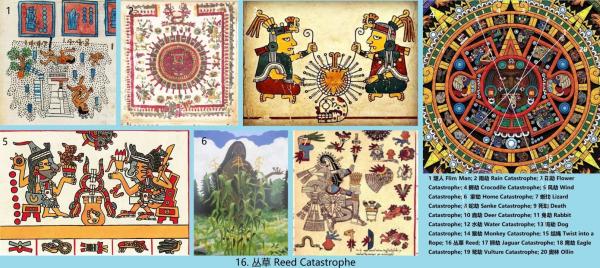
太阳石历的第16劫丛草从比喻而得名。丛草本来是形容眼识、耳识、鼻识、舌识、身识、意识、夏娃识(即前意识)、亚当识(即无意识的污染部分)和神识(即无意识的纯净部分),这九识像似一丛草,相互依持而生长壮大。在器世间(即物质世界)丛草比喻几位金童和玉女像似一丛玉米庄稼,相互依持而生长,开花,结果(如图6)。图6的背景是寇特鹠鸺,她看着一群金童玉女健康地长大了,就与天地同化了。
The 16th catastrophe of the Sunstone Calendar, the Acatl (i.e., clump of grass), is named metaphorically. The "clump of grass" originally described eye-sense, ear-sense, nose-sense, tongue-sense, body-sense, Intent-sense (consciousness), (7) Eve-sense (i.e., preconsciousness), (8) Adam-sense (i.e., the polluted part of unconsciousness), and (9) God-sense (i.e., the immaculate part of unconsciousness). These nine senses are like a clump of grass, mutually dependent and growing prosperously. In the vessel world (i.e., the material world), the clump of grass is a metaphor for several golden boys and jade girls, like a clump of corn, mutually dependent and growing, flowering, and bearing fruit (as shown in Figure 6). The background of Figure 6 is Coatlicue, who, watching the group of golden boys and jade girls grow up healthily, assimilated into the sky and earth.
标准丛草标志类似于图1左上,只是有五片叶子,代表前五基本识。底下也画着一粒种子,代表世界种,即无意识。上面也有一根杆,代表生命之树的树干。为什么树干和叶子并列着画?编者我认为这是突出墨西哥(即特拉洛克)在此事中的贡献,那生命之树的树干是他画的。他为人类文明的发展做出了重要的贡献。
The standard Acatl (i.e., clump of grass) symbol is similar to the upper left of Figure 1, except it has five leaves, representing the first five fundamental senses. Below it is a seed, representing the world seed, i.e., the unconscious. Above it is a stem, representing the trunk of the Tree of Life. Why are the trunk and leaves drawn side-by-side? The editor believes this highlights the contribution of Mexico (i.e., Tlaloc) to this work; he drew the trunk of the Tree of Life. He made a significant contribution to the development of human civilization.
图1是一幅复杂些的丛草注释图。左上部分代表第七识,夏娃识(即前意识),翠玉女。夏娃识能辨别善恶美丑,润色生命,翠玉女是根据夏娃识造出来的,所以说她是众生之母。夏娃识制造生命很快,象水流一样,很快就能让一个小世界充满生机,所以人们说她的绿玉裙总有水流出。
Figure 1 is a more complex illustration of an Acatl (i.e., cluster of grasses). The upper left part represents the seventh sense, Eve-sense (i.e., preconsciousness), and Jade Girl. Eve-sense can distinguish between good and evil, beauty and ugliness, and embellish life. The Jade Girl was created based on Eve-sense, so she is said to be the mother of all sentients. Eve-sense creates life very quickly, like flowing water, and can quickly fill a small world with vitality, so people say that water always flows from her green jade skirt.
图1右上部分被称作 Itztlacoliuhqui (意为 “弯曲的黑曜石刀”)是墨西哥人威严的霜、冰、冬、罪恶和冷酷正义之神,蒙眼正义(如图7),特拉洛克。无意识不辨别生与死,你我他,所就出现了前面冷酷的正义的说法。特拉洛克是根据第八识造出来的,代表着亚当识。违背了特拉洛克的法律,就是违背这部分无意识的自然法,无论谁都会受到同样的惩罚,所以出现了蒙眼正义,绝对地公平的说法。
The upper right part of Figure 1, called Itztlacoliuhqui (meaning "curved obsidian knife"), represents the Mexican god of frost, ice, winter, evil, and cold justice—the blindfolded justice (as shown in Figure 7), Tlaloc. Since the unconscious cannot distinguish between life and death, or between "you," "me," and "him," the aforementioned concept of cold justice arises. Tlaloc was created based on the eighth consciousness, representing Adam-sense. Violating Tlaloc's laws is violating this unconscious natural law, and everyone will receive the same punishment; hence the concept of blindfolded justice, absolute fairness.
有人说特拉洛克是位报仇的神,谁侵犯了他的利益,他记仇,并且肯定会报复。是的,这说明他的教法是正确的。那为什么欧洲的神不报复?神佛都报复,在超渡(参见7.5节)的过程中,就有一条是解决和神佛的矛盾的。对神佛的承诺要兑现;辱骂人家了,要赔礼道歉。这是因为神或佛都代表某个自然法,那些自然法在现实生活中有很多自然的因果报应规律。
Some say that Tlaloc is a vengeful god; he holds a grudge against anyone who infringes upon his interests and will certainly retaliate. Yes, this shows that his teachings are correct. Then why don't European gods retaliate? Gods and Buddhas do retaliate; in the process of performing “Transcendently Ferry” (see section 7.5), one must resolve conflicts with Gods and Buddhas. Promises made to Gods and Buddhas must be kept; if Gods and Buddhas are insulted, apologies must be offered. This is because Gods or Buddhas represent certain natural laws, and those natural laws have many natural cause-and-effect relationships in real life.
丛草劫是说特拉洛克和翠玉女结婚后,常打架,如图5。俩人中间的两条蛇表示他们俩同床异梦。特拉洛克把好多好东西自己藏着,不告诉翠玉女。这是因为他们俩的思维模式不一样,特拉洛克的好多知识对于翠玉女没用。翠玉女感觉,我们俩是双身神,但你那面的太阳总是光芒万丈,我这边总是漆黑和糊涂(如图5上部中间所示)。为此翠玉女很生气,她的另一手拿出了发簪,想扎特拉洛克。这是因为翠玉女是夏娃,是因地;特拉洛克是亚当,是果地。
The "Acatl Catastrophe" refers to the frequent fights between Tlaloc and Chalchiuhtlicue after their marriage, as shown in Figure 5. The two snakes between them represent their estranged nature. Tlaloc kept many valuable things to himself, not sharing them with Chalchiuhtlicue. This was because their thinking modes were different; much of Tlaloc's knowledge was useless to Chalchiuhtlicue. Chalchiuhtlicue felt that although they were two-bodied gods, his side was always bathed in sunlight, while hers was always shrouded in darkness and confusion (as shown in the upper middle of Figure 5). This angered Chalchiuhtlicue, and she took out her hairpin, intending to stab Tlaloc. This is because Chalchiuhtlicue is Eve, the land of reasons; Tlaloc is Adam, the land of fruits.
16.2 抓糊涂虫 Catching Muddle Bugs
图3中间的是糊涂虫,是说约从特拉洛克一岁开始青松石王一直对他做法,特拉洛克全记住了,但不懂那些事,所以称那些事为糊涂虫。直至特拉洛克的心里装了太多的糊涂虫,堕入了地狱。图中的骷髅表示在地狱期间的特拉洛克。
The figure in the middle of Figure 3 represents “Muddle Bugs”, referring to Xiuhtecuhtli's “Making Laws” (doing affairs) on Tlaloc beginning at approximately one year old. Tlaloc remembered them all, but he didn't understand them, so they called those affairs “Muddle Bugs”. Tlaloc's heart became overwhelmed with “Muddle Bugs”, so he fell into Hell. The skull in the figure represents Tlaloc during his time in Hell.
翠玉女自幼跟着她爸爸青松石王对特拉洛克做法,所以她是那些糊涂虫的作者之一。而特拉洛克是那些糊涂虫的受者,所以图3显示特拉洛克和翠玉女对糊涂虫各执一词。他们俩一起对整个奥林运动做了彻底的解析,总结出了很多法宝(如图2),汇总出了太阳石历内环的20个事件来作为墨西哥法典的主题线索。
Chalchiuhtlicue has been following her father, King Turquoise, in his making-laws regarding Tlaloc since childhood, so she is one of the makers of those "Muddle Bugs”. Since Tlaloc is the recipient of those "Muddle Bugs”, Figure 3 shows Tlaloc and Chalchiuhtlicue each holding opposing views on them. Together, they conducted a thorough analysis of the entire Ollin movement, identified numerous sacred juristic treasures (as shown in Figure 2), and compiled the 20 events of the inner ring of the Sun Stone Calendar to serve as thematic thread for the Mexican Codex.
16.3 墨西哥法典的主题线索 Theme Line of Mexican Codex
图4-1( Técpatl - Flint)是个燧火石,代表此次奥林运动的发起者青松石王(又名左翼蜂鸟)。图4底部的两张人脸代表左翼蜂鸟青松石王和右翼蜂鸟谷伯。
图4-2( Quiahuitl - Rain)的意思是雨神,表示青松石王献祭500位男婴给雨神特拉洛克。此献祭是在给金童做触目。此触目是青松石王造出的第一颗太阳。
Figure 4-1 (Técpatl - Flint) is a flint, representing the initiator of this Ollin Movement, Xiuhtecuhtli (aka. Huitzilopochtli). The two faces at the bottom of Figure 4 represent Hummingbird of the Left (Huitzilopochtli), and Hummingbird of the Right (Uncle Maize, Centeotl).
Figure 4-2 (Quiahuitl - Rain) means rain god, representing the sacrifice of 500 male infants by Xiuhtecuhtli to the rain god Tlaloc. This sacrifice was for the golden boy's touch-eye, which was the first sun created by Xiuhtecuhtli.
如图4-3(Xochitl - Flower)的意思鲜花,表示花王子(即青松石王子)指示谷伯为金童启蒙,并且喂食金童橡子。
图4-4(Cipactli - Crocodile)是个鳄鱼,表示三四岁的金童具有很强的神经质特质,常常被激怒。
Figure 4-3 (Xochitl - Flower) represents a flower, signifying that the Flower Prince (i.e.,Xiuhtecuhtli) instructed Uncle Maize to unfold the Gold Boy’s eyes and fed him acorns.
Figure 4-4 (Cipactli - Crocodile) is a crocodile, representing that the three- or four-year-old Golden Boy possesses strong neurotic traits and is easily provoked.
图4-5(Ehécatl - Wind)代表风。风代表老国王刀脸(Iztapaltotec)。这时青松石王刚刚成为国王,常常出差去实地考察。照顾金童和玉女的工作就由刀脸和太后黑曜石蝴蝶(Itzpapalotl)带领着寇特鹠鸺来完成了。
图4-6(Calli – House)是纳瓦特尔的象形文字 “房”,代表家。本文的家义为前王后黑蝴蝶和现任王后寇特鹠鸺。古人以女人为家。此处墨西哥法典讲述寇特鹠鸺成为红衣沙门的艰难过程。
Figure 4-5 (Ehécatl – Wind) represents the wind. The wind symbolizes the old king, Iztapaltotec. At this time, King Turquoise had just ascended the throne and frequently traveled on official business to conduct field surveys. The task of caring for the Golden Boy and the Jade Girl was carried out by Iztapaltotec and the Queen Mother, Obsidian Butterfly (Itzpapalotl), who led Coatlicue.
Figure 4-6 (Calli – House) is the Nahuatl hieroglyph for “house,” representing home. In this text, “home” refers to the former queen, Obsidian Butterfly, and the current queen, Coatlicue. In ancient times, women were considered the heart of the home. Here, the Mexican Codex recounts the arduous process by which Coatlicue became a Red-robed Shaman.
图4-7(Cuetzpallin - Lizard)是个蜥蜴,表示幼年的阿兹特兰(即金童,幼年的特拉洛克)的胆子很小,总是小心翼翼地行动,胆怯地探索新世界。阿兹特兰义为 “来自白色弥漫地方的男孩儿” 。 “白色弥漫的地方” 是对前文阿兹特兰患 “婴幼儿神经发育失调症” 期间的描述。那时阿兹特兰的世界里总是充满着白雾,是婴幼儿神经发育失调的症状。
图4-8(Cóatl – Snake)是一条蛇,代表龙,表示青少年晚期的阿兹特兰已经具备了四禅天(如图5所示,参见第11章)的经历。这种人的未来,即便不幸地堕入了地狱(即患了精神病),他或她也可以凭借自己的力量爬出地狱。到老了,再不济,他或她也可以证得三果圣人(参见15.2.5)。这个四禅天的经历是天眼,是青松石王造出的第二个太阳。
Figure 4-7 (Cuetzpallin - Lizard) is a lizard, representing the timidity of young Aztlán (the Gold Boy, young Tlaloc), who always moved cautiously and timidly explored the new world. Aztlan means "boy from the white-filled land". The “white-filled land" refers to the period in which Aztlán suffered from "infantile neurodevelopmental disorder" mentioned earlier. At that time, Aztlan’s world was always filled with white fog, a symptom of the infantile neurodevelopmental disorder.
Figure 4-8 (Cóatl – Snake) depicts a snake, representing a dragon. It indicates that Aztlan, in his late teens, had already experienced the fourth meditation sky (as shown in Figure 5, see Chapter 11). Even if such a person were to unfortunately fall into hell (i.e., suffer from mental illness), he or she could escape through his or her own strength. In old age, at the very least, he or she could attain the third fruit sage (see Section 15.2.5). This experience of the fourth meditation sky is the Celestial Eye, the second sun created by Xiuhtecuhtli.
图4-9(Miquiztli – Skull)是个骷髅头,表示阿兹特兰(即金童)和翠玉女(即玉女)相亲时,阿兹特兰的心被偷走了。从此他走上了去往地狱的路。
图4-10(Mázatl - Deer)是只鹿,表示此时的阿兹特兰的学识进步很快,很自负。
Figure 4-9 (Miquiztli – Skull) is a skull, representing Aztlan's (the Golden Boy) heart being stolen when he met the Jade Girl. From then on, he embarked on his journey to Hell.
Figure 4-10 (Mázatl – Deer) is a deer, representing Aztlan's rapid progress in learning and his growing arrogance at this time.
图4-11(Tochtli - Rabbit)是一只兔子,表示阿兹特兰逃跑了,在国外过着四处流浪的生活。
图4-12(Atl - Water)代表水。水是四大种之一,代表识。很多水意味着阿兹特兰的情绪波动很剧烈,就代表着他落难五行山和复活的经历。
Figure 4-11 (Tochtli - Rabbit) depicts a rabbit, representing Aztlan's escape and his wandering life abroad.
Figure 4-12 (Atl - Water) represents water. Water is one of the four big seeds, representing senses. A large amount of water signifies Aztlan's intense emotional fluctuations, representing his ordeal at the Five-Migration Mountain and his resurrection.
图 4-13(Itzcuintli – Dog)是一只狗,表示阿兹特兰觉悟成佛了,他忠诚于青松石王了。
图4-14(Ozomatli - Monkey)是一只猴子,表示此时阿兹特兰已经具有了人的外形,具有了慧眼。慧眼是青松石王造出的第三颗太阳。
Figure 4-13 (Itzcuintli – Dog) is a dog, representing Aztlan's enlightenment, who became a Buddha (as in Figure 21), and his loyalty to Xiuhtecuhtli.
Figure 4-14 (Ozomatli – Monkey) is a monkey, indicating that Aztlan has now taken on a human form and possesses Gnostic Eye. Gnostic Eye is the third sun created by Xiuhtecuhtli.
图 4-15(Malinalli - Twist into a rope ),结绳 ,指代墨西哥(即阿兹特兰,特拉洛克)和翠玉女结婚了,这俩人的生命线拧成为了奥林运动的主题线索。
图 4-16(Acatl - Reed)义为丛草。丛草是个宗教中常用的比喻,比喻眼识,耳识,鼻识等九识相互依持而生长。本文中指代几位金童和玉女相互依持。
Figure 4-15 (Malinalli - Twist into a rope) depicts twisting into a rope, symbolizing the marriage of Mexico (aka. Aztlan, Tlaloc) and Chalchiuhtlicue, whose lifelines intertwine to form the central theme of the Ollin Movement.
Figure 4-16 (Acatl - Reed) means a clump of grass. A clump of grass is a common religious metaphor representing the interdependent growth of the nine senses (eye-sense, ear-sense, tongue-sense, etc.). In this text, it symbolizes the interdependence of several golden boys and jade girls.
图 4-17 (Océlotl - Jaguar)是一只美洲狮,代表特拉洛克。此劫讲述特拉洛克的全部教法。
图 4-18 (Cuauhtli – Eagle)是一只鹰,代表翠玉女。此节讲述翠玉女的成佛过程和她的全部教法。
Figure 4-17 (Océlotl – Jaguar) depicts a jaguar, representing Tlaloc. This section covers the entirety of Tlaloc’s teachings.
Figure 4-18 (Cuauhtli – Eagle) depicts an eagle, representing Chalchiuhtlicue. This section covers Chalchiuhtlicue’s path to enlightenment and the entirety of her teachings.
图 4-19(Cozcacuauhtli - Vulture)是一只鹫。墨西哥法典用鹫的生活习性来表述学习墨西哥法典的方法:一次性全记住,然后慢慢消化吸收。
图 4-20(Ollin – Ollin)是奥林标志,表示翠玉女和特拉洛克已经成为了双身神。为了能让左翼蜂鸟成为上帝,进入流通,翠玉女对内发动了文化大革命,对外多次开展花之战,墨西哥共和国不断发展壮大。
Figure 4-19 (Cozcacuauhtli – Vulture) depicts a vulture. Mexican Codex uses the vulture’s behavior to illustrate the method for studying the Codex: memorize everything at once, then gradually digest and absorb it.
Figure 4-20 (Ollin – Ollin) depicts the Ollin symbol, indicating that the Jade Maiden and Tlaloc have become a dual deity. To enable Hummingbird of the Left to become a God and enter circulation, Chalchiuhtlicue launched a cultural revolution internally and waged multiple "Wars of Flowers" externally, leading to the continuous growth and expansion of the Mexican Republic.
返回太阳石历的目录 Return Catalog of Sunstone Calendar