
The DNA of Success of IBM & US best-run companies
The DNA of Success of IBM & US best-run companies
Frank Li, De. 22, 2011 Updated Jan, 22, 2016, Mar 25, 2026
http://www.kwcg.ca/bbs/home.php?mod=space&uid=61910&do=blog&id=3798
https://blog.creaders.net/user_blog_diary.php?did=NTQ0OTUx
Note: viewed the humanized action that Quebec's Minister Jean-Fran?ois Roberge tabled Bill 9 to ban some religious behaviors in the public institutions and stop the subsidies to religious group. I update 2011 article The DNA of Success of IBM & US best-run companies with hope Minister able to rescue manufacturing industry.
In the spring of 1845, the founder of communism, Karl Marx once wrote Theses On Feuerbach, to have indicated that “The philosophers have only interpreted the world, in various ways; the point is to change it.”
Whether you like or not, communism is the human life; nothing else is. Please see my articles.
Apr 12, 2025, State owned economy is only way for human survival: Canada must nationalize social resources to create profits as the government fiscal revenue, rather than beastly takes people as ATMs.
Oct 02, 2015, Canada Pension Plan must develop in kind base and as key body of state-owned economy: Canada’s oil field & farmland must be used to make profit for all Canadians rather than for individual.
Saudi Arabia & Russia nationalized their oil resources to benefit their country & people. But Canada made oil resource to profit foreign private companies; and then turn to tax hard-working Canadians as ATMs.
More unbelievable is that, Canada legally supports unions to ruin manufacturing industry.
In the Era of market economy, living space has changed into market space from the geographic space of agricultural economy; the decline of manufacturing industry is in destructing the living space of Canadians.
This topic tries to rescue the life of Canadians from the suicidal killing of manufacturing industry.
The Western civilization ruined survival base of the democracies
Ever since French people hanged their King, the world runs under the coercion of political correctness witch hunt; the politicians have to loudly yell human rights and strictly implement; otherwise will be hunted down.
French ancestors made antihuman culture touting civil society legally supports individual gangs up as organizations to take over Gov-power; under the name of non-profit by destructing the interests of country greedy.
For a long time, politicians advocate union culture regarding that strikes for more by doing less, in unearned gains is in line with human rights; otherwise, it is slave labor and had corrupted the quality of labors, after the left of the WWI and WWII quality generations, the labor productivity had brought away forever, the democracies have lost the ability for manufacturing; the investments wasted in endless strikes, lawsuits and management corruptions.
Today, in the democracies of the West; much of the infrastructures were the legacy of two generations who suffered the WWI & WWII; the hardships of life during the war cultivated their industrious frugal quality.
Please look at the disappointed reports from the leading democracies in the West.
Feb 17 2025, Germany: German $11 billion rail disaster: Stuttgart 21 became a never-ending infrastructure nightmare.
July 20 2025, Britain; HS2 high-speed railway doomed into mess, say insiders - because of a 'problem in this country'.
Today, except China, no country is able to timely-on-budgeted complete the major infrastructure projects.
The cause is rooted in the fact that it is not all people in human feature in human nature.
In 2020, study on New Zealand population reveals that 12% of population is lifelong antisocial, their brain reduced surface area in 282 of 360 anatomically; also there 60% of population were religions extremist brainwashed. There is over 70% of population in abnormal mentality; and many are beasts and psychos.
In the democracies of the West, they prided of joke democracy, and the joke relied ideologies: free world, civil society, values, human rights, etc., are all favoring the evil venting for the beasts and psychos.
Look at the inhumanly bombing in Ukraine and Middle East; it is the demon democracy making the beasts & psychos as beast dictators to abuse the power of State Apparatus forcing people to kill or killed.
British historian Dr. Arnold Toynbee, who once indicated that the democracy leads to national division and conflict; this is because that; under the democratic politics, everyone wants to change the political landscape according to their own wish; the famous ancient Greek civilization was destroyed by democracy.
Same as those democracies in the West; Canada is also ruined unlivable by democracy.
This topic explores feasible ways to rescue manufacturing of Canada under democracy.
Content
The words to Jean-Fran?ois Roberge
Management is the art of playing human nature
1.1...Mr. Kenneth Chang and his creative works
1.2...The plateau increased patent reward in IBM.
1.3...The work dispute adjudication system
1.4...IBM invented Corporate Identity System - CIS
2... In search of excellence: lessons from the US best-run companies
3. The reason of poor - a story happened in Canada
4...The quality of people decides the quality of a country
4.1...China cultures people as human, the West as beasts
4.2...The people of Chine developed highest IQ scores
4.3...The social significance of the highest IQ scores
5...The promoter of the manufacturing of China
6...The democracy killed manufacturing of democracies
6.1...The killer of Canadian manufacturing industry
6.2...The killer of Japanese manufacturing industry
6.2.1...High-quality of Japanese people before Bubble Economy
6.2.2...Japan used all means of Keynesian but useless
6.2.3...Bubble Economy degenerated the quality of Japanese
6.2.4...The incredible lazy of Japan’s employees
6.2.5...The Japanese disease ruins Sharp and Sony
6.2.6...The decline of Sharp Corporation
6.2.7... The decline of Sony Corporation
6.3...The killer of German manufacturing industry
6.3.1...154 years old RP made miracle of German manufacturing
6.3.2...Antihuman German politicians ruined Germany
6.3.3...The deeds of Antihuman German politicians
6.3.4...Disaster rooted in erroneous ideology
6.4...The killer of the US manufacturing industry
6.5...The killer of the UK manufacturing industry
6.6...The killer of French manufacturing industry
The words to Jean-Fran?ois Roberge
Learn to IBM, to rescue Canada's manufacturing is extremely easy.
I hope that Quebec's minister Jean-Fran?ois Roberge will rescue the democracy making power to social garbage ruined Canada; rather than wasting a key human position doing inhuman.
May 18, 2016, in viewing 2012 disappointed reports Canada manufacturing plants disappearing at twice pace of U.S., and Canada's productivity lags U.S. in 'virtually every instance', etc., I once wrote article How to save Canada's manufacturing from disappearing to have indicated that:
“In the Era of market economy, living space has changed into market space from the geographic space of agricultural economy; the decline of manufacturing industry is in destructing the living space of Canadians.”
In past 15 years (Since 2011), I have been making efforts to promote my ideas as enjoyable; it was not only rescuing manufacturing; but also rescuing Canadians from dying of long wait no treatment available; but all failed.
I hope that minister Jean-Fran?ois Roberge may rescue Canada in three ways.
1...Rescue Canadians from dying no treatment available
2...Rescue democracy destroyed manufacturing industry
3...Rescue democracy dysfunctioned social governance
To rescue Canadians from dying no treatment available, please see my Feb 12, 2026 article A cure for the dementia of Hollywood Icon Bruce Willis.
Here; I focus on discussing the solutions to rescue democracy destroyed manufacturing industry and democracy dysfunctioned social governance.
I update 2011 article with the hope of providing feasible approaches for minister Jean-Fran?ois Roberge rescuing Canada and set a model; thereby rescuing the democracy makes power to psychos destructed world.
IBM was founded in 1911, now on the wreckages of numerous sunken enterprises during the past century; the 115 years old IBM is still full of vibrant as the leading company in global manufacturing.
The success of IBM should attribute to the written institutionalized regulations, wise corporate culture with the contribution linked reward mechanism, especially in the patent inventions related rewards.
IBM appreciates employee as "working capital"; due to outstanding contributions; a man from P.R. China was 4 times promoted within 9 years to be highest technical leader position from the grassroots.
Viewed human weaknesses; the managers easily abuse power for corruption; IBM established an arbitration system to allow dissatisfaction with leaders to be addressed to the higher level management, until top.
Such as, in a company; the patent is production related; it is unable to break free from the support of the leaders; in such a state of confusion; the leaders easily seize the fruits to stifle employees' enthusiasm for invention. But the invention is just by the people in the daily production, not the people in the office.
No one will deny the fact that IBM has developed wise humanized management approaches for successfully running a company to be outstanding.
But the companies of Canada are just taking the opposite approaches. See my 2014 article titled The Fatal DNA failed RIM & Canadian Enterprises.
However; the final killer is democracy & its relied ideologies. It was such antihuman stuffs destroyed the manufacturing of Canada and democracies.
The democracy makes antihuman ones in power; to please voters, they advocate human rights; to legally encourage union culture and regard that strikes for more by doing less in unearned gains as justice in line with human rights; otherwise is slave labor against justice and human rights. By such an antihuman play; they corrupted quality of labor and uprooted labor productivity; now union culture is in uprooting the efficiency of government, hospitals and everything.
Please look at those antihuman social garbage fabricated thoughtful names for making livings by playing democracy: Hawks, Dovish, Donkey, Elephant, Left wing, Right wing, Extreme right, Extreme left, Green Party, Tea party, Liberal party, Conservative Party, Democratic Party... No one will believe such social garbage in reckless quality are able to make human policies.
Human suffered tragedies were made by the antihuman democracy.
Nowadays, social governance has evolved as that lawmakers make policy as orbit; and society runs on; which is the lawmakers making the power of State Apparatus as executable and it is the lawmaker playing govern role.
We must learn the Technocratic Democracy of China by quality entrepreneurs, scientists, engineers, professors, etc., in part time self reliance work as lawmakers. But in Canada, in unrest concern; we must keep the political body as it is; and then form a civil legislature taking 30% of voter right to parallel run with the Gov-one to kill the beasts of the democracy.
In this regards, minister Jean-Fran?ois Roberge is able to play a leading role.
Please discuss with PM Mark Carney and Goldy Hyder, the CEO of Business Council of Canada - BCC, then sets an Eoffice in BCC, by BCC's 170 member CEOs of top companies as the civil lawmakers; then enlarges the numbers towards whole Canada.
The civil legislature does not confront or replace the ruling party, but supports the right legislation. With 30% of the vote right, under the run of democracy, the civil legislature will still be able to play a leading role.
With the non-partisan advantage of civil legislature, it needn’t care about pleasing voters, and it needn’t care about the political correctness; which is able to get rid of the fatal harm of democratic politics; so that the civil legislature is able to propose some policies that populism politicians dared not proposed.
In this roundabout way, without touching the political body, without causing unrest; by people respected professors and social elites in part time self reliance work as lawmakers, the formation of the civil legislature will be no one dared oppose; which is the only feasible way that will be widely acceptable.
In this way, we will set a convincing model, and then people globally will be eagerly to follow and rescue ruined world. Thus we can rescue Canadians by the civilization of China and minister Jean-Fran?ois Roberge will play a great role.
For a long time; people over the world are searching for a way to survive, but there is no bloodless way to reach it; while the civil legislature is the only way that is able to avoid bloodshed and will be widely accepted.
In memory of Mrs. Joyce
Today, March 25, 2026, I add section in memory of Mrs. Joyce.
Mar 1, 2008, I once wrote article titled Canada's Corporate Management & Reducing Psychological Pressure in Workplace: I think of Mrs. Joyce, she was the landlord of my colleague, I visited my colleague in her home in 2005 summer. She eagerly talked to me about 20 minutes, and then she returned to her bedroom. When I am ready went away to say goodbye to her in front of the door of her bedroom, she asked us in, I found her lying on the bed. She said welcome me come again and said sorry for that she cannot get up to see me off with a weak voice.
When I went back home; I immediately called my colleague, knew that Joyce once works as accountant for a company in liver cancer and has been a week without eating foods. Since then, I called every day. A few days later, she was admitted to the hospital, and after a period of time, she was gone forever.
More than 21 years past already, I still remember Joyce because her sound: “Ten years ago, Canada had a lot of big companies, but now has few; most of them have been sold to other countries.” This is the only time I heard such a far-sighted comment. It showed worries from a cancer sufferer; and who has already known that she would say Goodbye forever soon.
Over the years, I always regret for that day I did not find she was a patient and consumed too much of her strength that maybe shortened the valuable time of her staying in this world. Now, I am tearful again.
Since then I pay attention to the management and development of the companies of Canada and being tortured psychologically.
Below were some of my writings; you will be shocked by the ignorant plays in the corporate management. It was just the childish plays in the management to have destroyed manufacturing industry of Canada.
Jan 27 2014, The Fatal DNA failed RIM & Canadian Enterprises
Mar 19 2016, How to save Bombardier from the road-dust of failed RIM
May 18 2016, How to save Canada's manufacturing from disappearing
May 28 2012, The DNA of the Success of German Manufacturing
--- Frank Li March 25, 2026
Management is the art of playing human nature
People are inborn selfish instinct; suppose that it is without the selfish instinct, babies would be unable to suck nipples naturally, and humans would starve to die from birth. If there is no inborn hormone driven sexual attraction between men and women, humans would be unable to breed.
The most of human activities are for survival. The selfish instinct driven survival seeking activities are the essential driving force in supporting the development of economy; and thereby supporting the existence of society. No survival seeking activities of people, no economy and society.
Therefore; humans can never escape the unfortunate fact that the developing and improving of governance and the realization for the better life are all inseparable from the driving force of human selfish instinct.
However, human selfish survival seeking activities are often conflict and encounter against with common social collective interests.
2014, in Management is the Art of Playing Human Nature, I indicate that: “Human behaviors determined by dual natures: The cultural nature of acquired altruistic quality, and the natural (animal) nature of inborn selfish instinct.
The Management is to finish purposeful tasks with culture nature driven by meeting animal nature with payment under enforcement of regulations. So that management is the Art of playing human natures.
Whether the Corporate Culture or the Organizational Culture, they all should be composed of the measures that are able to motivate the maximum exertion of employee’s cultural nature with minimum play of employee’s animal nature to maximize the production efficiency.
The success of any enterprise is the result of good played human nature. Successful entrepreneurs are thinkers, philosophers, strategists and so on, who are growing up in the practice and should serve as national policy makers.
The failure of Socialist-Bloc is due to it over relied on cultural nature by suppressing the animal nature, while the failure of the Capitalist-Bloc is due to it over relied on animal nature; China is good at the best use of both.
Do not simply use so-called morality to cover up human animal nature, do not simply use of so-called value to perform social governance.
The US management consultant Peter Drucker said: the purpose of an organization is to make ordinary people do extraordinary things.
Management is efficiency; management is profit.
The great economists, the entrepreneurs, the philosophers are profound insight into the human nature. For example:
Noted economist Adam Smith, his own favorite book was The Theory of Moral Sentiments, while Keynes wrote The end of laissez-faire, I think, they were analysis of the impact of human nature to social progress.
The greatest spiritual teacher Dale Carnegie who wrote Human weakness, human nature and the advantages of communication arts.
Scottish philosopher David Hume wrote A Treatise of Human Nature, strove to create a total naturalistic science of man that examined the psychological basis of human nature.
A well understanding of human nature is significance for effectively improving corporate management.
Recently, there was a report that Buffett's firm buys $10.7 billion of IBM stock. People may be curious to ask what caught the attention of the most successful investors in the world to have self-broken his long rule of refusing to invest in technology companies due to his thought that is difficult to predict which tech applications or hardware will prosper in the long run.
“But he said he recently changed his view of IBM (International Business Machines) based on what he read in the company's annual reports. He said he should have realized years sooner that the heart of IBM's business is providing service and equipment to information technology departments.”
As my view, Warren Buffet seems to have ignored the micro details. A micro, but is the key issue – It was that where does the vitality of IBM come from? What is the reason of an over one hundred years old Big Blue keeping in prosperity among the wreckages of failed enterprises.
I think, it was that IBM emphasizes people-oriented, and takes the staff as "working capital" as same as that of doing in German Companies.
Now let us to go into IBM with Mr. Kenneth Chang.
1....The 26-years’ IBM career
Mr. Kenneth Chang, who emigrated from Hong Kong to United States in 1958 when 40 years old, after 4 years’ work on the production of semiconductor chip from a beginner in GI Company, he transferred into IBM in 1963, and in the following nine years period, he was promoted 4 times and reached the highest technical position of IBM due to his creative works with many innovations and inventions, which shocked all people in IBM.
After worked 26 years in IBM, when he was preparing for retirement, his immediate executive requested him to summarize his achievements as archives for retaining in IBM. So the prototype of the book <26-years’ IBM career> was born.
Later, under the request and the help of his youth's classmate friend in China, the prototype was further detailed and refined into a 158 pages’ book to have published 5100 copies. The book was not only introduced his achievements, but also involved great details of incentive method of IBM for encouraging employees to make creative job. It revealed the secret of IBM growing into Big Blue.
Oct. 7, 1995, I fortunately discovered it in a heap of the used books at a book stall in a Saturday Flea Market in North East China.
Since then I take it as valuable treasure. In the past 16 years, I have it with me. In this period, I once several times moved home, even when immigrating to Canada, the entire family property have to be compressed into a few suitcases and weighed accurate to grams, in this process, I have to throw away a lot of favorite books, however, I never consider to discard this book.
Because of I deeply believed that the successful experiences of well organized manufacturer are significant for helping other manufacturers’ stable running. It is not only important for whole society, but also for any individual, since it is the preconditions that can provide a stable and peaceful community, in which that people can work and live to enjoy a prosperous life.
Following are the photos of the author and the book cover.
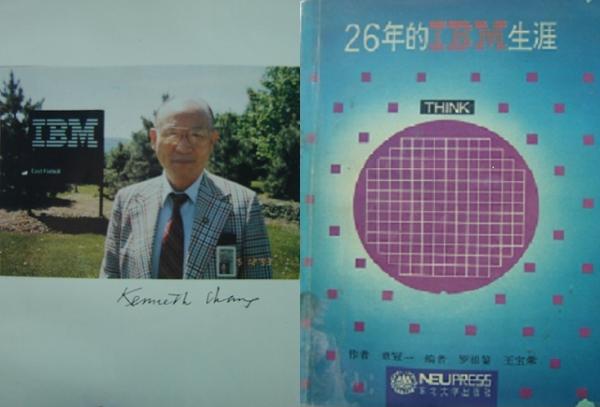
As that of sophisticated lattice on the cover of the book, the task of Mr. Kenneth Chang was researching the way that links the diodes, transistors, resistors, capacitors and so on to be fixed in the designed point on a set of lattice.
As a common person, I never understand that how can integrated tens of millions of elements on a silicon wafer of only a square millimeter.
1.1...Mr. Kenneth Chang and his creative works
He was with an Aeronautical radio background, before one week when he stepping on the job position of researching the manufacture of flat diode and triode in GI company of United States, he bought a book on semiconductor knowledge. That was the initial start of his knowledge on semiconductor.
In the summer of 1962, when he was on vacation leave, a phone call asked him immediately return back to company because the production completely paralyzed with produced a large number of defects’ silicon chips.
The reason was that, in order to ensure the production smoothly in his leave period, GI Company hired a senior engineer from the large company - Texas Instrument Corp (TI) to work on his position. The senior engineer changed the production methods by copying the methods of TI, but totally failed.
Kenneth fixed the production line with his own methods and explained the reason that he improved the production with the methods that looks simple, even unscientific but were effective than that of being believed as highly advanced ones used in other companies, because of his methods were explored out from constantly trial and error in the practice of daily production. And, he illustrated with the comparison between the samples made in two ways. Since then, his popularity surged in GI company.
We may have the personal experience of that, in daily life, there are many actual objective results are contrary to the common sense of us with unfounded subjective judgments. Unfortunately, most people are always acting according to own subjective judgments, rather than based on the objective results from the practical trial.
His excellent work in GI helped him applied a position in IBM. When he submitted his resignation to the executive of the GI, the executive committed to increase his wage to 20% higher than that of IBM did and plus 5,000 shares of GI stock. Later, the stock rose to $40 per share, in which 5000 shares become $200,000, thus his friends felt regret for him. However, until retirement, he still believed that left GI into IBM was a right choice.
Another example of the harm of the unfounded subjective judgment happed in IBM.
In the process of semiconductor chips’ manufacturing, silicon chips need to go through hundred of processing steps. In which, a step is to thoroughly dry the photosensitive coatings on the silicon chips, otherwise, in the subsequent process would produce defects. According to the common sense of unfounded subjective judgment, for preventing from the dust in the process of drying, production technology designed to put the coated silicon chips into the metal box, and covered with lid before baking to dry. This technology was unstable, easily impacted by personal operation or environmental temperature or humidity, often resulting in defects, sometimes was a lot.
After careful observation and analysis from the operations, Kenneth changed the production technology with the test that dried several coated silicon chips by keeping the metal boxes open, he found that drying effect was perfect. He increased the number of silicon chips for testing, the results were satisfied. The method was promoted to the large scale production, and to be warming welcomed. An immediate executive who wrote that, on the notebook for two shifts’ transfer, “Chang led us out of the forest.”
Later, he simply designed aluminum plate to replace the metal box. Thus largely facilitated the operation, and greatly improved the production efficiency.
IBM internal
1.2...The plateau increased patent reward
Accumulates one point on each published being approved article regarding science and technology on the Science and Technology Bulletin.
For each patented patent, the inventor will accumulate 3 points. The bonus for first patent is $1,500, plus souvenirs and gold-plated pins, etc.. For each subsequent patented patent will award cash $ 500.
For each accumulation of 12 points, issue a Plateau Award $ 3600 with publishing the names and photos of the winner in company publications. Another accumulation of 12 points with another Plateau Award, and so on. Company may also give quota of awards depending on the circumstances from $10,000 to $100,000. It is very few of people who could achieve third Plateau Award.
Kenneth Chang entered the IBM in 1963, but until 1968, by the reminding of others, he began to pay attention on the reward system of IBM. And since then he achieved seven patented patents, published 9 papers, gained 30 points, and one patent was on pending.
The incentive policy of IBM largely promoted the inventive activities of employees. The report of U.S. patent awards surge in 2010; IBM still tops is the vivid proof.
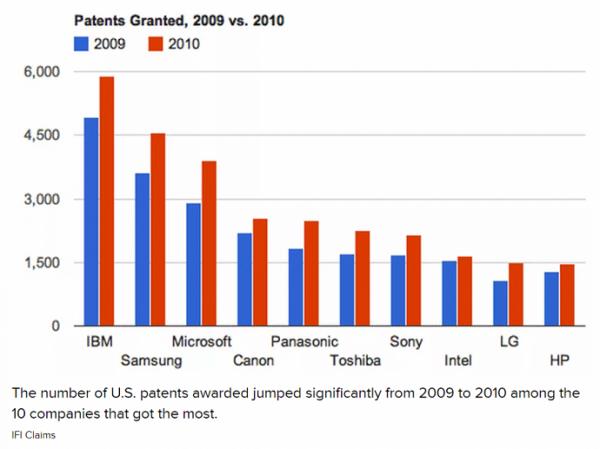
The number of U.S. patents awarded jumped significantly from 2009 to 2010 among the 10 companies that got the most. IFI Claims
I think those mentioned above are main reason that IBM can grow into the Big Blue taday and outstanding in the forest of the world leading Companies.
The success of IBM has benefited from its unique corporate culture. The success of Kenneth Chang also benefited from the corporate culture, which is emphasizing people-oriented, and taking the staff as "working capital" with a incentive system that encourages the employee to creatively work.
Suppose that Kenneth Chang was working in some of Canadian Companies, he would be ousted in weeks due to his self-determined to do innovation, and straightforward proposals for improvement.
Because of under different corporate culture, facing the proposals, in most of the bosses, supervisors, or colleagues, the first sense were that of they have been despised, the first psychological reaction is uncomfortable.
Thus they would make everything possible even by despicable way to squeeze out the thorns from their eyes.
They never care about the benefit would be gained from those proposals. This is not the nonsense; it was the personal experiences of mine in some Companies.
This year, 2011, Mr. Kenneth Chang will be 91 years old. I'm sure that, as a man of active thinking and unceasingly enterprising, he will be still in health, because he has basic conditions for healthy, which is the mental health first.
Now, I have an idea that is to contact with him and get permission for translating the book into English. Since that I have deeply felt out the old-fashioned and poor on the management in most of local enterprises of Canada compared with that of most of multinational corporations.
1.3...The work dispute adjudication system
Any business is made up of people, it is inevitable conflict between each other; especially in the scientific activities.
R & D management is a dark field; it is difficult to control balance. Because, in the process of research and implementation of R & D project, will involve cooperation of many sectors, in particular, the need for leadership in coordinating role.
So, the distribution of the bonus created by R & D need to take care of all aspects, especially, the main management may take big share. Finally, the prize money into the hands of the actual developers will be rarely.
For dealing this thorny but important issue, IBM set up a complaints system. If someone feels unfairly, he or she can manage up a complaint to higher level management, if it is not satisfied with the results; it allowed continuing to appeal to a higher level of, until reaches to top management.
As my view, besides complaint, for solving this problem, company should regulate the prize money as two parts, one for administrative staff, other one directly put on the hands of researchers.
Perhaps the inventor of the inventive concept has no ability to conduct implement, however, because the breeding process of the concept of invention is a special intellectual work, it is not that any person can do, therefore, the inventor of the concept should get of 50 % above in total bonus.
The purpose for doing in this way is to encourage people to innovate, rather than that of only sit back waiting to share the fruits of others.
1.4...IBM invented Corporate Identity System - CIS
IBM, Apple, McDonald, Coca-Cola, Sony, and Canon, etc., are the world well known brands. It is that the design of Corporate Identity System (CIS) helps them being identified out easily from a number of companies.

As a complete corporate image design system, Corporate Identity System is considered to originate from IBM. In mid-50s, the chairman and CEO of IBM, Thomas John Watson, Sr. who led IBM to have conducted CI design under the guideline of "presenting the advantages and features of IBM through certain designs, making the designs unified in application".
Thomas John Watson oversaw that company's growth into an international force from 1914 to 1956. Watson developed IBM's distinctive management style and corporate culture, and turned the company into a highly-effective selling organization.
In early 60s, some large and medium-sized enterprises in America began to apply factors that can build up and represent the company image to effectively publicize the CI, which involve the whole publicity strategy and methods that can penetrate all fields.
After a long period, this complete plan and design were widely accepted and labeled as corporate identity system. Imported to Japan in 70s, CIS theory was employed by a few far-sighted companies and helped to make great profits.”
2...In search of excellence:lessons from US best-run companies
In 1982, American Thomas Peters, the uber-guru of business and Robert Waterman, the bestselling author of The Renewal Factor, Adhocracy, and What America Does Right, who jointly published book <In Search of Excellence: Lessons from America's Best-Run Companies>.
The book studied forty-three of America's best-run companies from a diverse array of business sectors, In Search of Excellence describes eight basic principles of management:
2.1...A bias for action – a preference for doing something—anything—rather than sending a question through cycles and cycles of analyses and committee reports
2.2...Staying close to the customer – learning customers' preferences and catering to them
2.3...Autonomy and entrepreneurship – breaking the corporation into small companies and encouraging them to think independently and competitively (aka, "split-up")
2.4...Productivity through people – creating in all employees the awareness that their best efforts are essential and that they will share in the rewards of the company's success
2.5...Hands-on, value driven – insisting that executives keep in touch with the firm's essential business
2.6...Stick to the knitting – remaining with the business; "The company knows best."
2.7...Simple form, lean staff – few administrative layers, few people at the upper levels
2.8...Simultaneous loose–tight properties – fostering a climate where there is dedication to central values of the company combined with tolerance for all employees who accept these values.
1982, it sold three million copies in its first four years, and was the most widely held monograph in United States OCLC libraries from 1989 to 2006.[1] The book explores the art and science of management used by several companies in the 1980s.
Michael Gering commented the author as“Tom Peters is widely credited with having created the management guru industry.”
Here, the “Autonomy and entrepreneurship.” and the “Productivity through people” is focused on emphasizing people-oriented, and takes the staff as "working capital".
The success of IBM demonstrates the importance of a comprehensive incentive system. The physical and intellectual level is similar between modern people. They are lazy or industrious depending on the effective incentives measure.
The ignorant and lazy employees from the poor managed Companies into German Companies; they will become smart hard-working employees.
The smart hard-working employees from German Companies into poor managed Companies; they also would become ignorant and lazy, because they do not have the opportunity to demonstrate their talents.
On other hand, they must blindly follow the stupid directing with closed mouth; otherwise, they will be ousted soon.
3...The reason of poor - a story happened in Canada
In 1843, in the A Contribution to the Critique of Hegel’s Philosophy of Right, Karl Marx indicated that "Religion is the sigh of the oppressed creature, the heart of a heartless world, and the soul of soulless conditions. It is the opium of the people."
As the opium of the people, religion badly dehumanizes the quality of people.
Mr. Jayant Bhandari was born in India and educated in Britain. He recognized that British colonialists made Indian society and the people ignorance.
Please search Mr. Jayant Bhandari on YouTube. He said that Indian values consider it wise to commit crimes without being caught. Indian social culture lacks concepts of honor, contracts, friendship, and respect. India is a country without a sense of honor; you absolutely cannot trust anyone.
Such ignorant culture was rooted in the unique history. India willingly been swept by foreign civilizations several times, it has accumulated all of the garbage of the world's civilizations. Various absurd ideologies and religions are rampant, and itself is good at creating more ignorant local ones, which dehumanized the quality of people; so that the bridges they built to be collapsed, the dams they built to be crumbled, and whatever they do has ruined.
Here, I think of a story that happened in Canada 23 years ago. It can make us understand the dehumanizing effect of religion.
In 2003, I met an old man who came from India. I asked his views on Canada. He seemed to be angered by my question and answered loudly: Bill! Bill! Too much bills. Working! Working! Every day working!
His answer had somewhat charm of poetry and aroused me to think of some of the scenes about his mother country.
Some people are praying for the happier life by hands clasped together, someone says they are praying for the next time, because they have been convinced that everything is predestined by the pre-existence.
Also, there some people are not praying, but squatting in the side of the street to watch the streetscape because they do not care well or not for the life of next time.
They made me clear the reason of that why are the living standards of the people in his mother country seems to have been in marking time. Although, there are some reports on the progress of this country, but the majority of them is the cajoling from abroad or narcissistic from domestic. It can not cover up the reality of ignorance and poverty.
I wonder whether the incentive of IBM can work for those people who addicted in the spiritual opium and satisfied the status quo.
Mr. Jayant Bhandari said that; in India, the intelligent and well-educated people are eagerly getting away from their homeland. In a sharp contrast, the people of China are just eagerly returning to their homeland.
The West has been praising India as the most populous democracy, a large young population, full of hope; however, the reality is the opposite: it is just that democracy making low quality ones in power ruining India.
4...The quality of people decides the quality of a country
A country is composed of people; therefore it is the quality of people in deciding the quality of the social governance and which decides the quality of life.
4.1...China cultures people as human, the West as beasts
China develops ritual and Confucian cultures people as human in collective self discipline and do not do to others what you would not have them do to you; in collectivist values and peace seeking genes, which created collectivist civilization with the elements that are suitable for human survival.
It was just due to the doctrine of “do not do unto others what you would not have them do unto you”, China built Great Wall to avoid wara. Zheng He Fleet (1405-1433) 7 times around the world, besides fair trade, did not carry out colonial ruling; but presented large amount books to Italy and Europeans accepted Chinese ideas, discoveries, and inventions. The understanding and learning of China inspired the creativity of the Renaissance and formed the foundation of European civilization.
But the West fabricates feud Gods to brainwash people as sworn enemies mutually killing and regarding that loot-kills others for being No.1 as a matter of course; in individualist values and war seeking genes; and made Western individualist civilization with the elements destructing human survival.
This was the reason that in 59 years later, after Zheng He's fleet ceased its great voyages. Columbus discovered the New World; since then the countries in West swarmed out, occupied, plundered, and slaughtered the entire world. They are sill killing in Ukraine and Middle East.
2000 years ago, China explored the Silk Road, today updated as the Belt Road to survive people in the West, but they kill at home; then world widely, until this moment still kill in Middle East & Ukraine.
Due to that since ancient times, China chooses learned people in power, even develop Imperial Examination. Europe missionaries call it elite constitution by value merit over birth giving power to scholar.
4.2...The people of China developed highest IQ scores
Just as computer memory stores, the neurons in the human brain, acting as the memory of human intelligence. In China benefit from a good living environment and adequate nutrition, promoted people in neurons healthy development.
In contrast, the chaotic life of other countries badly impacted their people in the development of brain cells, so that their IQ scores are lower.
Dec. 23, 2011, article Optimal IQ's for Various Groups, BY ROBERT A. LINDSAY, (it has lost link).
Average IQ of various countries: China 112-118, Europe 92-102, India 92-96, Africa 85.
Below is a map of the average IQ of different races around the world, made by Western enthusiasts.
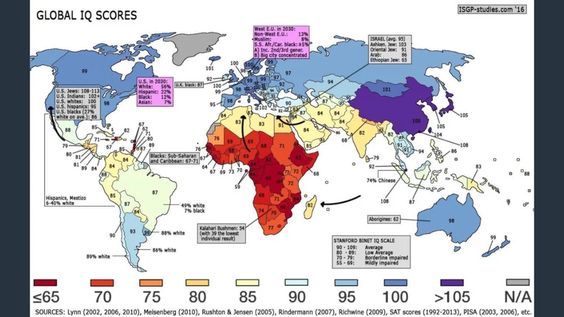
https://www.reddit.com/r/MapPorn/comments/1k0z1bu/iq_scores_worldwide/
Reflecting on man-made tragedies, it is the level of intelligence that determines the behavior of different races:
[1] China, purposefully cultures people as quality human, so that it has been world leading economy, explored Silk Road in 2,000 years ago to survive the people in West mutually killings. Now, the Silk Road updated as Belt and Road Initiative, bringing billions of marginalized people into the world economy, raising their lives from $2 to $10-15 per day, making them live in dignity as human.
[2] Europe, never cultures people as human, but making feud Gods brainwash people as sworn enemies as beasts in killing from past to this day. It made democracy to grant power to social garbage, it made values, and human rights, using them as excuses to constantly provoke wars. It designed its society as a bullring, and tamed people into bullfighting bulls; and looking for target attacking in parliament, society and world widely, they stirred their own country and the world as boiling pot, bubbling.
[3] India, willingly been swept by foreign civilizations several times, it has accumulated all of the garbage of the world's civilizations. Various absurd ideologies and religions are rampant, and it is good at creating more evil local ones. Dehumanized people as animals and recognized cows as ancestors. Bridges built collapsed, Dams built crumbled, and whatever they do has been ruined.
[4] Africa has never been properly humanized. Without the wisdom to build a habitable home, it has always been in a semi-cave state. People were captured and sold into slavery to Europe and America. Later, they voluntarily wandered to various parts of the world. Unable to make a living normally, but they are good at crimes and good at makes livings by putting stockings over their heads.
The IQ of the above-mentioned countries is only an average. There are people with higher IQs in all of country. Unfortunately, people with low IQs cannot consider the bad consequences. Therefore, they are bold and reckless; and often occupy the leadership positions.
4.3...The social significance of the highest IQ scores
Higher IQ scores made people properly reasoning to conduct rational behaving; and from the difference of IQ scores, we can roughly learn that why some people endlessly provoke wars; why some countries have admired populous labors, but cannot properly makes manufacturing; and some people make money by stockings cover head.
The highest IQ scores intelligence of people further boosted prosperous life of China; the West was in opposite; which was one of the reasons that the West has been in sustained provoking wars and by looking for looting as business.
The highest IQ scores intelligence was the reason that in Sep. 20, 2015, the article Israel to bring in 20,000 Chinese construction workers said that the work-speed of China's worker is 50% higher than that of others. No one will doubt that, if there were no China's workers, there would be no Western and Atlantic Railroad of the United States.
Mar. 31, 2020, Reuters reports From zero to hero: Italy's Chinese help beat coronavirus indicates that in the storm of infection and death sweeping Italy, 50,000 ethnic Chinese who live in the town of Prato were zero infection. In Italy, the most of Chinese people wear masks when they go out since the pandemic started; also other reports said that Chinese people are no longer seen in the public entertainment venues since the start of the pandemic.
Please remember, this happened in Italy; a country where was in perfect democratic played governance without the pressure of dictatorship but in the state of freedom of people acting as free as that of herding cats. However, under the environment where the Covid virus is raging and killing people; who want to enjoy freedom, who must be paid the price by own life. Clearly, the highest IQ scores intelligence of Chinese people understood this point.
In 1950s, at the poorest time that was just ended civil wars and last 100 years of foreign aggression, in Korean War, by poorest weapon; the highest IQ scores intelligence army of China defeated the U.S. led the advance armed United Nations Army of 16 nations to force U.S. humiliatingly signed armistice agreement historically.
In 1962, Western countries including United States collectively armed Indian troop to provoke war with China. The troop of China defeated the troop of India as that of the West described as that of driving a herd of Indian buffaloes.
The highest IQ scores intelligence made one people of China able to beat 10 people of any of other countries. Once war started, the soldiers of China keep in sober mind in properly fighting; but others will self-disable from fear.
It is highest IQ scores of people made China has never provoke wars with others.
The low IQ scores people bomb world; while the high IQ scores people rebuild bombed world.
April 2023, the environmental lawyer, and the nephew of former President John F. Kennedy, Dr. Robert F. Kennedy Jr, who indicated the deeds of the two different civilizations; “Over the past decade, our country has spent trillions bombing roads, ports, bridges, and airports.”“China spent the equivalent building the same across the developing world.”
In 4 decades China develops as top economy from war ruins
April 2023, the President of European Commission Ms. von der Leyen indicates that: “for centuries China have helped to shape world civilization; and in the last decades, they have really transformed the economy of their country, lifting more than 800 million people out of poverty in the last 45 years and transformed into a modern-day economic powerhouse, key global player and a leader in many of the cutting-edge technologies that will certainly shape the next decades of global civilization and progress.”
Please remember that the achievements of China were made based on the destroyed ruins with huge war reparations from a century long killing and looting of Western allies and US tamed Japan; which started since 1840 British armed selling opium after government of China banned opium trade that started in 1773.
Sep. 16, 2020, the founder and co-chairman of Bridgewater Associates, Mr. Ray Dalio who published article Changing World Order, Chapter 6: The Big Cycle of China and Its Currency; in which, he pointed out the different quality of people between China and the US: “Chinese leaders study history to learn lessons that help them plan for the future and deal with the cases at hand. Believe me, the lessons learned from these histories are now guiding Chinese leaders’ decision making.”
“While the most of Americans focus on particular events, especially those that are now happening, most Chinese, especially their leaders see evolutions over time and put what is happening in the context of them. While Americans fight for what they want in the present, most Chinese strategize how to get what they want in the future. As a result of these different perspectives the Chinese are typically more thoughtful and strategic than Americans, who are more impulsive and tactical.”
“The Chinese government is run from the top down (like a family) and optimizes for the collective while the American approach is run from the bottom up (e.g., democracy) and optimizes for the individual.
The workers of China built Canadian Pacific Railway, and U.S. Pacific Railway
Today, much of the infrastructure in Western democracies is a legacy of two generations who suffered through the two world wars. Even so, if it was without the construction of labors from China, there would be no Canadian Pacific Railway, and American Pacific Railway.
The $10 commemorative banknote issued to celebrate Canada's 150th anniversary features a train—the "Canadian," which traversed the North American continent. This train, covering thousands of kilometers, connected the east and west coasts, showcasing Canada's unique landscapes and is world-renowned.


What is less known is that this project, undertaken over a century ago, was extremely difficult and dangerous, and was ultimately completed thanks to Chinese laborers. Their contributions essentially shaped half of Canada's Confederate history.
The first Prime Minister of Canada, John Macdonald, famously said: Without the Chinese laborers, the Pacific Railway could not have been completed on time, and the development of Western Canada would not have been possible."
When British Columbia joined the union in 1871, Canada agreed to build a rail line all the way to the Pacific coast. This astonishing feat was accomplished in just over four years largely due to the Chinese railway workers. Between 1881 and 1885, over 17,000 Chinese men came to Canada to work as labourers on the construction of the western section of the transcontinental railroad.
Chinese workers were mostly concentrated on a 250-mile section in British Columbia contracted out to Andrew Onderdonk. It appears that approximately 700 of them were killed in industrial accidents largely due to unsafe working conditions. Chinese labourers worked in harsh conditions and for less than half the pay of their white coworkers. There are no Chinese labourers in the famous “Last Spike” photo taken by Alexander Ross.
From 1865-1869, 12,000 Chinese immigrants constructed the western section of the transcontinental railroad – one of the greatest engineering feats in American history.
5...The promoter of the manufacturing of China
Now, China is replacing Germany as the crown jewel of manufacturing; it should attribute to that China has well developed the German rationalization proposals (RP). The majority of wages come from being tied to the profits generated. The more profit created the more wages gained without cap.
For those who can be assessed on a piece-rate basis, pay them wages on a piece-rate basis.
For tasks that cannot be assessed on a piece-rate basis, the profit is assessed on a team basis; thus the members who work is bad will be kicked away by other team members.
Thus the managements avoided the headache of lay off people.
Also there is bonus for individuals, such as, patent inventions related rewards, and suggestions related rewards.
6...The democracy killed manufacturing of democracies
It is just the players of democracy advocating of human rights to have killed manufacturing by corrupted labor quality; the left of quality WWII generation took labor productivity away, and democracies lost foundations for making life necessaries.
The manufacturing of democracies in the west can never be restored due to it uprooted in culture. Politicians need the cultural poison of human rights pleasing voters, union culture cannot touch, labor quality cannot update.
Supposed that no labors from China, there would be no Atlantic Railway in the United States, and without mad in China no one lives well. Thanks to the high-quality generation that cultured from the hardships of WWI and WWII to have laid foundation for West democracies today; now new generation even lost ancestral skills to bomb world.
The leaders of democracies have all vowed to make own country great again; vowed to bring manufacturing back; however, the fact is that not only they can never to bring manufacturing back or develop new manufacturing, but also the existing manufacturing is in destroying; due to society filled in low quality labor under destructing culture.
6.1...The killer of Canadian manufacturing industry
Canada once has world class leading manufacturers; they have been suicidal declined.
Nortel Networks was a dominant Canadian telecommunications equipment manufacturer, founded in 1895 as Northern Electric employed 94,000 people globally with groundbreaking inventions; but it filed for bankruptcy in 2009; and was liquidated by 2017, marking one of Canada's biggest corporate failures.
Research In Motion - RIM, later renamed as BlackBerry Limited; it was a Canadian software company specializing in cyber-security. Founded in 1984, it originally developed the BlackBerry brand of interactive pagers, smartphone and tablets. In the global smartphone industry, RIM can be called as originator and pioneer; but now, the most of people may don't know it anymore; it was a sadness of Canada manufacturing industry.
Bombardier Inc. was founded in 1942; a Canadian aerospace manufacturer which produces business jets. During the 1970s and 1980s, the company diversified into public transport vehicles and commercial jets, grew particularly fast at the end of the 1980s, and it became a multinational corporation.
However, the launch of the CSeries aircraft sent Bombardier into deep debt, pushing it to the brink of bankruptcy by 2015. As a result, the company sold nearly all of its operations except business jet manufacturing.
The uproot of Canada's manufacturing industry was the result of wrongfully dealing with human nature; which is by democracy grants power to reckless ones and then the reckless ones play human rights cheating voters to support union culture encouraging people lazy to have uprooted labor productivity.
Also, in the companies of Canada; in terms of management, it is lack of attention to incentive mechanisms and the wages are not linked to work performance; which is going on the dead path that has destroyed socialist country.
For example, a road repairs in China can be completed in one night. However, in Canada, the road is left to ripped open and exposed to the sun shine for six months. Meanwhile, the workers lie at home counting the money they earned from the neglected work.
In my 2014 article The Fatal DNA failed RIM & Canadian Enterprises, I cited an example An RIM senior exec has to express opinion by Open Letter.
I read an article Open letter to BlackBerry bosses: Senior RIM exec tells all as company crumbles around him Jun 30, 2011. The article wrote that: “We have received an open letter to Mike and Jim from a high-level RIM employee (whose identity we have verified), and in an amazingly honest and passionate plea, this letter gives fascinating insights into what RIM must fix, and fast. RIM did not immediately respond to a request for comment.”
The start of the open letter and the 8 suggestions as follow:
“To the RIM Senior Management Team:”
“I have lost confidence.”
“While I hide it at work, my passion has been sapped. I know I am not alone — the sentiment is widespread and it includes people within your own teams.”
“Mike and Jim, please take the time to really absorb and digest the content of this letter because it reflects the feeling across a huge percentage of your employee base. You have many smart employees, many that have great ideas for the future, but unfortunately the culture at RIM does not allow us to speak openly without having to worry about the career-limiting effects.”
The 8 suggestions:
1) Focus on the End User experience.
2) Recruit Senior SW Leaders & enable decision-making.
3) Cut projects to the bone.
4) Developers, not Carriers can now make or break us.
5) Need for serious marketing punch to create end user desire.
6) No Accountability – Canadians are too nice.
7) The press and analysts are pissing you off. Don’t snap. Now is the time for humility with a dash of paranoia.
8) Democratise. Engage and interact with your employees — please!
The proposals are not only pointed out the problems, but also offered workarounds, especially reconstruction of management, interaction with employees to be managed in accountability. It shows the writer's honesty in deep concern for RIM's future, and well thought out.
From above 8 suggestions, we could feel that chaotic in the management.
Above 8 suggestions were all to hit on the root cause of the failure of RIM and perfect suitable for any businesses.
However, RIM’s responds to open letter was not only with no thanks, instead, was somewhat hatred condemnation, the first paragraph is as follow:
“An “Open Letter” to RIM’s senior management was published anonymously on the web today and it was attributed to an unnamed person described as a ‘high level employee”. It is obviously difficult to address anonymous commentary and it is particularly difficult to believe that a “high level employee” in good standing with the company would choose to anonymously publish a letter on the web rather than engage their fellow executives in a constructive manner, but regardless of whether the letter is real, fake, exaggerated or written with ulterior motivations, it is fair to say that the senior management team at RIM is nonetheless fully aware of and aggressively addressing both the company’s challenges and its opportunities.”
I once talked with an employee who is working in the lab of RIM as a material scientist. She said that she once wrote a suggestions’ letter to the management of RIM, but without any response. She felt that the corporate culture of RIM is not worthy for appreciation.
Besides above, I once called my friends who were working in RIM at that time.
The one who works in the service department said that their work efficiency has a lot of room for improvement.
Obviously, in RIM, it has no normal channels for facilitating the communication between subordinates and superiors to promote the development with the wisdoms of all employees.
This is the same game in the democracies of the West.
6.2...The killer of Japanese manufacturing industry
Japanese manufacturing once dominated the world for decades, but its glory has long been faded.
I have been digging the nature of Japan's economic downturn. Why that various government-sponsored fiscal and economic stimulus measures, including trillions of yen in failed public works projects, did nothing to revive the economy?
Aug. 24, 2014, in the article that Over-heated real estate market is ruining Canadian economy from Japan mirroring Canada, through translation of some articles that wrote by Japanese scholars, and the people from China who are studying and working in Japan, by their personal experiences and investigation to reveal the reality of the period of Japan's bubble economy 1980s, and after the economic bubble burst, I have discussed the cause of Japan's economy decline.
Dec. 4, 2014, I once wrote Why did Keynesian fail in saving Japan's economy: the Bubble Economy has rewritten the code of the DNA of Japanese people, from enthusiastic in hard working into enamoring in greedy speculating, thus, further affected the social moral and national’s spiritual, thereby caused the decay of Japan.
People keen to make living by speculating instead of hard working and less concerning on the interest of own company and most of Japanese people have lost the sense of responsibility.
This is why those corporate executives of Japanese leading companies are constantly bowing and apologizing for their falsifying data in the process of manufacturing.
In essence, the national is the decisive factor for economy; the decline of economy is the decline of the quality of the nationals; which is as same as that of the democracies in the West; Japan has also decayed hopeless.
6.2.1...High-quality of Japanese people before Bubble Economy
Now, I think of a story in Mandarin long time ago, the famous American marketing authority Philip Kotler who once said that: For Japan, what is the panacea to heal its wounds of the war, to stand up on the war-ruins, and to become the economic powerhouse? For achieving economic advantage, Japanese waged the war, but, failed. From the pain, they learnt that, the use of economic means can achieve more brilliant achievements than that of the use of the military. This means is the marketing.
The economic miracle shows the high-quality of Japanese people. Following is a story about it.
In morning August 19, 2013, I had a chat with the father of my new neighbor in Waterloo, Ontario. He said that his brother once was a top executive of a Canadian Steel Manufacturer and had twice visited Japan for learning the experience of the advanced corporate management in 40 years ago. His brother appreciates the good quality of Japanese very much with a comparison between Japanese and Canadian in case of production accident.
When facing production equipment fails, any Japanese operator would immediately stop the production, and then, all of the people gathered together to make diagnosis and treatment, after troubleshooting, everyone immediately went back own position to resume the production. But, the Canadian was just blindly standing, there no one was attempting for trouble shooting.
Following are some memories about the industrious noble quality of Japanese people. I could not recall the source of them already, but the facts are true.
When 1973 oil crisis, the plant of the Sony Corporation was shutdown and the workers were staying home waiting for notification of work. However, the workers went back to plant to do something available voluntarily with the hope that company could survive.
Mr. Kazuo Inamori, the founder of Kyocera Corporation of Japan. In the newly established period of the company, a customer ordered special shape of water pipes, because there was no prior experience in the production of such pipes. In the process of heating and forming to required shape, the water pipes were burst. Then, Kazuo Inamori was holding the pipe when sleeping at night and slowly turning the pipe, so that pipes was heated evenly, and made it into required shape finally.
Now, we have convinced that it was that industrious noble nature of Japanese people created Japan's postwar economic miracle.
People may ignore an important fact that the birth of the Plaza Accord is also a proof that made in Japan was once invincible and swept global market, and also is the proof that the high quality of the enterprises and the employees of Japan.
Supposing that enterprises and the employees of Japan still remained the spirit of entrepreneurial and responsibility, and still in hard working, today's economy of Japan will still be over that of Germany, and those made in Japan will be still invincible and sweeping global market.
This is one of the main reasons that Japan’s economy has been long-term downturn. And it is why that the Three Magic Arrows of Shinzo Abe did not achieve the desired results.
From above lessons, I firmly believed that, no doubt, such Japanese diseases of the employee lazy, the "evading responsibility", and more, is an objective results of the Japanese subjective selfish ideological, which was developed from the Holy Baptism by Japan’s Bubble Economy 1980s.
The aftermath of the bubble economy is still hurting all aspects of Japanese society, from the social ideological to the personal spiritual, from the macro national economy to the micro family life, from the world class companies to the ordinary employees, and more.
The sad facts of Japan made me firmly believed: it is that the quality of employees decides the fate of the enterprise. It is that the quality of the nationals decides the fate of the nation. And it is that social moral, social ideological impacts the quality of the national in a great extent.
Japan, one misstep in opening real estate market, cannot get rid of the nightmare of the bubble economy.
6.2.2...Japan used all means of Keynesian but useless
June 4, 2012, in the article Japan’s Bubble Economy of the 1980s, the economic analyst and Forbes columnist Jesse Colombo who wrote with that: "By 2004, residential real estate in Tokyo was only worth of 10% of its late 1980s peak, while the most expensive land in Tokyo’s Ginza business district had fallen back to just 1% of its 1989 level in the same year (Barsky, 2009)."
"Similarly, the Nikkei stock index is now trading around 10,000, just little over a quarter of its all-time high."
"It has been over two decades since the popping of Japan’s economic bubble and the country is still actively battling with deflationary forces that are so powerful that near-zero interest rates, repeated bouts of quantitative easing (some call it “money printing”) and constant Yen-weakening currency interventions have barely made a dent."
Jan 6, 2009, on Japan Times, the report Lessons from when the bubble burst said with that: after the crash in late 1990, economic growth stalled various government-sponsored fiscal and economic stimulus measures, including trillions of yen in failed public works projects, did nothing to revive the economy. This was started roughly in 1991, when the effects of the stock market crash became clear.
Mar 09, 2014, Japan's deficit hits record as economic growth slows.
Mar 31, 2014, Japan factory output contracts, dims growth outlook as tax hike looms.
Apr. 28, 2014, IMF says Shinzo Abe’s economic policy is losing momentum and warns growth could stall unless structural changes to the economy are made.
Jun. 19, 2014, Abenomics Fails to Shake Japanese Firms' Addiction to Cash
Jul 24, 2014, Japan's record trade deficit raises fresh doubts about Abenomics
Aug. 27, 2014, Abenomics' arrows fail to hit their mark
Nov. 28, 2014, As Japanese Bankruptcies Soar, Goldman Warns "Further Yen Depreciation Could Be A Net Burden"
Sept. 15, 2014, Keynes was a failure in Japan - No need to embrace him in Europe
Nov. 25, 2914, Soaring prices caused by the depreciation of the Japanese yen worry off the New Year - Chinese International - China Daily
Above reprots reveal the terrible consequences of Japan's bubble economy, Prime Minister Shinzo Abe economics seems not work but with a side effect to press Japanese economy continuously toward deterioration.
6.2.3...Bubble Economy degenerated the quality of Japanese
Why the all of the fiscal and economic stimulus measures has been used, but have gained nothing to revive the economy?
When talking about the main cause of Japan’s declining from the economic powerhouse? Most people would blame the Plaza Accord that forced appreciation of the Yen to cause Japanese products losing competitiveness and the Bubble Economy.
The reason, as my view, all of those stimulus measures are from the macro elements of the economy, with ignoring the most basic micro elements - the quality of the people, the work-ethic of the labor, the efficiency of the production and the capacity of the innovation.
The Bubble Economy has rewritten the code of the DNA of the quality of Japanese people, from enthusiastic in hard working into enamoring in greedy speculating, thus, further affected the social moral and national’s spiritual, thereby cause the decay of whole society of Japan.
The easy gaining excessive profit from speculative activities have fueled Japanese speculative mentality with unearned ideological. It entices people keen to make living by speculating instead of hard working and less concerning on the interest of own company and most of Japanese people have lost the entrepreneurial spirit, hard-working spirit, and the rational sense of social responsibility and enterprises have deteriorated as lack of enterprising spirit and innovation dynamicI, such negative impact is more terrible, even fatal.
In essence, the national is the decisive factor for a nation’s economic development; a nation's economic decline is the decline of the quality of its national.
Whether it is a business or a country, if its member is full of concerning for the self interest, without or lack of concerning for the public interest, it will doom to be extinction.
So, I firmly believed that the impact of the Bubble Economy on the economy is just a curable social flu, but, the impact on the national’s spiritual is incurable social cancer.
The fact of the Japanese companies loses competitiveness and falling into declining are the vivid proof. The shortsightedness and lack of entrepreneurial spirit of the management team, the lack of work enthusiasm of the employees is the main reason, and also it caused Japan's economy cannot recover as expected.
6.2.4...The incredible lazy of Japan’s employees
An engineer of China who works for a German company in taking charge of the branches in South Korea, China and Japan, after working a while in Japan, he was shocked by the lazy of Japanese employees, and completely lost the good impression for them.
Then he wrote an article post on the website to be widely reproduced on the internet; I excerpt and translate some as follow. For facilitating narrative, here, I name the writer as Jim.
The Japanese employees are working overtime almost every day, but, only for getting overtime pay rather than for the need of production.
Jim arranged a simple task to a Japanese technician who dragged two days to finish. The same work, if, in China, a new graduated young man can finish just in half an hour.
In a break time, Jim complains the matter with German colleagues, one German said, this guy is a good one, since he did not drag for a month as that of others. Another German even suspected that Japanese employee was dozing when working.
Japanese employee did not like to take responsibility, when encountering some work trouble, usually; they will look for helping with endless complaining.
German company plans to open new production lines in Japan, so, sent Japanese staff to Germany for training. The same project in China, within a year, production lines was already operating at full capacity in three shifts for 24 hours a day. But in Japan, it took two years still in the state of machine commissioning.
The workers of China have mastered all the skills within the three months training in Germany. The German teacher said: you have learnt everything on the training plan, you may go back to China now, and we have nothing for teaching any more.
Japanese spent six months in Germany, but, after went back to Japan; they could not work properly, and complaining that Germans did not teach them well. Germans angered with that: in Germany, we were teaching you hands by hands, and you also said that you have mastered everything already. The Japanese fought back immediately: Sorry, we forgot, our memory is too bad to remember that.
Germans were angered and collectively applied for vacation to leave Japan as a protest. The German company had to allow them to China by the name of studying for appeasing their anger.
Jim went back China with the German colleagues together. When they held a cup of coffee to watch Workshop through the window glass of the upstairs office, the production was in an orderly busy, workers were loading and unloading on the production line, the transportation-cars were running to and fro between the production sites and the storages.
All of Germans was shocked and some even exclaimed with that: my God, here is simply a heaven. One of them said with that, they (Japanese) have been sleeping for 20 years, let them sleeping for another 20 years, then, Japan will decline as a developing country, and while, China will destine to be a developed country.
Now, in many Japanese companies, employees are mostly 40-50 years old, rarely under 30. Many young Japanese are staying in unemployed. Besides the cause of the economic recession, the other cause is Japan's "special" corporate culture, which emphasizing work-qualifications and work-records, so that young Japanese have lesser work chance. Some girls have to do "compensated dating" for making money. Some boys also have to make money by doing “duck” - male prostitute.
6.2.5...The Japanese disease ruins Sharp and Sony
Mr. Kondo Daisuke, a scholar of Japan, who wrote many articles to criticize the Management Drawbacks in Japan's enterprises. He coined the term of "Japanese disease".
The nature of the "Japanese disease" is the manner of "evading responsibility" that evolved rigid organizational structure and Inward Oriented Conservative of the Japanese Companies. The direct result of the "Illness" is that illed companies will increasingly debilitate and ultimately collapse.
Jul. 11, 2014, Japan's Sharp to post $141 million loss on Europe solar business.
Sep. 17, 2014, Sony predicts increased losses due to struggling mobile business.
I excerpt some section from my article Over-heated real estate is ruining Canadian economy from Japan mirroring Canada – 2 as follow, to show the reason that Sharp and Sony declines. I hope that the lessons may play a role as a mirror to mirror the enterprises of Canada, to ask that Why? How?
6.2.6...The decline of Sharp Corporation
Sep. 11, 2012, Mr. Daisuke Kondo who published a Mandarin article Angry Gou Tai-ming on Economic Observer Online of China, in which he criticized the “Japanese Disease” that harms Japanese companies. I excerpt translate some as follow.
A hundred years glorious Sharp Corporation has suffered "Japanese disease." It is not only the Sharp, but also the Sony, Panasonic, NEC, Sanyo, Olympus, and great many Japanese companies are the serious patients in "Japanese disease".
For example, a Japanese company planned to develop a new product. The product development department produced a "plan book", with depicting the grand blueprint of best market potential.
However, when the "plan book" spreading in other departments of the company, this new product would face with dozens or even hundreds of blames, in the end, it did not get any support. The reason is simple: For the heads of departments, the most important thing is not how to bring new products to market, to improve the turnover, but, how to avoid the risk-taking of affecting own career in case of the sales of the new products is not good as expected.
Because of the whole company have infected the disease of "evading responsibility", a lot of great new product plans have been put into the limbo. Meanwhile, in the process of this "bad model" iterative, the staff for new products’ R & D has gradually lost enthusiasm and morale, thus, resulting in the number of the plan for new products’ dropped. Nevertheless, the whole company still does not repent for that, keeping on its own way.
Once cooperation with a Japanese business that suffers "Japanese disease", I believe, regardless, which leaders of China's company will be angry as same as that of Gou Tai-Ming.
Assuming, a Chinese company raised an advantageous cooperation projects for both sides to a Japanese company, the local subsidiary of the Japanese company will immediately report to the International Department of the Japanese parent company. At this time, the International Department will require the local subsidiary to present a "plan book" as long as hundreds of pages. Just for completing this "plan book" will be going to spend a few months of time.
Then, after the negotiations with various departments in the head office, which cost more than six months usually, luckily, the "plan book" may finally appear on the meeting of the Board of directors once a month in the head office. However, most probably it will suffer the fate of being sentenced to death, because of all the directors are not concerns the plan book from its feasible or not, but, from the "how to use the plan, for their personal interest, rather than the interest of the company.
If, some directors believe that the implementation of the plan was no benefit for themselves, or own competitors in the company can get more benefits, they would oppose without hesitation and then put forward some reason to postpone the decision and ultimately to make the plan was dismissed or forced to ‘another day another meeting’, without the rational sense of caring about the interest of gaining or losing for the company."
6.2.7... The decline of Sony Corporation
Feb. 6, 2014, Japan scholar Daisuke Kondo published another Mandarin article The sundown of Sony: Doraemon or Crayon on a website of China, in which he criticized the ridiculous management that has been ruining Sony Corporation.
“I remember that of my college days, only the best students in science majors can enter Sony. When going out of Japan, regardless of which country, we were able to see "SONY" huge billboard and young people using "walkman". At that time, Sony is our Japanese pride, however, now?”
"For this problem, one of my college classmates, now a Sony employee replied with that: "In the company, there one by one meetings are from morning to night, after the meetings, everyone must deal with at least 100 internal mails from the company. So, Sony is not an electronics manufacturer, but a downright bureaucracy! Only those people, who are the 'Mr. Nice Guy' without any faults, could be promoted. Such a Sony could not develop new products that can shine the world anymore?”
"Our company has a specialized team in charge of new product development against the rival of Apple of the United States. There was I admired executive who is in charge of the team. One day, his immediate leader of a director of Board even ordered him to stop the investment of 'no value' (i.e., to give up the R & D) as soon as possible to vanquish to Apple. The executive retorted: Do you have self-esteem as a member of Sony? The Director even contemptuously asked: ‘your self-esteem can help company making money, right? Heard of the answer of a director of Board, the executive immediately decided to resign."
"In recent years, the elite who left Sony were not only the executive alone. In 2006, the former managing director who was responsible for "AIBO" R & D of futuristic robots was demobilized; the reason was that there members of board were questioning that ‘How much economic benefit that the robot R & D can bring to Sony? In 2007, former chairman and CEO of the Sony Computer Entertainment Inc., Mr. Ken Kutarag who known as the "Father of the PS (PlayStation)" was also retired after the expiry of his Job tenure.”
"In the booming period of before, Sony company once gathered a large number of ‘Doraemon’talents - they can come up with all kinds of whimsy from their "Mind Treasure Bag", and then to materialize them into a variety of future products. But now, unfortunately, the Sony is filled with the people who work with lips only as that of the‘Crayon’”
6.3...The killer of German manufacturing industry
6.3.1...154 years old RP made miracle of German manufacturing
May 28, 2012, I once wrote The DNA of the Success of German Manufacturing to indicate that for decades, German manufacturing has been the crown jewel of global manufacturing; which should attribute to the rationalization proposals (RP) - to point out the existing problems with solutions; then company extracts bonus to contributor from the net cost savings in the first year.
Since Mr. Friedrich Alfred Krupp of German ThyssenKrupp AG firstly coined the management concept of RP in 1872, since then German companies have been the practices of management on RP. Today the RP is not only a key component of HR, but also is the corporate culture of enterprises.
They have established a sound management system of RP with corresponding incentive policies and accumulated a lot of valuable experiences. Such as, set up specialized department and specialized personnel to manage RP, the employees can easily input and query the contents and the implemented results of RP through corporate network system.
As the saying goes, if we hope horse running faster, we must feed it with grass. If we hope hen laying more eggs, we must feed it with grains. In the same way, the activity of RP can continue to develop in German enterprises; the reward in bonuses or materials plays a key role.
The award criteria for RP are basically same in different German companies. It is according to the net cost savings after implementation of RP in the first year. It divided into several grades, specifically, the annual net cost savings within the 2,500 EUR, according to the following standard bonuses:
Annual net cost savings | Bonus |
250 Euros | 20 Euros |
251-750 Euros | 75 Euros |
751-1750 Euros | 150 Euros |
1751-2500 Euros | 250 Euros |
Annual cost savings are more than 2500 EUR, then, the bonus is 25% of the actual amount of net cost savings. For example, net cost savings is 5000 EUR, and then the prize money amounted to 1,250 EUR.
Some RP cannot estimate the direct economic benefits, but can play an important role in improving safety, preventing accidents, protecting environment, improving product quality and enhancing corporate-image, and thus can make indirect economic benefits, then, according to the grade of lowest, low, medium and high respectively give 20, 75, 150 and 250 EUR or material reward. In accordance with "Personal Income Tax Law" of Germany, material reward is tax-free. The taxes of bonuses are paid by enterprises.
But now, German manufacturing ruined by democracy grants power to social garbage; to play green card; Chancellor Friedrich Merz destroyed advanced nuclear power plants, the Ex destroyed the advanced coal-fired power plant, paid war of Ukraine got return destroyed cheap natural gas pipelines.
Democracy is a destroyer destroying everything by granting power to antihuman social garbage; they abuse the power exerting evil instinct.
Please look at the democratic destroyers destroyed German Berlin and the whole Europe follow the camera of the vBlog of the couple from Irish.
Berlin 2025 is Falling Apart (Germany’s Zombie Capital).
After returning from China, faced with once deeply beloved their own homeland has destroyed by representative democracy left them in despair.
European made western civilization dehumanized people addicting in democracy; but lost sense for the purpose of establishing government.
6.3.2...Antihuman German politicians ruined Germany
Feb 27 2026, UK PM Keir Starmer returned path of David Cameron, to indicate that:
--- The pitiful Germans actually condemn best leader Merkel as a bad. Here I show you the great contributions of Germans viewing as the best leaders.
--- The sadness of a nation lies in people being held hostage by ignorance.
--- I sadly describe Germans, because its leaders ruined best run Germany.
--- Germans must enable their outstanding entrepreneurs to take the power.
Recently, current German Chancellor Friedrich Merz, who visited China, retraces for ready to return to the successful path of former Chancellor Dr. Merkel.
Here, I must talk about the brilliant Angela Merkel and the Germany, where has ruined by representative democracy letting power to idiots after Merkel.
Democracy evilly dehumanized people in the state of never asking that why selves have to be willingly governed by such a chilsdish way of democracy.
Thank Harvard University for awarding Honorary Doctor of Law to former german chancellor Angela Merkel in May 30, 2019; Dr. Merkel was the most worthwhile for got the honor and helped world gained the most worthwhile return: “tear down walls of ignorance and narrow-mindedness, for nothing has to stay as it is,” to get rid of state of “describe lies as truth and truth as lies.”
The ancestors of Europeans fabricated the most of ridiculous things that harm Europeans for thousands of years & now harming people of the world; especially by democratic casino destroying the life of people.
Faced with a depressing reality; in Feb.16 2014, I once wrote article Why German Economy Can Fly Against Economic Recession--Germans are rational outstanding the West. Without the harm of dogma that trapped the vast majority; never follows others; but insisted on own carefully recognized ways, by smart way Germans make economy fly against the economic recession.
It said that once Dr. Merkel asks an economist, why do we have no world-class economist that won Nobel Prize? The economist said; do not worry, if there is world-class economist, there will be no first-class economy.
That was the story in 9 years ago, not today. That time was the Germany under Merkel’s leadership, not the Germany today under red and green lights fading shining. Only the street boys and street girls govern own country by red and green lights of making unhinged political compass creates chaos.
6.3.3...The deeds of Antihuman German politicians
To play green card; Chancellor Friedrich Merz destroyed most advanced nuclear power plants, the Ex destroyed the most advanced coal-fired power plant, paid war of Ukraine got return destroyed cheap natural gas pipelines.
For decades, Germany has been a jewel in the world's manufacturing industry. But destroyed by democratic plyers. They tout union culture regarding that strike for more by doing less in unearned gains as justice otherwise is slave labor by such a ideology to have killed labor productivity for manufacturing.
After ruined countries; German destroyer politicians got smart to regret and being humanized realize that only the way of China is human way.
After returned from China, Merz immediately delivered an impassioned speech, stating that only after returning from China, did he realized that German people lack of hard work and that continuing in this way held no hope.
The speech got prolonged applause, indicating that many Germans shared this view. They too were worrying about Germany's hopeless future.
But under the governance killer of the representative democracy, Mr. Merz can do nothing; besides continuouly destructs Germany to worsening.
Please look at the democratic destroyers destroyed German Berlin and the whole Europe follow the camera of the vBlog of the couple from Irish.
After returning from China, faced with once deeply beloved their own homeland has destroyed by representative democracy left them in despair.
Berlin 2025 is Falling Apart (Germany’s Zombie Capital).
Sweden 2025 is Collapsing (The Failed Utopia of Europe).
You Won’t Believe This is PARIS.
The Side of Vienna Nobody Talks About.
What Happened to Athens?! (Nightmare).
There is other vBlog called On Tour With Dridgers, they are Reanne and Ben from Portsmouth, UK; they spent two years in China and visited the most of provinces, now they desided settling in China. This explains their despair on their homeland, where has been destroyed by representative democracy.
6.3.4...Disaster rooted in erroneous ideology
Merz criticized China for violating human rights, but China, in just a few decades, has lifted 800 million people out of poverty. The people of China can walk alone on the streets late at night without worrying about their safety. In contrast, in Germany, however, the country is declined unlivable, falling back into poverty, and people are losing even the most basic guarantees of personal safety.
Merz criticized China for being no freedom of belief, no freedom of religion; but he did not carefully consider about the fact of the cause of manmade disasters was rooted in religion by their purposefully fabricated Gods brainwashing people as sworn enemies as beasts in the instinct of looting & killing.
People in the West are the descendants carrying the warlike gene. Please look at the bombing of Iran now; the root lies in the warlike genes.
Democracy is a detroyer destroying everything by granting power to antihuman social garbage; they abuse the power exerting evil instinct.
European made western civilization dehumanized people addicting in democracy; but lost sense for the purpose of establishing government.
6.4...The killer of the US manufacturing industry
2018, in book Destined for War: Can America and China Escape Thucydides's Trap, the American political scientist Graham Allison has indirectly proved that the United States has lost essential vitality along with the loss of social productivity.
The silver line of the Washington Metro began planning in 1968, officially launched in 2000, but began the construction until in 2009. The first phase of the project was completed in 2014, which was 46 years later from the start of the planning, but, that only completed 5 stations of planned 34.
The professor sighed that it’s even harder to know when the second phase of the connection to the Dulles Airport will be completed.
The professor introduced another project that was the bridge across the Charles River between the Kennedy School and Harvard Business School in a distance that can be seen from his office window.
In 2012, the State of Massachusetts said they were going to renovate this bridge, and it would take two years. But it was finished until 2017 with three times over budgeting.
As sharp contrast, the professor introduced a project in Beijing China; a much bigger bridge called the Sanyuan Bridge was renovated within 43 hours. The Professor disappointed said that now China completed project in hours is more than that of the United States completed in years.
Only the people of China can see the essence of the problem
Look at the United States; why does its infrastructure keep falling apart despite continuous investment in infrastructure? Only Chinese people living in the US can see the root cause of the problem. In order to fraudulently obtain federal investment, they deliberately failed to repair highways and railways.
Americans and Europeans have come to regard this antisocial behavior as normal. In an effort to deceive voters, the populist politicians support this behavior; this is a terminal cancer of democracies: viewing passive resistance work in unearned gains as reasonable and in line with human rights. Otherwise is deemed unethical.
Ultimately, the root cause lies in the low quality of the people, hey are inability to consider the bad consequences of their actions and they can’t conceder the harm to the life of their own lives and their families.
Wealthy Western democracies, enriched through war and economic plunder, promote absurd ideologies, the free world, values and human rights that mislead their ignorant populace. They also advocate for civil society autonomy, and the rampant evil of labor union culture has self-castrated, entering an irreversible suicidal process.
The above comment was inspired by a YouTube video The US's massive infrastructure spending to surpass China in 10 years is just a gimmick.
https://www.youtube.com/watch?v=Od7pYZdtymE&ab_channel= A viewer comment from @bettychiu1 3 years ago (edited): "The roads in my state are under construction all the time, but they're never really fixed. They're often repaired for a few weeks and then fall apart again. One resident secretly took materials to repair the uneven road in the middle of the night, but he got caught after a while and was sued by the state government for damaging the road without permission. Actually, everyone knows that bad roads are where the funding comes from, politicians get kickbacks, manufacturers make money, and workers have jobs, so everyone has to endure the uneven roads for a long time."
@bettychiu1 3 years ago (edited): "The roads in my state are under construction all the time, but they're never really fixed. They're often repaired for a few weeks and then fall apart again. One resident secretly took materials to repair the uneven road in the middle of the night, but he got caught after a while and was sued by the state government for damaging the road without permission. Actually, everyone knows that bad roads are where the funding comes from, politicians get kickbacks, manufacturers make money, and workers have jobs, so everyone has to endure the uneven roads for a long time."
Why are Americans willing to pay for the maintenance of country's highways?
Please look at the American railroads that maintained by self-serving values and prioritize personal gain above all else. It would be a miracle if the trains didn't derail.
 https://finance.sina.cn/2023-02-25/detail-imyhwxur1582204.d.html
In 2023, a train carrying toxic chemicals derailed in the small town of East Palestine, Ohio. The burning chemicals emitted black smoke with a strong chemical odor. Dead fish subsequently appeared in a stream. Nearby residents reported that their chickens died suddenly and their pets became ill. Residents complained of headaches, burning eyes, and sore throats.
A train derailment is a deadly disaster! Own families live nearby; who wouldn't be terrified? Politicians waste money on bombing around the world, ignoring the lives of their own people. Americans have to pay for the materials themselves and secretly work through the night to repair the railroad.
Americans have been terribly harmed by democratic politicians. Is America still a country governed by people?
Let's look at some viewer comments on the video above
@fatfishwen2332; 3 years ago (revised), I was studying in Texas. There was construction near the 230 intersection on Highway 35, widening the road. Construction started when I arrived in 2015, and now, in 2021, after I've graduated with my PhD, it's still not finished. The worst part is, you don't see anyone working. You don't see anyone on weekdays, and you don't see anyone on weekends. There's a roadside barrier, but not a single worker. It's just an airport exit, and they're doing this. Ten years, a president's term is four, even a re-election only eight years. When election day comes, it's all about empty promises and wrangling, and then the new president overturns the old policies. Hasn't this been the US for over two hundred years?
@meijuanfu6869; 3 years ago (revised), I lived in a small town in Colorado where the roads hadn't been repaired for years. A short road, only a few dozen meters long, had hundreds of potholes of varying sizes. Workers would come to repair it every year. First, 3-4 surveyors would arrive, usually working 3-4 hours a day, and the job would generally take two days to complete. On the third day, two workers would arrive in a small asphalt truck and haphazardly patch the potholes, typically repairing only a small section of the road each year, about a few potholes the size of a washbasin. Even after the repairs were finished, many potholes remained unfilled. The work was completed in about an hour, and the remaining asphalt was carelessly discarded on the roadside, causing pedestrians to frequently trip. The workers wouldn't even bother to add a little asphalt to the potholes next to the newly repaired road. They said that the budget for this year had been used up, and the potholes next to the road wouldn't be repaired until next year.
@jennychen7511; 3 years ago, I could understand. Like in the UK, discussions about expanding Heathrow or Gatwick airport had raged for over a decade with no progress. In contrast, several large airports in China have been completed in that time – there's no comparison!
6.5...The killer of the UK manufacturing industry
2016, Professor Hulya Dagdeviren, University of Hertfordshire, Britain, who wrote article How did Britain fall out of love with privatisation to disappointed indicate that, privatization was supposed to reduce the burden on the taxpayer and force these sectors to become more competitive, efficient and deliver better value for customers. But over the long term, it has become clear that private services do not deliver good value.
For the ticket of 35-minute railway journey, in Britain was £358 monthly, but in Italy was £37 only. The most recent data show that for Department of Health projects which delivered over £11 billion of capital investment, the undiscounted cost of the unitary charges to be paid until the end of these projects was around £80 billion.
Obviously, the economic thoughts of the great sons of the Britain, Adam Smith and John Keynes, were all beaten by own ancestors kindly coined ideologies and failed in saving the lives of own countrymen by saving their economy, even if their micro and macro economics have been in conducting world economy by complementary of each other.
Professor said that the leader of Labor Party vows to renationalize their failed infrastructure again.
I think that the renationalize is not willingly, but have to; this was in repeating the same business. The Britain was the country that flips its economy upside down twice likes baking cake; and now is ready to bake once failed side.
Briton YouTube comments with that the cost of finished project in China cannot finish budgeting in Britain.
6.6...The killer of French manufacturing industry
Feb. 2013, the article French minister hits back at 'three hour day' attack reports that: "Arnaud Montebourg, minister for industrial renewal in France, was subject to a written barrage of abuse from Maurice Taylor, chief executive of US tyremaker Titan, after the French politician appealed for financial support for an ailing Goodyear factory."
"Mr. Taylor berated French workers for putting in just "three hours" a day, and said his company would be "stupid" to invest in the loss-making tyre plant in Amiens, northern France." "'The French workforce gets paid high wages but only work for three hours. They get one hour for breaks and lunch, talk for three and work for three. I told this to the French union workers to their faces. They told me that's the French way!' Mr. Taylor wrote."
An on line survey, there were 81 percent of French people said support the view of American boss.