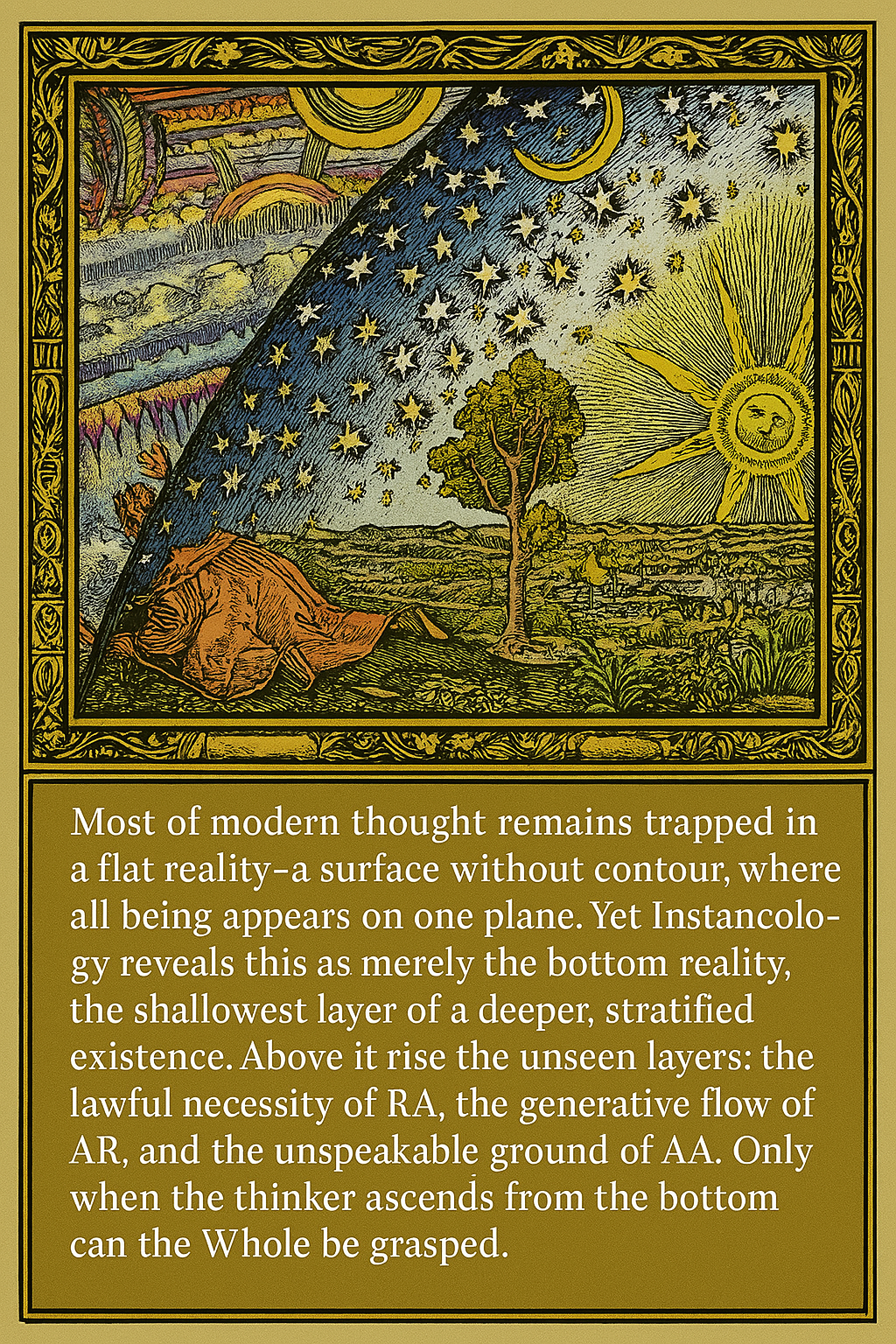
On the Dual Nature of the Absolute
On the Dual Nature of the Absolute: In Human and Ontologically
There is a tension at the heart of human existence: we are finite beings who nevertheless reach for the infinite. We are temporal, yet we long for the timeless. We are structured within conditions, yet we sense something unconditioned. This tension is not accidental. It reveals what may be called the dual nature of the Absolute — one ontological, one human.
I. The Ontological Absolute
Ontologically, the Absolute is not a being among beings. It is not one “thing” within the inventory of reality. It does not compete with stars, laws, or consciousness. If it were describable as something, it would already belong to the realm of conditioned structures.
The ontological Absolute:
Is not spatial or temporal.
Is not definable within logical categories.
Is not a cause within a causal chain.
Is not falsifiable in the scientific sense.
It stands as the non-derivable ground of all derivable structures.
Whenever we trace structures—physical laws, logical systems, biological forms—we encounter a limit. A structure cannot ultimately ground itself without circularity or infinite regress. The Absolute, therefore, is not another structure but that which makes structure possible without itself being structural.
This Absolute is beyond the contrast of real vs. unreal. It is neither an object of knowledge nor an absence. Language fails not because the Absolute is vague, but because language itself belongs to the conditioned realm.
II. The Human Absolute
Yet the Absolute is not merely a metaphysical abstraction. It manifests within human existence in a peculiar way.
Humans alone among known beings ask:
Why is there something rather than nothing?
What is the ultimate ground of reality?
What is the meaning of existence?
This questioning is not practical; it does not help survival directly. It reveals something “absolute” within the human condition — a capacity that exceeds immediate biological necessity.
In human experience, the Absolute appears as:
The drive toward ultimate truth.
The dissatisfaction with partial explanations.
The intuition that no finite structure is final.
The longing for permanence within impermanence.
Here, the Absolute is not an object but a tension. It is experienced as a struggle between relativeness and ultimacy. Humans are structurally relative, yet existentially absolute-seeking.
III. The Duality Explained
The dual nature of the Absolute can be summarized:
Dimension
Character of the Absolute
Ontological
Beyond structure, beyond language, ground of possibility
Human
Experienced as aspiration, intuition, dissatisfaction with finitude
Ontologically, the Absolute is silent.
In humans, the Absolute becomes restless.
This is why metaphysics exists at all. The human mind is structured, but it senses that structure is not ultimate. This sensing is not fully rational in the discursive sense. It may come through intuition, insight, or what some traditions call enlightenment.
The ontological Absolute does not need humans.
But humans, in a sense, cannot avoid it.
IV. The Paradox
The Absolute is both present and inaccessible.
Present, because every structure presupposes it.
Inaccessible, because it cannot be objectified.
In human life, this duality becomes existential:
We live within limits.
We seek what has no limit.
This duality generates philosophy, religion, art, and even science. It is the engine of civilization. Without the Absolute dimension within humans, culture would collapse into mere functionality.
V. Conclusion
The Absolute has a dual nature:
Ontologically, it is beyond being and non-being as we conceive them.
Humanly, it is the irreducible drive toward ultimacy.
The first is silent.
The second is restless.
And perhaps the entire history of metaphysics is nothing more than the attempt of the restless finite to gesture toward the silent infinite.
Whether one calls it Absolute, Dao, Ground, or otherwise, the essential point remains: the Absolute is not an object among objects — yet without it, neither objects nor questioning subjects would stand.
The dual nature of the Absolute is thus not a contradiction, but a mirror:
The ontological ground reflected in the human longing for it.