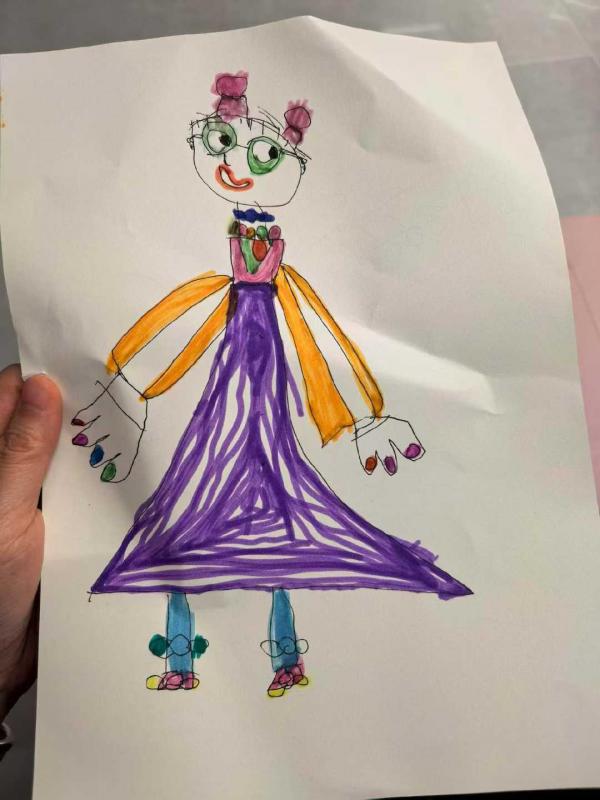
《小女孩眼里的小姨》(中英文)
《小女孩眼里的小姨》
她总是这样
像支被彩虹咬过的铅笔,
从门口一闪,
把整个房间点亮成一幅不守规矩的画。
头发被魔力驱使
如两朵随时会飞走的紫色云团,
在空气里轻轻晃着,
像在听只有她能听见的音乐。
眼睛大得发亮,
似两颗会发光的玻璃珠。
小女孩觉得,
那里面藏着一个秘密世界——
有跳舞的小猫,会说话的星星,
还有永远不会生气的大人。
衣服总是穿错季节:
冬天披着春天的紫,
夏天挂着秋天的橙。
像把四季都借来穿在身上,
只为逗小女孩笑。
手指涂着五种颜色,
像盒随时打开的蜡笔。
她不画纸,
画空气,画风,
画小女孩的额头,
画一个看不见的祝福。
走路时,
鞋子会发出小小的叮当声。
不是金属的,
是那种“今天会很好”的声音——
只有孩子听得见。
小女孩觉得,
小姨不像大人。
大人不会这么五彩缤纷,
不会这样不讲规则地微笑,
也不会把世界当成一张白纸。
她更像——
从童话里悄悄跑出来的人,
忘了关门,
顺手把一点魔法
带进了现实。
小女孩知道,
等她长大,
世界会灰一点、硬一点、窄一点。
她也知道,
只要想起那双绿色玻璃珠一样的眼睛,
想起那双涂着彩色指甲的手,
想起那件紫和橙混在一起的怪衣服——
她就能重新相信:
世界是可以被重新涂色的。
小姨教她的不是画画,
而是——
在长大的路上,
偷偷留住一点不长大的能力。
The Aunt Through a Little Girl’s Eyes
She is always like this—
like a pencil nibbled by a rainbow,
darting in through the doorway,
and in one bright stroke
turning the whole room
into a painting that refuses to behave.
Her hair seems moved by some quiet spell,
two violet clouds on the verge of flight,
swaying in the air
as if listening
to music meant for her alone.
Her eyes are wide and luminous—
two glass marbles holding their own light.
The little girl is certain
there is a secret world inside them:
cats that dance, stars that speak,
and grown-ups who never raise their voices.
She dresses in the wrong season on purpose—
wearing spring’s lilac in winter,
draping autumn’s amber across summer.
As though she has borrowed all four seasons
and put them on at once
just to coax a smile.
Her fingers are painted five different colors,
like a box of crayons forever open.
She does not draw on paper.
She draws on air, on wind,
on the little girl’s forehead—
sketching invisible blessings.
When she walks,
her shoes make a soft chiming sound.
Not metal—
but the sound of today will be kind.
Only children can hear it.
The little girl knows
her aunt is not quite like other adults.
Adults are rarely so vivid,
so gloriously out of bounds.
They do not smile without permission.
They do not treat the world
as a blank page waiting for color.
She is more like someone
who slipped quietly out of a fairy tale,
forgot to shut the door,
and carried a trace of magic
into the ordinary air.
The little girl also knows
that when she grows up,
the world will turn a little grayer,
a little harder,
a little narrower.
But she knows something else, too:
If she remembers those green-glass eyes,
those hands tipped with color,
that improbable dress
where purple and orange make peace—
she will remember
that the world can be recolored.
What her aunt taught her
was not how to draw.
It was this—
how, along the long road of growing up,
to keep hidden within herself
the quiet power
of not entirely growing old.