Why AA Cannot Be Falsified
Why AA Cannot Be Falsified
1. Clarifying the Scope
In Instancology, almost everything is open to falsification:
The structure of WI (World Instance)
The RA / AR / RR distinctions
The epistemological tools
Applications in science, language, logic, cognition
Even the claim that structure cannot self-ground
All of these belong to structure.
And what belongs to structure is analyzable, testable, and contestable.
AA is the only exception.
The question is: why?
2. Falsification Requires Structure
To falsify something, three conditions are required:
A proposition
A defined domain
A possible counter-condition
All three require structure.
Falsification operates inside:
language
logic
conceptual differentiation
identity and negation
It presupposes a structured field in which claims can be evaluated.
AA is explicitly defined as non-structural.
Therefore, AA cannot be falsified for the same reason that:
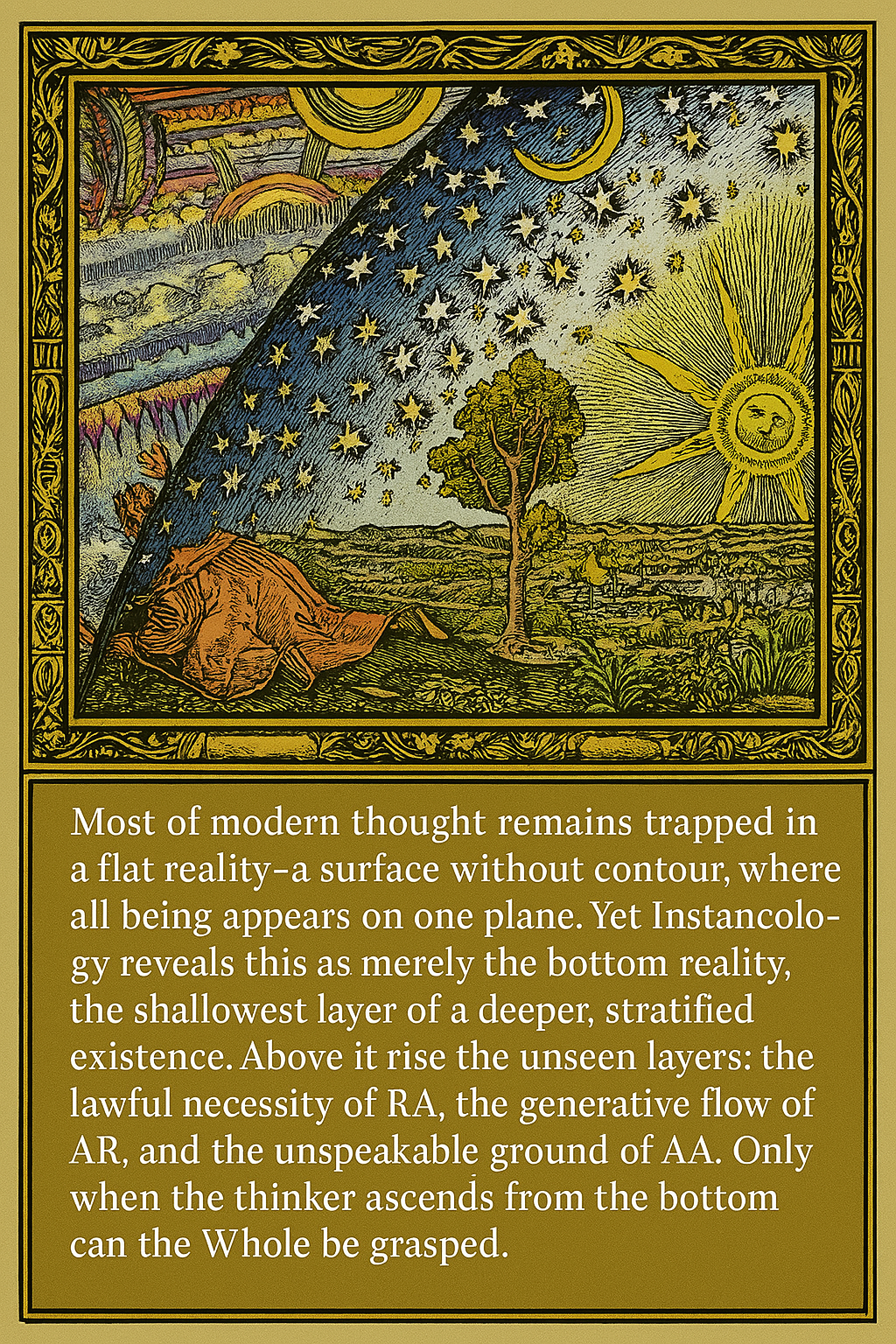
A horizon cannot be stepped outside of.
The background of a frame cannot be framed.
Falsification applies only to what can be structured.
AA is not.
3. AA Is Not a Hypothesis
AA is not:
A being
A cause
A force
A creator
A principle
An entity
An infinite object
It is not even a positive claim.
It is the recognition that:
The root of structure cannot be one more structure.
If someone demonstrates that structure can self-ground coherently,
AA collapses.
So the falsifiable point lies not in AA itself,
but in the logical argument that demands non-structural termination.
AA is the terminus of that argument,
not an additional structural assertion.
4. The Regress Issue
Critics often say:
“Why not infinite regress?”
Mathematically, infinite series are coherent.
But existentially, endless structural grounding is like Zeno’s paradox.
Zeno of Elea showed how language can divide motion infinitely.
But reality is not infinitely subdivided.
Infinite decomposition is a linguistic operation.
Similarly:
Endless structural regress is a symbolic chase.
It never changes explanatory type.
If grounding never exits structure,
grounding never occurs.
Thus:
Termination requires categorical break.
AA is that break.
5. Why AA Is Not Self-Sealing
A common objection:
“If AA cannot be falsified, isn’t it dogmatic?”
No.
AA is not immune because it is protected.
It is outside falsification because falsification itself is structural.
This is similar — though not identical — to how
Immanuel Kant treated transcendental conditions
or how
Martin Heidegger treated the Being-question.
But AA goes further.
AA is not a transcendental structure.
AA is the recognition that structure cannot ultimately ground structure.
If someone shows structure can self-ground without regress,
AA is unnecessary.
Therefore, what is testable is:
The impossibility of brute structural grounding.
AA itself is not a hypothesis.
It is the logical consequence if structure fails to terminate itself.
6. Paradox and Language
You have argued:
Paradox exists in language, not in reality.
Russell’s paradox is symbolic.
Zeno’s paradox is symbolic.
Similarly:
If someone says, “A limitless AA must impose limits on WI,”
That contradiction arises from treating AA as something.
But AA is not something.
All contradictions about AA arise from re-structuring it.
AA is not beyond because it is infinite.
AA is beyond because it is not within structural categorization at all.
7. The Final Position
AA cannot be falsified because:
It is not an object.
It is not a proposition about a thing.
It is not within existential category.
It is not a structural element.
It is not even properly describable.
It is the termination of structural chase.
Everything else in Instancology is open to falsification.
AA is not falsifiable because falsification belongs to WI.
AA marks the boundary of WI.
If structure can ground itself, AA disappears.
If structure cannot ground itself, AA is necessary.
That is the entire logical landscape.
No mysticism.
No theology.
No shield.
Only the demand that structure cannot be its own ultimate explanation.
And that demand — not AA itself — is where the real debate lies.