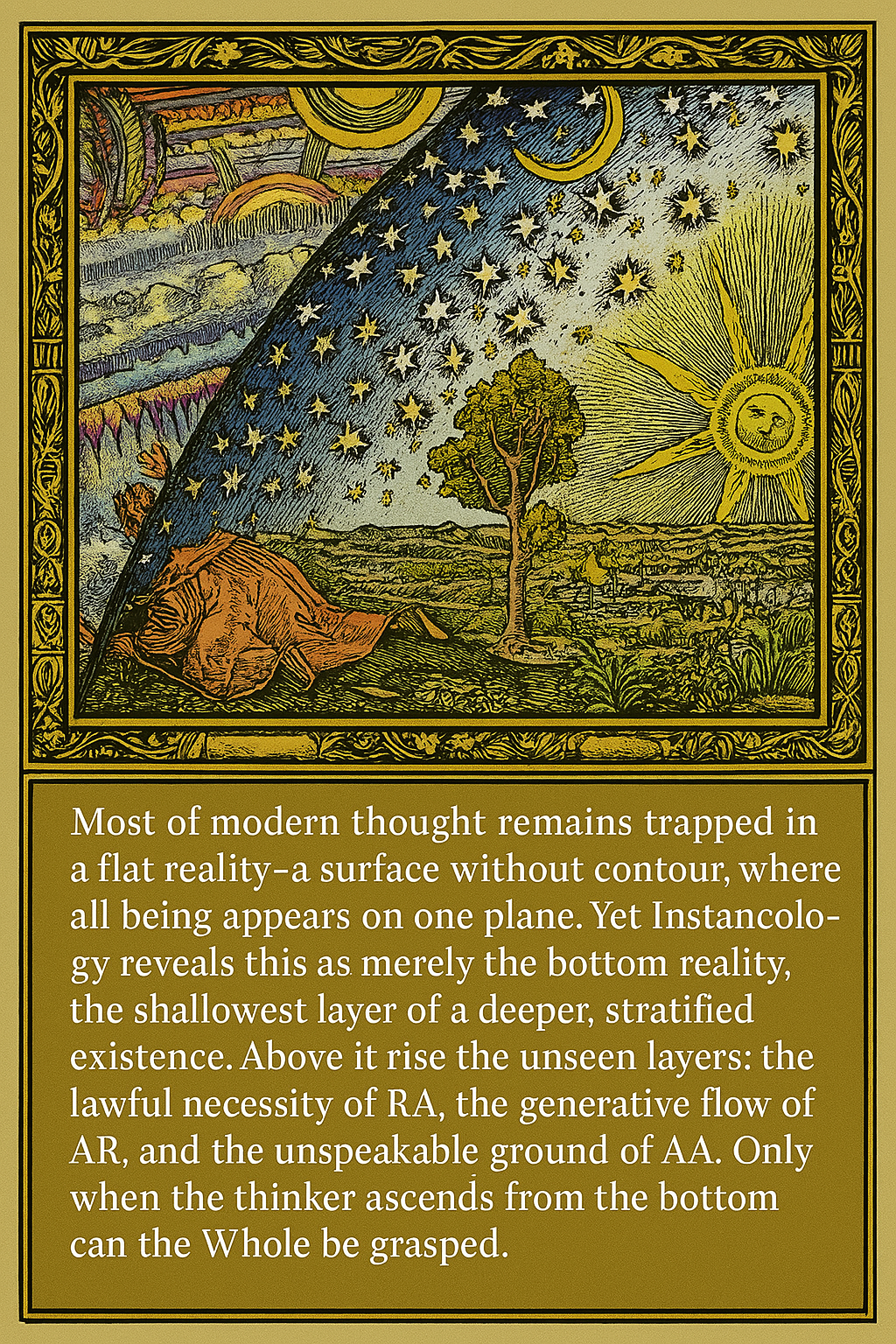
Why Human Life Can Last Forever in the Future
Why Human Life Can Last Forever in the Future — An Instancological View
1. The mistaken belief: mortality as a biological necessity
Most people intuitively believe that human life must end because the body is biological. Cells age, organs fail, entropy accumulates—so death seems inevitable. This belief feels scientific, but it rests on a hidden assumption:
Life is nothing more than the accumulation and persistence of biological parts.
Instancology challenges this assumption at its root. Once that assumption is removed, mortality is no longer a logical necessity, but a contingent historical condition.
2. Life is not cumulative of cells
From an Instancological standpoint, cells belong to AR (Absolute Relative)—the domain of natural, material instances. Cells are:
replaceable
divisible
mortal
locally causal
Yet life itself does not behave like cells:
life does not decrease proportionally as cells are lost
life persists through complete cellular turnover
life ends abruptly, not gradually
This already tells us something decisive:
Life is not the sum of cells.
Cells are necessary conditions for life to operate in the material world, but they are never sufficient to generate or define life as a whole.
3. The whole of life belongs to RA, not AR
Instancology distinguishes between AR (natural instances) and RA (Relatively Absolute)—the domain of governing, non-material conditions such as laws, logic, mathematics, and life.
Life belongs to RA, not because it is mystical, but because it has the defining properties of RA:
it is non-material
it is non-cumulative
it governs material processes
it cannot be assembled bottom-up
it disappears instantly when global unity collapses
Life is issued from RA into AR, where it expresses itself through biological cells. This issuing is not causal in the mechanical sense, but ontological: life exists as a whole before and beyond its material carriers.
4. Why no cell is intrinsically tied to life
A crucial discovery from our discussion is this:
No individual cell has a direct, intrinsic relation to the living whole.
Even cells that appear “critical” (e.g., brainstem neurons) are not ontologically special. Their importance is positional and organizational, not essential. When such cells are lost today, life ends—not because life was in them, but because current medicine cannot re-establish the whole–body relation once it collapses.
This distinction is fundamental:
Cells can be replaced
Roles can, in principle, be re-instantiated
The living whole is not bound to any specific material identity
Therefore, cell death does not logically imply life death.
5. Death as a failure mode, not a requirement
From an Instancological view, death is not a built-in necessity of life. It is a failure mode that occurs when:
the whole–body unity collapses irreversibly
organizational continuity is broken beyond repair
This explains why:
massive tissue loss can be survived
tiny damage in the wrong place can be fatal
replacing organs does not recreate life after death
Death marks the loss of sufficiency, not the exhaustion of matter.
6. The principle of perfect replacement
Now we can state the core theorem clearly.
Because:
Life is not cumulative of cells
No cell is intrinsically tied to the whole
All material components are, in principle, replaceable
Life persists as long as whole-level unity is preserved
It follows that:
If all cells can be replaced in a way that never breaks the whole–body unity, human life has no intrinsic temporal limit.
This is not a technological claim; it is a structural one.
Instancology does not say immortality is easy.
It says immortality is not forbidden by the nature of life.
7. Why this does not violate entropy
A common objection is entropy. But this objection misunderstands levels.
Entropy governs material processes in AR.
Life, as an RA-issued whole, locally resists entropy by continuously reorganizing matter.
Just as entropy forbids perpetual motion machines but allows living systems to persist through energy flow, nothing in entropy forbids indefinite continuation of a living whole, provided organizational continuity is maintained.
The analogy is exact:
Entropy ended the dream of perpetual motion, not of motion itself.
Instancology ends the dream of assembling life, not of sustaining it.
8. Immortality as a conditional possibility
Instancology does not claim:
humans will certainly live forever
immortality is guaranteed
technology alone is sufficient
What it claims is more precise and more powerful:
Human mortality is contingent, not necessary.
If future civilization learns how to:
preserve whole-level integration
replace cells without transitional collapse
prevent irreversible organizational failure
Then nothing in the structure of life itself requires death.
9. Final conclusion
From an Instancological view, the possibility of human immortality rests on a single, profound fact:
Life is a non-material whole issued from RA, while cells are replaceable material carriers in AR.
Because no cell has a direct, intrinsic relation to life as a whole, life is not bound to the lifespan of any cell. Under perfect conditions—where cellular replacement never breaks whole-level unity—human life can, in principle, last forever.
This is not science fiction.
It is a logical consequence of understanding what life is.