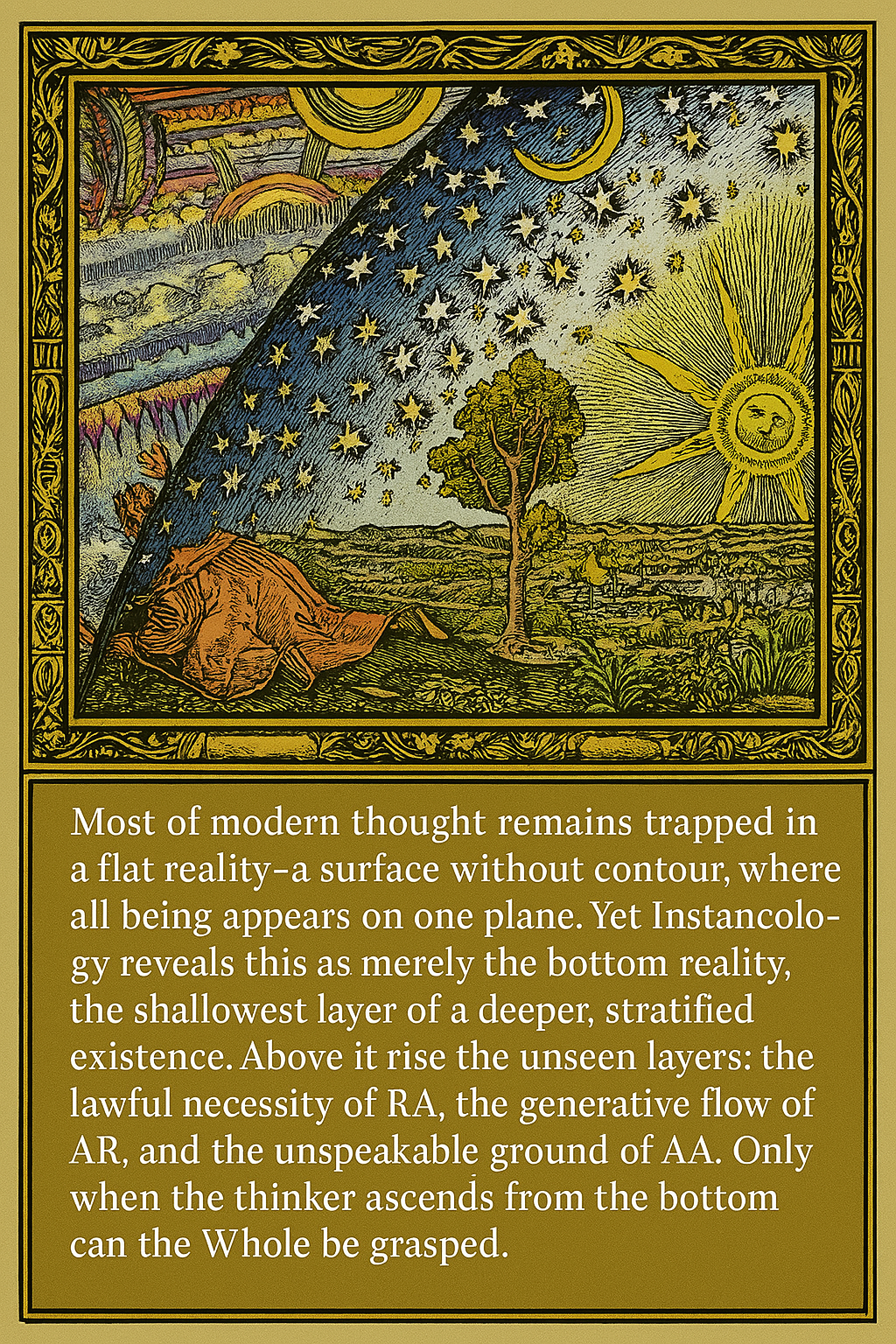
Why Science Cannot Reach AA — An Instancological V
Why Science Cannot Reach AA — An Instancological View
From the perspective of Instancology, science is one of humanity’s greatest achievements—yet it is structurally incapable of reaching AA (the Absolutely Absolute). This is not a criticism of science’s rigor or power; it is a clarification of ontological limits. Science operates flawlessly within reality, but AA is not within reality. The boundary is structural, not methodological.
1. Science Presupposes Reality; AA Is the Condition of Reality
Science begins only after something is already given: space, time, matter, energy, laws, fields, probabilities. Its task is to model, explain, and predict relations inside the given world. Even the most radical theories—quantum fields, spacetime curvature, multiverses—remain entities or structures within existence.
AA, however, is not an entity, not a field, not a law, not a background substrate. AA is the condition for any instance whatsoever, including the universe itself. Science can analyze what is, but AA concerns why there is anything at all to analyze. That question lies prior to all scientific objects.
2. Science Always Works in the Relative Domain (AR / RR)
Instancology distinguishes four ontological quadrants:
RR (Relative–Relative): human constructs, models, languages, theories
AR (Absolute–Relative): natural instances—matter, life, energy, spacetime
RA (Relative–Absolute): laws, logic, mathematics (non-empirical but operative)
AA (Absolute–Absolute): the unspeakable, unconditioned background
Science operates across RR (theories, equations, models) and AR (nature), occasionally touching RA through mathematics and logic. But AA is not a higher layer of RA. It is not “more fundamental physics.” It is not part of the ladder at all.
No extension of scientific depth—smaller particles, earlier cosmology, more unified equations—can cross the ontological boundary into AA, because AA is not something inside the hierarchy science explores.
3. Explanation Cannot Explain Its Own Possibility
Every scientific explanation presupposes:
logical consistency
mathematical structure
law-like regularity
intelligibility of nature
But science cannot explain why explanation itself is possible.
Why do laws hold at all?
Why does mathematics apply to reality?
Why is the universe intelligible rather than chaotic or absent?
These are not unanswered scientific questions; they are pre-scientific conditions. To explain them scientifically would require science to step outside the very conditions that make science possible, which is a logical impossibility.
This mirrors insights hinted at by figures like Immanuel Kant, who saw the limits of reason, and Kurt G?del, who showed that no formal system can ground itself completely. Instancology goes further: it identifies the ontological reason for this impossibility—AA.
4. Science Requires Objects; AA Is Not an Object
Science progresses by objectification: even abstract entities (fields, waves, functions) are treated as objects of inquiry. Measurement, falsification, and modeling all require something that can be distinguished from something else.
AA, by definition, cannot be objectified.
It has no properties, no boundaries, no relations.
It cannot be measured, modeled, or represented.
The moment AA is treated as an object—“a thing,” “a cause,” “a substance,” “a god,” or “a field”—it is no longer AA but has already fallen into AR or RA. Science can only reach what can be made into an object. AA cannot.
5. Even Ultimate Science Stops at a Boundary
One might imagine a “final theory of everything.” Instancology does not deny this possibility—such a theory would belong to RA, a complete system of laws governing an instance of reality.
But even a final theory leaves one question untouched:
Why is there this instance governed by these laws rather than nothing, or something else?
That question is not empirical, not mathematical, not theoretical. It marks the termination of explanation itself. Naming that termination—without turning it into a thing—is precisely what Instancology calls AA.
6. Why This Is Not a Failure of Science
Science does not fail by not reaching AA—just as eyesight does not fail by not hearing sound. Each faculty has a domain of validity.
Science excels at:
discovering patterns within reality
formulating laws
predicting outcomes
expanding control and understanding of the AR world
AA belongs to a different epistemic mode altogether—what Instancology identifies as Absolute WuXing (AW): realization, not inference; recognition, not construction.
Expecting science to reach AA is a category mistake.
7. Conclusion: Science Ends Where AA Begins
Science ends not because it is weak, but because it is precise. It reaches the edge of explanation and stops—rightly. At that edge, Instancology does not offer a new theory, belief, or hypothesis. It offers a recognition:
AA is not reality
AA is not explainable
AA is the condition for any reality and any explanation
Science maps the world.
Instancology clarifies why there is a world to map at all.
That boundary is not bridgeable—
and it was never meant to be.