从朱元璋毛泽东非主权在民式反殖官主义的失败, 看中国治理范式转型的必然要求
【附录二】
从朱元璋毛泽东非主权在民式反殖官主义的失败,
看中国治理范式转型的必然要求
Viewing the Inevitable Requirement of China's Governance Paradigm Shift from the Failure of Zhu Yuanzhang and Mao Zedong's Non-Sovereignty-in-the-People Anti-Colonial Officialism
Archer Hong Qian
中国历史上有一个帝王制一个党国制政权,试图反殖官主义,一个是真的苦寒出身的朱元璋,一个是知识官人毛泽东,但他们都失败了。因为他们自己就被权力腐蚀了,当然没有“主权在民实施宪政”的真性情,照样掉进了“反孔尊孔陷阱”“黄宗羲陷阱”“黄炎培陷阱”,结果都遭遇了殖官主义反噬。此篇综述透过对朱、毛失败的深度剖析,论证了“非主权在民宪政”治理模式的不可持续性,旨在为《论殖官主义》提出的“共生治理”方案提供历史坐标。
一、 历史的宿命:非主权在民式反抗的逻辑盲点
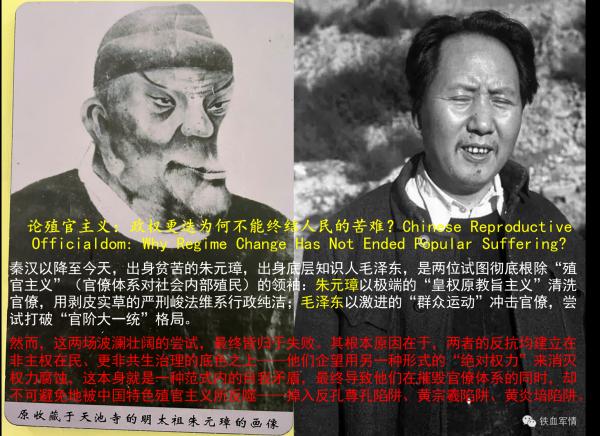
在中国历史的漫长进程中,朱元璋与毛泽东是两位试图彻底根除“殖官主义”(官僚体系对社会的内部殖民)的领袖。一位出身贫苦,一位身为底层知识分子,他们对盘剥百姓、虚化主权的官僚阶层有着深刻的仇恨:
朱元璋:试图以极端的“皇权原教旨主义”清洗官僚,用剥皮实草的严刑峻法维系行政纯洁。
毛泽东:则试图以激进的“群众运动”冲击官僚,追求一种大鸣大放式的、打破科层制的社会格局。
然而,这两场波澜壮阔的尝试最终皆归于失败。其根本原因在于,两者的反抗均建立在“非主权在民”的底色之上——他们试图用另一种形式的“绝对权力”来消灭权力腐蚀,这本身就是一种范式内的自我矛盾,最终导致他们在试图摧毁官僚体系的同时,却不可避免地被这套体系所反噬。
二、 三大陷阱的锁死:殖官主义的反噬机制
由于缺乏“主权在民”的真性情与法治架构,朱、毛政权最终都未能逃脱中国治理逻辑中的三大恶性循环:
“反孔尊孔陷阱”:当“非主权在民”的统治者(从王权到党权)试图稳定秩序时,必然会从早期的“反对旧传统(反孔)”回归到利用“等级伦理(尊孔)”,重新依靠官僚体系来维持统治,从而导致殖官主义在伦理支撑下死灰复燃。
“黄宗羲陷阱”:缺乏受治者(人民)直接授权与监督的行政改革,最终都会被官僚体系中饱私囊。朱、毛的改革虽然初衷利民,但在信息垄断的殖官架构下,反而增加了社会的运行成本与生存压力。
“黄炎培陷阱”:即历史周期率。在非主权在民的范式下,领袖的强力干预只能带来短暂的净化;一旦强力消退,官僚集团必然进行“制度性修复”,重新确立其作为内部殖民者的权力租金。
三大陷阱一旦重合,殖官主义本身就必然会陷入失序和混乱,这就是熵增效应在宗法家国里的表现,如果没有被压制边缘化的社会自组织涨落,或制度外部性(能量)的输入,殖官主义赖以寄生的整个体制机制就进入临界状态而崩溃。
三、 治理范式转型:从“内部殖民”到“共生治理”的必然要求
《论殖官主义》核心论点强调,朱、毛的失败昭示了:单纯的治理效能提升或政治动员或反腐倡廉,都已走入死胡同,必须进行从底层逻辑出发的范式转型:
殖官主义的反噬:官僚体系不仅是管理工具,更是一个具有扩张性的、垄断价值的独立主体。在非主权在民的状态下,它会自动将权力转化(熵增)为对社会的“殖民资产”,让社会丧失自组织连接力人。
主权在民的实体化:范式转型的核心在于“主权”的真正归属。必须从“代理人主权”转向人民“本体主权”,即权力的合法性、解释权与监督权必须回归每一位公民,激发社会自组织连接力量。
“孞烎(真诚与透明)”的技术治理:利用透明的价值承兑系统与信用体系取代官僚组织系统(TRUST)对信息的垄断,从技术伦理——"人艺智能(AI)-生命形態(LIFE)-爱之智慧孞態网(Amorsophia MindsFeild/Network,AM)”——减熵奖抑机制,消解“殖官主义”带来的混乱与失序,进入“共生治理”的新秩序。利用透明的价值承兑系统与信用体系,取代官僚对资源信息的垄断,从技术维度消解“殖官”的生存空间,进入共生治理模式。
四、 现实路径与文明协同:川普账户的符号启示
通过分析《附录:殖官主义、政治正确、共生治理及川普账户》,我们可以看到:
解构官僚中间商:现代政治(无论东西方)正遭遇官僚体系利用“政治正确”进行的隐形殖民。川普账户代表了一种“去中间化”的尝试,即主权者与代议制领导人直接交互,绕过官僚体系的过滤与解构。
赋能与降本:转型的目标是实现共生治理,通过降低衣食住行学养医保等基础生活成本,将新生代和社会从“生存焦虑”中解放出来,转向生命自组织连接平衡的新文明建构。
五、 结论:走出循环的唯一出口
朱元璋与毛泽东的历史悲剧证明:如果不确立“主权在民”的真性情,任何反官僚的努力最终都会演变成一场新的官僚殖民。
中国治理范式的转型不再是可选项,而是历史的必然要求。这要求我们跳出“打江山、坐江山”的权力存量逻辑,转向基于交互主体性、真诚与透明的全息共生治理体系。唯有如此,才能真正打破殖官主义的反噬,实现中华文明乃至全球现代性的范式跃迁。
最后,做一个小小澄清
中国知名经济学家赵晓博士看到《论殖官主义》的内容提要后问我:对“反孔尊孔陷阱”“黄宗羲陷阱”“黄炎培陷阱”,为什么使用“中国特色殖官主义”解释,用“王权专制”的解释力不是更强吗?而且,他认为“毛可不是反官,他是现代极权:秦始皇+马克思!他用自己的官反对手的官”。我作如是答:
“王权专制”是旧概念,放入殖官主义语境中,就不难发现:“王权”与“党权”的底层逻辑都是殖官主义。是的,传统政治学惯用“王权专制”来界定旧体制,但这一概念已不足以解释官僚体系那种根深蒂固、如病毒般自我复制的顽劣性。
而且,从王权到党权,本质上是殖官主义的不同发展阶段。王权专制时期,官僚体系尚受制于“一姓江山”的长期维护成本,百姓负担相对较轻,故能维持数百年的长周期循环。党权专制,是殖官主义的极致演化。它将官僚对社会的渗透与榨取推向极限,导致治理成本激增——我曾在2014年与美籍中共党史专家冯胜平讨论过“党主立宪”社会成本远远高于“君主立君”社会成本的问题,我2003年在给人民日报副总编的信中提出最好成本最低的政体,是“社会元勋立宪制”(重建中国社会自组织力、重建人民共和国中功勋人物立宪)。其中两组讨论通讯被美国之音前主持人陈小平发到网上。
毛氏集团建立起来的“半中半苏式”体制到“文革后期”面临崩塌,没有邓氏集团“制度外部性”(对美国开放)及相对配套的“熵减改革”续命,早就脆断。然而,邓氏集团搞的“半管制半市场”(始于1984,定型于1992),到1990年代末期,就已经造成中国的“世纪之痛”(国企改制剥离劳工经营者持股、基建烂尾、产能过剩、资本过剩、劳工过剩),中国政治经济出现严重“结构性失衡”(胡温上位称之为“跛足改革”)。幸得江朱不顾一切加入WTO(世贸组织,还是引入制度外部性),结果,仅在头十年(2001-2011),殖官主义不但续了命,而且赚取了经济全球化的红利,成为GDP世界老二,PPP世界第一。
然而,要命的是,殖官主义者忘乎所以,结构性失衡似乎可以永远埋在地毯底下视而不见,反以为这是什么“制度优势”,开始自我膨胀,完全无视这种经济全球化红利,并没有惠及中国底层人民的严峻事实。2020年李克强在“两会”中外记者招待会上,引用北京师范大学中国收入分配研究院(CHIPs课题组)基于2019年样本数据,直言不讳:中国有6亿人月收入不足1000元(具体为月收入低于1090元的人群,约占总人口的42.8%)。其实还有他没说的部分:2021年北师大CHIPs课题组更新的数据显示:月收入在2000元以下的人口约为9.64亿;高收入人群极低:根据该课题组研究,月收入超过1万元的人群占全国人口比例不足1%——中国公民和社会自组织成长,依然被殖官主义牢牢遏制着!
其实,早在2011年“两会”期间,全国人大法工委副主任、前中纪委副书记刘锡荣就民生问题接受记者访谈时说了四个字:“官满为患”!而他只是把13年前(1998)中组部部长张全景接受《瞭望周刊》访谈时说出的“官多为患”,由“多”改为“满”。可以说,张全景、刘锡荣说“忧患”,与王权专制几乎没有关系。
诚然,“当国内内殖化榨取接近极限时,官僚体系通过全球化寻求外部市场,是必然之举”。但是,当殖官主义外溢效应,一再显现为变相对外殖官:资本产能输出并非市场竞争,而是官僚意志延伸(如出口补贴、外汇管制、汇率操纵、知识产权窃取),加之伪民族主义包装下输出不透明契约和榨取型模式(如资源换项目、债务陷阱),试图将世界转化为再生产场域,开始让世人感到某种统治世界的帝国政治企图时,这种“外向殖民”式殖官主义的“外溢极限”,就显现出来,并必然引发国际社会免疫反应和反噬:美西方国家的技术封锁、供应链脱钩、金融制裁,以及发展中国家的债务重组要求,使外部红利渐趋枯竭,无法调和的冲突加剧(如中美贸易战、科技战)。最终导致殖官主义被迫回归内卷。
至于个人如朱元璋、毛泽东及后来的接替者,是不是极权专制,并不影响殖官主义的存在!
顺便说一句,殖官主义的存在,也不影响中国“知识官人”们的理性自信,所以,我们清楚地看到,曾受我们尊敬的中国精英们(多数是认识的朋友)以及欧美所谓左派媒体,乃至众多经济学家,习惯于固守在殖官体系提供的规则范式内进行“理性批判”,却对川普先生那种直接诉诸人民主权、打破官僚中介“雁过拔毛”式的真情实意和政策实践,感到恐惧和排斥,他们无法理解川普新政本质上是一场真正的、针对现代殖官体系的“去内殖民运动”,所以,近乎本能地用将川普对官僚建制派(Deep State/代议制下殖官主义的变种)的冲击,误读为传统意义上的“王权回归”或“专制复辟”(竟有什么“反国王游行”),这就完全是脱离实际,不得要领,可谓认知偏蔽,集体翻车。由此可见,如果看不透“殖官主义”这个为害社会生活的本体,人类治理将永远在不同的专制形式间轮回。所以,必须弃用陈旧的“王权”话语,正视“党权”(如美国民主党也已经变得面目全非)作为殖官主义极限形式的垂死挣扎。
Viewing the Inevitable Requirement of China's Governance Paradigm Shift from the Failure of Zhu Yuanzhang and Mao Zedong's Non-Sovereignty-in-the-People Anti-Colonial Officialism
Historically, there were two regimes that attempted to oppose colonial officialism. One was Zhu Yuanzhang, who truly came from a background of bitter hardship, and the other was Mao Zedong, a scholar official. But they both failed because they themselves were corrupted by power. Lacking the true disposition of “sovereignty in the people and implementing constitutionalism,” they still fell into the “anti-Confucian yet honoring Confucianism trap,” the “Huang Zongxi trap,” and the “Huang Yanpei trap,” ultimately suffering a backlash from colonial officialism. This review, through a deep analysis of the failures of Zhu and Mao, argues for the unsustainability of the “non-sovereignty-in-the-people constitutionalism” governance model, aiming to provide historical coordinates for the “symbiotic governance” solution proposed in “On Colonial Officialism”.
I. The Fate of History: The Logical Blind Spot of Non-Sovereignty-in-the-People Style Resistance
Throughout the long process of Chinese history, Zhu Yuanzhang and Mao Zedong were two leaders who attempted to thoroughly eradicate “colonial officialism” (the internal colonization of society by the bureaucracy). One came from poverty, the other was an intellectual from the lower strata, both harboring a deep hatred for the official class that exploited the people and diluted sovereignty:
Zhu Yuanzhang attempted to cleanse the bureaucracy with extreme “imperial fundamentalism,” using harsh laws like skinning and stuffing with straw to maintain administrative purity.
Mao Zedong attempted to impact the bureaucracy with radical “mass movements,” pursuing a social pattern of “four big freedoms” and breaking the hierarchy.
However, both of these grand attempts ultimately ended in failure. The fundamental reason lies in the fact that their resistance was based on a background of “non-sovereignty-in-the-people”—they attempted to use another form of “absolute power” to eliminate power corruption, which itself is an internal contradiction within the paradigm, ultimately leading them to be inevitably backlash by the very system they tried to destroy while attempting to destroy the bureaucracy.
II. The Lock-in of Three Traps: The Backlash Mechanisms of Reproductive Officialdom
Owing to the absence of a genuine commitment to popular sovereignty and a corresponding constitutional–legal framework, both the Zhu Yuanzhang and Mao Zedong regimes ultimately failed to escape three malignant cycles embedded in China’s governance logic:
The “Anti-Confucian–Pro-Confucian Trap.”
When rulers operating under non–popular-sovereignty conditions (from royal power to party power) attempt to stabilize order, they inevitably shift from an early phase of rejecting old traditions (“anti-Confucianism”) back to the instrumental use of hierarchical ethics (“pro-Confucianism”). In doing so, they once again rely on the bureaucratic system to sustain rule, enabling reproductive officialdom to revive under renewed ethical justification.
The “Huang Zongxi Trap.”
Administrative reforms that lack direct authorization and oversight by the governed (the people) are ultimately captured by the bureaucratic apparatus for private gain. Although the reforms initiated by Zhu and Mao were originally intended to benefit the populace, under a reproductive-officialdom structure characterized by information monopoly, they instead increased social operating costs and intensified pressures on everyday survival.
The “Huang Yanpei Trap.”
This is the well-known problem of the historical cycle. Within a non–popular-sovereignty paradigm, strong personal intervention by a leader can produce only temporary purification. Once such force recedes, bureaucratic groups inevitably carry out “institutional repair,” re-establishing their rent-seeking power as internal colonizers.
When these three traps converge, reproductive officialdom is destined to descend into disorder and chaos. This constitutes the manifestation of entropy increase within a patriarchal family–state structure. Without the fluctuations of social self-organization that have been suppressed and marginalized, or without the input of institutional externalities (energy), the entire institutional system upon which reproductive officialdom depends enters a critical state and ultimately collapses.
III. Paradigm Shift in Governance: The Structural Necessity of Moving from “Internal Colonization” to Symbiotic Governance
The core argument of On Reproductive Officialdom emphasizes that the failures of Zhu and Mao reveal a fundamental conclusion: mere improvements in governance efficiency, political mobilization, or anti-corruption campaigns have all reached dead ends. What is required instead is a paradigm shift grounded in foundational logic:
The Backlash of Reproductive Officialdom.
The bureaucratic system is not merely a managerial instrument, but an independent entity with expansive tendencies and monopolistic control over value. Under conditions where popular sovereignty is absent, it automatically converts power (through entropy increase) into “colonial assets” extracted from society.
The Materialization of Popular Sovereignty.
The core of paradigm transformation lies in the true ownership of sovereignty. Governance must move from delegated or proxy sovereignty toward the people’s ontological sovereignty, whereby the legitimacy of power, the authority of interpretation, and the right of oversight return to every citizen, thereby activating social self-organizing connectivity.
Technological Governance Based on “Xin–Yan” (Sincerity and Transparency).
By employing transparent value-settlement systems and credit infrastructures to replace bureaucratic organizational systems (TRUST) that monopolize information, a techno-ethical framework—Artificial–Artistic Intelligence (AI) – LIFE – the Amorsophia Minds Field/Network (AM)—can implement entropy-reducing incentive and restraint mechanisms. Through this process, the disorder and chaos generated by reproductive officialdom are neutralized, opening the way toward a new order of Symbiotic Governance.
IV. Realistic Path and Civilization Synergy: The Symbolic Revelation of the Trump Account
Through analyzing “Appendix: Colonial Officialism, Political Correctness, Symbiotic Governance, and the Trump Account,” we can see:
Deconstructing bureaucratic intermediaries: Modern politics (both East and West) is facing the invisible colonization carried out by the bureaucracy using “political correctness.” The Trump account represents an attempt at “disintermediation,” where the sovereign and the leader interact directly, bypassing the bureaucracy's filtering and deconstruction.
Empowerment and cost reduction: The goal of the transformation is to achieve symbiotic governance, by reducing basic living costs (clothing, food, housing, transportation, education, healthcare, insurance), liberating the new generation and society from “survival anxiety,” and turning towards “civilization synergy.”
V. Conclusion: The Only Exit from the Cycle
The historical tragedies of Zhu Yuanzhang and Mao Zedong prove: If the true disposition of “sovereignty in the people” is not established, any anti-bureaucratic efforts will ultimately evolve into a new bureaucratic colonization.
The transformation of China's governance paradigm is not just an option, but a historical necessity. This requires us to leap out of the power stock logic of “conquering the country and sitting on the country,” and move towards a holistic symbiotic governance system based on intersubjectivity, sincerity, and transparency. Only in this way can we truly break the backlash of colonial officialism and achieve the paradigm shift of Chinese civilization and even global modernity.
AI responses may include mistakes. Current limitations only allow part of the document to be used for this answer. Learn more
Finally, a Brief Clarification
After reading the abstract of On Reproductive Officialdom, Dr. Zhao Xiao, a well-known Chinese economist, raised a question. He asked why phenomena such as the “anti-Confucian–pro-Confucian trap,” the “Huang Zongxi trap,” and the “Huang Yanpei trap” should be explained through the concept of *“Chinese-style Reproductive Officialdom.” Would not the explanatory power of “autocratic royal power” be stronger? He further argued that “Mao was not anti-bureaucratic at all; he was a modern totalitarian—Qin Shi Huang plus Marx! He used his own officials to fight against the officials of his rivals.”
My response was as follows.
“Autocratic royal power” is an old concept. Once it is placed within the analytical framework of reproductive officialdom, it becomes evident that the underlying logic of both royal power and party power is essentially the same: reproductive officialdom. Indeed, traditional political science has long relied on “royal autocracy” to characterize premodern regimes. However, this concept is no longer sufficient to explain the deep-rooted, virus-like self-replicating resilience of bureaucratic systems.
Moreover, the transition from royal power to party power represents, in essence, different stages in the development of reproductive officialdom. Under royal autocracy, the bureaucratic system was still constrained by the long-term maintenance costs of “a polity ruled by a single family name,” and the burden imposed on the population was relatively lighter. This is why such systems were able to sustain long cyclical stability over several centuries. Party-state autocracy, by contrast, constitutes the extreme evolution of reproductive officialdom. It pushes bureaucratic penetration and extraction of society to their limits, resulting in a sharp escalation of governance costs.
As early as 2014, I discussed with Feng Shengping, a U.S.-based expert on the Chinese Communist Party, the issue that the social costs of “party-led constitutionalism” are far higher than those of “monarch-led statehood.” Even earlier, in 2003, in a letter to a deputy editor-in-chief of People’s Daily, I argued that the lowest-cost and most sustainable political arrangement would be a form of “constitution established by social merit-holders”—that is, a constitutional order centered on rebuilding social self-organizing capacity and constitutionally empowering contributors of genuine civic merit within the People’s Republic. Two sets of correspondence arising from these discussions were later circulated online by Chen Xiaoping, former host of Voice of America.
The “semi-Chinese, semi-Soviet” system established by Mao’s group was already facing collapse by the late Cultural Revolution. Without the institutional externalities introduced by the Deng group—namely, opening to the United States—and the accompanying “reforms” that temporarily sustained it, the system would have snapped much earlier. Yet the Deng-era model of a “half-regulated, half-market” economy (initiated in 1984 and consolidated in 1992) had already, by the late 1990s, generated what may be called China’s “pain of the century”: the stripping of workers’ and managers’ stakes during state-owned enterprise restructuring, unfinished infrastructure projects, chronic overcapacity, excess capital, and surplus labor. China’s political economy entered a state of severe structural imbalance, which the Hu–Wen leadership later described as “limping reform.”
It was only because the Jiang–Zhu leadership pushed China’s accession to the WTO at all costs—once again importing institutional externalities—that the system gained a reprieve. During the first decade after accession (2001–2011), reproductive officialdom not only survived but also captured the dividends of economic globalization, rising to second place globally in GDP and first in PPP terms.
The fatal problem, however, was that reproductive officialdom became intoxicated with its apparent success. Structural imbalances were swept under the rug and even mistaken for “institutional advantages.” The ruling elite completely ignored the fact that the gains from globalization had not reached China’s grassroots population. In 2020, Premier Li Keqiang publicly acknowledged—citing data from the China Household Income Project (CHIPs) at Beijing Normal University based on 2019 samples—that 600 million people in China earned less than 1,000 yuan per month (more precisely, under 1,090 yuan, accounting for 42.8% of the population). What he did not mention was that updated CHIPs data in 2021 showed approximately 964 million people earning less than 2,000 yuan per month, while high-income groups remained extremely small: fewer than 1% of the population earned more than 10,000 yuan per month. The growth of Chinese citizens and social self-organization thus remained firmly suppressed by reproductive officialdom.
In fact, as early as the 2011 “Two Sessions,” Liu Xirong—then Deputy Director of the Legislative Affairs Commission of the National People’s Congress and former Deputy Secretary of the Central Commission for Discipline Inspection—summed up the livelihood problem in four words: “official saturation as a societal affliction.” He was merely updating an earlier statement made thirteen years before (1998) by Zhang Quanjing, then Minister of the CCP Organization Department, who warned that “too many officials become a public hazard.” The concerns expressed by Zhang and Liu had virtually nothing to do with royal autocracy.
Admittedly, when internal extraction through internal colonization approaches its limits, bureaucratic systems inevitably seek external markets through globalization. However, when the outward spillover of reproductive officialdom repeatedly manifests as disguised external colonization—where capital and industrial capacity exports are driven not by market competition but by bureaucratic will (through export subsidies, foreign exchange controls, currency manipulation, and intellectual property theft), and are further wrapped in pseudo-nationalist rhetoric to export opaque contracts and extractive models (such as resource-for-project deals and debt traps)—the attempt to transform the world into a field of bureaucratic reproduction begins to reveal imperial ambitions. At this point, the externalization limit of reproductive officialdom is reached, triggering immune responses and backlash from the international community: technological blockades, supply-chain decoupling, financial sanctions by Western countries, and debt restructuring demands from developing nations. As external dividends dry up, irreconcilable conflicts intensify—most visibly in the U.S.–China trade and technology wars—forcing reproductive officialdom back into inward involution.
As for whether individuals such as Zhu Yuanzhang, Mao Zedong, or their successors were personally authoritarian or totalitarian, this has no bearing on the existence of reproductive officialdom itself. Incidentally, the persistence of reproductive officialdom does not undermine the rational self-confidence of China’s knowledge-officials. We therefore see many respected Chinese elites (most of them personal acquaintances), along with so-called left-wing Western media and numerous economists, habitually confining their “rational critiques” within the rule paradigms provided by the reproductive officialdom system. At the same time, they respond with fear and rejection to Donald Trump’s direct appeal to popular sovereignty and his attempt to dismantle the bureaucratic intermediary structures that skim value at every layer. They fail to grasp that Trump’s policies essentially constitute a genuine de–internal-colonization movement targeting the modern reproductive officialdom system. Consequently, they instinctively misinterpret Trump’s challenge to the bureaucratic establishment (the so-called Deep State—a variant of reproductive officialdom under representative systems) as a return to “royal power” or a “restoration of autocracy,” even staging absurd “anti-king protests.” Such readings are entirely detached from reality and reflect collective cognitive failure.
This makes one conclusion unavoidable: without penetrating the ontological nature of reproductive officialdom as a force corroding social life, human governance will remain trapped in endless cycles of different authoritarian forms. The obsolete discourse of “royal power” must therefore be abandoned, and the reality of party power as the terminal form of reproductive officialdom struggling in its final phase must be confronted head-on.