Why the Human Mind Can Discover the Truth (edited
Why the Human Mind Can Discover the Truth
An Instancological View
Why can the human mind discover truth at all?
Why is reality intelligible instead of chaotic, opaque, or forever hidden?
From an Instancological perspective, this question is not primarily epistemological but ontological. It does not begin with methods of knowing, standards of justification, or psychological mechanisms. It begins with what truth is, what the mind is, and where both are situated in the structure of reality.
Instancology answers this question by revealing a fundamental symmetry at the heart of existence: truth and mind are both absolute—though in different modes—and therefore capable of recognition and alignment.
1. Truth Is Discovered, Not Invented
Classical philosophy oscillates between two insufficient explanations:
Rationalism claims truth is produced by reason.
Empiricism claims truth is assembled from experience.
Instancology rejects both as partial.
Truth is not manufactured by the mind, nor accumulated from sensory fragments. Truth pre-exists cognition as part of the structure of reality itself. The human mind does not create truth; it encounters it.
This explains why mathematics, logic, and natural laws exhibit necessity rather than convention. They are not social agreements, linguistic habits, or evolutionary tricks. They belong to what Instancology calls the Relatively Absolute (RA)—the domain of law, logic, mathematics, and life-structure that exists independently of human thought yet is intelligible to it.
2. The Ontological Location of the Human Mind
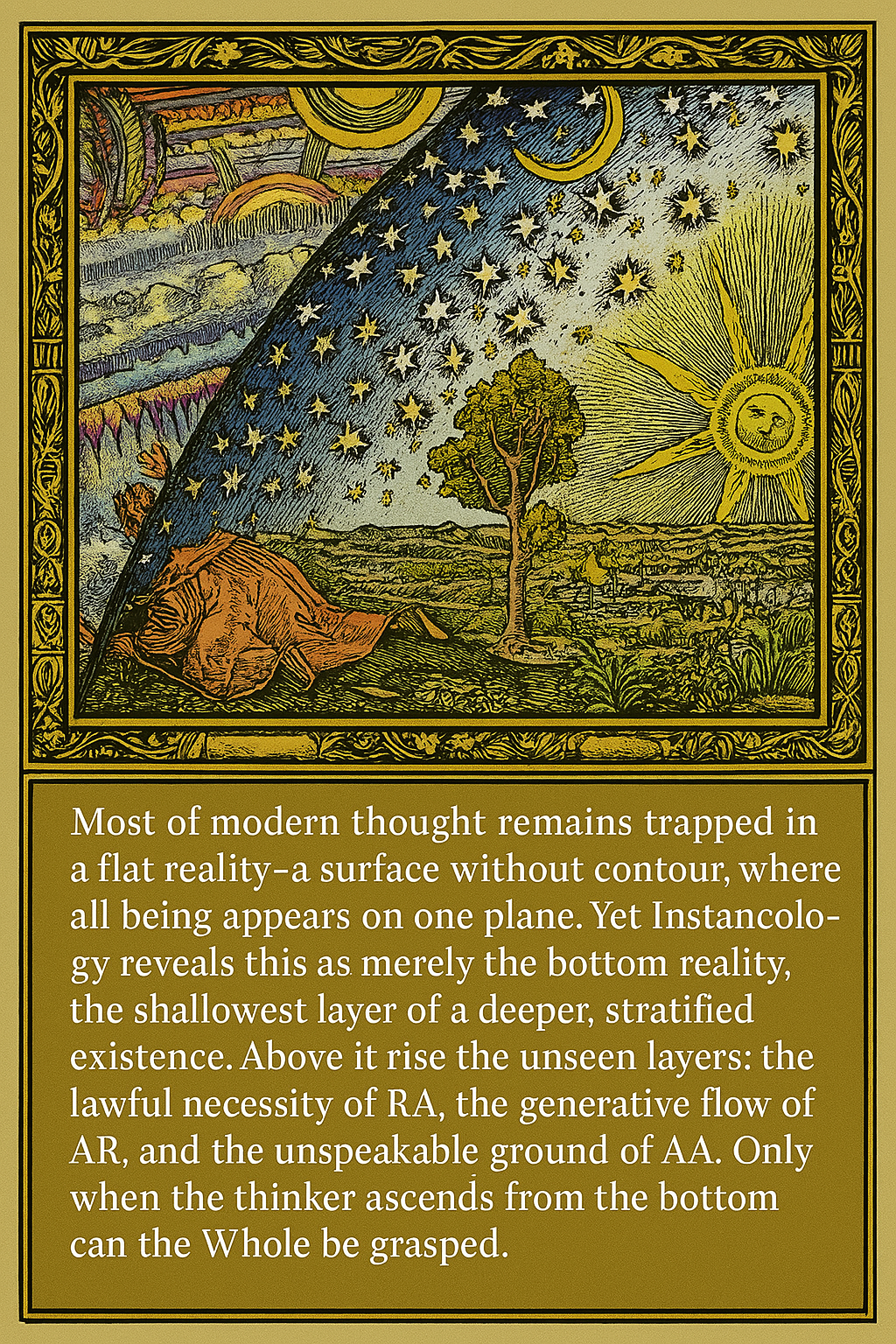
Instancology articulates reality through four irreducible domains:
AA (Absolute Absolute) – the unspeakable, non-representable ground of all instances
RA (Relatively Absolute) – law, logic, mathematics, life-structure
AR (Absolute Relative) – nature and humans as natural instances
RR (Relative Relative) – language, culture, symbols, theories
The human mind belongs primarily to AR, as a natural, biological instance. But unlike other natural instances, the human mind is structurally open to RA.
This openness is not learned, trained, or socially produced. It is ontologically issued with the human instance itself. That is why humans can:
Discover mathematical truths they did not invent
Recognize logical necessity across cultures
Identify natural laws before fully explaining them
Experience insight that exceeds empirical input
The mind is not merely adaptive—it is structurally aligned with absoluteness.
3. The Core Instancological Claim: Two Absolutes
Instancology makes a decisive clarification absent from traditional epistemology:
Truth belongs to the Objectively Absolute,
and the human mind belongs to the Subjectively Absolute.
Two Absolutes are equal.
This equality is the ontological condition of possibility of cognition.
Truth is absolute as object: it is what it is regardless of any observer.
Mind is absolute as subject: not merely subjective opinion, but a lawful, necessary mode of cognition capable of accessing absolute structure.
Cognition is possible not because the mind copies the object, but because both participate in absoluteness, though in different modes.
This replaces the classical “correspondence theory” with ontological equality.
4. Why Equality Matters More Than Correspondence
Traditional epistemology asks:
Does the idea in the mind correspond to the object outside?
Instancology asks a deeper question:
Are mind and truth ontologically commensurate?
If truth were absolute but the mind merely relative, cognition would be impossible.
If the mind were absolute but truth merely constructed, cognition would be arbitrary.
Cognition is possible because absoluteness meets absoluteness.
The Objectively Absolute guarantees truth’s necessity.
The Subjectively Absolute guarantees cognition’s legitimacy.
No representational bridge is required.
No infinite regress of justification arises.
Recognition replaces representation.
5. Why Logic Is Necessary—but Never Final
Logic plays a crucial but limited role.
In Instancology, logic belongs to RA, not to human invention. Humans use logic, but do not ground it. This explains a long-standing philosophical tension:
Logic is universally binding
Logic cannot justify itself
No logical system can fully ground its own necessity because logic is not the foundation of reality—it is a lawful manifestation within RA.
The human mind can recognize logical truth because it is structurally compatible with RA, but logic alone can never reach the ultimate ground.
6. WuXing (悟性): Why Insight Surpasses Reason
Instancology introduces WuXing (悟性) as an ontological mode of cognition—not mysticism, not emotion, not intuition in the psychological sense.
WuXing is direct apprehension of a whole instance.
This explains why genuine breakthroughs in philosophy, science, and mathematics arrive as insight:
“I see it now.”
“It suddenly becomes obvious.”
“Everything falls into place.”
WuXing is not irrational. It is pre-rational and meta-rational—the mind aligning with an already-existing absolute structure.
Reason explains after recognition.
Language follows insight.
Neither produces it.
7. Why Animals Cannot Do This—and Why AI Will Not
Animals live entirely within AR. They adapt, survive, and learn patterns, but they do not access absoluteness or ask why laws are necessary.
Artificial intelligence, however advanced, operates entirely within RR—symbol manipulation, probability, and pattern optimization. It rearranges representations but lacks ontological anchoring in RA and lacks WuXing altogether.
Thus:
Animals do not seek truth
AI cannot discover truth
Humans alone can—and must
Because humans alone are natural instances endowed with Subjectively Absolute cognition.
8. Culmination at AA: Absolute Absolute
The equality of the Objectively Absolute (truth)
and the Subjectively Absolute (mind)
does not terminate at RA.
It culminates at AA (Absolute Absolute).
AA is not an object of knowledge, nor a supreme subject.
It is the unspeakable ground from which:
truth issues as objective necessity
mind issues as subjective absoluteness
The human mind does not represent AA.
It rests in AA as its ultimate condition.
This is why truth is discoverable yet never exhaustible.
Why philosophy progresses yet never fully concludes in language.
Why silence ultimately surrounds the deepest insight.
Conclusion
From an Instancological view, the human mind can discover truth because:
Truth is Objectively Absolute
Mind is Subjectively Absolute
Two Absolutes are equal
Cognition is recognition, not construction
Insight precedes language and reason
All cognition ultimately rests in AA (Absolute Absolute)
Truth is not a human achievement.
Human discovery is a response to what already is.
That is why truth can be known at all.