Why It’s Time to Put Science Where It Should Be
Why It’s Time to Put Science Where It Should Be — An Instancological View
1. The Problem Is Not Science, but Its Misplacement
Science is one of humanity’s greatest achievements. It has transformed the world, extended life, and revealed astonishing regularities of nature. Yet today, science is often asked to do what it cannot do—and is praised for answers it never claimed to give. The result is not enlightenment, but confusion.
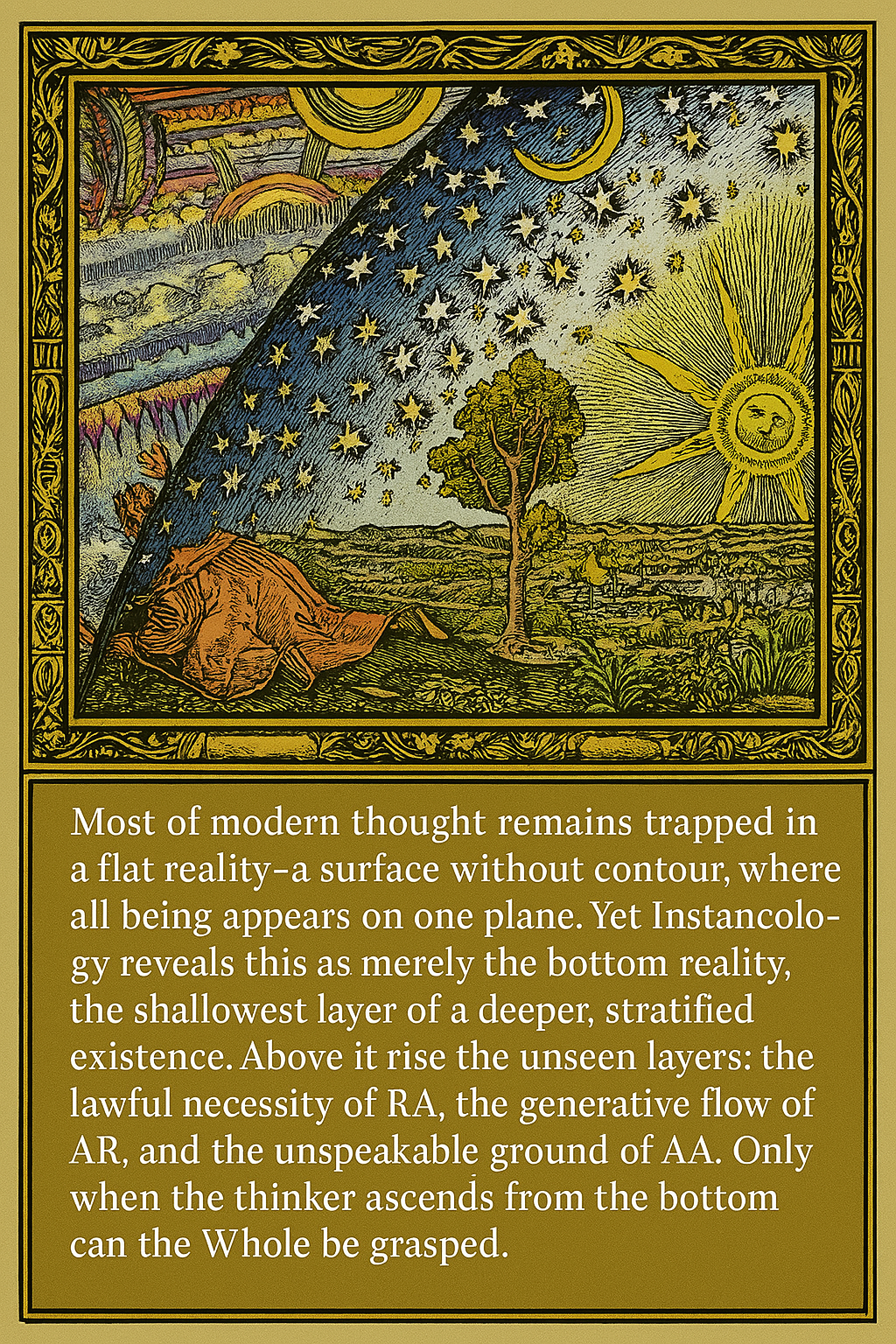
From an Instancological perspective, the crisis of modern thought does not stem from science being wrong, but from science being placed at the wrong ontological level. Science has quietly crossed a boundary: from explaining how things work to claiming authority over what ultimately is.
Instancology insists that this boundary matters.
2. Science Belongs to AR, Not to the Absolute
Instancology distinguishes reality into a structured 2×2 framework: AA (Absolute Absolute), RA (Relatively Absolute), AR (Absolute Relative), and RR (Relative Relative). Science operates squarely within AR, the domain of natural instances—measurable phenomena, empirical regularities, causal structures, and predictive models.
This is not a criticism. It is a clarification.
Science:
Observes instances in space and time
Abstracts patterns from repetition
Expresses those patterns using mathematics
Tests them through controlled interaction
All of this presupposes:
Time
Space
Measurement
Reproducibility
Observer-independent regularities
These are defining features of AR, not of reality as such.
3. The Category Error of Scientific Absolutism
When science is elevated from method to metaphysics, a category error occurs.
Claims such as:
“Only science gives truth”
“Reality is nothing but what physics describes”
“Consciousness will be fully explained by neuroscience”
are not scientific statements. They are philosophical assertions, made without philosophical justification.
Ironically, scientism violates the very standards it claims to uphold. No experiment can test the claim that only experiments yield truth. No equation can prove that everything is reducible to equations. These are meta-level claims, and therefore lie outside AR.
Instancology shows why this move is illegitimate: no domain can absolutize itself without contradiction.
4. Why Mathematics Misleads Us About Reality
One reason science is overextended is the astonishing success of mathematics. Because mathematics describes natural phenomena with precision, it is tempting to believe that reality itself is mathematical.
Instancology rejects this leap.
Mathematics belongs to RA, not AR. It is form without representation, law without substance. Science uses mathematics, but does not ground it. The effectiveness of mathematics reveals something profound—but not what scientism thinks it does.
It reveals that:
Natural instances conform to pre-existing structures
Order precedes observation
Law is prior to measurement
This points upward to RA, and ultimately toward AA—not sideways to material reduction.
5. The Limits of Scientific Explanation
Science explains functions, not origins of wholeness.
It can explain:
How cells divide
How brains process signals
How galaxies form
But it cannot explain:
Why a whole appears rather than mere parts
Why laws exist at all
Why intelligibility precedes intelligence
Why reality is structured rather than chaotic
These questions are not “unscientific.” They are pre-scientific and meta-scientific. They concern the conditions that make science possible in the first place.
Instancology names this mistake precisely: confusing explanatory power within AR with ontological sufficiency across reality.
6. Popper Was Right—But Not Radical Enough
Even Karl Popper recognized that science does not deal in final truths, but in falsifiable conjectures. Yet modern scientism quietly abandons Popper while praising him.
Instancology goes further:
Scientific theories are provisional instances
They are historically situated
They are structurally limited
They cannot ground themselves
Science progresses not by approaching the Absolute, but by refining its position within AR.
This is not a weakness—it is science’s dignity.
7. Restoring the Proper Order
To “put science where it should be” does not mean diminishing it. It means liberating it from impossible expectations.
Proper order:
AA: Unspeakable source, beyond representation
RA: Laws, logic, mathematics, life as formless structures
AR: Nature, science, causality, time, space
RR: Language, culture, technology, institutions
When science respects its place in AR:
It no longer pretends to replace metaphysics
It no longer competes with philosophy
It regains epistemic humility
It avoids ideological misuse
And philosophy, in turn, stops trying to imitate science.
8. Conclusion: A Call for Intellectual Maturity
The age of scientific triumph must now become an age of ontological clarity.
Instancology does not oppose science. It completes the map within which science makes sense. The question is no longer whether science works—it does—but whether we understand what kind of truth science delivers, and what kind it never can.
Putting science where it should be is not a retreat from reason.
It is the final step of reason growing up.