Can Relativity Theory and Quantum Mechanics Be Uni
Can Relativity Theory and Quantum Mechanics Be Unified by Mathematics?
This question has haunted modern physics for more than a century. It is often framed as a technical problem—find the right equations, invent a deeper symmetry, quantize gravity correctly—and the expectation is that mathematics alone will eventually deliver a unified theory.
From the standpoint of Instancology, however, this expectation rests on a category mistake.
The short answer is:
No—Relativity and Quantum Mechanics cannot be unified by mathematics alone.
A mathematical unification is possible only within a deeper ontological framework that already explains why both theories exist and why each is valid only in its own domain.
Below is the structured explanation.
1. Why Relativity and Quantum Mechanics Resist Unification
Relativity Theory (RT) and Quantum Mechanics (QM) are not merely two sets of equations. They arise from different ontological commitments.
Relativity Theory
Describes the macro world
Operates in continuous spacetime
Assumes determinism (or geometric necessity)
Treats gravity as geometry
Quantum Mechanics
Describes the micro world
Operates with discreteness, probability, and non-locality
Replaces determinism with statistical law
Treats interaction as operator-based, not geometric
The conflict is therefore structural, not technical.
Trying to unify them mathematically without addressing this difference is like trying to merge:
Geometry and probability
Continuity and discreteness
Deterministic structure and indeterminate process
No amount of mathematical sophistication can erase these contradictions unless their place in reality is first clarified.
2. The Historical Illusion: “Mathematics Will Save Us”
Physics has been extraordinarily successful by letting mathematics lead. This success has created an illusion:
If something exists, there must be an equation for it.
But this is historically false.
Mathematics formalizes reality; it does not generate reality.
Every major mathematical framework in physics presupposes an ontological domain where it applies.
When equations fail, it is often because they are applied beyond their legitimate instance-level.
The failure to unify RT and QM mathematically is not accidental—it is a signal.
3. The Instancology Diagnosis: A Level-Mismatch Problem
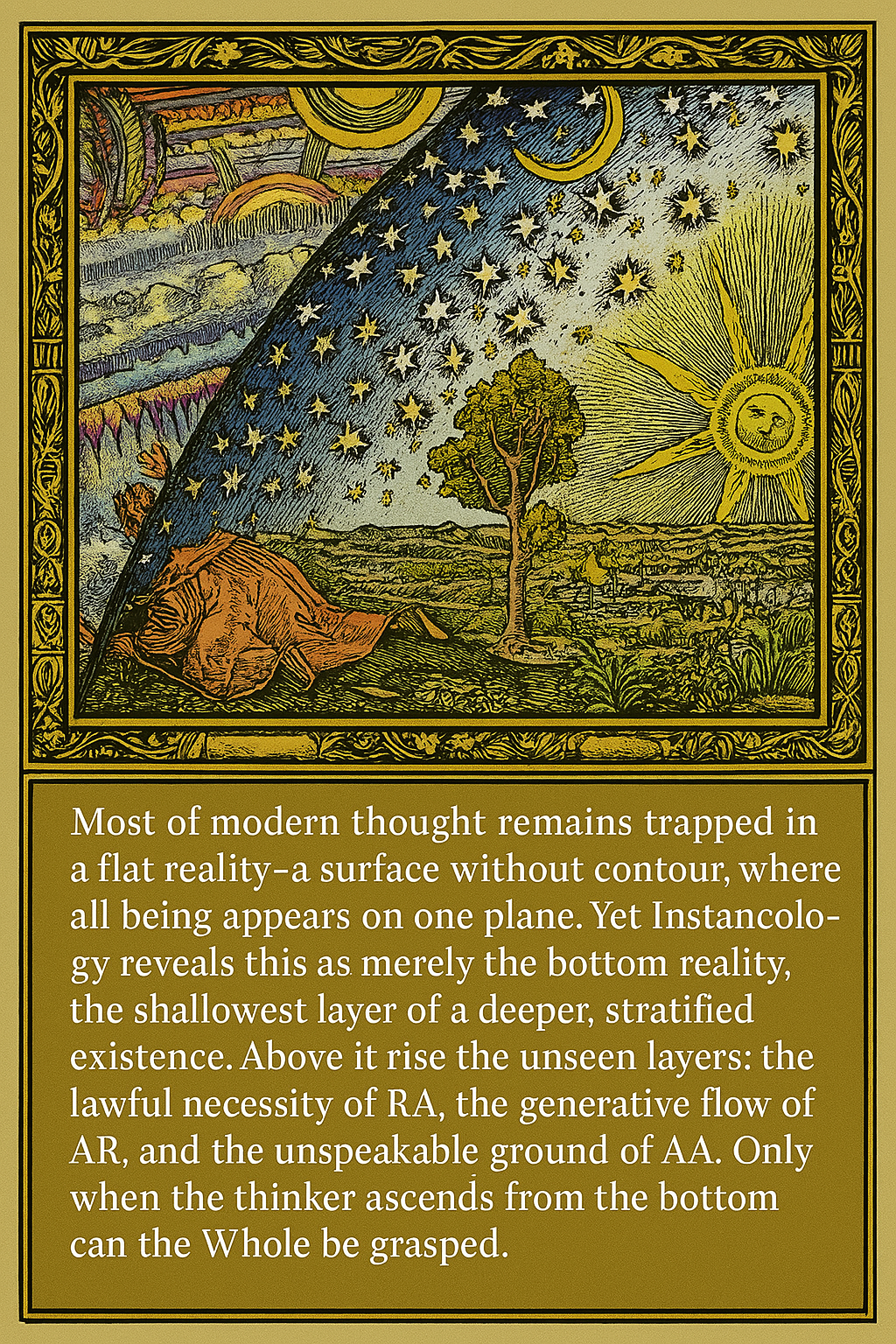
Instancology distinguishes reality into different instance-levels:
RA (Relatively Absolute): laws, logic, mathematics, life (formless, timeless)
AR (Absolute Relative): natural instances (space, time, matter, energy)
RR (Relative Relative): human constructs, instruments, representations
Now observe:
Quantum Mechanics is anchored in RA → AR transition
It deals with pre-spatiotemporal constraints and probabilistic lawfulness
Relativity Theory is anchored fully in AR
It presupposes spacetime as given
Thus:
QM and RT do not live at the same ontological level.
Trying to unify them purely mathematically means forcing one level’s language onto another—this is guaranteed to fail.
4. Why Existing Unification Attempts Stall
String Theory
Mathematically elegant
Physically untestable
Expands formalism without clarifying ontology
Loop Quantum Gravity
Quantizes spacetime itself
Still presupposes what it tries to explain
Remains trapped inside AR assumptions
TOE Programs
Assume “everything” means everything describable by equations
Ignore the unspeakable background (AA) and the level-structure of reality
These are not wrong theories—they are overextended methods.
5. What Mathematics Can and Cannot Do
Mathematics can:
Describe consistent structures
Encode laws once their domain is fixed
Bridge theories within the same instance-level
Mathematics cannot:
Decide what is fundamental
Determine ontological priority
Resolve category mismatches
Speak about the Absolute (AA)
Mathematics belongs to RA.
Unification requires understanding how RA relates to AR, not just manipulating symbols inside RA.
6. What a Real Unification Would Require
A genuine unification would involve:
Ontological clarification before equations
Why spacetime exists at all
Why probability appears at the micro level
Acceptance of level plurality
Not all realities share one mathematical language
Recognition of limits
A TOE cannot include AA
“Everything” never means literally everything
From Instancology’s view, the goal is not:
One equation to rule them all
but rather:
A coherent instance-structure in which each theory is exactly valid where it belongs.
7. Final Answer
Relativity Theory and Quantum Mechanics cannot be unified by mathematics alone.
They can only be co-situated within a deeper ontological framework that explains:
why different mathematical languages are required,
why reality itself is stratified,
and why no single formal system can exhaust the Whole.
In this sense, the failure to find a purely mathematical unification is not a defect of physics—it is evidence that physics has reached its natural boundary, where ontology must lead and mathematics must follow.
This is precisely where Instancology begins.