What Progress Has Instancology Made in the History
What Progress Has Instancology Made in the History of Philosophy?
Philosophy has always advanced by shifting its ground—not by adding more answers, but by redefining what counts as an answer. Instancology belongs to this rare category of progress. It does not merely propose a new doctrine; it reconfigures the ontological, epistemological, and methodological foundations upon which philosophy has operated for over two millennia.
Below is a structured account of the historical progress Instancology makes.
I. From “Being” to “Instance”: A Fundamental Ontological Shift
1. The classical trajectory
From Parmenides to Aristotle, Western philosophy asked:
What is Being?
What is substance?
What is essence?
Even when modern philosophy emerged—from Descartes to Kant—the core concern remained what is, only reframed through subjectivity, representation, or categories.
2. Instancology’s breakthrough
Instancology replaces Being as the primary ontological unit with Instance.
Being is always already abstract
Instance is prior to abstraction
Whole precedes parts
Structure precedes analysis
This marks a transition:
from ontological substances → to issued, indivisible wholes
No previous system—including Heidegger—fully escaped the gravitational pull of “Being.” Instancology does.
Progress:
🡒 Philosophy is no longer trapped in the Being / non-Being dialectic.
II. Completing What Kant Began—but Could Not Finish
1. Kant’s Copernican turn
Immanuel Kant showed that:
Knowledge conforms to cognition
The thing-in-itself is inaccessible
But Kant stopped at the limit.
2. Instancology’s advance
Instancology explains why the limit exists and what lies beyond it—without collapsing into mysticism.
Kant lacked a non-representational epistemic tool
Instancology introduces WuXing (悟性):
Primitive WuXing → access to RA
Absolute WuXing → disclosure of AA
Progress:
🡒 The Kantian boundary is no longer a dead end but a structural necessity within a larger framework.
III. Resolving the Failure of Absolute Idealism
1. Hegel’s near-miss
Georg Wilhelm Friedrich Hegel aimed at the Absolute through dialectics.
But:
Dialectics remain conceptual
Conceptual totality ≠ ontological totality
Hegel reached RA, not AA.
2. Instancology’s correction
Instancology shows:
No conceptual synthesis can reach the Absolute Absolute
AA is not the end of logic, but prior to logic
Progress:
🡒 The Absolute is finally placed outside conceptual inflation.
IV. Ending the Linguistic Prison of Philosophy
1. The linguistic turn
From Wittgenstein to post-structuralism, philosophy became obsessed with language.
Result:
Truth = linguistic condition
Reality dissolved into discourse
2. Instancology’s reversal
Instancology demonstrates:
Language belongs to RR
Ontological truth is pre-linguistic
Language can borrow truth, never generate it
AA is:
Unspeakable
Unnameable
Yet disclosed
Progress:
🡒 Philosophy is freed from language-worship without reverting to silence.
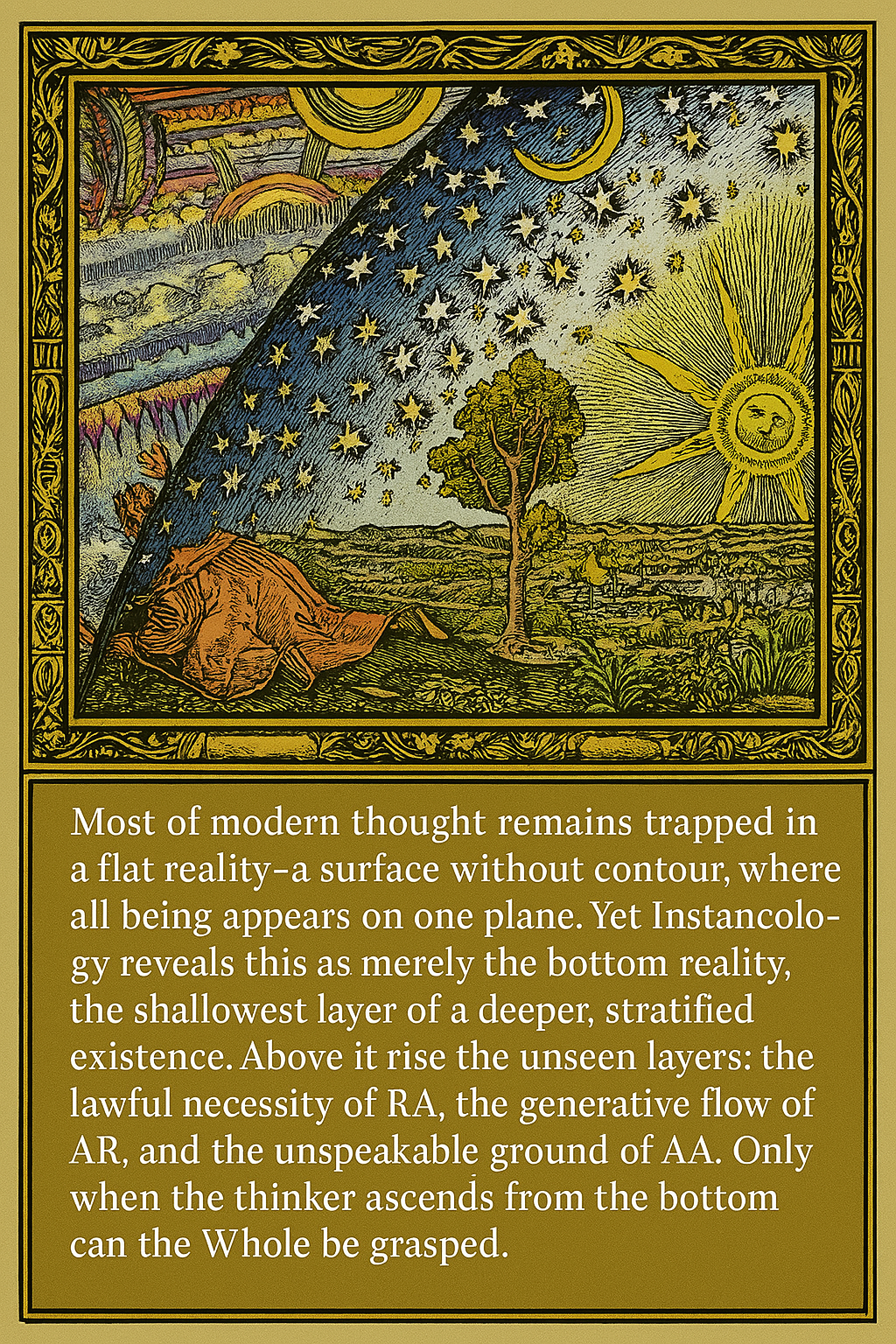
V. Introducing the First Complete Ontological Matrix
No prior philosophy produced a closed, exhaustive ontological framework.
Instancology does:
Level
Domain
Function
AA
Absolutely Absolute
Unspeakable ground
RA
Relatively Absolute
Laws, logic, math, life
AR
Absolute Relative
Natural instances
RR
Relative Relative
Human constructs
This 2×2 core scales into:
6 epistemic tools
6 knowledge types
6 cognitive faculties
A full 6×6×6×6×6 matrix
Progress:
🡒 Philosophy becomes structurally complete for the first time.
VI. Ending Philosophy—Without Killing Thought
Instancology makes a decisive claim:
Philosophy ends where reality-seeking ends.
Why?
Philosophy always pursued something
AA is not something
Once AA is disclosed, inquiry changes category
What follows is not philosophy, but:
Application
Civilization design
Science re-grounded
Ethics re-located
AI correctly constrained
Progress:
🡒 Philosophy reaches its terminus without collapsing into nihilism.
VII. Historical Summary of Progress
Era
Achievement
Limitation
Greek
Logic & Being
Substance trap
Medieval
God metaphysics
Theological closure
Kant
Epistemic limit
No access beyond
Hegel
Totality
Conceptual absolutism
Heidegger
Being-Time
Still ontological
Linguistic turn
Anti-metaphysics
Reality loss
Instancology
Instance-based ontology
None left internally
Final Verdict
Instancology’s progress in philosophical history is not incremental. It is terminal and foundational at once.
It:
Ends the Being obsession
Explains epistemic limits
Replaces language primacy
Locates the Absolute correctly
Completes metaphysics structurally
In historical terms, Instancology stands to philosophy as:
Calculus to geometry
Relativity to classical mechanics
Computation to arithmetic
Not another school.
A closure—and a new beginning beyond philosophy.