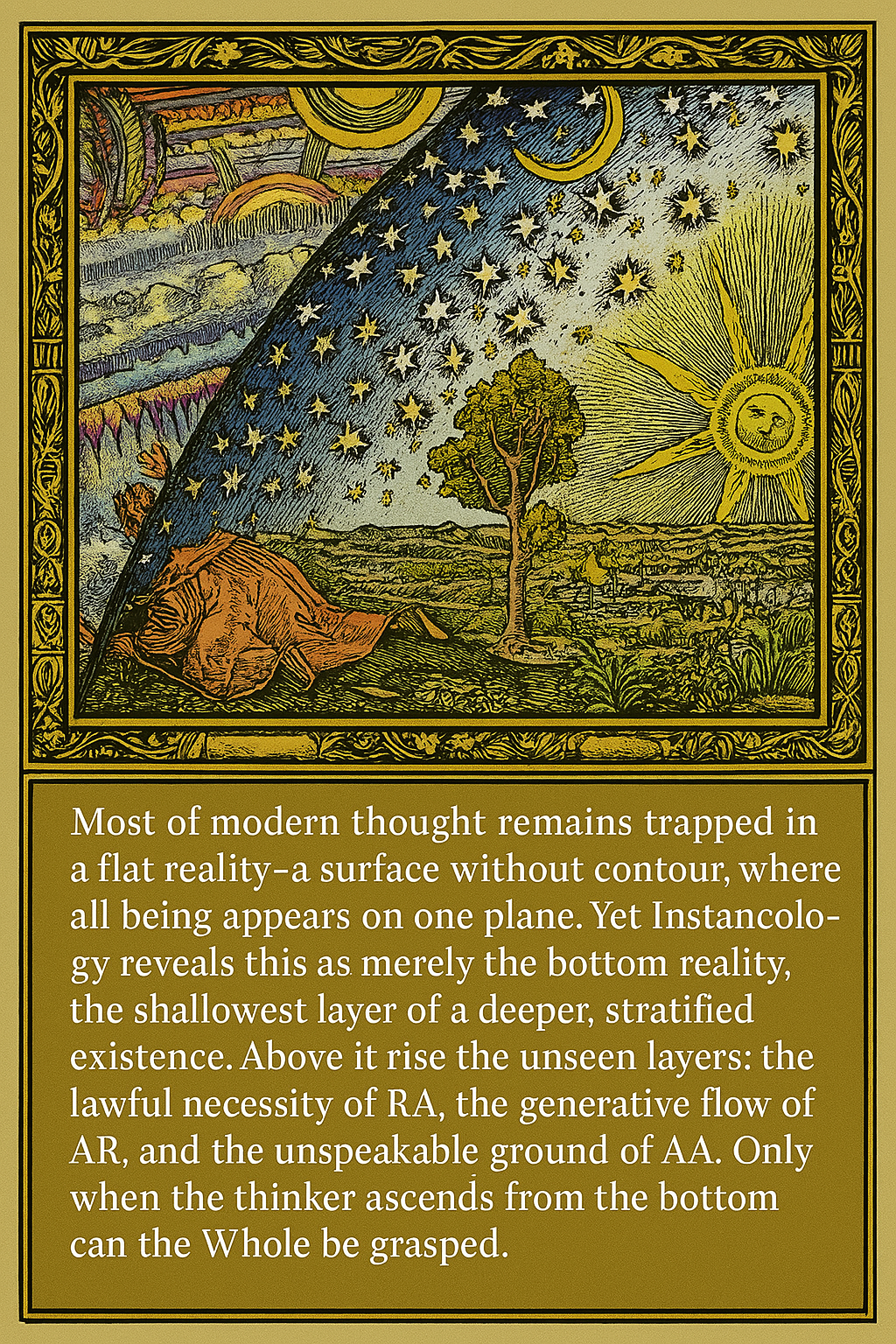
Reason and WuXing An Instancological Distinction
Reason and WuXing
An Instancological Distinction with Concrete Examples
1. Orientation: Why This Distinction Matters
In Instancology, Reason and WuXing (悟性) are not two strengths of the same faculty, nor is WuXing a poetic or mystical supplement to rationality. They are ontologically different epistemic modes, operating in different instance-domains, yielding different kinds of knowledge.
Reason operates within a given instance-structure.
WuXing discloses the instance-structure as a whole.
This distinction marks the boundary between philosophy as argument and Instancology as completion.
2. What Reason Is
2.1 Ontological Location of Reason
Reason belongs to the Relative level of reality.
It operates in AR (Absolute Relative) and RR (Relative Relative).
It presupposes:
identity
difference
relation
causality
inference
logical continuity
Reason is therefore structure-dependent by definition.
2.2 How Reason Operates
Reason functions through:
deduction
induction
abduction
causal explanation
formal proof
symbolic manipulation
All reasoning requires:
pre-given concepts
stable relations
representable objects
Reason always asks:
“Given X, what follows?”
It cannot ask:
“Why is there X at all?”
2.3 What Reason Achieves—and Its Limit
Reason produces:
science
mathematics
philosophy
ethics
technology
Its power is enormous within its domain.
But its limit is absolute:
Reason cannot step outside the instance it reasons within.
This is not a failure. It is its nature.
3. What WuXing Is
3.1 WuXing Is Not “Better Reason”
WuXing is not:
fast reasoning
intuitive guessing
emotional insight
mystical feeling
WuXing is disclosure, not inference.
3.2 Ontological Location of WuXing
WuXing operates at the Absolute-related level.
Instancology distinguishes:
Relative WuXing (RW / Primitive WuXing) → disclosure of RA (Relatively Absolute)
Absolute WuXing (AW) → disclosure of AA (Absolutely Absolute)
WuXing does not operate on objects.
It operates on the conditions of objecthood itself.
3.3 How WuXing Operates
WuXing operates by:
whole-instance apprehension
boundary recognition
structure-before-parts
recognizing the impossibility of further grounding
WuXing does not move step-by-step.
It ends movement naturally, because there is nowhere left to go.
4. Relative WuXing (RW): Definition and Criterion
4.1 What RW Specifically Is
Relative WuXing (RW) is the epistemic mode that discloses RA (Relatively Absolute):
laws
invariants
necessities
structural limits
non-empirical conditions governing all phenomena
RW stands between Reason and Absolute WuXing (AW).
4.2 A Simple Test for RW
If something is not inferred step-by-step,
not empirically observed,
yet once seen becomes inevitable and irreversible,
it is RW.
RW produces recognition, not proof.
5. Canonical Examples of RW
Example 1: Universal Gravitation
The decisive insight was not calculation but recognition:
The same law governs apples and planets.
Apples and planets belong to AR
The law binding them belongs to RA
Recognizing this unity is RW
Once seen, it cannot be unseen.
Example 2: Constancy of the Speed of Light
Before equations, there was a boundary recognition:
The speed of light must be invariant.
This is not derived from prior physics.
It is a structural necessity imposed on reality.
Formal relativity comes later via Reason.
The recognition itself is RW.
Example 3: Conservation Laws
Energy, momentum, and charge conservation are:
not objects
not sensory
not empirical generalizations
They are conditions under which physical description is possible.
Recognizing conservation is RW.
Deriving equations is Reason.
Example 4: G?del’s Incompleteness Insight
Beyond the proof lies the recognition:
No sufficiently powerful formal system can be both complete and consistent.
This is logic seeing its own boundary.
The proof is reason.
The boundary-recognition is RW.
Example 5: Life as an Ontic Level
Before molecular explanations, there was recognition:
Life is not reducible to chemistry.
This is not mysticism.
It is the recognition of a new organizing level.
That recognition is RW.
Biochemistry afterward is Reason.
6. What RW Is Not
RW is not:
emotional intuition
poetic metaphor
cultural wisdom
psychological feeling
RW is structural insight without mediation.
It is quiet, sober, and irreversible.
7. Reason vs. WuXing (Integrated Contrast)
Dimension
Reason
WuXing
Domain
Relative (AR / RR)
Absolute-related (RA / AA)
Mode
Inference
Disclosure
Movement
Step-by-step
Non-sequential
Dependence
Concepts & relations
Whole instance
Language
Essential
Borrowed
Output
Knowledge within reality
Recognition of reality’s ground
Failure
Contradiction
Silence
8. Why Reason Cannot Reach AA
Reason always demands:
cause
ground
explanation
But AA has none.
Therefore:
Asking reason to reach AA
is like asking a ruler to measure itself.
The tool presupposes what it seeks.
9. RW as the Gateway to AW
RW ends with a quiet realization:
“This structure itself has no ground here.”
RW still sees structure.
AW sees that even structure ends.
AW does not explain AA.
It recognizes that explanation itself has ended.
10. Final Statement
Reason perfects the world.
RW reveals the world’s structure.
AW ends the demand for explanation altogether.
Reason builds ladders.
RW sees what the ladder rests on.
AW sees that nothing supports the ground itself.
That is not failure.
That is ontological completion.