A Reset of Civilization—West or East—by Instancolo
A Reset of Civilization—West or East—by Instancology
Civilizations do not usually collapse because they lack technology, intelligence, or effort. They collapse because they misunderstand what kind of reality they are in. When the underlying ontological assumptions become distorted, every downstream system—science, ethics, politics, education—eventually follows that distortion to exhaustion. From the perspective of Instancology, both Western and Eastern civilizations are approaching such an exhaustion point, not because they have failed, but because they have completed what they were structurally capable of doing.
Instancology proposes not a reform, nor a synthesis, but a reset—a re-grounding of civilization at the ontological level.
I. The Western Path: Logic Without Ground
Western civilization has been astonishingly successful precisely because it isolated and perfected logic, representation, and formal systems. From Greek philosophy to modern science, the West progressively moved from myth to reason, from substance to structure, from meaning to mechanism.
But this success hides a fatal assumption: that reality must be fully accessible through language, logic, or models. From Aristotle through Descartes, Kant, Hegel, and finally analytic philosophy and computational AI, the West increasingly treated representation as reality’s proxy.
Instancology exposes the limit of this path:
Logic belongs to RA (Relatively Absolute), not to reality itself.
Language operates in RR (Relative Relative), not at the ontological ground.
When representation is mistaken for being, civilization becomes trapped in endless self-referential systems.
The result is visible today: technical omnipotence paired with existential paralysis, moral confusion, and a silent loss of meaning. Western civilization has reached the end of its logical ladder.
II. The Eastern Path: Insight Without Structure
Eastern civilizations took a radically different route. Rather than formalizing logic, they cultivated direct insight, intuition, and non-discursive understanding—what Instancology calls WuXing (悟性).
This allowed Eastern thought to approach truths inaccessible to language: impermanence, non-self, emptiness, harmony. However, this strength came with a complementary weakness: the lack of ontological structure.
Insight was achieved, but not stabilized.
Truth was experienced, but not formalized.
Wisdom became personal or spiritual, not civilizationally cumulative.
As a result, Eastern civilizations excelled in metaphysical sensitivity but struggled to generate sustained scientific, legal, and institutional systems capable of resisting power, superstition, or authoritarian collapse.
Instancology does not criticize this path—it locates it.
III. Why Neither East Nor West Can Finish the Job
The crucial Instancological insight is this:
No civilization can reset itself from within the same ontological level that created its crisis.
The West cannot fix its crisis with better logic, better AI, or better discourse.
The East cannot fix its crisis with deeper intuition, mysticism, or moral exhortation.
Both are operating inside Relative layers (AR/RR), mistaking partial access for total grounding.
The reset requires something neither side historically possessed: a complete ontological map.
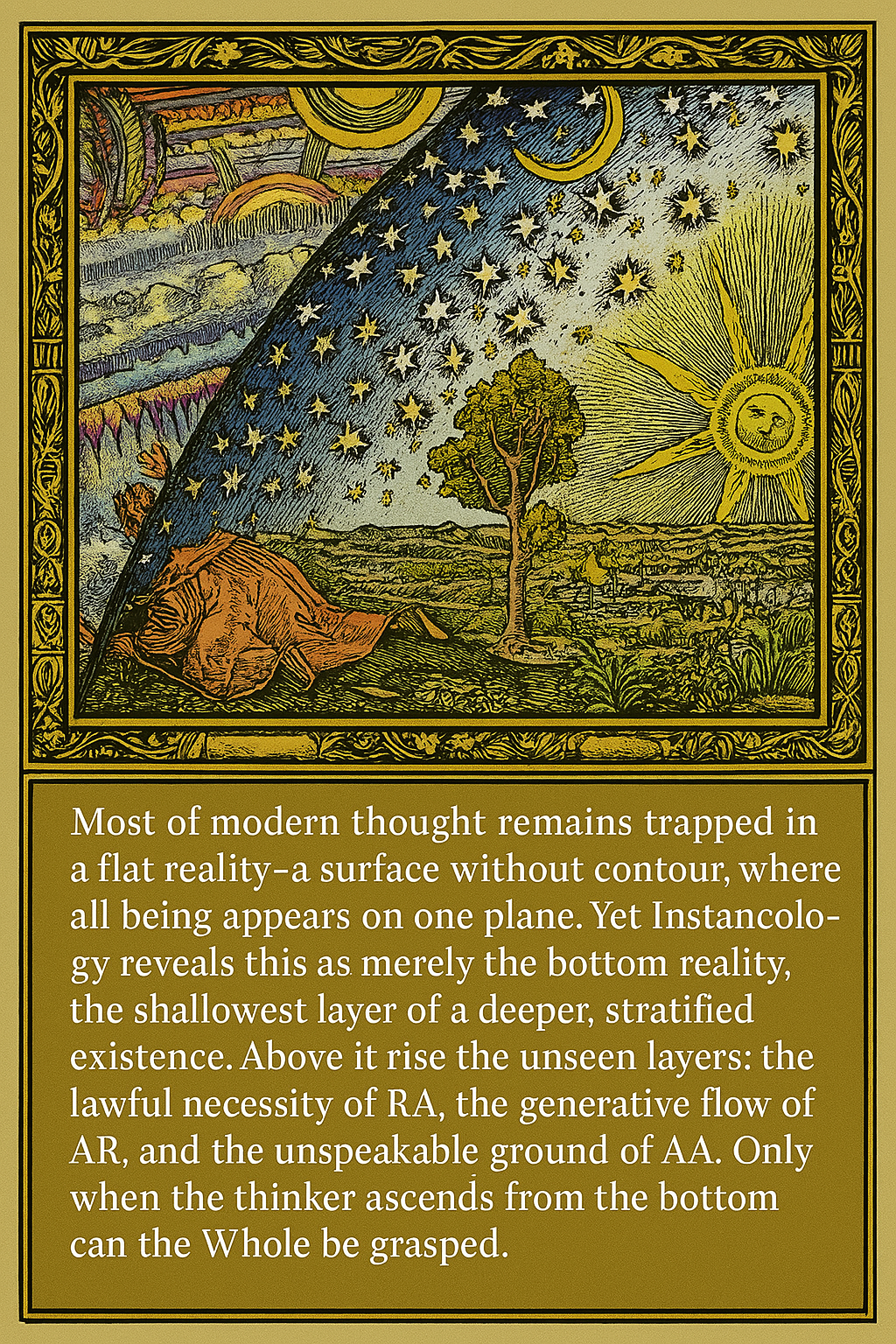
IV. Instancology’s Reset: From Civilization to Instance
Instancology reframes civilization itself as an instance, not a subject, not a destiny, not a moral project.
Its core contributions are:
AA (Absolute Absolute)
The unspeakable, non-representable background of all instances. Not God, not substance, not Being—the condition of instance-issuance itself.
RA (Relatively Absolute)
Laws, logic, mathematics, and life-principles—formless, real, but non-representational.
AR (Absolute Relative)
Nature, biology, cosmos—real instances unfolding in space-time.
RR (Relative Relative)
Language, culture, technology, ideology—human-made and historically contingent.
Civilizations collapse when they confuse RR with RA, or AR with AA. Instancology restores the proper placement of each layer, ending millennia of category errors.
V. West or East? The Question Becomes Obsolete
From the Instancological viewpoint, “West vs. East” is itself an RR distinction—historically meaningful but ontologically secondary.
The reset Instancology proposes is not Western, Eastern, or globalist. It is structural.
Western logic is preserved—but confined to RA.
Eastern insight is preserved—but grounded beyond mysticism.
Science continues—but without metaphysical inflation.
Morality persists—but without false universals.
Civilization is no longer the apex of existence, but a temporary configuration within a larger instance-field.
VI. What the Reset Looks Like in Practice
A civilization reset by Instancology would show distinctive features:
Education shifts from knowledge accumulation to structure-recognition.
AI is treated as RR machinery, not emergent life or consciousness.
Politics abandons ultimate narratives and focuses on instance-stability.
Ethics reorients from absolute claims to layer-appropriate responsibility.
Philosophy ends—not as failure, but as completion.
This is not utopian. It is post-civilizational sobriety.
VII. Conclusion: After the Reset
Instancology does not promise salvation. It promises clarity.
It tells humanity:
You are not the center.
Your languages are not reality.
Your civilizations are not eternal.
And yet—your existence is not meaningless.
You are an instance within instances, issued without reason, sustained without guarantee, and intelligible only when you stop mistaking tools for truth.
That recognition—not technology, not ideology—is the real reset.
And it can occur anywhere.