Can Instancology Be Falsified?
Can Instancology Be Falsified?
Abstract
Falsifiability has long been regarded as the demarcation criterion for scientific theories, most famously articulated by Karl Popper. Metaphysical systems, however, are often dismissed as unfalsifiable by definition, since they do not produce empirical predictions. This essay argues that such a dismissal is misguided. While metaphysics is not empirically falsifiable, it can be ontologically falsifiable—that is, vulnerable to refutation at the level of structural necessity. Using Instancology as a case study, this essay examines whether a comprehensive ontological framework can meaningfully expose itself to falsification, and if so, under what conditions Instancology would fail.
1. The Problem of Falsifiability in Metaphysics
The modern suspicion toward metaphysics is largely inherited from scientific epistemology. Popper’s criterion of falsifiability successfully distinguishes empirical science from pseudoscience, but it was never designed to evaluate ontology itself. When applied indiscriminately to metaphysics, it leads to an impoverished conclusion: that all metaphysical systems are equally unfalsifiable and therefore equally speculative.
This conclusion is historically untenable. Aristotle’s substance ontology, Cartesian dualism, Kant’s transcendental idealism, and Hegel’s absolute idealism did not merely differ in opinions; they excluded one another by making incompatible structural claims about reality. Some metaphysical systems collapse when specific conceptual contradictions are revealed. Others survive only by semantic inflation. The relevant question, therefore, is not whether metaphysics is falsifiable in a scientific sense, but whether it is structurally falsifiable.
2. Ontological Falsifiability: A Working Definition
Ontological falsifiability may be defined as follows:
A metaphysical system is ontologically falsifiable if it makes necessary and exclusive claims about the structure of being such that the existence of a counter-structure would invalidate the system as a whole.
This criterion differs fundamentally from empirical falsification. It does not ask whether a prediction fails, but whether the system forbids certain possibilities—and whether those possibilities can be coherently demonstrated.
A metaphysics that explains everything by absorbing every counterexample is not unfalsifiable in a strong sense; it is vacuous.
3. The Core Ontological Commitments of Instancology
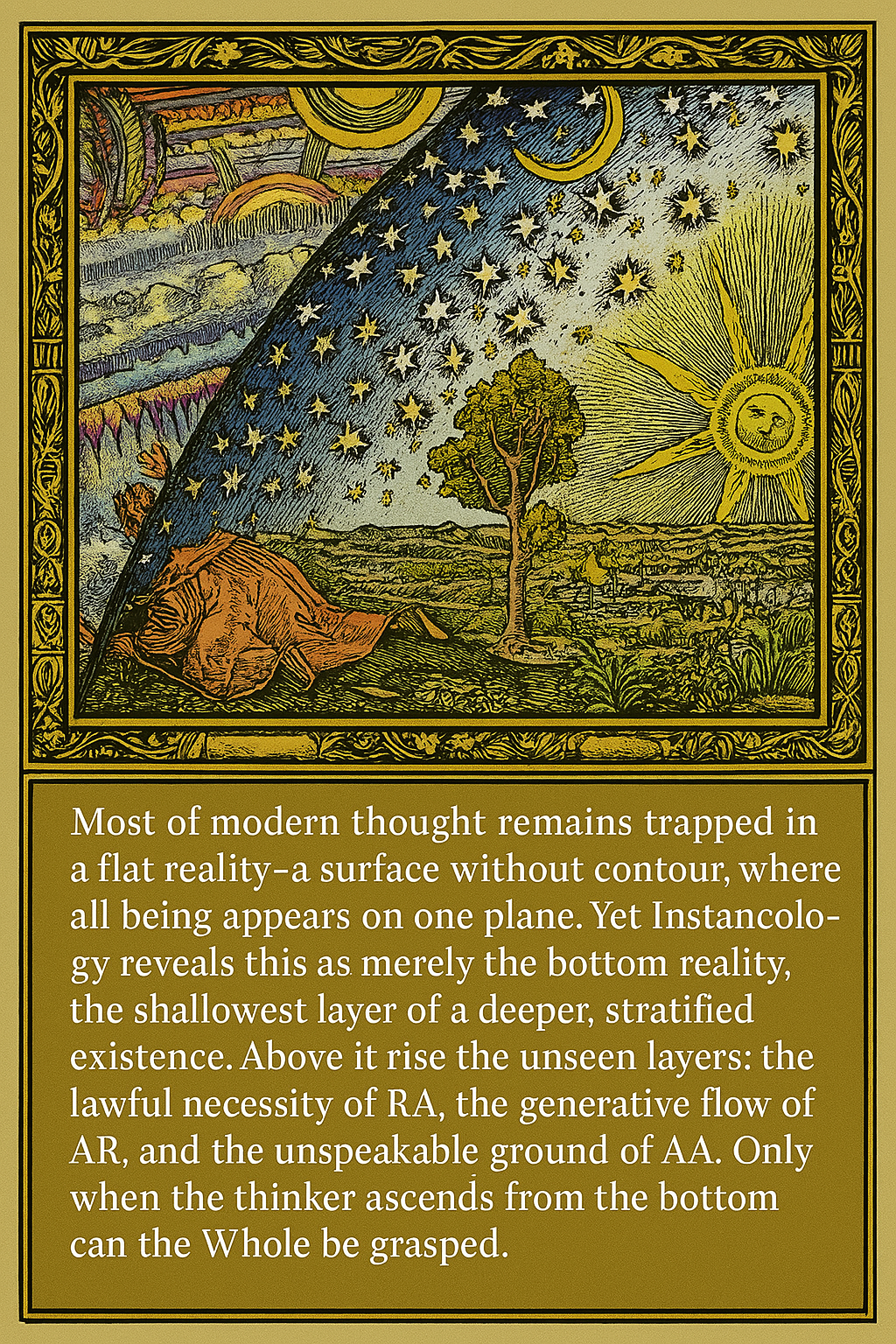
Instancology presents itself not as a theory of particular beings, but as a theory of how anything can appear at all. Its falsifiability therefore depends on the rigidity of its foundational commitments. Among them, the following are decisive:
Exhaustiveness of Instance
Everything that exists, appears, or is thinkable exists only as an instance. There are no non-instanced entities.
Completeness of the 2×2 Ontological Structure
Reality is exhaustively articulated by four domains:
AA (Absolute Absolute): the unspeakable background
RA (Relative Absolute): laws, logic, mathematics, life
AR (Absolute Relative): natural reality
RR (Relative Relative): human products
No fifth ontological domain is permitted.
Non-representability of the Absolute
Any representable absolute is already relative. The Absolute Absolute cannot be spoken, conceptualized, or formalized.
Instanced Cognition
All cognition, including metaphysics itself, occurs within instanced conditions. There is no God’s-eye epistemology.
These commitments are not provisional. If any one of them fails, Instancology fails as a system.
4. Conditions Under Which Instancology Would Be Falsified
Instancology is ontologically falsifiable because it can be broken—cleanly and decisively—under the following conditions.
4.1 A Non-Instanced Entity
If a phenomenon can be shown to exist that is neither an instance nor instanced—one that does not arise, appear, or function as an instance—then the foundational claim of Instancology collapses.
This is not a trivial requirement. Invoking “Being,” “God,” “Nothingness,” or “Pure Consciousness” is insufficient unless such entities can be demonstrated to operate without instancing conditions.
4.2 A Fifth Ontological Domain
If a coherent ontological domain can be articulated that is:
irreducible to AA, RA, AR, or RR,
necessary for ontological completeness,
and not merely a hybrid or re-description,
then the 2×2 structure is incomplete and therefore false.
4.3 A Representable Absolute
If the Absolute can be fully represented without becoming relative—if it can be spoken without mediation—then the AA–RA distinction collapses. In that case, Instancology’s core asymmetry between background and structure fails.
4.4 Non-Instanced Knowledge
If there exists a mode of cognition that is demonstrably unconditioned—neither perspectival, contextual, nor instanced—then Instancology’s epistemology is false.
This includes not only human cognition but any conceivable intelligence.
5. Why Instancology Is Not Immunized Against Refutation
Many metaphysical systems survive criticism by expanding definitions, introducing new categories, or appealing to ineffability whenever contradictions arise. Instancology does something riskier: it forbids certain moves.
It forbids a speakable Absolute.
It forbids unconditioned cognition.
It forbids ontological excess beyond its structure.
Because of these prohibitions, Instancology does not merely explain reality; it excludes possible realities. That is precisely what makes it falsifiable.
6. The Present Status of Falsification
To date, no proposed counterexample—whether drawn from theology, physics, consciousness studies, mathematics, or mysticism—has demonstrated a phenomenon that cannot be situated within RA, AR, or RR without contradiction. This does not establish the truth of Instancology. It establishes only that it has not yet been ontologically refuted.
In metaphysics, survival under attempted refutation is the strongest available form of validation.
7. Conclusion
Instancology is not falsifiable in the scientific sense, nor does it claim to be. But it is ontologically falsifiable in a stronger and rarer sense: it makes exclusive claims about the structure of reality that can, in principle, be shown to be false.
A metaphysical system that cannot fail is not profound; it is empty.
Instancology risks failure—and therefore qualifies as philosophy rather than mythology.