
金融时报 :中国人的内斗:一场继位战争后面的秘密
金融时报 :中国人的内斗:一场继位战争后面的秘密
原文连接:http://chinainperspective.com/ArtShow.aspx?AID=14531
这是一位亿万富翁的故事。他在镇压犯罪的运动中据说遭到酷刑。
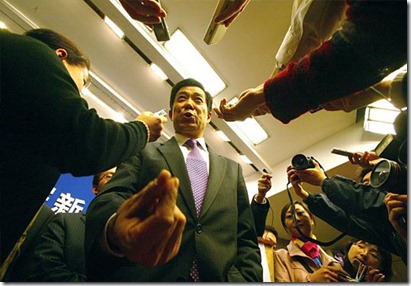
受人瞩目。图为重庆共产党总书记在北京的一次记者招待会上。
李俊穿着铁蓝色的鞋子、粉红色的马球衫、
事实上,他曾经是中国西南部城市重庆市的一位亿万富翁。
一 年多来,李先生一直不断地在逃亡。一些事件的突变之后,
从他命运的倒转中可以看到中国政治精英中鲜为人知的内斗,
直 到一个月前,
可那 是薄熙来信任的重庆市公安局局长王立军试图在2月份叛逃到美国之
所谓的“重庆模式”就是让大众怀念过去的共产党领导,
在薄熙来和王立军的命令下,警察和军方对几万名富有的商人下手,
今天,这一模式以及薄熙来进入頂端权利的机会受到质疑,
李俊在中国以外一个没有透露的地点上说得更直接:“
李 俊所說的经历有大量书面证据的支持,
警察局长请求庇护:原忠实干将逃之夭夭
就在近一个月前, 重庆人背后称为“打黑英雄”或“王疯子”的王立军,
而在2月6日,
直 到王先生在成都出现,
接近中国领导层的人士说,对王先生的此次追究,
但买卖成交后不久,
当时他名列重庆30个首富之中,对于物业、加油站、夜总会、
但 到2009年六月,随着“打黑”台风席卷全市,
他后来得知,2009年8月22号这天,负责“打黑”
接 下来的三个月里,因他的看守人员试图逼他承认自己是涉及行贿、
起初第一个月,
最近,
许 多政界内部人士及分析家认为,
因他们直言不讳的政治伎俩和角逐对抗而以“两门大炮”
王立军叛逃的企图及随后的拘留,
2009 年12月31日,
2010年2月10日左右,经过几星期如此待遇后,
“金 融时报”透露,2009年年中的官方资料表明,
“[‘打黑’运动] 的主要和基本目的旨在削弱和铲除民营企业及相关公司和企业家,
2010 年3月5日,李先生在支付了所谓“罚金”之后被释放,
调查李先生的警察单位拒绝发表评论,重庆市公安部门称案件“
在他获释后才几个月,其生意仍萧条之际,
国家媒体曾报道,特工人员正在世界各地到处搜寻他,
眼下几乎身无分文的他,受到国际人权团体的支持,
Chinese infighting: Secrets of a succession war

In his metallic blue shoes, pink polo shirt and battered baseball cap pulled down over his receding hairline, Li Jun looks more like an ordinary middle-aged Chinese tourist than an international fugitive.
In fact, he is a former billionaire property developer from the southwestern city of Chongqing who fled China after he was arrested, tortured and had his assets seized in the most sweeping crackdown on “organised crime” in the country’s recent history.
More
ON THIS STORY
- China’s defence spending to rise 11.2%
- Chinese defence budget set to double by 2015
- Analysis A less pacific ocean
- Beijing muted on US Asia-focused defence policy
- Editorial Europe should heed shift in US defence
ON THIS TOPIC
- Rahul Jacob Wine spills on Beijing’s favoured candidate
- China wants say in World Bank choice
- Chinese princeling Bo Xilai comes under pressure
- Wukan’s young activists embrace new role
IN ANALYSIS
- America and the Middle East An explosive mix
- Costa Concordia’s fateful night
- Pakistan In the shadow of giants
- On course for a steady descent
After more than a year on the run, Mr Li has decided to tell his story following a stunning turn of events that has cast doubt over the political fate of the man who launched that crackdown – Bo Xilai, Chongqing’s Communist party secretary.
As China’s most senior leaders gather in Beijing for Monday’s annual meeting of the rubber-stamp parliament, the country is mesmerised by the fate of Mr Bo, who is also the privileged “princeling” son of a top Communist party leader.
The reversal in his fortunes offers a rare glimpse of infighting among the political elite, while Mr Li’s harrowing tale provides a hint of the direction in which China might go should Mr Bo realise his ambition to lead the world’s most populous nation and second-biggest economy.
Until a month ago, Mr Bo was a frontrunner to join the party’s nine-member politburo standing committee, the country’s highest authority – a promotion that would give him power over every facet of the nation’s policy and the way it deals with the rest of the world. Seven members, including President Hu Jintao and Wen Jiabao, premier, are due to be replaced at the end of this year. But that was before Wang Lijun, Mr Bo’s trusted chief of police, tried to defect to the US in February, offering to divulge his boss’s darkest secrets and claiming his life was at risk after a rift with Mr Bo.
The betrayal was all the more astonishing to the public, which heard about it mostly through the internet and foreign media reports, because Mr Wang was inextricably linked to Mr Bo’s vaunted “Chongqing model” of governance. Apopulist mix of communist nostalgia, better public services and a crackdown on what the Chongqing authorities call “organised crime”, the model was widely regarded as a political masterstroke that would ensure Mr Bo’s elevation later this year.
On his and Mr Wang’s orders, the police and military targeted tens of thousands of wealthy businessmen accused of involvement in “organised crime”, extracting confessions that led to hefty prison terms and death sentences for more than a dozen “masterminds”. The anti-mafia campaign, which mostly targeted the wealthy elite, was hugely popular among ordinary people.
Today, both the model and Mr Bo’s chances of making it to the pinnacle of power are in doubt as the party and the public start to question exactly what this experiment entailed.
“One does not have to be a political analyst to understand Bo’s objective: to obtain a seat on the next politburo standing committee,” says Professor Cheng Li, an expert in elite Beijing politics at the Brookings Institution, a Washington think-tank.
From an undisclosed location outside China, Li Jun is more direct: “The Chongqing model is nothing but a new red terror in which Bo Xilai and Wang Lijun trampled on the law and human rights, attacked their political enemies and took whatever they wanted in order to enhance their power.”
Mr Li’s account of his ordeal is supported by extensive documentary evidence, most of which has been authenticated by two Chinese experts who asked not to be named, and Prof Andrew Nathan of Columbia University, a leading sinologist and co-editor of The Tiananmen Papers, a compilation of leaked official documents from that crackdown.
In several extended interviews with the Financial Times, Mr Li has de-scribed how he paid little attention in mid-2008 when Mr Bo launched his “sing red and smash black” crusade – a catchy populist campaign combining mass (red) revolutionary singalongs with an attack on (black) “underworld criminal gangs”. In the midst of the financial crisis and a slump in the property market, Mr Li was busy negotiating with the People’s Liberation Army to buy a large plot of military land in Chongqing, which he planned to develop into a luxury residential project he called Shangri-La.
Police chief’s asylum plea: Flight of a former loyal lieutenant
As recently as a month ago, Wang Lijun, referred to behind his back in Chongqing as “RoboCop” or “Crazy Wang”, appeared to be a loyal lieutenant to Bo Xilai, serving without question and doing the dirty work of the Communist party boss in the western Chinese metropolis.
But China’s normally opaque political machinations were thrown into the open on February 6 when Mr Wang arrived at the US consulate in Chengdu, 300km from Chongqing, and requested asylum, claiming his former boss was trying to kill him.
He eventually left “of his own volition” in the company of a vice-minister of state security and was flown to Beijing where he is currently under investigation, according to a government statement on Friday.
Until Mr Wang’s appearance in Chengdu, he and Mr Bo had been seen as an inseparable political team – the “princeling” son of Bo Yibo, a former vice-premier and veteran of the revolutionary Long March, and the ethnic Mongolian police chief with a penchant for guns and fast cars.
The betrayal appears to have been prompted by an investigation not into the brutal “smash black” anti-mafia campaign Mr Wang oversaw in Chongqing but into his earlier role in north-east China. There he served as a city police chief under Mr Bo, who was in charge of Liaoning province.
People close to China’s leadership say the investigation into Mr Wang, who carries out autopsies in his spare time and claims to have invented a technique to carry out more efficient organ transplants from executed prisoners, was actually a veiled attack on Mr Bo by his political enemies.
These people believe Mr Wang’s decision to betray his master came when Mr Bo tried to pre-empt his enemies by taking Mr Wang down himself. As one person with close ties to the country’s top leaders puts it: “In Chinese we say, tu si gou peng – when the dog is no longer needed to hunt rabbits he is boiled for food.”
But soon after the sale went through, Mr Li’s district party secretary asked him to hand the land to the government to turn into a park. After rebuffing repeated advances from the secretary and people close to him, Mr Li found out in early 2009 that he was the target of a police investigation. “I hadn’t done anything wrong so I refused to meet with them and just went about my business as usual,” Mr Li says.
At the time he was ranked among Chongqing’s 30 richest men. His extensive investments in property, petrol stations, nightclubs, finance and hotel management were earning combined annual revenues of about Rmb1bn ($159m), and he estimates his total assets at that time at about Rmb4.5bn.
But by June 2009, dozens of business people were being arrested as the “smash black” typhoon engulfed the city. As the authorities closed in, Mr Li transferred ownership of his companies to his brother, Li Xiuwu, and his nephew, Tai Shihua, both of whom were low-level employees on salaries of Rmb8,000 a month. He also divorced his wife, in an attempt to protect her and their two young daughters, and fled Chongqing.
He later learnt that on August 22 2009 Mr Wang, the police chief in charge of the “smash black” campaign, had personally signed an order establishing a joint military and civilian taskforce to investigate his case. While on a secret visit to his family in Chongqing on December 4 the same year, he was snatched by police, hooded, handcuffed and taken for interrogation.
. . .
Over the next three months, Mr Li says he was subjected to long periods of physical and mental torture as his captors tried to extract confessions that he was a mafia boss engaged in bribery, gun-running, pimping, usury and supporting illegal religious organisations. The interrogations were mostly conducted while he was chained hand and foot to a “tiger bench”, a straight-backed steel chair with ridged steel bars instead of a seat, and he was often beaten, kicked and hit with electric batons.
For the first month he was kept in the Chongqing municipal number one detention centre with dozens of other businessmen accused of running criminal gangs, all of whom he says were tortured to extract confessions.
His extremely detailed account, including names, dates, locations and cell numbers, is corroborated by lawyers who defended some of the accused businessmen and say that torture was widely used in the campaign.
“Some of the methods employed in Chongqing were even rare in feudal society,” writes Prof Tong Zhiwei of East China University of Politics and Law, who recently submitted a detailed report to the central government on Chongqing’s crime-fighting campaign. “One method was to secretly detain anyone who might testify on behalf of the accused and another was to detain any family members who spoke out.”
Many political insiders and analysts argue that Mr Bo’s primary aim in the crackdown was to discredit Wang Yang, his predecessor as Chongqing party secretary and his main rival for a spot on the politburo standing committee. Most of the targeted Chongqing business people and officials had flourished under the administration of Wang Yang (who is unrelated to Wang Lijun). The most prominent casualty of the campaign was Wang Yang’s former deputy police chief, who was executed in July 2010.
Known as the “two cannons” for their outspoken politicking and rivalry, Mr Bo and Wang Yang have presented very different visions for China’s future, with the latter – now party secretary of Guangdong province in the south – arguing strongly for a fresh political and economic approach.
“China is now at a historic crossroads – either it turns towards political reform, as people like Wang Yang are advocating, or returns to a new cultural revolution, as Bo Xilai would like,” says Jiang Weiping. Mr Jiang, a veteran Chinese journalist now based in Toronto, was sentenced on Mr Bo’s orders to eight years in prison in 2001 for writing three critical articles in a Hong Kong magazine. “If Bo wins and China turns back, that would be a disaster for the country and the world.”
The attempted defection and subsequent detention of Wang Lijun appear to have ruined Mr Bo’s chances and prompted a wave of revelations about his heavy-handed campaigns.
According to Mr Li and numerous other witnesses, the most brutal treatment was meted out in secret detention chambers and “ranches” scattered around the city, where prisoners were taken for torture sessions.
Mr Li was taken to a specially constructed interrogation cell at the Chongqing arsenal storage military facility on December 31 2009. There, he was tied to a tiger bench for six days and six nights, and kept awake with high-wattage floodlights, electric shocks and repeated beatings. When he became incontinent, he was forced to sit in his own filth.
When he was given a list of 20 senior military officers and told to accuse them of breaking the law, he says, he realised Mr Bo hoped to use him to purge political opponents.
On about February 10 2010, after weeks of such treatment, his captors said he could be free of his torment if he agreed to pay Rmb40,043,400 to the military unit from which he bought the Shangri-La land. They told him they had decided he was innocent of major crimes but had breached his land sale contract with the military.
Official documents from mid-2009, seen by the FT, show it was in fact the military unit that was in breach at that time and that there was no outstanding dispute between the two sides just two months before the taskforce was set up to investigate Mr Li. “When they told me I’d breached the contract and would have to pay for my freedom I felt I had been kidnapped by a group of bandits,” Mr Li says. “But I didn’t have any other choice.”
. . .
Analysts and experts say the huge expense involved in funding the Chongqing model’s extensive social programmes demanded new sources of revenue and appropriating “illegal” assets was seen as a neat solution.
“The primary and basic goal [of the “smash black” campaign] was to weaken and eliminate private businesses and the relevant companies and entrepreneurs, thereby strengthening state-owned enterprises or local government finances,” Prof Tong wrote in his report. “The most striking result of Chongqing’s anti-mafia war on crime was the large number of private entrepreneurs who lost their money, power and families.”
On March 5 2010, Mr Li was released after paying the “fine”, and was given a set of documents from his captors stating they had found no evidence of any crimes and he was to be regarded as a person of good standing.
Mr Li later learnt that the military unit that accepted his payment rewarded his police interrogators with a Rmb100,000 bonus and invited them to an army shooting range to fire heavy machine guns and drink special Moutai liquor reserved for officers.
The police unit that investigated Mr Li refuses to comment. The Chongqing municipal police department says the case has “not yet been resolved” and reporting on it is forbidden. Mr Bo and his administration declined to be interviewed for this article. The military unit involved could not be reached for comment. State media reports refer to Mr Li as a mafia godfather and accuse him of many of the same crimes that his interrogators exonerated him of.
Within months of his release, with his business in tatters, Mr Li received an anonymous tip-off that he was about to be arrested again and, with the help of his wife, he managed to escape from another city in China to Hong Kong in October 2010. As soon as he landed he discovered his wife and 31 family members and company employees had been arrested immediately after his escape.
His brother and nephew, to whom he had transferred his assets, were sentenced last year to respectively 18 and 13 years in prison for being “mafia bosses”, and the rest of his family and employees were given sentences ranging from eight months to several years. For helping him escape, his ex-wife was sentenced to one year in prison. The government seized virtually all his assets.
State media have reported that security agents are scouring the world to find him, and Mr Li claims to have reliable information that hitmen are on his tail, forcing him to change countries and locations regularly.
Now virtually penniless and being supported by international human rights groups, he hopes to return some day to China but believes that will not happen unless Mr Bo is deposed. “I am living evidence of the dark secrets of the Chongqing crackdown,” he says. “My case is a warning to the world of what could happen if Bo Xilai takes power.”